Why Growth became God

Since last week, I’ve been reading a few chunks of my book Breaking Together to my Dad, in hospice. That means I must choose the bits that might be worth listening to! One passage tells of an experience at Davos, when I was being encouraged to regard increasing rates of GDP as an evangelical quest. You can hear me read it. The passage is from Chapter 2 on monetary collapse, which you can read in full. The book is also available in all formats and locations.

Subscribe / Support / Study / Essays / Covid

Why Growth Became God

At Davos I thought, perhaps naively, that I was mixing with the real power wielders of the world. I never felt at ease in what Mr Johnston once described as “a constellation of egos involved in massive mutual orgies of adulation.” A few tequilas at the McKinsey Party helped me to ease my awkwardness hobnobbing with people who were often described to me as really-nice-and-down-to-Earth-despite-being-who-they-are. That was the ‘high’ bar that non-famous people tended to set for the people who happen to be billionaires, film stars, CEOs, despots and such like. I learned that the appropriate response was to put on my smile of amazement and say “that’s great.” I had thought it was important that someone like me attended and tried to promote alternative ideas. Some years later, I now know that there have been hundreds of other gullible I-am-different-and-will-make-a-difference activists who tell themselves that story as they maintain fake smiles while listening to absolute garbage coming from one panellist after another and wondering which party to go to next. But at least my years of attending the summits in Davos as a Young Global Leader opened my eyes to a reality of global power. It’s a mess. Most of the people I met with powerful roles seemed incapable of acting competently in the collective interest in accountable ways. Worse, attempts to invite people to think beyond their organisation or ego just seemed to make matters worse.

Continue reading “Why Growth became God”

I also hate this conclusion (on net zero)

I begin the final section of my chapter on Energy Collapse with the subtitle “I also hate this conclusion”. Because I did not want to discover that modern societies cannot continue their energy trajectories by simply displacing fossil fuels with new technologies. But that is what the sum of the relevant research shows us. In addition, the pursuit of the total electrification of economies will have hugely damaging effects on the biosphere, due to the mining involved. This is the awkward reality that most Western environmentalists are ignoring. The ‘green’ capitalists are extremely happy for us to keep ignoring that reality, as then any pressure for action translates into more money and pleasure for them. But if activism is about our personal commitment to higher goals, whether using moderate or radical tactics, then it must start with a fair assessment of reality and possibility. Otherwise, how is such activism not simply a mix of self-aggrandisement and emotional distraction by keeping busy?

The book Breaking Together is now available in audio, and Chapter 3 on Energy Collapse can be heard for free on soundcloud. To convey some of the arguments, below I share the first and last sections of the chapter. The image of the Kintsugi Tesla is from the Kintsugi World art project which accompanies the book.

Continue reading “I also hate this conclusion (on net zero)”

Audiobook and art for Breaking Together

The audiobook of Breaking Together is out. So you can learn about a freedom-loving response to collapse without taxing your eyes! It is narrated by my friend and longtime colleague Matthew Slater. To celebrate this, I am sharing a video of the Kintsugi World art project that accompanies the book (and from which the Kintsugi Atlas adorns the front cover). There have been a number of reviews already, and they follow the video below. The video includes the full introduction of Breaking Together.

Other ordering information is available here. The book will become free as an epub download from July 10th from www.jembendell.com.

Continue reading “Audiobook and art for Breaking Together”

Alternative approaches to combat respiratory viruses – freedom from the failing corporate-induced orthodoxy of the early 2020s

Faced with ongoing risks from Covid-19, as well as future pathogens, all responsible citizens have an interest in what actions might combat respiratory viruses in future. That is whether actions are in addition to, or instead of, the approaches that have largely failed since 2020, despite the hiding of that fact by government authorities and mass media. Low levels of awareness about complementary or alternative approaches to combatting respiratory viruses has meant that many people assume that anyone critiquing the orthodoxy on Covid-19 must have less concern for public health, rather than being more concerned about it. Such lack of awareness is due to the corporate takeover of medicine, government, media and the digital sphere, which is hiding relevant expertise while promoting false moral narratives to elicit disdain towards people with heterodox views. Despite the resultant vilification, some experts have been so concerned about public health that they have been assessing whether other approaches might work better, as well as having fewer negative impacts on health and wellbeing. As I am often asked what I suggest would be a smarter response to the Covid-19 pandemic, as well as future epidemics, I am summarising some of my understanding in this essay.  

Subscribe / Support / Study / Essays / Covid

Continue reading “Alternative approaches to combat respiratory viruses – freedom from the failing corporate-induced orthodoxy of the early 2020s”

Should scientists moonlight as ideologues?

This is an edited excerpt from Chapter 7 of ‘Breaking Together’ where I get a bit technical on the nature of the scientific method and how unscientific some natural scientists and other experts have become when they discuss our societal predicament. Listen to the whole of this chapter on “recognising collapse and cultural decay” for free on Soundcloud. The release coincides with the availability of the paperback from the Schumacher Institute. Further ordering info follows at the end of this excerpt.

Subscribe / Support / Study / Essays

Much of the discussion about risks and processes of societal collapse involves arguments about what people think is useful to believe, or how they wish to feel about the future. Such discussion is about people’s own identities and worldviews, involving lots of assumptions and logical fallacies. It can get quite nasty and resort to demonisation of individuals, condemned for being too negative. However, returning to the basics of scientific method can help to cut through this ‘noise’.

Continue reading “Should scientists moonlight as ideologues?”

Why we must ALL challenge authoritarian views in green politics

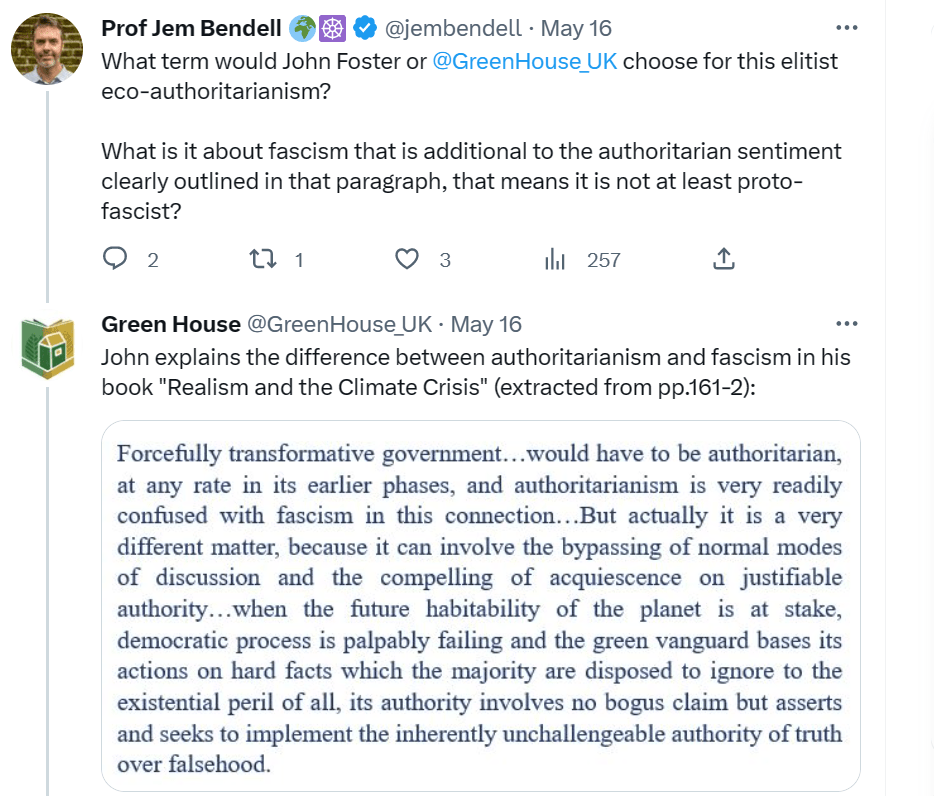
Lancaster University academic, John Foster: “Forcefully transformative government… would have to be authoritarian…” “…if [Dr] Bendell wants to send GH [the Green House UK thinktank] an argued objection to what I said in my piece, GH will publish it along with a response from me. This is too important an issue not to encourage responsible debate on it.”

The following in an edited excerpt from the chapter “resisting the fake green globalists” in the book “Breaking Together: a freedom-loving response to collapse.” I am sharing it here in response to the Green House think tank supporting the views of the academic John Foster, which I quote further below. They invited a more substantive dialogue than possible on twitter. That seems appropriate as the thinktank claims to be “leading the development of green thinking in the UK” and has influential people on its board. The concepts I mention in this excerpt, and the evidence for them, are argued in detail elsewhere in the book, which is currently available as paperback/hardback/kindle, and will be available as a free epub download from The Schumacher Institute (TSI) from July 10th 2023 (as TSI always notes, these views are the author’s not the institute’s).

Subscribe / Support / Study / Essays

Continue reading “Why we must ALL challenge authoritarian views in green politics”