I'm a British national living in Indonesia. I am known for my work on societal collapse risk and response. That includes the Deep Adaptation paper and Breaking Together book. I cofounded Scholars’ Warning to help academics communicate about a post-Sustainability agenda for reducing harm in the face of catastrophic ecological change. I cofounded Bekandze Farm School to enable smallholders to switch to organic and resilient farming methods. Last year I quit my full Professorship to focus on deep adaptation to societal disruption and collapse.
One year ago this month, our Institute at the University of Cumbria released my paper on Deep Adaptation to our climate tragedy. It has since been downloaded over half a million times, been translated into many languages, inspired Facebook groups (one with over 4000 people), many events, and been credited by commentators and activists as helping the Extinction Rebellion movement. Not bad for what one journalist suggested to me was a “career suicide note.”
Over the past year I have sought to do what I could to channel the shock, anger, fear, despair, and passion of so many people who got in touch with me, into networks of solidarity, contemplation, inquiry and action. That has included the launch of the Deep Adaptation Forum for people who want to work through what this means for their day jobs – or whether to quit. I have also sought to provide some ideas and guidance via writings, talks, interviews, retreats, contemplative practices and videos.
It has been a powerful year of strong emotions, deeper connections and great admiration for people changing their lives to serve love and truth. That will need to be the subject of a future blog!
I have been impressed by how many print journalists have spent the time to really explore this issue with me, and to process their own emotions to arrive at balanced, informative and lively coverage of this difficult topic.
In addition, we have seen more people inside establishment organisations become bolder in how they talk about the emergency we are now in. I used to work in the UN and know there are huge pressures to conform, sound calm, and avoid upsetting any of the Member States or their corporate friends. So it is a relief we are seeing reports from different UN agencies about how bad things have become with our environment. In addition, more scientists are clearer on the implications of their findings, breaking with some of the reticence of their profession to say anything that would illicit emotion.
Working with my colleague Matthew Slater, I have produced a Compendium of Research Reports on Climate Chaos and Impacts, which we release today. In it I summarise 23 studies which I consider key from the past 12 months. Last year it was unusual to claim that it is too late to stop runaway climate change damaging our agriculture to such an extent that it will lead to the breakdown of our societies within the next ten years. However, the key takeaway from this Compendium of research is that there is now a wider range of peer-reviewed dots to draw from in order to arrive at that perspective. However, there are not many mainstream researchers joining all those dots, to offer conclusions and predictions for human society. The difficulty is that researchers exist in academic silos, such as climate modelling on the one hand, agronomy on the other, or migration on the other, and a belief in the meaningfulness of silos is at the core of what gives us a sense of self-esteem and confidence for expressing our views. To move beyond drawing dots, to joining those dots, requires an ability to understand multiple fields of scholarship, their methods and limitations, which is a challenging skill set and time-intensive process.
When attempting to provide that overview and synthesis, especially for policy makers or the general public, you can find yourself suddenly being written about by people who like to tell stories about reality in order to buttress their worldview, sell their book or organisation, or serve an interest group. It has been an interesting year of witnessing the kinds of reactions people have when they want to engage this topic from a pre-defined view, and therefore deny or spin information on our predicament. Some right-wing writers have misrepresented what I wrote in the original paper in order to lampoon it. Some left-wing writers have suggested my work isn’t revolutionary, which meant they had to overlook how many of us who share the Deep Adaptation perspective are actively engaged in the most vibrant challenge to state power and the status quo in decades – XR.
Then there are some people who have worked on environmental issues for some time and have portrayed my analysis as suggesting that we give up on the drawdown and cutting of carbon; which I do not. When people say “we need hope” they might be expressing their assumption that they themselves need a pleasant story of the future in order to avoid their own emotional pain – and avoid witnessing it in others. Fortunately, I have discovered this past year that the loss of a hope that we can reform to maintain our way of life has been shocking people into waking up to not only to our environmental predicament but also the reality of impermanence and death. That means they engage in the present moment with a passion for truth and love. In general all of the criticisms I have heard fall into one of the forms of denial that I wrote about last year.
Meanwhile, some other commentators have agreed with the general analysis that we face imminent collapse, but have questioned how certain we can be, or when it will happen. I think it is important to stay aware of the latest data and revise what we think will happen. I also think it is important to consider how we explain our views to different audiences. However, to argue against saying collapse is “inevitable” due to abstract theoretical notions that nothing is inevitable is not worth much attention. After all, our mutual death seems certain to me, and we are also complex living systems. People may want to avoid believing societal collapse is inevitable in order to provide themselves with a psychological escape, so that they can still hope that someone or something will stop it happening somehow. Looking at the current climactic changes, the rising emissions and habitat destruction, the biological impacts, the warming feedbacks, the agricultural impacts, the slowness of response, the intransigence of capitalism and its client politicians, and the cultural dependence on ideas of progress and control, and the rise of stories of blame that avoid reality and foster ignorance and hate, I think that “inevitable” societal collapse is a more accurate way of communicating my view that it is now unavoidable, than saying collapse is likely or near certain. I am aware that some people challenge us to recognise that societal collapse is already underway but unevenly distributed. The recent statement from the UN on this matter is a sober reminder that millions have already suffered terribly from climate chaos. For the Deep Adaptation groups that I am involved with, we ask people to agree that societal collapse is either likely, inevitable or already unfolding, so that we can have meaningful engagement upon that premise.
Since the paper came out, I have come to consider a new reason why societal collapse is inevitable. It came to me when I spoke at the European Commission. During my talk I did a quick poll to discover that about 90 percent of the officials in the room believed that collapse is coming within their lifetimes. Yet their ability to conceive of what was appropriate to discuss as policy responses and activism was, in general, woeful. The ideas being shared were more of the same tinkering with capitalism and redirecting private investment into mitigation efforts. Why? One hypothesis is that the highest have the farthest to fall. If one is well-respected, well-paid, and living well in the current system, perhaps with a sense of responsibility for lots of employees and stakeholders, then one has the most to let go of in order to allow the full impact of our current situation to sink in. At a sub-conscious level it eats away at assumptions you didn’t know you had. For instance, assuming that one would be respected by your children and younger generations as you enter old age, and, ultimately as you lie on your death bed. To be successful in society means one is having affirmed, daily, the illusion of the socially-respected agentic separate Self. Instead, our climate chaos invites us to see that we aren’t separate, we aren’t in control and our stories of self-respect and meaning were always made up. We must let our deepest assumptions and stories melt away to find what else can emerge. That may be why I have a better time talking to children about collapse than I do talking to people with senior jobs. I will release a short video about that next month but for now, I recommend this video from my 13-year-old friend, Oskar.
Many people ask me about when a societal collapse is likely. As I explained in the paper, I do not know, but guess that within 10 years that it will be occurring in many, perhaps most, countries of the world. Some have argued it could occur more quickly. As I explained above, some argue that it has already started in some countries. This question about the timing of collapse is an understandable one, given that it affects our assessment of what to focus on. Given the uncertainty of prediction in complex systems, to avoid putting a date on predictions is justifiable. The direction is clear but the speed of it less so. For instance, I know I am going to die, but, because I have no interest in killing myself, nor have a terminal diagnosis, I do not know when I am going to die. The problem I have with the argument that I should not give a time horizon like 10 years is that not deciding on a time horizon acts as a psychological escape from facing our predicament. If we can push this problem out into 2040 or 2050, it somehow feels less pressing. Yet, look around. Already harvests are failing because of weather made worse by climate change. So, a year after my paper came out, I am still guessing that the society I will be living in, whether the UK or elsewhere, will have collapsed within 9 years. It could be sooner. I hope to help slow things down by bringing attention to our predicament and promoting adaptation.
In the original paper I did not explain fully what I mean by societal collapse, nor did I go into the mechanisms by which it might occur. Therefore, I did not explore how it could be slowed or softened. By societal collapse I mean “the uneven ending of our current means of sustenance, shelter, security, pleasure, identity and meaning. Others may prefer the term societal breakdown when referring to the same process.” My theory is that multi-breadbasket failure across the northern hemisphere, combined with location-specific damage to other harvests, will disrupt our societies within 9 years, due to the impact on food prices and food supplies. I also predict that water shortages will trigger migration and conflict, thus making collapse more likely in some countries. I warn that the reactions of our financial system may precipitate collapse ahead of the shortages of food and water or the movements of populations. The psychological impacts of the increasing economic, societal and political turbulence may also trigger disturbances, which could manifest through civil unrest or political extremism. I respect those who believe these processes are already underway. Clearly there is more analysis needed on these possibilities, and I have been encouraging people in food security, disaster risk reduction, human security and related fields to explore these questions. Although I am often asked to develop my own theories of the mechanisms of collapse, I have been more drawn to enable others to begin such work, as well as any response that arises from engaged compassion.
Which brings us to the question of “what to do?” There are so many options for people when they come to believe that a collapse of our normal way of life is inevitable and soon. Over the year I have had conversations with people as they, and I, process this information and consider how we want to be and what we want to do. They all relate to the types of response I described last year here (which I strongly recommend you read if you are exploring how to feel and act in light of this information). Despite my earlier grumblings about the conservativism of people with senior roles in our society, in the past year more people have begun to discuss with me how they want to find ways to respond meaningfully from within their organisation. It appears now is a good time to map out a range of ideas for activities that could be supported and pursued in different sectors and walks of life. I will share some ideas on this blog in the coming months and feed these into the relevant professional interest groups on the Deep Adaptation Forum.
How on earth do we approach these times well? What might resource us to face our collapsing social and ecological systems with open hearts, wilder questions and renewed capacity? In mystic traditions, soul craft and the work of artists The Void is the place of possibility, emergence and the other/wise. And so we invite you to come and lean into the trouble, as a lover might; tender, curious and courageous. As we play our parts in communities and workplaces to meet these times well, we believe it’s important to pause, play and call upon the creative spirit.
Are you an educator, policy maker, artist, activist, therapist, business or community leader working with Deep Adaptation? Would you like time to dwell with the unknown in good company?
This isn’t fiddling while Rome burns, this is a call for people who are actively engaged in our crisis to build your muscles of presence, love and creativity.
We’ll touch on the ‘4 Rs’ of Deep Adaptation: Resilience, Relinquishment, Restoration and Reconciliation, maybe explore a few more for luck, leaning in to the marginal and the mysterious that often get left behind in the fullness of our daily lives and the urgency of action.
Part regenerative retreat, part creative lab, our time will include:
Being alone on the land, connective practices, movement, breathwork and space for strong feelings to be met well in good company.
Creative stimuli and time for writing, devising, making, composing etc. Improvisation and the sacred fool. Embodied explorations of Kissing the Void.
Offerings at the feet of grief and mystery; feral rituals and invocations to things we trust and long for, songs of courtship to both the human and the more than human world, the ecosystems and the lands we love.
This gathering serves to inspire and resource us individually and collectively in order to deepen the potency of our work in the world. Join us.
To apply please email kissingthevoidevent@gmail.com
The Facilitators
Toni Spencer (Lead facilitator):
Toni is a Curator with the Emergence Network leading on ‘Vulture: Courting the Otherwise in a Time of Breakdown’. In 2018 she co-lead a Deep Adaptation Deep Dive and is part of the Deep Adaptation Forum. Toni initiated ‘the pause’ as part of Extinction Rebellion: an invitation to bear witness and to lean in to the liminal in the midst of action: part of an ongoing inquiry in to ‘A Politics of Wonder’.
As a lecturer and course leader Toni has taught on the faculty of Schumacher College and Goldsmiths, University of London and as a participatory artist and facilitator with Encounters Arts, Embercombe, the Transition movement, St Ethelburgas and others. She is on the team for Call of The Wild with Wildwise /Schumacher College.
She has an Action Research based MSc in Responsibility and Business Practice and is trained in a range of facilitation modalities; awakening, deep ecology and embodiment practices; grief tending and activism.
Prof. Bendell originated the concept of Deep Adaptation to near term societal collapse due to climate chaos (his paper was downloaded over 400K times in the first 9 months).
For the previous 20 years he had been a researcher, educator, facilitator, advisor, & entrepreneur in the field of sustainable development. Clients included corporations, UN agencies, charities and political parties. He helped create the Marine Stewardship Council and The Finance Innovation Lab. As a leadership specialist, he worked with the leadership office of the Labour Party during the 2017 general election, including speech writing. Bendell launched Masters degrees on sustainability and leadership. With over 100 publications in sustainable business, his work on currency innovation gained significant international media attention. In 2012 he was recognised by the World Economic Forum as a Young Global Leader.
In response to the latest climate science, he now focuses on helping humanity face climate-induced disruption and founded the Deep Adaptation Forum.
Jem will not be taking a fee for this retreat and he will not be co-hosting another retreat before March 2020. https://jembendell.com/
Tina Sharman:
Tina is a breathwork facilitator, coach and a director and co-founder of a land-based education project (www.onthehill.camp) where she now lives and which she runs with her partner and team. Before this she lived and worked for many years at Embercombe (www.embercombe.org) where she still co-runs the Journey programme and The Descent. She is a potter, making hand-built, smoke fired vessels and is a part of The Waiting Room, an interactive, improvised theatre group.
The Venue
The venue is a beautiful converted farm in a South Devon valley. An artists led project dedicated to supporting creativity and research, it is part of CultureDeclaresEmergency https://coombefarmstudios.com
The group size will be limited to 15 people (plus team). Food will be mainly vegan with some local organic dairy and wild meat options. For any access needs contact us.
Costs
Price includes all food, accommodation, hosting, facilitation and materials. We’ve created a 3 tier price system with some variables to try and make this event as accessible as possible: 1. £900 / 2. £650 / 3. £450
There is Potential room sharing / camping / bursary options / luxury accommodation : be in touch for detail.
NB There will be limited places for options 3+4. Your generosity in paying the fee option 1. will enable more people to access this event.
More details and options to apply will be available soon via our application form but in the meantime please contact kissingthevoidevent@gmail.com
the pause is a radical act, an invitation to stop in the midst of action, to disrupt our normal modes of being, to collectively fall silent and become aware of the moment we’re in.
the pause is counter to the culture that has driven us to the brink of extinction. It is an invitation for everyday magic to unfold.
It is time to explore new approaches to change in the face of a climate emergency. In a 4-day course on the foundations of sustainable leadership, we will explore alternative ideas for how to lead change in organisations and society. The course combines experiential exercises with insights from critical theories and the tales of impactful leadership in British politics and civil society.
A co-founder of Extinction Rebellion will share insights on the movement. I will share insights on communications and leadership that we applied for the Labour leadership in the UK General Election. We will be joined by consultants from Impact International, which supports leadership development with some of the largest global companies. Katie Carr will co-facilitate. The deadline to book is June 30th.
This is not a typical leadership development course; it offers you the chance to explore how you want to respond to our challenging times.
The course starts at 9am on 18 July and finishes at 5.30pm on 21 July.
You can take the course only for a Certificate of Attendance. Or complete a summative assessment for 20 credits at L7 and a Certificate of Achievement.
The full cost of the non-credit Certificate of Attendance option is £600.
To take it as a short course without credits, click here.
To take the course as part of a qualification, click here.
Accommodation must be booked separately. For any logistical or administrative enquiries, contact iflas@cumbria.ac.uk
In the past few months I have attended many gatherings on Deep Adaptation to our climate tragedy. Some of them have involved a talk, followed by Q&A and discussion. One of them was a week-long retreat in Devon, UK. Another was a dinner of leaders within the Extinction Rebellion. Online gatherings using zoom have also been a revelation, with friends joining from San Francisco to Kyoto. The interest groups on the Deep Adaptation Forum have also started meeting on zoom, and the collaborations that are emerging are wonderful to witness. Each of these gatherings, whether online or in-person, has offered opportunities for people to express difficult emotions and feel into our predicament, before then moving into discussions about what to start and what to stop.
Some of these gatherings have inspired participants to go on and lead future organising. For instance, the Poetics of Leadership conference my University organised with Crossfields Institute in September last year, inspired some participants to help launch Extinction Rebellion. The retreat in Devon also helped nourish the personal connections that were carried into the International Rebellion week. I could write a roll call of names, but you know who you are, and I love you for who you are and how you have been responding to our predicament. You helped me appreciate the value of gatherings in a way I had never experienced before. Because I had lost all interest in conferences, talks, and workshops. They seemed like soulless exercises in small talk and card swapping, punctuated by pep-talks from people we were told to listen to due to their seniority. But thanks to the amazing experiences of the past 7 months, I am convinced of the value of people gathering to share their pain, confusion, insights and faith that we will find meaning and useful action.
To make the most of these gatherings on Deep Adaptation, some principles and practices of hosting and facilitation could be useful. For me, one important aspect is to welcome participants connecting with and sharing any of their emotions, however painful. Another aspect is to invite everyone’s questions as much as anyone’s ideas for answers. That is because, when facing collapse, we are in new terrain, where people who have been most confident in society-as-we-find-it today might not be the most helpful to our inquiry in future. In hosting such gatherings, there are many existing processes that can be drawn upon. Facilitators of the Deep Adaptation Deep Dive in Devon adapted a few practices from The Work That Reconnects (from Joanna Macy) and the Inner Transition, which Sophie Banks and Naresh Giangrande had developed for participants in the Transition Towns movement. Toni Spencer also used some practices for grief tending.
As my partner Katie Carr and I now design two forthcoming retreats on Deep Adaptation, I realise that many facilitators could benefit from sharing ideas on principles for hosting such gatherings as well as guidance on specific processes. Therefore, I have started a thread within the Deep Adaptation Forum on facilitating gatherings, within the Holistic Approaches interest group. If you are a facilitator, then I invite you to join us there and share ideas and experiences on hosting gatherings, whether in-person or online.
One issue will be how to scale the provision of such gatherings. Katie and I are not able to offer more than a few retreats a year, and so we are particularly interested in participants who can host future meetings and retreats. If that resonates with you, and if you are in Greece or could make it there for June, then we would welcome hearing from you. A few late cancellations mean we have 3 places available at the time of writing (click here for information and to apply). Katie and I will also be teaching leadership for deep adaptation at the University of Cumbria over 4 days in the English Lake District in July, which also has some places available. Also in July, Katie and I are hosting a free one day event on deep adaptation in Lancaster, UK.
In a few weeks I will also be able to announce the 5 free events that the Deep Adaptation Forum will be funding (around the world). If you are able to financially help the organising of such gatherings in future, please contact us.
If you are organising a gathering on the theme of Deep Adaptation, please feel free to announce it by leaving a comment below.
If you would like to promote the success of these gatherings, and the effort to help people share practices for effective hosting of them, then I’d be grateful if you could share this blog to your relevant professional networks.
My own schedule of gatherings is rather busy until the end of this year (some of them are listed here). Therefore, I will not be accepting any new invitations to speak at any event during 2019. Instead, superb thinkers, speakers and hosts can be found via the forum at www.deepadaptation.info
On April 29th 2019 Prof Bendell gave a talk at the anti-fracking demo at Preston New Road, where he called on more insiders to take inspiration from the Extinction Rebellion and take risks to Tell the Truth about our climate crisis. The video of the talk is here on Facebook. The following is the transcript.
It’s good to be back in the Northwest, after the launch of the international rebellion against extinction in London. There I spoke from the pink boat of truth about the need for our politicians and media to wake up to the scale and urgency of the climate emergency. Today I’m here outside the shale gas fracking site of Cuadrilla because this project was only conceivable because people were afraid to accept the truth on climate change. Afraid to see the truth for themselves, so unable to tell the truth to others and therefore unable to act as if that truth is real.
Seeing people give up their freedom on the streets of London and elsewhere sends a strong signal to people everywhere that it is time for taking personal risks in the pursuit of truth, love and transformation. Extinction Rebellion has opened the space for truth telling.
So I’m here to thank all you activists, for also helping us all to create that space. And I want to say some more about what that truth-telling could involve now.
The truth is that climate change is unfolding faster and harder than we were told was likely. Seventeen of the eighteen hottest years ever recorded have occurred since the year 2000. We have woken up to the warm dawn of dangerously hot century. The colourless blanket of carbon gases wrapping our planet is trapping so much heat that forests are catching fire and harvests failing. Already there have been more forest fires in the UK in 2019 than ever recorded. The last highest year was 2018. Also last year we saw how chaotic weather could begin to threaten our own lives. In the UK and in many European countries the production of grains and open-air vegetables fell by over twenty percent. The climate emergency is therefore about all of us, and the future of our food and water. Yet humanity is heading in the wrong direction, with carbon emissions rising last year faster than ever.
That is why it has been so important to protest fracking at this Preston New Road site. We should not be building any new fossil fuel extraction facilities anywhere. The excuse that gas is better than coal is like saying ketamine is better than heroin. We need to get off these fossil fuel drugs entirely. The fracking process can also release fugitive methane. It is a greenhouse gas many times more warming than CO2. And that’s before we consider the poisoning of our water table. To risk such poisoning at a time when the country is facing a new era of unprecedented water scarcity due to climate change, is frankly absurd.
So the only reason this fracking project can be here is because people have been lying to themselves and each other about how bad things are. So the time has come from more people to take risks in their own lives to come clean and tell the truth about what they know of our situation. It is time for people in senior jobs across our society to come clean or step down. By which I mean come clean on the scale and speed of our crisis and what that means we must now focus on now.
That includes people who care about climate change. But who are in denial about how bad things are and the risks they now need to take. It is time for more of our Climate Experts to come clean about how bad things are. In particular, the members of the Committee on Climate Change (CCC), who will issue new advice later this week. They advise the government and are meant to be somewhat independent. In the past, they have justified ongoing fossil fuel development, such as fracking shale gas and airport expansion. They have ignored emissions from aviation, shipping, imports & exports. The CCC assumes that Carbon Dioxide Removal & Negative Emissions technologies will work at a huge planetary scale. That is a convenient fantasy for them but is a travesty for the children who will have to live with the reality. It is time for the CCC to tell the truth on the perilous situation we are in, and the need for emergency responses to protect food and water.
In the past 6 months we have seen some of the climate experts in established institutions be clearer on the alarming situation. The Intergovernmental Panel on Climate Change or IPCC last October finally rang the alarm bells. It told us we have to cut carbon emissions by 18% a year, globally, each year for the next 12, just to have a chance of avoiding catastrophe. And soon the UNISDR will report on risks to global food production from the destabilising of our weather. But we need more experts to step forward and tell the truth, so as to build the public will for the scale of changes that are needed to reduce the harm from climate change.
Academics like me also need to tell the truth to ourselves. We work in a profession that is meant to identify knowledge and share it. Yet we get stuck in silos so have a very partial perspective on public issues. We focus on publishing in specialist journals that reach so few people. After criticism for that lack of impact, the response is now to pursue impact only in ways that can be easily documented and that government can approve of. In my case, I realised my old work in sustainable business was becoming meaningless in the face of rapid climate change. It was only when I decided to follow my concern outside of my comfort zone and publish for the goal of sharing my truth that did I have a significant impact. Instead of a handful of experts reading my paper on Deep Adaptation to our climate tragedy, now over 400 thousand downloads later, many people are reading it and waking up to the emergency we are in.
Since my paper on climate went viral, I have been contacted via email by many hundreds of people. Some of those people have been insiders in organisations with privileged information on our climate crisis. People within NASA, our Royal Navy, and food security institutes. They have told me that the information they have means that the situation is as bad as I am saying or even worse. And therefore, that I should keep going. Well I’m not a journalist or Wikileaks, so its time these people and other insiders with similar views, speak out for themselves. The climate crisis is such a risk to humanity that there has never been a greater matter of principle for which to be whistle-blower. So please, join us in telling the truth.
For years I was told by colleagues in the environmental movement that we should be positive and not be too alarmist. That we should inspire action with a positive vision and tales of success. However, decades of that green positivity coincided with humanity releasing more carbon than ever before. Although my work reflected my despair, and has triggered despair in others, that has been transformative. It has meant we have left behind our concerns with conforming with assumptions of what is appropriate and pragmatic. Our despair took us into truth and radicalised us. That is the personal story of so many of the activists in Extinction Rebellion and will make it such a resilient and transformative movement.
The success of XR has caught the attention of business people who are engaged in public issues. Some have expressed their support. But the clearest form of support would be to admit what hasn’t been working. Since the 1990s business people have been engaged in voluntary activities to promote sustainable development. Its time to tell the truth that for all the effort it hasn’t worked at achieving the changes at the speed and scale that would make a difference to either carbon emissions or biodiversity loss. To tell the truth that it was wrong to think we could achieve the necessary change within the existing system. Instead, it’s time to throw their weight behind systemic reforms, and that should include a redesign of our monetary system so that we don’t require economic growth just to keep our money circulating. Without such change, our efforts at reducing carbon are like swimming up stream.
The question of what to do is more difficult if you work in a company like this one, Cuadrilla, or other companies involved in the current problem. Everyone has bills to pay and so it is difficult to know what to do. If you are working in a fossil fuel company or a bank, or a multinational selling stuff we don’t need, then you must be wondering what to do. Perhaps the stories your CEOs have told you about how your company is doing OK are now wearing thin. So, what do you do? You could look for another job. But you could also start telling the truth in your offices and meetings. And if you need the job but can’t have those conversations, then here is another idea. Show up at work and do absolutely nothing. Let us see rebellions inside oil companies, fracking companies and banks where staff show up and spend the whole day watching youtube, reading novels, and even having fun wasting their colleagues time. Because rebellion can take many forms. And we are not in this the blame and shame but to invite everyone to find a way of participating in rebellion in their own lives.
Ultimately what XR has brought to light is that climate change is a political challenge. It is positive to see a response from politicians, both locally and nationally. But to those politicians now declaring a climate emergency, we also need to talk about telling the truth. Because declaring a climate emergency would itself be a lie if it is not backed by measures that give it meaning. Our climate emergency requires us to respond at speed and scale, across all of society, and to prepare for what’s coming. It must be recognised as a whole-of-government agenda where both reducing and adapting to climate change are central concerns of all departments, as well as a standing item in cabinet meetings. So, to the politicians declaring an emergency, I ask you to now tell the truth. The truth about the coming disruption to our food production and imports, our fresh water supply, and our essential services. About what we need to do to reduce the disruption. About how that will entail sacrifice. From us all. And that this will be hard for most of us to accept and respond to. But that this is the conversation the country has to have. And have now.
Only then will pressure build on government to take significant action. Because there is a lot to change. The UK government has given the go ahead for a new north-sea oil field that will amount to one quarter of a billion tonnes of CO2 across the life of the oil field. The UK government has also just overseen planning permission for a new coal mine. Perhaps it didn’t realise how bad our situation is? Well since the IPCC report in October there are no excuses. It said we have to make massive cuts right now, each year for the next 12 years to have a chance of avoiding catastrophe. The government has done little to nothing to respond to the IPCC report.
So this is my message to the Prime Minister. You may not care much about the environment, but climate change is now a matter of national security. It is disrupting food production and water supplies. It threatens the future of Britain as a stable and prosperous country. Its time you heard the truth and told us the truth.
For the Prime Minister, it is time to come clean or step aside.
I was fascinated to read a letter in support of the Extinction Rebellion last week, expressing support, as business people, for the aims of XR. After 24 years focused on voluntary business efforts on sustainable development, last year I abandoned that to explore different approaches to our climate disaster. That included supporting people putting together XR. Part of that was being a lead signatory of the letter from academics last October that declared our support for the forthcoming rebellion. So, I believe in the utility of expressing public support as professionals in addition to what we can do as volunteers in the range of activities needed in a social movement. But the negative reaction from some to the letter from businesses brings to light some issues that need to be explored at this critical time, so I am writing this open letter.
Photo by Pixabay on Pexels.com
I see that the letter was signed mostly by people who work in companies that are proactive on environmental issues. So that means, like me, you have been following global sustainability issues closely, and must be feeling a similar anxiety at how bad things are becoming. The confirmation from the IPCC that we are heading for imminent disaster for the human race, as well as the rest of life on Earth, really helped bring that home. Suddenly, the lives of our own families seem at risk. Then there is the deeper pain we may feel as we sense that our own choices were mistaken. We believed that we had time and techniques to reform this capitalist system towards something sustainable. It was a wonderful idea at the time, and even got its swansong with international agreement of sustainable development goals. I have experienced myself how difficult it is for that sense of personal efficacy to fall apart.
The frustration we feel at the predicament we are in means we can feel great solidarity and respect for people giving up their freedom on the streets of London to bring national and global attention to our climate emergency. I felt such an honour to have helped a bit and spoken to launch the international rebellion on April 15th.
As some of you may now have heard, the letter of support for XR from business leaders, and its suggestion of some sort of “XR Business” initiative, caused concern amongst many volunteers and convenors of XR, both in the UK and internationally. While some might think this was simply a case of uninformed negative views of businesses or business executives, that would be mistaken. There is something to be learned from the concern, which may help any potential future support from businesses, banks, celebrities or anyone with perceived power in the current unsustainable system.
Perhaps some of you have already joined in XR individually as meeting organisers, arrestables, legal observers, or the other many roles that exist in the movement. But in writing a supportive letter that identified your companies and your role as business people, you are not simply joining in as equals. You are deploying your status as people in the private sector to help add weight to this activism. We did the same as academics when we wrote that letter of support. In the case of business leaders, this raises some questions about the role of business in our current predicament and how that will need to change. While organisations and individuals from the private sector have major roles to play in responding to climate change, and in helping us cope with the massive disruptions ahead, it is important they help not hinder the power of citizens coming together for radical change.
So I am going to suggest some ideas that could be recognised by business people if considering support for Extinction Rebellion. These are only relevant after you confirm you understand what XR stands for. The group has declared a peaceful rebellion, which means inviting non-violent law-breaking as a way of rejecting the legitimacy of governments and the system they are part of. So in declaring support, you are recognising that our climate emergency means that our current political and economic system is broken and in need of transformation. After accepting that, then the following five ideas could be useful to hear from business leaders. If you may excuse the presumptuousness, I will have a go at writing it as a letter from you to XR:
Dear XR activists, as business leaders we recognise the following:
First, we failed. Although we tried to make businesses and financial institutions more sustainable from the inside, it has not stopped carbon emissions rising or biodiversity loss increasing. We work in the most funded and dynamic sector of society but couldn’t achieve the change we hoped for.
Second, we were wrong. We believed that working with existing systems of power, within market systems, was the way to deliver positive change at scale. While we do not know what could have been achieved by efforts going into other approaches towards climate stability and biodiversity conservation, we told people our approach was more pragmatic and scalable.
Third, we will learn. We believed that being business professionals gave us credibility in addressing issues of climate and biodiversity. Now we realise that some of the assumptions and attitudes we have learned in the private sector may not be that useful, so we are ready to learn from others.
Fourth, citizens need more influence than us. Although as individual executives we think we have been useful participants in dialogues with communities and governments, overall, the effect has been to prioritise the interests of profit-making over other concerns. Because businesses can fund initiatives, lobbyists and so on, as a sector we have had unfair influence over our societies. As this has coincided with the predicament we are in, it is understandable to conclude this unfair influence is at fault. Therefore, citizens and scientists need more influence than us in future on how to drawdown and cut carbon, as well as how to manage the difficulties ahead.
Fifth, we must be made to behave. Although it is difficult for some of us to say this, it is the natural implication of where we have got to now facing catastrophic climate change. Praising individual companies doing useful things was never enough. We need state intervention to redesign the economy so we can more swiftly decarbonise and also prepare for the disruptions ahead. That means corporate support for changes in the law, perhaps even introducing a law on ecocide by corporations.
We hope that by expressing these realisations, we can find ways for our knowledge and resources to help humanity respond to our climate emergency. That may mean supporting you from a distance as organisations, but closely as individuals. Or it may mean finding ways to support you more actively with our organisations. Perhaps we can find ways to hold space open for your activism and ideas without any influence from the private sector. We will certainly work to ensure other companies do not get in your way.
Sincerely,
Concerned executives, deeply impressed by your sacrifice.
I do not speak for XR in presenting these suggestions. However, I am aware of the sentiment of many of the lead organisers and volunteers and believe that if business executives wish to support or engage as representatives of companies, then it will help to acknowledge the need for massive change.
The XR leaders I have worked with all recognise that the difficulties we face require a great coming together of people from all walks of life and all corners of the world. They deliberately avoid blaming people or sectors, as they know we need to foster a culture of forgiveness and love, so we do not make matters worse as an unstable climate ruins our normal life. It’s an approach that I share, and what we are promoting in the Deep Adaptation Forum, which is focused on enabling readiness for likely societal collapse.
Like me, the XR leadership does not believe that one group or ideology has all the answers. To help get things started, with Rabbi Newman, I shared some ideas for the kinds of economic reforms we will need to help us decarbonise and prepare for disruption, on the XR Blog. While we will need more ideas to be shared and trialled, the options for responding to the climate emergency must not be driven by those with more time and money to shape dialogues, policies and initiatives.
I understand how deeply challenging this issue is so thank you for reading.
Sincerely,
Jem Bendell
Professor of Sustainability Leadership
Former Director of the Institute for Leadership and Sustainability (IFLAS)
When the UN reported that we must cut carbon emissions massively every year for the next 12 years to have a chance of preventing catastrophic climate change, what did our government do?
The sane response would be to call an emergency and convene the best minds to help decarbonise our economy.
Perhaps that did not happen because the message got lost. So allow me to translate: catastrophic climate change means harvests failing to the point where you and I could be starving. In which case, most of us won’t be going to work or obeying the rules. That’s the seeds of a societal collapse.
One might assume that action to reduce this threat would be top of the agenda in the corridors of power.
Not if you are in denial, which most of our politicians are. As more people wake up to this predicament, we demand leadership from government.
Last year global carbon emissions jumped higher and faster than they have ever done in human history.
Our climate crisis is the central political challenge of our time and requires a complete redesign of our economic system.
Some people gain a sense of personal self-worth from respecting the norms of life. Thankfully, enough think more freely and can respond.
At our demonstrations I met such people, from all generations and walks of life. They know we need to break the norms, express our fears and come together to make the best of a terrifying situation.
I’m glad to be here in Oxford Circus where today we challenge the circus of lies that is our political system and mainstream media.
I am an academic, a Professor at a University. So my profession is meant to be all about finding and sharing truths. But I discovered that most of us have been too afraid to look closely at what is happening in our world and what we are doing to it.
For over 20 years I slaved away at changing business and finance to be a little kinder to people and planet. Then a couple of years ago I was invited to speak at a conference on climate change and business. As the time to speak came close I felt a rising fear. To get up on stage and give another pep talk? To say well done and let’s do more? It had begun to feel like a lie. I ditched my standard speech and told a room of climate specialists that I think it is too late to save this system. Too late for tinkering around the edges. I spoke without any idea what it means we should do now. Apart from how we must stop pretending to ourselves and to the world. And start speaking our truth.
We have come out on to the streets today to raise our voices in alarm. We knew climate change was coming, but we didn’t know how fast. 17 of the last 18 years were the hottest ever recorded. We have woken up to the warm dawn of dangerously hot century. Forests are catching fire, harvests failing, animals and insects dying off in vast numbers. The extra energy trapped from our carbon emissions is warming the oceans by as much as if six atomic bombs are going off every second. That’s an explosion of warming and turbulence that we cannot turn off.
Our media have failed us. When it was over 20 degrees during mid-winter most of us thought it was nice but weird and scary. But on TV and newspapers we were told how people were just happy to be basking in the warmth. The same journalists scoff at climate change when a blast of Arctic air is forced down on Britain precisely because of the breakdown of normal air patterns.
Last year we saw how chaotic weather could begin to threaten our own lives.
In the UK and in many European countries we grew a fifth less vegetables and grains because it was too hot and dry. Imagine that year on year, globally, and worse. If the authorities think today is a bit of a headache imagine if we were all hungry right now.
In the last few years we have seen more worrying information from the world’s most credible organisations. Just last month the UN’s weather organisation reported that the global sea level is rising faster and faster. That tells us that the warming of our global climate is speeding up. Which suggests the Earth has begun to heat itself because of what we have started.
So I’m sorry, our future climate is not under our control.
So what do we do? Go home?
No.
We gather and rebel not with a vision of a fairy-tale future where we have fixed the climate, but because it is right to do what we can. To slow the change. To reduce the harm. To save what we can. To invite us back to sanity and love.
The truth is we are scared and we are brave enough to say so.
The truth is we are grieving and we are proud enough to say so.
The truth is we are traumatised and we are open enough to say so.
We are angry and we are calm enough to say so and invite others to join us.
And though we are uncertain, we are smart enough to say so.
We are here to demand that the government admit the truth to themselves and start the dialogue on what to do now.
As countless scientific reports emerged in the last 12 months about how dire our situation is, what has the government done to prepare us? Or even warn us? It did not say, we need to think about how to feed ourselves when other countries have no surplus to sell us. It did not say, let’s build seed banks, greenhouses, and irrigation so we can grow food whatever the weather. No, it said we are doing OK in reducing our emissions, so we can frack gas and mine coal.
Given what we know about climate, we can see that; The government is lying to us that the future of our food supply is nothing to worry about. The government is lying to us that our pensions will be worth anything 20 years from now. The government is lying to us that the economy is stronger than in 2007. The government is lying to us that our children should stay in school and study hard to get on in a global economy.
Maybe that is because they are lying to themselves. We are here to wake them up.
Since Al Gore’s film in 2006 we have been told to do our bit. I can switch off a light, but I can’t switch off the consumer society that requires us to trash more of the planet to service debts to the banks. Our climate crisis was always a political challenge. The Extinction Rebellion is now making that known.
And it has started to work. Some politicians are slowly coming on board. Last month the Labour Party declared a climate emergency and backed the school strikes. But their policy proposals will need to go so much further.
Meanwhile the government still sees climate change as a mere hindrance to economic growth. They seem to believe that the belly of Mother Earth contains unlimited fossil fuels for us to gouge out and burn. Nothing seems to shake this belief. It’s why peaceful disobedience is needed to force their attention.
And if the politicians do all come on board then the necessary changes won’t just happen. Because they don’t have any track record in pursuing the kind of systemic change we need. That means taking on the financial system. We will need to peacefully rebel again and again.
Today is the start of a broader rebellion against business as usual. Taking inspiration from today, we need to stretch the rebellion into our workplaces. Not simply to disrupt. But to risk those awkward conversations with our colleagues, so every decision might begin to align with reducing or adapting to the climate crisis. Because the changes ahead will affect all of us in every workplace and community.
Our elders in action at Marble Arch (members of Christian Climate Action).
Today will be beautiful. But it might also be stressful, especially as the rebellion unfolds, as it will. So, I want to address our fellow humans here today and around the world who serve as our police.
Today and this week, we will have the honour of seeing mothers and grandmothers putting their bodies on the line for the defence of life itself. For the defence of your children. So I see the women protesting today as our elders. They are here for you. They are here for me. They are here for all of us.
So to our police, I say, when you lay a hand on mothers and grandmothers you will not just be doing your job. It will be your personal decision to participate today, in a process of oppressing women and their wisdom that reaches back thousands of years. An oppression that is at the root of our crisis today.
All of us, including the police, can remove ourselves from that chain of destruction. We can refrain from that act of uninvited touch. So I ask you to listen to the loving call of nature in your own hearts.
And you might hear that Our Mother Earth Says Me Too.
Our Mother Earth Says Me Too. Our Mother Earth Says Me Too.
I want to share a poem that speaks to this. It’s not a famous old poem but written by a friend. Because we are writing history right now. It’s called Galvanize, by Toni Spencer.
“The time has come to galvanize those heaving sighs from fraught days and spiritual malaise. From miles and miles spent in supermarket aisles overwhelmed by choices to the point where we lose our voices and so silently we loosen our ties to life. “Oh my loves what magic we could make if we galvanized. Realized beyond fantasized futures, the power of our presence” Yes. The time has come, to get together. To claim the prize of a collective awakening: Get off our arses. Realize our vastness and put it to work: Stopping the shopping and stepping out in the streets. Shop fronts. Fields. Boardrooms. Classrooms. Living rooms. It’s time to galvanize. To alchemize a fullness of voice. A radical choice. To speak up for what we know to be true.”
We will not accept this mass extinction quietly.
We will not accept the threat of our own extinction quietly.
We may not succeed in shaping the future but we can succeed in living our truth today.
And living it louder. Living it prouder. Living it together. Thank you.
We are all troubled by difficult emotions as we consider our environmental predicament. Some of us may seek to escape those difficult emotions by getting busy with activism or perhaps by complaining about others who don’t share our views.
Some recent negativity towards my work reminded me of how despair is something we can learn from – but that it takes time. Including time away from the public sphere and the rush of our daily lives.
Last January 2018 I shared some recommendations for people experiencing difficult emotions. based on my looking back over the 4 years since I had begun to accept that near term societal collapse would be likely, or even inevitable. This was in my long essay called “After Climate Despair”. It was before my work on this topic had become well known and it feels appropriate to re-post it below.
When experiencing difficult emotions associated with the latest news and analysis on climate change implications for societal collapse…
1) Return to, or explore afresh, the idea of a divine or a spirit or a consciousness or a God that is prior to the Earth and moves through the Universe right now and forever more. Do so without seeking a simple story of explanation but a sense of faith that there is an existence and a meaning beyond our culture, our species and our planet. Such ‘faith’ helps anyone to experience and process the inevitable difficulties and traumas of life.
2) Listen to those stories from people both past and present who tell us that despair is not the end and therefore does not have to be avoided. Recognise how many spiritual traditions see despair as a gateway to our growth.
3) Beware when people are promoting their views on what they think the implications of information will be, rather than views on the information itself. The impacts of certain information about climate on other people’s motivations are not certain, and in many cases the darkest analyses have triggered a new level of creativity and boldness. Instead, look at the information and analysis directly for yourself, without second guessing what some interpretations might lead to.
4) Recognize that any emotional or intellectual resistance you may experience to information which implies catastrophe may come from what you have been consciously or subconsciously telling yourself about your own self-worth, purpose and meaning. Then remember how your views of yourself and the world have evolved through your life and still can.
5) Don’t panic. Give yourself time to evolve both personally and professionally in response to your emerging awareness, but ensure you stay connected to a group or an activity which keeps reminding you of the basis for your emerging awareness.
6) Recognize there is much work ahead for you to reconstitute concepts of meaning and what’s good and to align your life with those. It will not happen overnight, yet it will not happen if you do not give time to this work. There may be some time needed to bridge your existing life with the way you will want to live in future.
7) Plan more time and resources for you to do things which inspire wonder at life. This could be more time in beautiful environments, or with uplifting music, or in contemplation, or through creative writing, or being with loved ones and close friends. That means freeing up time from other activities such as TV, social media and mainstream news. It may also mean downshifting from your workload.
8) Look for opportunities for supported self-reflection and sense-making. This is because your worldview and self-identity will undoubtedly transform overtime as you process the new information and analysis.
9) Expect a catharsis, both personal and professional. This will occur because the subconscious or conscious limits that you placed on yourself until now will be lifted. Go with that rush of energy and creativity, but be vigilant that those new activities don’t become so consuming they distract you from the personal work you still need to do.
10) If you are a mission-driven professional in fields related to environment or social justice then expect that you may be driven to rebuild a sense of self-worth and that this need of the ego, while natural and potentially useful, could become a frantic distraction.
11) Expect a change in your personal relationships and how you spend your spare time. Some forms of small talk and light-hearted social interaction with acquaintances may seem pointless, while you may wish to spend more time with close friends and family. While for some this could be a welcome rebalancing, for others this can become a vector of reclusiveness and loneliness. Therefore, it is important to find new ways of connecting with people on the new levels that feel meaningful to you.
12) Create a positive vision of people sharing compassion, love and play. It may feel that an eco-tragic outlook means you cannot have any meaningful vision of a better future for yourself, your community, or humanity. An absence of something positive to work towards can be destabilising and limiting. Some people will think you are depressed – or depressing – and need some “positive thinking”. For a personal vision, the answer may lie in developing a vision for how you will be approaching life, rather than imagining attributes of a lifestyle. This may parallel the dimensions of a collective vision. A future full of love and learning, rather than flying cars and fancy robots, could be a way to imagine a more beautiful world. And remember, the future will still be beautiful in its own way, no matter what life forms are in it – or if your favourite town is under water!
13) Don’t get dogmatic and avoid those who do. That comes from recognising that our terms for phenomena are not the same as the phenomena themselves. The words we use imply things which may have effects on us but aren’t necessarily so. Words like near-term, civilisation, collapse, and tragedy, are our words, and may trigger ideas, images and emotions which aren’t inevitable consequences of the phenomena being described.
14) Do not prioritise maintaining your own mental and physical situation at the expense of the need to act in solidarity with future generations who will live with the future we are creating for them. Tomorrow’s children won’t thank us much for having joined a support group on Facebook or taken up yoga, unless it aligned with us remaining active in the world.
Looking back over the year since I drafted these suggestions, number 10 is particularly relevant for me now that my work on Deep Adaptation became famous. That reaction has meant I’ve been far busier than I had planned. Could it be a form of denial? Perhaps. So long as I don’t feel frantic or begrudging, then I will keep at it for now.
I sense that some of these 14 steps may be particularly difficult for people with public roles or self-images as environmental leaders. I have listed some resources on emotional support here.
My original essay from last year is also available as an audio file here.
If you have your own suggestions for steps in the process of collapse-acceptance, then please leave them below, or join the Positive Deep Adaptation Facebook Group to share.
Since my paper on Deep Adaptation to climate chaos came out in July 2018 and “went viral,” there have been some criticisms of the concept and what people think it implies. Some people argue that I have overblown the case for inevitable near-term societal collapse due to climate chaos. Others argue that I have “underblown” it and that we face human extinction in the near term. Some people suggest that I have not emphasise a specific approach enough (e.g. permaculture) or that I include mention of approaches they dislike in principle (Marine Cloud Brightening over the Arctic). Others who accept a near term societal collapse is likely, argue that the people coalescing around the Deep Adaptation framing are emphasizing compassion and collaboration in a naïve way, as we need to prepare for civil and international conflict. Some people argue that it is defeatist and counterproductive to conclude it is too late to stop a societal collapse. That last one is a way of thinking that has existed for a while within the environmental movement, and which I unpacked in the paper itself as a mechanism of denial. And it is one that has been published yesterday by the respected author Jeremy Lent (who wrote the Patterning Instinct). A by-product of a concept becoming a bit famous is that many people read people’s views about the concept, rather than reading the original concept themselves. When those summaries come from critics, they can misrepresent the concept. So if you want to learn what I meant by Deep Adaptation, please read a summary here.
Last August I anticipated and discussed a range of responses that prevent people engaging in discussions on what acceptance of a coming societal collapse could mean for our life and work. Now that the concept of Deep Adaptation is more widely used for framing discussions and initiatives, in the coming weeks I will prepare a generic response to the types of criticisms I have seen since August, before imposing a moratorium on myself in responding to such. That is because my focus at this time is on helping connect people who are accepting that societal collapse is either likely, inevitable, or already unfolding, so that they can begin to share ideas and build initiatives in a positive spirit from that starting point. That is one way of living my own truth. Debating whether collapse is likely is not a way I wish to spend my time over the coming years. Ahead of sharing that general response to the range of criticisms, in this blog I will attempt to respond to environmentalists who are concerned about the Deep Adaptation approach. I will do that below, by including the full text of Jeremy Lent’s article and offering my thoughts along the way. It is a well written and well-meant piece. It provides a classic example of the “green positivity” arguments that I deconstructed in the Deep Adaptation paper itself. Jeremy’s article is called “What will you say to your grandchildren?” and appeared on Open Democracy on April 9th 2019. Every paragraph of his original article appears below in italics with my response in normal text. I hope you find it of interest and some use. Over to Jeremy…
Every now and then, history has a way of forcing ordinary people to face up to a moral encounter with destiny that they never expected. Back in the 1930s as Adolf Hitler rose to power, those who turned away when they saw Jews getting beaten in the streets never expected that decades later, their grandchildren would turn to them with repugnance and say, “Why did you do nothing when there was still a chance to stop the horror?”
Now, nearly a century on, here we are again. The fate of future generations is at stake, and each of us needs to be prepared, one day, to face posterity—in whatever form that might take—and answer the question: “What did you do when you knew our future was on the line?”
Unless you’ve been hiding under a rock the past few months or get your daily updates exclusively from Fox News, you’ll know that our world is facing a dire climate emergency that’s rapidly reeling out of control. The Intergovernmental Panel on Climate Change (IPCC) has issued a warning to humanity that we have just 12 years to turn things around before we pass the point of no return.
My reply: At this point in his writing, mostly I agree with Jeremy. Ours is a critical time in the history of humanity. It is a time to reflect on what is most important in life and focus our attention on that. One issue I have with Jeremy’s comparison of our predicament with Nazi Germany is that the problem of climate change is all pervasive, rather than comprising a specific enemy, and the environment is not under human control. A key argument in Deep Adaptation is that the latest science now indicates that we are witnessing non-linear changes in our climate system that mean self-reinforcing feedbacks have begun. My other disagreement with Jeremy is to suggest that we have 12 years to turn things around. The implication of the IPCC report is that we must be achieving massive emissions reductions and drawdown immediately, each year, or in 12 years we have already passed the point of no return. Whether they are right in that is something I’ll come back to. Now back to Jeremy…
Governments continue to waffle and ignore the blaring sirens. The pledges they’ve made under the 2015 Paris agreement will lead to three degrees of warming, which would threaten the foundations of our civilization, and they’re not even on track to meet those commitments. Even the IPCC’s dire warning of calamity is, by many accounts, too conservative, failing to take into account tipping points in the earth system with reinforcing feedback effects that could drive temperatures far beyond the IPCC’s worst case scenarios.
My reply: I agree. Since my paper came out there have been detailed studies on why the IPCC has always been behind the curve on climate change, due to their processes to arrive at consensus. To take the IPCC argument as climate reality is understandable if you aren’t actively engaged in the topic. But if you look closer, as I did in my paper, then things appear a lot worse than their 2018 report says. This is the point where many writers within a frame of “green positivity” use this scariness to call for more action. In my work, I decided not to respond to the fear arising in me by doing the same things with more urgency or imagining a promised land of sustainability. Instead, I looked more closely at what recent measurements could mean for our climate. I discovered that sea level rise is now non-linear. That means that climate change is non-linear. Which suggests that self-reinforcing feedback loops are heating our climate. Which means future warming is not under our control. We could reduce our contribution to the heating. But there is momentum in the system. The recent research on the amount of heat in the oceans lends weight to this view. In Jeremy’s article he does not address the specifics of the scientific basis for my proposal that we work on preparing for societal collapse. Back to Jeremy…
People are beginning to feel panicky in the face of oncoming disaster. Books such as David Wallace-Wells’s Uninhabitable Earth paint a picture so frightening that to some it already feels like ‘game over.’ A strange new phenomenon is emerging: while mainstream media ignore impending catastrophe, increasing numbers of people are resonating with those who say it’s now ‘too late’ to save civilization. The concept of “Deep Adaptation” is beginning to gain currency, with its proponent Jem Bendell arguing that “we face inevitable near-term societal collapse,” and therefore need to prepare for “civil unrest, lawlessness and a breakdown in normal life.”
There’s much that is true in the Deep Adaptation diagnosis of our situation, but its orientation is dangerously flawed. By turning people’s attention toward preparing for doom rather than focusing on structural political and economic changes, Deep Adaptation threatens to become a self-fulfilling prophecy, increasing the risk of collapse by diluting efforts toward societal transformation.
My reply: This last sentence is a summary of the denial-enabling argument that I detailed in my original paper on Deep Adaptation. It is where we censure our consideration of reality due to how we think it might affect the general public. Rather than reprint the sections of my paper here that debunk this view, I will unpack the sentence. First, Jeremy mentions “doom.” I realise that since my paper came out, that we need to be more specific with our terms! I define societal collapse as “the uneven ending to our current means of sustenance, shelter, security, pleasure, identity and meaning”.
I argue that to begin to prepare for this we need structural political and economic changes. In an article with Rabbi Newman for Extinction Rebellion, I went further than in the paper to explain some areas where such changes are needed, for both bold carbon cuts and Deep Adaptation.
The argument that placing attention on Deep Adaptation will be “diluting efforts at societal transformation” is not one that can be stated as fact when there is much evidence to the contrary. In my paper I report on studies in environmental psychology that suggest the exact opposite. I also report on the impact on my students, who became more radical in their work on the environment as a result of realizing collapse is likely, or inevitable or unfolding. Many people have quit their jobs to become full time activists as a result of that same realisation. Since the paper came out, I discovered how the same analysis published in France in 2015 has birthed a growing movement of people who are demanding major changes in food security policy and working at community and local government levels to seek resilience. There are many ways people react to the argument that life as we know it will break down in the near term. But to say that it dilutes action is, currently, not evidenced and is merely conjecture. Back to Jeremy again…
I have no disagreement with the dire assessment of our circumstances. In fact, things look even worse if you expand the scope beyond the climate emergency. Climate breakdown itself is merely a symptom of a far larger crisis: the ecological catastrophe unfolding in every domain of the living earth. Tropical forests are being decimated, making way for vast monocrops of wheat, soy, and palm oil plantations.
The oceans are being turned into a garbage dump, with projections that by 2050 they will contain more plastic than fish. Animal populations are being wiped out. The insects that form the foundation of our global ecosystem are disappearing: bees, butterflies, and countless other species in free fall. Our living planet is being ravaged mercilessly by humanity’s insatiable consumption, and there’s not much left.
My reply: The wider destruction of the biosphere is itself a horror, is exacerbated by rapid climate change and drives species extinctions. The term “climate breakdown” has become popular in activist rhetoric but is not clear. A climate does not really “breakdown” – it changes. Sometimes it changes so fast that it leads to a breakdown in ecosystems. By which I mean a complex living system such as a forest, wetland, or hillside, shifts from one state to another, with a major change in the wildlife as well as nutrient and water cycling. To say rapid climate change “is merely a symptom of a larger crisis” misrepresents the specific existential threat involved. There are deep causes of many different environmental and social problems, which involve economics, finance, patriarchy and our cultural assumptions about dominion over nature. Jeremy writes about these deeper structures in our societies in his book The Patterning Instinct. However, just because climate change arises from the same causes as other dilemmas facing humanity does not mean it is no different to those other dilemmas. To suggest that is a logical fallacy. There are many other threats to our way of life than climate change. But it is an imminent one, because disruptive weather is undermining our food production and will continue to do so. Back to Jeremy…
Deep Adaptation proponents are also on target in arguing that incremental fixes are utterly insufficient. Even if a global price on carbon was established, and if our governments invested in renewables rather than subsidizing the fossil fuel industry, we would still come up woefully short. The harsh reality is that, rather than heading toward net zero, global emissions just hit record numbers last year; Exxon, the largest shareholder-owned oil company, proudly announced recently that it is doubling down on fossil fuel extraction; and wherever you look, whether it’s air travel, globalized shipping, or beef consumption, the juggernaut driving us to climate catastrophe continues to accelerate. To cap it off, with ecological destruction and global emissions already unsustainable, the world economy is expected to triple in size by 2060.
The primary reason for this headlong fling toward disaster is that our economic system is based on perpetual growth—on the need to consume the earth at an ever-increasing rate. Our world is dominated by transnational corporations, which now account for sixty-nine of the world’s largest hundred economies. The value of these corporations is based on investors’ expectations for their continued growth, which they are driven to achieve at any cost, including the future welfare of humanity and the living earth.
It’s a gigantic Ponzi scheme that barely gets a mention because the corporations also own the mainstream media, along with most governments. The real discussions we need about humanity’s future don’t make it to the table. Even a policy goal as ambitious as the Green New Deal—rejected by most mainstream pundits as utterly unrealistic—would still be insufficient to turn things around, because it doesn’t acknowledge the need to transition our economy away from its reliance on endless growth.
My reply: I agree with Jeremy here. Our economic system is designed and destined to destroy the Earth. I have worked for many years on monetary system transformation and suggested some ideas for Extinction Rebellion in that article with Rabbi Newman. The Green New Deal, and any related idea which does not propose to redesign our financial and corporate systems, will do little to nothing to curb emissions, let alone prepare communities for the impacts from climate chaos. But Jeremy and I are about to disagree again when he says…
Faced with these realities, I understand why Deep Adaptation followers throw their hands up in despair and prepare for collapse.
My reply: “Throwing hands up” suggests a form of giving in or perhaps dismissal of the topic. Jeremy does not say which. I have witnessed no one do either as a result of accepting the inevitability, likelihood or current unfolding of societal collapse. Instead, I have witnessed a transformation of identity and priority. At different times over the years, I worried what allowing my despair might mean for my mental health and sense of self-worth. That fear of despair is something I have learned more about and explored what psychologists and spiritual teachers tell us about it. It turns out that despair can be transformative. Jeremy may seem to suggest here that “preparing for collapse” is equivalent to giving up on carbon cuts and drawdown. But I have not seen that amongst the people now engaged in Deep Adaptation. Indeed I am witnessing a great diversity of responses. Moreover, if we don’t prepare to help keep people fed, watered, in situ and peaceful, as our economic system breaks down, then we will see neither the political will or organizational power to achieve bold carbon cuts. If the power goes down across a cold country in the depth of winter, won’t people burn coal?
Jeremy has more to share on the psychology involved…
But I believe it’s wrong to declare definitively that it’s too late—that collapse is “inevitable.” It’s too late, perhaps, for the monarch butterflies, whose numbers are down 97% and headed for extinction. Too late, probably for the coral reefs that are projected not to survive beyond mid-century. Too late, clearly, for the climate refugees already fleeing their homes in desperation, only to find themselves rejected, exploited, and driven back by those whose comfort they threaten. There is plenty to grieve about in this unfolding catastrophe—it’s a valid and essential part of our response to mourn the losses we’re already experiencing. But while grieving, we must take action, not surrender to a false belief in the inevitable.
My reply: I have been inviting people to share their grief more publicly. I include here the grief of others who, like me, choose not to have children due to the predicament we are in. Many people are accepting collapse as near-certain, likely or unfolding, rather than choosing to consider it as “inevitable,” as I concluded in my paper. One doesn’t have to believe it is inevitable to embrace the need for Deep Adaptation. My interpretation of the science meant that to conclude collapse is inevitable is closer to my felt reality than to say it is likely. Moreover, I realize if one chooses to see something as “likely” rather than “inevitable”, one is consciously or sub-consciously finding mental and emotional solace in the idea that this might not happen. The meaning of the word inevitable is the same as unavoidable. My view is that we can’t avoid societal collapse. I wish that I am wrong. But I invite you to discuss together “what if” it is inevitable and see what arises as a result. In my experience the first step is to let your despair transform to you, where you drop past stories of what is sensible or not. But back to Jeremy…
Defeatism in the face of overwhelming odds is something that I, perhaps, am especially averse to, having grown up in postwar Britain.
My reply: My view, as articulated in the paper, is that Deep Adaptation invites a new basis for action and therefore is not “defeatist”. One might liken it to a strategic retreat, but it is not defeatism. Jeremy continues…
In the dark days of 1940, defeat seemed inevitable for the British, as the Nazis swept through Europe, threatening an impending invasion. For many, the only prudent course was to negotiate with Hitler and turn Britain into a vassal state, a strategy that nearly prevailed at a fateful War Cabinet meeting in May 1940. When details about this Cabinet meeting became public, in my teens, I remember a chill going through my veins. Born into a Jewish family, I realized that I probably owed my existence to those who bravely chose to overcome despair and fight on in a seemingly hopeless struggle.
My reply: I hear and welcome Jeremy’s call for courage. The comparison with war is understandable, increasingly popular in activist circles, but misguided. As society is increasingly disrupted by the impacts of rapid climate change, people will feel increasingly anxious and hear stories of who to blame and how we must suspend freedoms to save ourselves. When I see some climate activists argue we must do “whatever it takes” and have “realistic” discussions about how some people can’t be saved, I fear the rise of new forms of fascism. I will continue to argue against people who hold up the illusion that we can stop climate change as a justification for giving themselves unaccountable power.
Like Jeremy, I love stories of human ingenuity and massive social change…
A lesson to learn from this—and countless other historical episodes—is that history rarely progresses for long in a straight line. It takes unanticipated swerves that only make sense when analyzed retroactively. For ten years, Tarana Burke used the phrase “me too” to raise awareness of sexual assault, without knowing that it would one day help topple Harvey Weinstein and potentiate a movement toward transformation of abusive cultural norms. The curve balls of history are all around us. No-one can accurately predict when the next stock market crash will occur, never mind when civilization itself will come undone.
There’s a second, equally important, lesson to learn from the nonlinear transformations that we see throughout history, such as universal women’s suffrage or the legalization of same-sex marriage. They don’t just happen by themselves—they result from the dogged actions of a critical mass of engaged citizens who see something that’s wrong and, regardless of seemingly insurmountable odds, keep pushing forward driven by their sense of moral urgency. As part of a system, we all collectively participate in how that system evolves, whether we know it or not and whether we want to or not.
Paradoxically, the very precariousness of our current system, teetering on the extremes of brutal inequality and ecological devastation, increases the potential for deep structural change. Research in complex systems reveals that, when a system is stable and secure, it’s very resistant to change. But when the linkages within the system begin to unravel, it’s far more likely to undergo the kind of deep restructuring our world requires.
My reply: Unlike previous social revolutions, climate change has been the wrong kind of challenge. It was largely invisible and with no clear enemy and no clear policy ask – because our civilization was based on fossil fuels. I have argued in my paper that recent measurements suggest we are experiencing non-linear climate change, which is no longer under our control. Therefore, we could soon witness the most exponential social movement in history and it won’t stop collapse. However, it might achieve a lot else: we could reduce harm, save more people from starving, work out how to stop the Arctic unfreezing and threatening human extinction, or organize to avert meltdowns of nuclear stations in countries that collapse, and learn how to care for each other and ourselves through this calamity. Indeed, I am hopeful of an exponential transformation in human consciousness as we wake up to our predicament and thus our delusions of dominion and progress. Meanwhile, Jeremy offers a new term…
It’s not Deep Adaptation that we need right now—it’s Deep Transformation.
My reply: I chose the term Deep Adaptation to indicate how existing work on adaptation to climate change had been somewhat shallow. It was shallow in profile and funding, as most focus was on efforts to reduce emissions. Adaptation work was also shallow in its scope, as it was premised on the continuance of our industrial consumer societies. The meaning of the word transformation is a deep and radical change, so I don’t see logic in the term “deep transformation” – just a rhetorical feel. Jeremy offers it as he begins the kind of rhetorical flourish that is seen in environmental utopian writing…
The current dire predicament we’re in screams something loudly and clearly to anyone who’s listening: if we’re to retain any semblance of a healthy planet by the latter part of this century, we have to change the foundations of our civilization. We need to move from one that is wealth-based to once that is life-based—a new type of society built on life-affirming principles, often described as an Ecological Civilization. We need a global system that devolves power back to the people; that reins in the excesses of global corporations and government corruption; that replaces the insanity of infinite economic growth with a just transition toward a stable, equitable, steady-state economy optimizing human and natural flourishing.
My reply: Awakening from our delusions of separation with nature and each other is a wonderful thing to do. Liberating ourselves from political, monetary and economic systems that structure those delusions of separation is also a wonderful thing to pursue. Both are important whether they achieve any material outcome or not. We do not need a fairytale of flourishing on this planet for these processes of awakening and liberating to be pursued. Rather, such a fairytale could even be counter-productive by suggesting we only do these things in so far as they create a desired end state. It is useful here to note that many past civilizations collapsed, and many hominids went extinct over millions of years. What is humanity’s destiny in infinite time, next to a Sun that will one day blow up, and on a planet where all previous hominids have gone extinct? We were always going extinct at some point. So a state of human society that we might call flourishing would have only ever been temporary within the wider sweep of time. Recognising the impermanence of our species could invite us to consider how awake and liberated we can be today; to flourish now and during chaos and loss. Back to Jeremy…
Does that seem unlikely to you? It seems unlikely to me, too, but ‘likelihood’ and ‘inevitability’ stand a long way from each other. As Rebecca Solnit points out in Hope in the Dark, hope is not a prognostication. Taking either an optimistic or pessimistic stance on the future can justify a cop-out. An optimist says, “It will turn out fine so I don’t need to do anything.” A pessimist retorts, “Nothing I do will make a difference so let me not waste my time.” Hope, by contrast, is not a matter of estimating the odds. Hope is an active state of mind, a recognition that change is nonlinear, unpredictable, and arises from intentional engagement.
My reply: Many redefinitions of hope have been offered. Here Jeremy is pointing to the notion of an “active hope” which doesn’t imply someone or something else will fix things. Unfortunately, most people I meet who speak of their hopes at a societal level are expressing a self-calming passive hope, where there is the story of someone or something fixing things. I have two perspectives on hope. First, that to discuss whether we need active hope or not, is a distraction from what that hope is for and what it invites from us. In my paper I write of “radical hope” which begins when we give up hopes that no longer seem credible. Deep Adaptation is imbued with this radical hope – that humanity will find compassion and collaboration during terrible circumstances. Second, I have come to see any hope, even radical, as influenced by our egos’ fear of the unknown. All hope is a story of the future rather than attention to the present. If we lived ‘hopefree’ rather than hopeful, might we take more ownership and responsibility for how we are living in the present? Back to Jeremy, who quotes from a blog I wrote on hope and vision in the face of collapse…
Bendell responds to this version of hope with a comparison to a terminal cancer patient. It would be cruel, he suggests, to tell them to keep hoping, pushing them to “spend their last days in struggle and denial, rather than discovering what might matter after acceptance.” This is a false equivalency. A terminal cancer condition has a statistical history, derived from the outcomes of many thousands of similar occurrences. Our current situation is unique. There is no history available of thousands of global civilizations bringing their planetary ecosystems to breaking point. This is the only one we know of, and it would be negligent to give up on it based on a set of projections. If a doctor told your mother, “This cancer is unique and we have no experience of its prognosis. There are things we can try but they might not work,” would you advise her to give up and prepare for death? I’m not giving up on Mother Earth that easily.
My reply: Giving up on a civilization, giving up on humanity and giving up on Mother Earth are three different things. I am giving up on this civilization, and in doing so believe this gives us more chance of being effective in helping humanity and helping Mother Earth. Jeremy is arguing here that we do not give up on our civilization. I also enjoy this civilization. But it has caused the calamity that Jeremy and I have described. So, I don’t see why it’s so important not to give up on it. In addition, Jeremy writes as if this “giving up” is simply a choice of story – as if our topic here is how we wish to speak about our situation. If I hadn’t studied the latest data and instead was toying with different potential ways of talking about our situation, then I might plump for one which is easier to tell myself, friends and family. But the material world is now crashing in on our ‘story world’ (aka paradigm, worldview, discourse).
Jeremy now switches focus to current and ongoing suffering…
In truth, collapse is already happening in different parts of the world. It’s not a binary on-off switch. It’s a cruel reality bearing down on the most vulnerable among us. The desperation they’re experiencing right now makes it even more imperative to engage rather than declare game over. The millions left destitute in Africa by Cyclone Idai, the communities still ravaged in Puerto Rico, the two-thousand-year old baobab trees suddenly dying en masse, and the countless people and species yet to be devastated by global ecocide – all need those of us in positions of relative power and privilege to step up to the plate, not to throw up our hands in despair.
My reply: Yes, societal collapse triggered by climate change is underway in some places, and that is why some people are prioritizing adaptation. It is why the World Bank is now committed to put half their climate-related funds towards adaptation. That situation demonstrates the relevance of the invitation to focus on a deeper adaptation agenda. Nowhere in my work have I suggested we stop engaging in efforts at positive impact. If some people feel that they can’t continue pursuing impact unless they tell themselves a story of hope of a better tomorrow, then they may be acting from a need to affirm their ego against their fear of death. Instead, we can keep pursuing change and keep helping those afflicted by climate-related disasters, with an acceptance that we are not likely to escape tragedy ourselves. Back to Jeremy…
There’s currently much discussion about the devastating difference between 1.5° and 2.0° in global warming. There will also be a huge difference between 2.5° and 3.0°. As long as there are people at risk, and as long as there are species struggling to survive, it’s not too late to avert further disaster.
My reply: I agree. So, let us try to prevent humanity descending into civil and international war, by adapting urgently to what is coming. Without such preparations, we will make matters worse and efforts at cutting emissions will suffer. After all, there is a lot of fossil fuel and burning during war.
Like me, Jeremy is enthusiastic about children becoming vocal on climate…
This is something many of our youngest generation seem to know intuitively, putting their elders to shame. As fifteen-year-old Greta Thunberg declared in her statement to the UN in Poland last November, “you are never too small to make a difference… Imagine what we can all do together, if we really wanted to.” Thunberg envisioned herself in 2078, with her own grandchildren. “They will ask,” she said, “why you didn’t do anything while there still was time to act.”
That’s the moral encounter with destiny we each face today. Yes, there is still time to act. Last month, inspired by Thunberg’s example, more than a million school students in over a hundred countries walked out to demand climate action.
My reply: There is always time to act, so the issue is what to act upon. In creating a ‘straw man’ argument of Deep Adaptation as amounting to inaction, Jeremy promotes a narrative that may even be counter-productive to his own aims at achieving carbon cuts and drawdown. Let’s consider the situation of the children that we are praising here. They will have to live with the future that is coming. How can they be supported in that? Education International, the global federation of teaching unions, backed their actions and called for a change in curricula so children can be supported to prepare for a difficult future. So if adults wish to act in love and solidarity with children, we could challenge how they are currently being hindered, not helped, to prepare for what is coming. That is why I have been engaging with school children, discussing collapse and the need to change their curricula (… I am making a short film on the topic).
To his credit, even Bendell disavows some of his own Deep Adaptation narrative to put his support behind protest. The Extinction Rebellion (XR) launched a mass civil disobedience campaign last year in England, blocking bridges in London and demanding an adequate response to our climate emergency. It has since spread to 27 other countries.
My reply: I supported the launch of Extinction Rebellion last year and have argued that the climate adaptation dimension of the campaign message is made clearer over time. Some of the key people in the Rebellion joined after reading my paper. Some of the leading organisers consider collapse as likely or inevitable. So the idea people might be disavowing their acceptance of collapse by campaigning for both emissions cuts and adaptation action is misinformed. Back to Jeremy, now on tactics…
Studies have shown that, once 3.5% of a population becomes sustainably committed to nonviolent mass movements for political change, they are invariably successful. That would translate into 11.5 million Americans on the street, or 26 million Europeans. We’re a long way from that, but is it really impossible?
My reply: It is not impossible, but it won’t stop climate-induced collapse. It could help us reduce how bad things will get. But not if we are scared of realizing what is ahead of us and so aren’t able to have the necessary conversations and policy initiatives.
My reply: I am not ready to rely on any one bet. Instead, working on Deep Adaptation as well as bold mitigation means that we aren’t putting all our bets on one outcome.
XR is planning a global week of direct action beginning on Monday, April 15, as a first step toward a coordinated worldwide grassroots rebellion against the system that’s destroying hope of future flourishing. It might just be the beginning of another of history’s U-turns. Do you want to look your grandchildren in the eyes? Me too. I’ll see you there.
My reply: I will never look my grandchildren in the eyes because I decided not to have children. Many people are choosing to make this very difficult decision. One reason is that having a child in the West is the greatest contribution to carbon emissions that you could make. Another reason is the realization of the world they will have to live and die within.
Sadly, many grandchildren will look their parents in the eyes and say why did you bring me into this world, knowing what you knew? Worse, some may be starving when they say it. If this seems too dramatic or provocative a statement for you, then you may not have recognized the situation we are facing. Which would prove my point – people are looking at this issue in ways that they can cope with due to their own levels of reconciliation with mortality. While driven by an unacknowledged fear of death, then discussions and initiatives won’t be responsive to our situation. Maybe a writer who calls for hope will help someone feel better for a while. Until they can’t avoid despair anymore, and let it arise and ultimately transform their identity. My reason for inviting collapse-acceptance within my professional circles, is for the talents of people to be applied to the current situation that so many people can’t face.
To conclude, I regard this article from Jeremy Lent as a well-written and well-meant articulation of what I will call the “Green Positivity Critique”. It is a critique that implies we should see reality the way we wish to see it in order to enable our action. To excuse that illogical formulation, proponents of this view explain that we do not know what reality is or what the future is. That argument is a misuse of a fundamental truth. Just because all human conceptualization is fallible and provisional does not mean we do not try to develop models and stories of reality that correspond more with reality than others. In that thinking, it is helpful to spot inside of ourselves when our psychological desire to avoid emotional pain influences our choices of models and stories. Initially, near term societal collapse can be a more painful model and story of reality than an ordered societal transformation. It is why we will see the Green Positivity Critique of Deep Adaptation again and again, even if in a few years, food prices rocket up and civil unrest spreads cross the West. Therefore, I will not reply to future critiques in the same vein, and instead would like to invite readers of this blog to post any future critiques of this type in the comments section, with their own polite rebuttals.
I will offer a more generic response to all the types of criticism in the coming weeks and then step away from these debates to focus on helping the community emerging around Deep Adaptation to create meaningful action.
Once again, if you would like to see how I summarise the concept, I recommend starting here.
Addendum to my reply.
Jeremy has subsequently published a reply to this response. I see on social media that people have valued the exchange. Rather than a new blog, I update my response here.
Jeremy writes: The Deep Adaptation Paper “doesn’t adhere to academic standards by constantly jumping from factual evidence to personal opinion without clarifying the distinction.”
Moving between factual evidence and personal opinion is a form of academic writing. In addition, personal experience is a form of factual evidence if one is doing an autoethnography. My paper was a conceptual paper, so I did not outline a methodology. However, it used autoethnography in the large section on denial and on looking at how people are framing our situation. Autoethnography is now widely understood in academia. I believe I was clear in the paper where I am expressing my opinions about implications. I am also clear about why at times I used emotive language to address the reader. There is no one set of “academic standards.” I’m pleased we have moved on from the dominance of positivism in social science. I have been invited to submit a version of my paper to a number of journals but have been so busy working with the wave of response, to help it channel into useful action, that I haven’t done that yet. But soon!
Jeremy writes: “I’m not taking sides on this debate. I don’t feel qualified to do so (and I wonder how qualified Jem is?).”
By citing some scientist’s opinions and not others, I think Jeremy does take sides. I invite everyone to unpick the science that I review in the Deep Adaptation paper. This is too important to choose some preferred views from some famous climatologists. Let us remember that climate scientists are not psychologists or social scientists, so their views on impacts on people and society should not automatically carry the weight of their status from climatology.
Jeremy writes: “It’s irresponsible to package this as a scientifically valid conclusion, and thereby criticize those who interpret the data otherwise as being in denial.”
In the paper I explain my interpretation of the situation is that collapse is inevitable and that others may read the situation otherwise. I do not argue that people who see it as near certain, likely, very possible, or already unfolding, are in denial. Indeed, many with those views are now using a deep adaptation framing in their work. However, I agree that I could explain more about the processes of societal collapse. I began that in an article about food security. Sadly my views on food security will not be unusual within a few months (a UN report in May will likely say similar things).
Jeremy writes: “He derisively describes as leading to meaningless activities avoiding the reality of impending collapse.“
I am sad to hear that it seemed as if I am deriding people. In my paper I offer an autoethnographic critique of my own past decades of work. In the paper I didn’t intend to call the range of environmental activities listed as meaningless. I was citing John Foster’s work that suggests such actions are a form of implicative denial (which doesn’t mean they are meaningless). I argue for and welcome all kinds of positive actions on emissions reduction but argue against stories of them leading to our material salvation. My often-stated aim is to invite conversation on needed action after collapse-acceptance.
Jeremy writes: “Given Jem’s pushback on the seriousness of our broader ecological breakdown, I’m not sure if even he appreciates how deeply our values need to be transformed.”
I don’t pushback on that in the paper or elsewhere. I simply stated that just because climate chaos arises from the same deep causes as other problems does not mean it is of the same significance as those other problems. Jeremy writes that he wonders if I understand the delusion of separation that underlies everything that’s problematic in our world. I spoke about that in my first speech in deep adaptation in 2016, my last book and in the blog I linked to in my reply. One aspect of that separation that we do every day, often without realising, is “othering” and projection. Because the story of separation starts with the ego and it’s need to be right and be in control. Climate chaos challenges that. A tendency in many of us not only believe in one’s story of material and/or metaphysical salvation but to challenge and demean those who do not believe, has accompanied us since the beginning of time. It’s why we have religious violence and nationalist wars.
“Brave visionaries are living into the future we all want to see. Jem might not choose to expend his own energy in co-creating that future, but I think his disdain for their efforts is damaging.”
I do not and did not express disdain for radical alternative economic models. Supporting them has been a key part of my work since 2010. During 2017 and 2018 I volunteered for a network of 200+ local communities promoting local exchange. Their work is useful in Deep Adaptation. I recommend reading about them here, or seeing the related work we supported in Kenyan slums here, or studying a free course I cowrote on it here. The Deep Adaptation Forum that we have launched is supporting community dialogues. In my experience the people working within grassroots initiatives are ambivalent about any grand stories that they are the future. Instead, they do what they do because it feels right to them. They are often suspicious of academics, consultants and authors who want to spin what they do with little benefit to the communities themselves.
Jeremy writes: “Building support structures for the grieving that is part of our new reality. But I don’t think it ends there.”
It doesn’t end there and no one I know who is within the Deep Adaptation field has said it does. There are lots of implications of a deep adaptation approach, both practical and policy related. There are many groups on the Forum, sharing ideas on health, food, policy etc.
Jeremy writes that hope is not a story of the future. In that case, I invite you, the reader, to think for a minute about how you can hope without focusing on the future and your story about it. I have been clear in my writing about the radical hope I have for how we will be compassionate and creative before and during collapse, and how we might enable each other’s awakening. I have also been clear that such hope is still just a story and we can act hopefree.
Jeremy writes: “I plead with you not to disparage those who are driven by hope, and working to transform our current destructive civilization.”
I aim not to disparage. I did attempt to deconstruct the patterns of denial within environmentalism as I was aiming for more of us to have another conversation that is premised on collapse-acceptance. That doesn’t silence anybody but broadens the conversation. I realise how this is uncomfortable for people who really feel a need for a hope of a materially better future, and am sorry that they experience an emotional pain as a result. In my speech at the launch of XR International Rebellion Day I continued to seek to state my approach without disparaging activists who might see things differently. I said: “We gather and rebel not with a vision of a fairy-tale future where we have fixed the climate, but because it is right to do what we can. To slow the change. To reduce the harm. To save what we can. To invite us back to sanity and love.”
Jeremy writes: “I urge you not to keep repeating that collapse is inevitable;”
It is my view but I don’t censure anyone who has a different view.
Jeremy also urges me not to repeat: “that your approach is the only one that’s realistic;”
Deep Adaptation is an open agenda and can complement bold mitigation; most people who discuss it with me are interested in or working on both. I don’t claim any exclusive correctness or that others must not think differently to me. I wish to break the taboo on discussing what to do if a societal collapse is coming.
Jeremy also asks me not to suggest: “that other people working toward a positive vision are merely in denial.”
I believe many are. I believe that is why some of people may publicly condemn people with other views rather than just living their own truth. Extinctionists believe I’m in denial. I hear them and understand but currently disagree. I don’t see need to tell them to shut up (unlike David Suzuki, who said just that).
Jeremy writes: “Instead, please recognize that you really don’t know the future course of our world; that despair at the inevitability of collapse is a gut feeling you experience, but is not based on scientific fact”
I hear from this challenge an invitation to further build my analysis of why societal collapse is inevitable. Of course, my conclusion means I have less motivation to do that not than those who feel a desire to articulate a positive vision of the future. Also people don’t need to believe collapse is inevitable in order to work on Deep Adaptation. So its not a priority, but I will flesh out my logic and evidence in a future academic paper. Reports that will come out from UN agencies in 2019 will help clarify how my view is not so unusual. Which is painful to me. I feel no joy at being vindicated over time. And I’m sad to trigger some pain in people’s lives. It is why I turn down interviews on mainstream TV and radio – because I don’t want to share these ideas without there being a means of supporting people when they hear the information. That’s why I focus on talking with print journalists, as we can then discuss things together so they can be helped with their own emotional journey with this topic, and also because people who read a article can easily find out more, including support, than through a quick TV or radio segment. Which is why I am so impressed with the women leading XR, as they seek to manage that delicate balance when they talk to mainstream TV and radio.





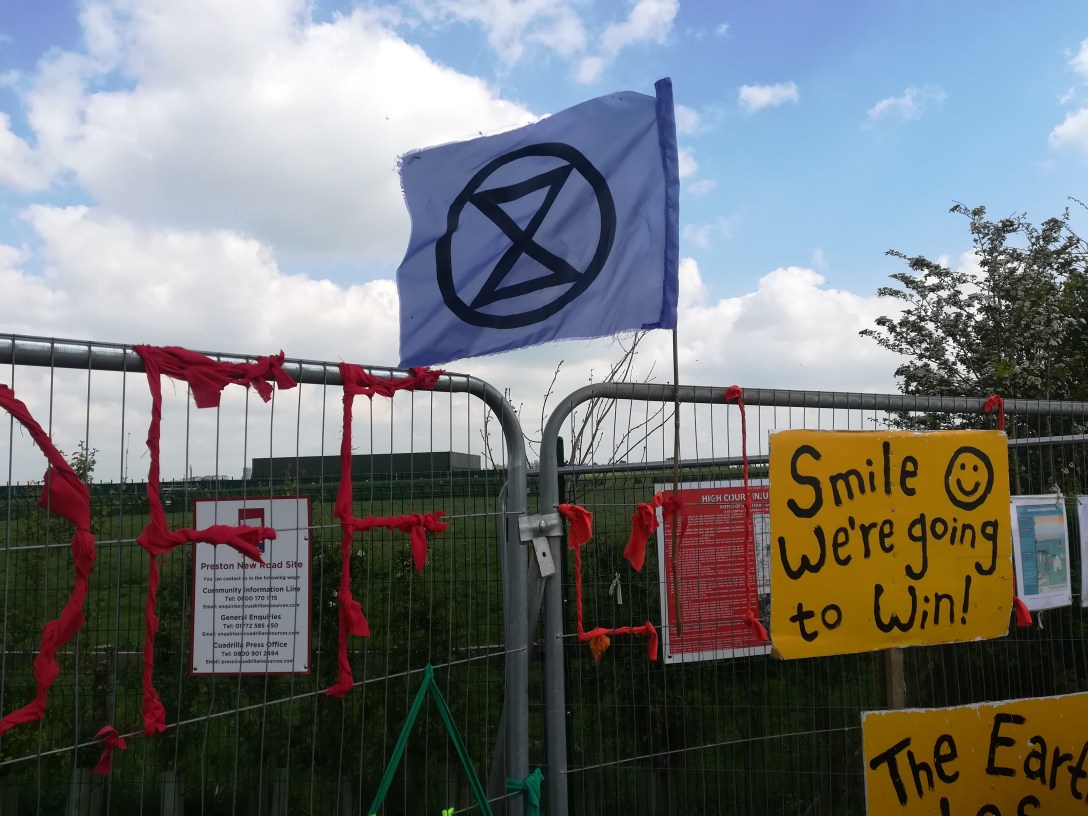



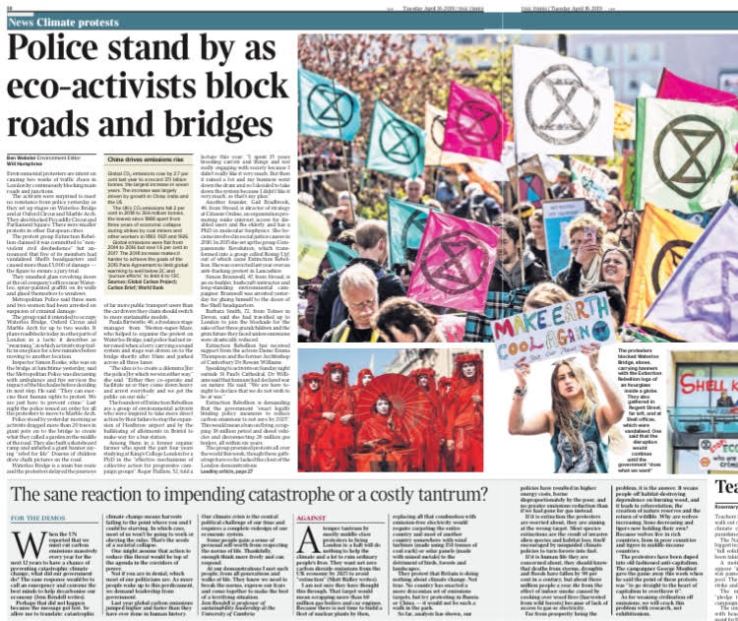







You must be logged in to post a comment.