“Water is Love”: restoring an ecological approach to climate change and beyond.

Skeena Rathor was a founder-member of the campaign group Extinction Rebellion, which changed the conversation on climate change in 2019. The group called for carbon neutrality in Britain by 2025. So the growing global emissions and worsening climate has been generating some reflection amongst activists. I invited Skeena to share her experiences and why she is now focusing on the importance of water. In the following essay, she shows how we can experience nature and climate as part of us, and vice versa, so we meet the challenges of social and ecological breakdown in a more holistic way. We publish on World Water Day to encourage attention to a wonderful new documentary on this theme: Water Is Love. Over to Skeena…

Water is more than just H2O. For times immemorial, many Indigenous and other wisdom traditions have regarded water as a living, spiritual entity, as a medium connecting the physical world with the spiritual, and as an essential force that sustains all life. For example, the Akan people of West Africa see it as a divine energy, the Māori view rivers and lakes as living entities with spiritual significance and the Lakota tradition reveres water as “the first consciousness bestowed upon Mother Earth” (Tiokasin Ghosthorse).

Continue reading ““Water is Love”: restoring an ecological approach to climate change and beyond.”
Staying Curious During Collapse

On this day 6 years ago, I released through my university the ‘Deep Adaptation’ (DA) paper on climate chaos. Since then, I’ve been experiencing a range of emotions that arise from my view of the situation and the reactions of other people to that – and learning how to be OK with that. I’ve also been experimenting with ways of living differently as my old sense of self broke apart. These two themes were the focus of a new documentary about my life that was shown on Dutch TV a few weeks ago. The filmmakers made it beautiful and so I recommend watching below on YouTube or Odysee.

The emotional side of researching, communicating, and educating on collapse has been colourful and, at times, draining. I made and lost friends. I gained allies and enemies. I lost and gained a way of life. I wonder whether I could have learned anywhere near as much about psychology and spirituality without the emotional roller-coaster of becoming public about collapse risk and readiness. 6 years after the release of the DA paper, I want to share some reflections on the conflictual side of me coming out as a ‘doomster’.  

Continue reading “Staying Curious During Collapse”

Real allyship in an age of collapse – supporting anti-imperialism

A year ago, the co-founder of the activist group Extinction Rebellion joined me in Glastonbury Town Hall to mark the launch of Breaking Together and put it in the context of a liminal space that environmental activism had entered. A year on, an edited version of Gail Bradbrook’s talk is featured in the May/June issue of Resurgence Magazine. In that time, have been impressed by how Gail has been exploring forms of international solidarity for an era of disruption and collapse. That is because it can be easy to turn inward, either by arguing over agendas that will probably never win power in the West, or trying to prepare one’s own community for further decline and disruption. I don’t disparage such a focus, but it can lead to a lack of attention to the wider world, and how we influence it. Or might do if we tried. Therefore, I’d like to share with you a recent blog from Gail where she offers reflections on solidarity with the revived anti-imperialism movements in Africa. Comments are welcome below. Thx, Jem

The leadership able to bring about a “Just Transition” – how we join our global family to unplug the death machine. By Gail Bradbrook.

As Europeans, MEPs and movement founders, we are honoured to have been invited to support a delegation study visit to the Alliance of Sahel States (Mali, Burkina Faso and Niger). We have found common cause with our family in the Sahel; here’s why we believe this matters immensely to you too.

Continue reading “Real allyship in an age of collapse – supporting anti-imperialism”

Speed matters more than size, when considering impacts of climate change

“But the world’s climate was as hot as this in the past.”

Do you hear this a lot? I do. The obvious answer is “sure, it was especially hot when our planet was just a chunk of molten rock spun out from the Sun. But back in terra logica, the main issue for ecosystems and agriculture is the SPEED of climate change.”

The problem with this issue of the speed of change is that consensus in climate science moves very slowly. The more funding that went into climate science, the greater was the amount of research and people to find consensus amongst. That meant the key signals, like the 2017 paper predicting 1.5C by 2025, went largely unnoticed by institutional climatology – and was certainly not acted upon.[1] 

In a 2021 chapter with Dr. Rupert Read and a top German climatologist, who chose to remain anonymous, we explained the limitations of mainstream climatology for telling us the real situation. We pointed to how, in fast moving crises with high hazards, there needs to be an ability to identify salient information rapidly. This even has a name: post-normal science.[2] 

Continue reading “Speed matters more than size, when considering impacts of climate change”

Accurate climate activists face prison, while their incorrect critics face… a pay rise?

What I have really valued, but also taken for granted over the years, is how my leadership courses have always been attended by a mix of people, brought together by a shared concern for being their best selves in an era of disruption and collapse. There have been climate activists, scientists, NGO officials and government officials in the room, or the zoom room, exploring sensitive issues together. It has been clear how much they are able to learn from each other. That contrasts with the way many top climatologists appear in the media, and on social media, to assume themselves to know everything that matters. That has led many over the years to casually disdain activists in various ways. The inconvenient truth they now need to face is that the activists are turning out to have been better at reading what was salient from the climate science than them, the salaried experts. Might some humility ensue? Or perhaps some curiosity about what creates such dangerous reticence amongst senior scientists and science bureaucrats? Maybe. But I’m not holding my breath.

Continue reading “Accurate climate activists face prison, while their incorrect critics face… a pay rise?”

Let’s tell the moodsplainers they’re wrong and then get back to work

As we reel from the impacts of strange weather and the news of unprecedented ocean temperatures around the world, the moodsplainers are out in force. They tell us we are right to be anxious but wrong to not believe that our way of life can be saved. In our favourite news outlets, they tell us that it is both morally and practically important to stay positive, stem panic and bypass despair. They warn us not to abandon fairytales of change and salvation. It might be OK if they wanted to live in a self-protective bubble of delusion. But in their public advocacy, they’re dangerously suppressing necessary dialogue that might help us all to reduce harm in this era of societal disruption and collapse.

Continue reading “Let’s tell the moodsplainers they’re wrong and then get back to work”

4 better or 4 worse? As XR nears its ‘big one’

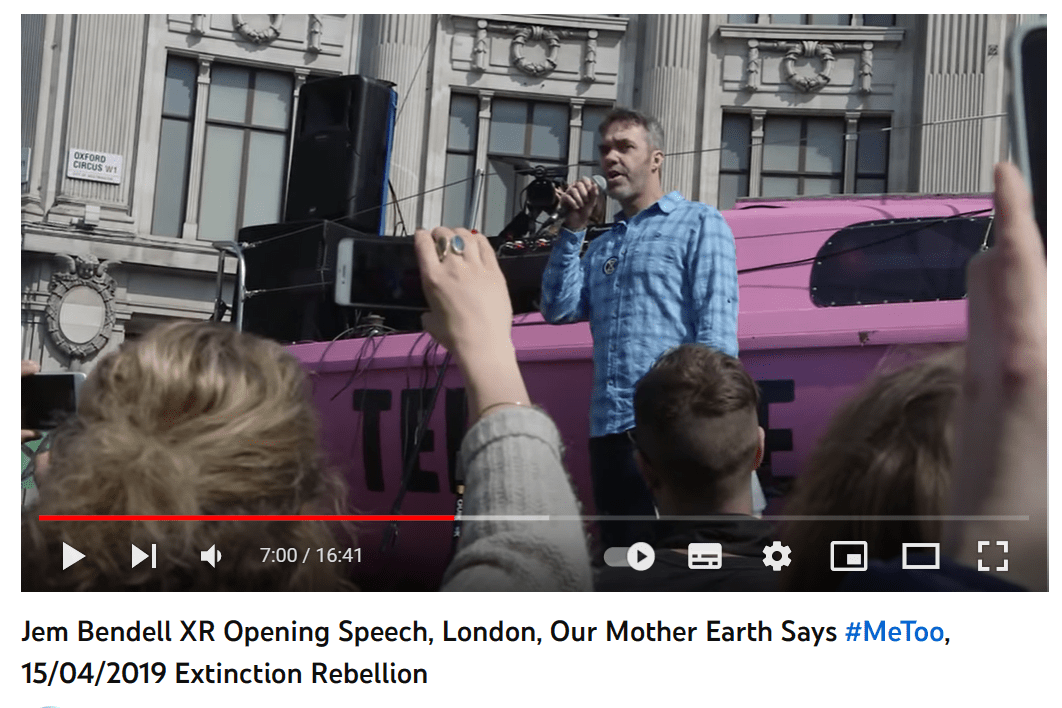
Four years ago I stood by the pink boat of truth in Oxford Circus to give the opening speech at the international rebellion against governmental crimes against humanity for inaction on the ecological and climate crises. The video of the full speech:

Four years on, many of the activists who have been involved in XR since that time have been reassessing how they will engage in future. The former finance lead of XR UK, Andrew Medhurst has written up his reflections, where he also summarises some of the new strands of work – showing how movements evolve due to successes and failures. I share my own journey in a book that is now on sale (ahead of free release as an epub in July). It is called Breaking Together: a freedom-loving response to collapse” – a title that I hope conveys some of the ideas. It has entered the Amazon bestseller charts at #1 in its category ‘political freedom.’ That category fits, as I map out a very different agenda to the one that has hijacked Western environmentalism in the last decade. That is the now-dominant agenda telling us that technology, enterprise, surveillance, restrictions and the schemes of billionaires, are the way ahead, and so we must force each other to stay hopeful and compliant. As co-founder of Extinction Rebellion, Clare Farrell, has explained “if you want to save some of the world, but hate being told what to do, this book is for you.” She is encouraging everyone out for the ‘big one’ in a couple of days. I am pleased to see a range of environmental groups supporting their effort to remind leaders of the level of public concern about the climate and ecological crises.

I remained convinced, however, that unless the green movement escapes its deference to the establishment and stops looking down on whomever corporate media tells us to, then there is no chance of a truly society-wide mass mobilisation for radical social change.

Continue reading “4 better or 4 worse? As XR nears its ‘big one’”

It really is time to do more about food (and liberty)

It really is time to do more about food. As most governments aren’t acting, we can look to our own organisations, local councils and groups of neighbours to do more – and build from there. My new paper on the trends driving the breakdown of the global food system explains why. Endorsing the paper, the Contributing Lead Author for the UN Global Assessment Report on Disaster Risk Reduction, Scott Williams, notes:

“We are conditioned to fear disorientation and seek safety in certainty and solutions regardless of the information available to us. Breaking that protective screen, this paper adds to the weight of analysis that the collapse of food systems and societies more broadly is inevitable. But how we are in relationship with these changes is not fixed even if, as this paper argues, we are stuck. Perhaps what this paper is calling for is the spaciousness to ask new questions, to challenge habits and myths, that may then shift perceptions. Consequently, we could be in relationship differently with the inevitability of collapse, and sense the possibilities that are perceivable with renewed care, compassion and generosity to ourselves and to all life.”

I hope the paper might help inform the evolution of environmental activism. Co-founder, Extinction Rebellion, Clare Farrell, notes:

Continue reading “It really is time to do more about food (and liberty)”

When #ClimateScam is Trending –rethinking climate comms

Text of speech delivered at COP27, Nov 9th 2022, Sharm El Sheikh, Egypt, by Prof Jem Bendell. Check against delivery. The video of the speech:

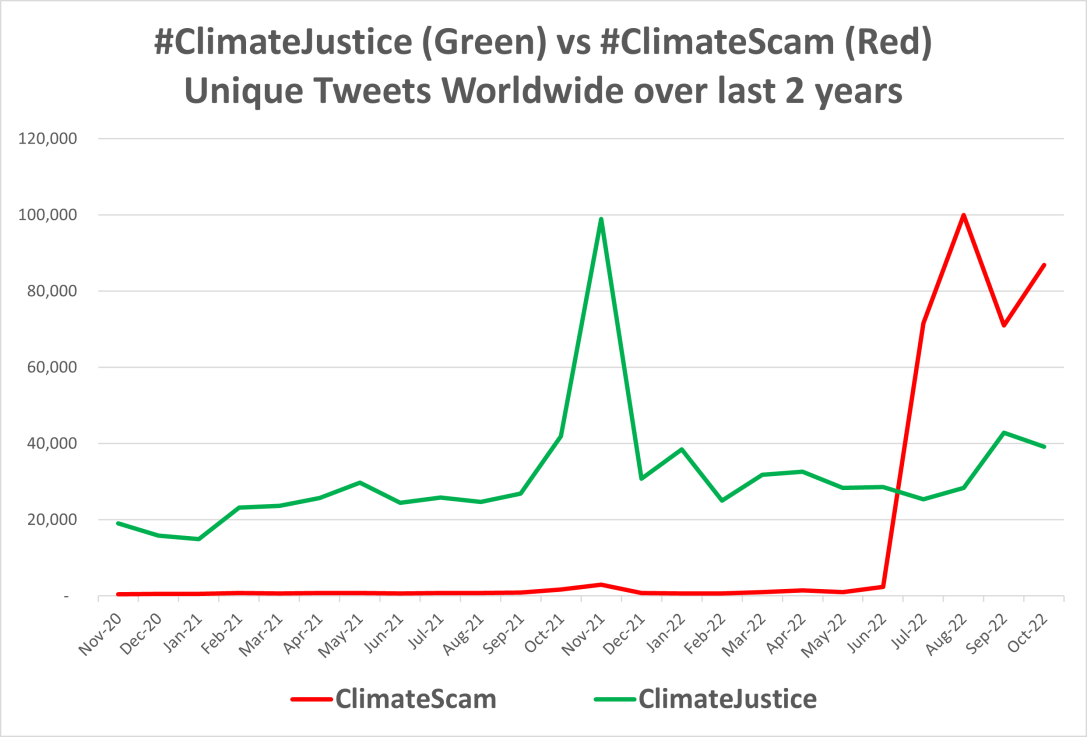
“We have a communications problem. Just as political support for climate action is growing, so political resistance to climate action is also growing. The use of the hashtag #ClimateScam has exploded since July of this year. From never exceeding more than 3,000 tweets in any month up to June 2022, it has been used 70,000-100,000 times per month in the four months since. Compare that to the hashtag #ClimateJustice, which has averaged about 30,000 tweets per month for the last two years and almost hit 100,000 unique tweets in the month of COP26 in Glasgow, with all the world’s media attention. But now? #ClimateScam is being used two and a half times for every #ClimateJustice tweet throughout the last 4 months. These twitter trends are one indicator of a growing resistance to climate action.

Continue reading “When #ClimateScam is Trending –rethinking climate comms”

4 years ago: “climate change is now a planetary emergency posing an existential threat to humanity”

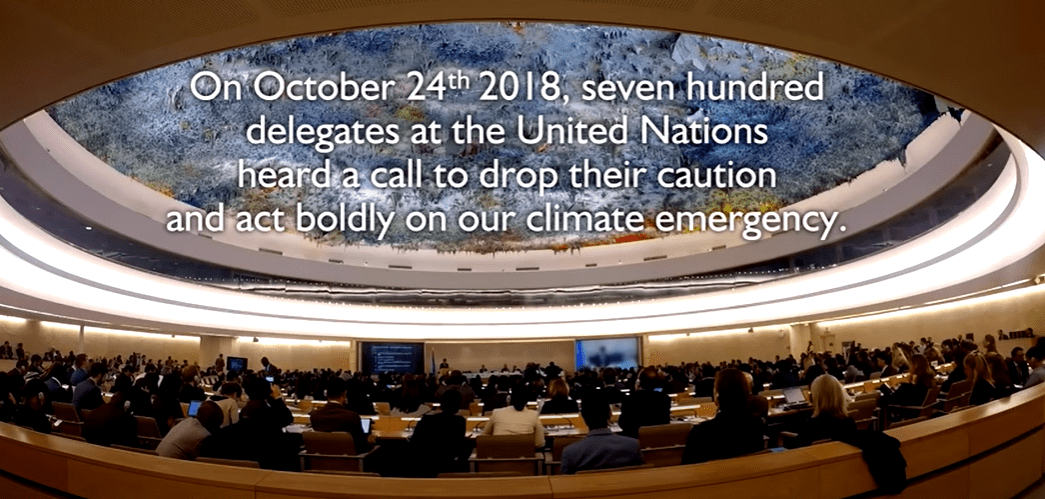
4 years ago today, I gave a keynote speech at the United Nations in Geneva, Switzerland. Soon after, a section of the talk was featured by the campaign group Extinction Rebellion (before they became famous).

Here is a transcript of a section of that speech:

“The Sustainable Development Goals offer one framework on public need. And we will hear of a range of efforts on different SDGs from our panellists. But I’d like to invite us to consider something bolder, more urgent. Although climate change is included in the SDGs, the latest report from the Intergovernmental Panel on Climate Change invites a reprioritisation. It implies that climate change is now a planetary emergency posing an existential threat to humanity. The artist who made this ceiling said he was inspired by a mirage in the Sahel where trees, donkeys and people all appeared to be melting up into the sky. We could take that a dramatic metaphor, in this human rights room, of the human face of climate change. So as our climate spirals away from one friendly to our civilisation, we need to face up to why we have been so incapable of changing our ways, collectively, at scale.

Continue reading “4 years ago: “climate change is now a planetary emergency posing an existential threat to humanity””