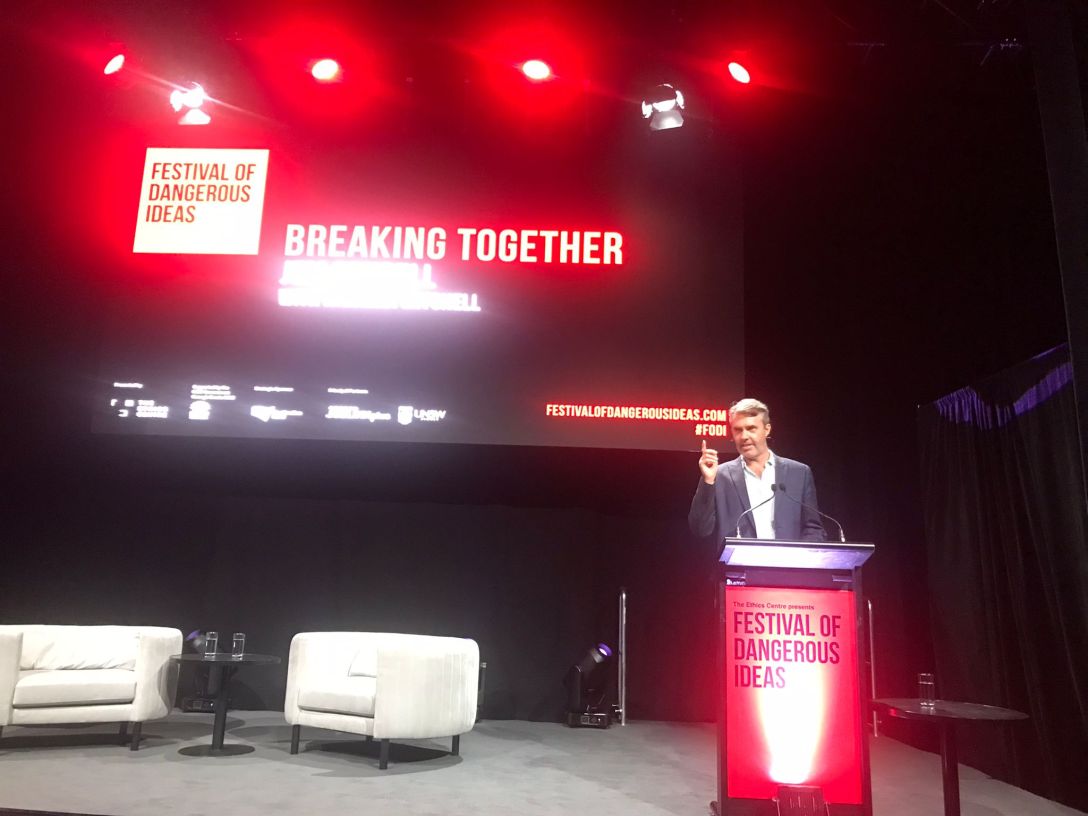
Last week, over dinner, the British comedian and author David Baddiel asked me whether my new life of farming, music and meditation means I am effectively hiding away from the difficulties of the world. We were both guests of the Festival of Dangerous Ideas, in Sydney. I accepted the invite as it’s a major cultural festival in one of the nearest English-speaking cities to where I live in Bali. David’s question reminded me of how I used to think about meditation and people focusing on their mindfulness. I wondered if they were running away from reality, and trying to be happy by disengaging. I was letting the fact that isolationism is the motive for some people to imply the motive for everyone who is into meditation. I explained to David that I could not have done my work over the last few years if I had not benefited from Buddhist philosophy and practice. It helped me to better notice and slow down my reactions to incoming information so that I didn’t reactively adopt views that might quell any difficult emotions or distract me from them. That meant I could notice the delusions arising from craving for material, psychological and spiritual salvation, both for myself and others. It meant I could look into the abyss for longer and explore what good might be done in our new context. It also helped my resolve to keep working on this topic despite a backlash and recurring feelings of defeat. Maybe I didn’t say it as eloquently as that after a couple glasses of red, but I think he got my gist. And it reminded me of my gratitude for what I’ve been exposed to over the last few years.
Here is relevant section from Chapter 8 of Breaking Together:
“I want to share a few thoughts on what I mean by mindfulness as it helps to explain where I am coming from in writing this chapter and book. All of us want not only to experience life but to conceptually ‘know’ life to some degree— that is, to know about reality, our relationship to it, and what is good or not. Our motivations for wanting to know life in those ways are central to whether we gain knowledge or construct greater delusion. Do we want to know life so as to have a sense of the stability of reality and then pay less attention? That is a desire for order and, when unrestrained, can become a key cause of delusion. Do we want to know life so as to feel like we belong in a particular group? That is a desire for belonging, and, when unrestrained, it can become a second cause of delusion. Do we want to know life so as to feel status within a group that we are identifying with? That is a desire for power, and, when unrestrained, it can become a third cause of delusion. Do we want to know life, so as to be able to blame someone or something for the pain we experience during our lives? That is a desire for absolution, and, when unrestrained, it can become a fourth cause of delusion. Each of these causes of delusion relate to an aversion to the impermanence of life and perceived risks to our individual safety (ref 554). It is near impossible to rid ourselves of these motivations, and a risk to think that we might have done so. Instead, various choices can help us to become aware of these motivations within us, so we are not consumed by them and can access more wisdom. First, we can cultivate mind states that are both observant of our inner emotions and motivations, as well as cultivating more benevolence towards all life. This can involve the widely known practice of meditation, but without a supportive context, it will be difficult to overcome the constant pull towards delusion. Second, therefore, is the choice to become less—or not at all—dependent on institutions that shape our sensemaking. An employer, for instance, and the career we have, can frame our identity and worldview. If we can find networks of people to engage with to support each other in conversations to make sense of our predicament, that may help. But given the dominance of death aversion in all of humanity’s cultural constructs and our own choices in life, a third important choice is to seek to be aware of any anxieties or denials about our mortality and seek to reconcile with both our own death, the death of other living beings, and any feelings about ageing and loss. I have come to understand that it is unfortunate that many spiritual teachings, both traditional and counter-cultural, offer escape from our death aversion through stories of our individual egos being even bigger in space, time and dimension. The unfortunateness is due to people then feeling a need to validate those stories through the shared retelling of them by groups, and the shunning (or worse) of those who do not believe the same. Mindfulness involves not letting our emotional responses to various stories of reality dictate our adherence to them. Therefore, it involves allowing any painful feelings of death aversion, rather than seeking to escape them with a story (we return to this topic in Chapter 12 on positive responses to collapse awareness).
With the sense of mindfulness that I have just described, I was able to approach the two years of research for this book without wanting to see the human situation in one way or another. Equally important was my training and experience in critical literacy, so that I could interrogate the concepts that swirl around within the various domains of thought that are relevant to assessing humanity’s predicament. So, for the rest of this chapter, I will explain what I mean by that and show how it is useful.”
Reading this passage again, I want to offer a couple of caveats on my positive views on mindfulness. I don’t want to imply that meditation and mindfulness are important only or mainly because they can help people to be better change agents, activists or leaders. Nor do I wish to imply that meditation and mindfulness always help people to be better agents of change. Instead, some folks can meditate to seek peace, and perhaps to find it, while also engaging in practices and promoting ideas that are delusional and even harmful. Due to the cultural habit of deference to high status individuals, many meditators are guided in how they apply their mindfulness in their daily lives, including work on the environment. I believe that the responsible way to enact such influence is to actively avoid dominating inquiry into what thoughts and behaviours are aligned with mindfulness, in one’s sphere of influence. For instance, an influential person within a Sanga or spiritual community can invite plural ideas on the climate situation and how to respond, rather than promoting one story about the challenge and response. That intention towards plurality, and not colonising the consciousness of others, is clearly the aspiration if one is made aware of the destructive power of ‘Imperial Modernity’. I describe that in Chapter 8 when explaining the need for ‘critical wisdom’ at a time of collapse. But more on that another time.
—
My speech at the Festival of Dangerous Ideas mostly focused on elaborating the nine lies of the Fake Green Fairytale which is enriching elites with our money, oppressing the poor, licensing new waves of ecological destruction, and delaying adaptation and justice. My talk was recorded for broadcast but in the past editors of mainstream media (ideological police) have cancelled broadcasts of my ideas (eg NPR), so I am not holding my breath.
Discover more from Prof Jem Bendell
Subscribe to get the latest posts sent to your email.

Hi Jem,
I’ve been enjoying your blogs, particularly on the 9 lies of the Fake Green Fairytale.
Equally important, I believe, are the lies that surround the myth of what you have termed Imperial Modernity.
I view it like this:
The Nine lies behind the Myth of Modernity.
The myth is that we are part of a rational, intelligent, honest, humane, society that is continually making progress and can enjoy constant economic growth and thus there is no benefit to individuals developing personal morals, critical faculties or using common sense.
1. Progress
Continual positive progress of society from primitive Cave Man through the present into the future.
(Despite evidence that previous civilisations were incredibly skilled, developed, successful and complex in ways that we don’t understand.)
2. Growth
Constant growth, an essential feature so that standards of living will always improve across the planet.
(Despite the obvious impossibility of this and the historical evidence that that civilisations have risen and collapsed.)
3. Humane
Steady tendency towards an increasingly humane society.
(despite what we know is happening in Gaza and Ukraine, the poverty and violence rife in cities in the west, and what we ignore is happening in Sudan and elsewhere.)
4. Rational
Rational science has all the answers, that we emerged from the primeval soup by total random chance, and that the universe in all it’s incredibly fine-tuned detail, grew inevitably from the big bang in ways that are now completely explained.
(Ignoring that science by definition does not set out the answers to the big questions, such as what is the point of existence.)
5. Honest
That our society is honest.
(Ignoring little give-aways like having Fairtrade food standards for some items is an acknowledgement that all other items are produced with exploitative trading.)
6. Intelligent
That we are the most intelligent species and that we are steadily becoming more intelligent.
(Slight hubris, particularly in view of all of the above.)
7. Personal morals
Unnecessary.
8. Critical faculties
These are useless when faced with only multiple choice questions.
9. Common sense
This has become an endangered species.
Part of the erosion of any cohesiveness in our society is the increasing exposure of these lies by the extreme circumstances that we are creating on the planet.
Best wishes for continuing your journeys of music and meditation,
Matthew
craving salvation is the fundamental force in us to realize salvation as being our fundamental goal. It will look for methods to realize salvation. As being trapped in matter and so in the illusion that salvation can be engineerd and carried out we use material methods like behaviours and technologies. However, life can’t be known. So these methods fail. So the method for salvation must be an immaterial, a spiritual, one. A method that liberates us from that in us that wants to control life and especially our painful experience from life. That liberation will be realized by allowing pain to be felt in stead of suppressing it. Life helps us with that by inevitably confronting us with our pain.