
Subscribe to continue reading
Become a paid subscriber to get access to the rest of this post and other exclusive content.
living with metacrisis and collapse
Become a paid subscriber to get access to the rest of this post and other exclusive content.
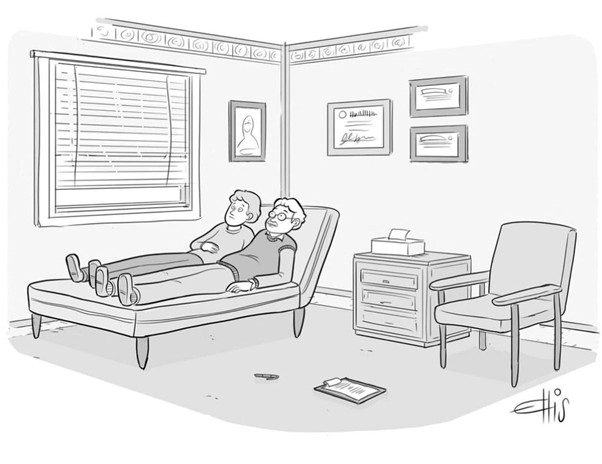
I invited the co-admin of the largest Deep Adaptation group in the world to share her ideas on the difficult emotions experienced by people who awaken to metacrisis and collapse. In this essay Krisztina Csapo explains it is unhelpful to frame such emotions as a form of general anxiety. Instead, more can be gained from recognising and responding to them as dread, grief, trauma and moral injury. I have left comments open for you to share relevant resources and initiatives at the end. Thx, Jem (Image by Ellis Rosen).
How do we psychologically sustain ourselves in times like these? This question arises again and again within communities working on ecological and social harm, and especially on the prospect of societal collapse. Through six years of engagement with the international Deep Adaptation movement, including facilitating the largest such national group, I have become much clearer about what helps — and what does not. That clarity begins with taking seriously the emotional reality people are living with as they confront the full gravity of our predicament.
I have come to see that framing what people — especially young people — are feeling as “climate anxiety” is often a misdiagnosis. It is misleading because it suggests a variant of generalized anxiety, thereby pathologizing responses that are understandable and proportionate to the situation. And it is unhelpful because well-known anxiety-management strategies frequently fail to address the deeper distress involved, sometimes adding shame or a sense of inadequacy when the “anxiety” does not go away.
Continue reading “Don’t Forget the Dread – Deeper Healing in the Metacrisis”
I invited an essay from a conservationist who recently worked in the crucible of US politics, and is now seeking ways to bring more authentic attention to ecological realities.
By Aaron Vandiver
Over the past several decades, environmentalism has been driven far from its roots. What began as a movement grounded in ecological understanding, love for the living Earth, and resistance to industrial destruction has been reduced to a narrow technical problem: carbon emissions.
When, on this blog, Professor Jem Bendell explains a pan-ecological perspective, he is calling us back to a truth environmentalists once grasped intuitively. As Rachel Carson wrote, “Nothing in nature exists alone.” Forests, oceans, soils, coral reefs, and natural hydrological cycles are, as philosopher Charles Eisenstein puts it, the “vital organs” and systems of a living Earth. A mechanical climate model focused on atmospheric physics and emissions cannot capture this living dimension. As Professor Bill Rees put it in response to Jem’s essay, climate is not primarily a physical system but a “biophysical” one. Recognizing this requires elevating biology — life itself — to the same status that physics and chemistry have enjoyed in the institutions of science on environment and climate.
Continue reading “Reclaiming Environmentalism: Saner Responses to the Ecological Crisis”
How was your Christmas? I had a lovely day walking the dog and recording a video of the amount of colourful trash “decorating” some of the trees here in Indonesia. We are in a majority Muslim country, which happily celebrates Christmas. That might be something to tell any grumpy neighbours who fear a Muslim “invasion” of where you live. Maybe they told you it’s time to put Christ back into Christmas, exhibiting a new religiosity with few prior symptoms (such as care for the poor or foreign). Reflecting on such declarations of the need to remember Jesus, this year I decided they have a point. Here’s why…
Every December, as the tills jingle and the Christmas songs play, we are invited to celebrate the birth of a man who asked us to stop worshipping money and start paying attention to what was going on inside our own hearts. Naturally, we mark this by maxing out our credit cards as we imagine what random stuff might pass as thoughtful presents. But if we are to be serious about “putting Christ back into Christmas,” we could begin by putting the actual Christ back into view.
Continue reading “Next time, let’s put the true Christ back into Christmas”
The following notes are my end-of-year reflections, which I sent to people who subscribed to receive that from me. I think they may be useful for prompting your own reflections, ahead of the next Metacrisis Meeting, so am posting them here as well. Wishing you bright times in the year ahead, no matter the darker stuff that surrounds . Thx! Jem
When I look back on a year I don’t just consider what I experienced, contributed and accomplished. I always wonder what I have learned, and how I want to apply that in future. I had that in mind recently when I was interviewed by the e-zine Grist. One of their journalists is aware that the creeping collapse of societies has become a more credible framing amongst both experts and members of the public. She was interested in what can happen from such an awareness. So she asked how that awareness has shaped me over the years, and what’s been changing. I realised my own journey might help you with your own reflections, so I wrote them up for this personal newsletter that I send out twice a year…
Becoming collapse-aware doesn’t mean the process of collapse suddenly concludes around us. Like me, most of you reading these words are fortunate enough not to be living in destitution. We live in the society as we find it, with our identities, assets, skills, networks, responsibilities and desires — which have built up over time within that society. So with collapse awareness, or even collapse acceptance, there are many types of response.
Continue reading “Taking time to reflect, remember, and recommit – year end thoughts”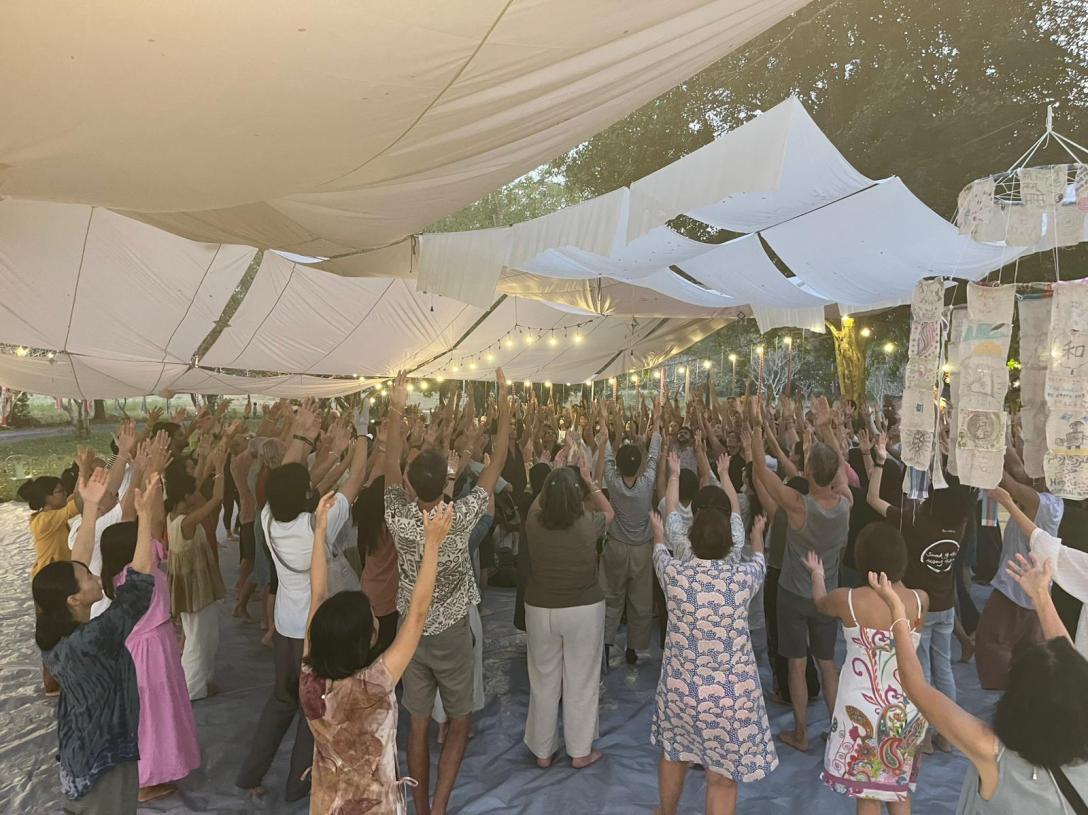
From a plea for pardon to an invitation to heal within a universe of unconditional love.
Across centuries of liturgy, the solemn chant “Kyrie Eleison”, often translated as “Lord, have mercy,” has echoed through churches and cathedrals. It is one of the most recited phrases by congregations of Christians around the world, and can convey the idea that believers are penitent persons before an omnipotent judge. I heard it regularly during my childhood, in Anglican, Catholic and Evangelical contexts. After I stopped going to church, for decades I didn’t think about the meaning of the phrase. Not until I was in a field in Thailand, with two hundred people from different faiths, as we sang and moved in prayer. That set me on a journey into the meaning of the phrase “Kyrie Eleison”, and a discovery about the loss of Jesus’s original message, as quoted in the Gospels. This realisation is opening up the possibility to reconnect with my roots in a new way, through a Christianity more mystical than the institutions of religion convey.
To understand the true meaning of the phrase “Kyrie Eleison”, it helps to journey back before the Gospels. It had been a common Greek plea, where “Kyrie” invoked a divine power. They had many to consider, from Asclepius to Zeus. The word “eleison” had a poetic meaning, because it was not only the verb “to forgive”. Our dance leader in Thailand explained it sounded similar to ‘elaion’, which meant oil. In ancient Greece, as in modern times, oils were used for various forms of healing, including wounds and aches. Thus, “eleison” meant something other than a cry for forgiveness from a sinning or guilty person. Instead, it was a plea, or an invitation, to “anoint me, soothe me, and heal me.” It is important to remember that the worldview at the time, across many cultures, regarded illness as a symptom of spiritual or relational disorder, rather than a random physical misfortune. To cry out “Kyrie Eleison” was to ask the divine to restore a person’s wholeness.
Continue reading “Reclaiming “Kyrie Eleison” this Christmas”Become a paid subscriber to get access to the rest of this post and other exclusive content.

There are moments when life confronts us with such undeniable pain that our hearts split open. For many people I know, that moment came with the realisation that our civilization is unravelling – that the seas are rising, the forests are dying, and the systems built to sustain our comfort are breaking. In that shock, there can be a strange grace. For a time, we awaken from the trance of consumption, routine and ambition. We see more clearly the suffering of the Earth and of each other. That often inspires compassion, and a yearning to live differently. It is a process I’ve often described in my past writings. It is why I encourage people to talk about societal collapse more openly, including our desires to reduce harm. Which is why, when I founded the Deep Adaptation Forum in 2019, I proposed that its ethos would be to “embody and enable loving responses to our predicament, so that we reduce suffering while saving more of society and the natural world.” Over the years I have witnessed people of all races, creeds, and economic classes, find their own ways to pursue that noble goal. It’s something I celebrate in the newly released video of Chapter 12 from my book. However, I have had to accept that something quite different can happen when we awaken to collapse, which might suppress presence, service and creativity. I wonder if that happened in me and others who participate in communities formed around an awareness or acceptance of collapse. If you are in such a community, I hope the following reflections on not becoming attached to narratives about collapse will be useful.
Continue reading “Let’s not become attached to collapse”
Lying in bed, I was too tired to read but not yet asleep. “Can you read me a bedtime story,” I said, half jokingly. “Sure,” my partner replied, and began to read aloud. Drifting off to sleep, I suddenly heard a word I never hear in normal life — relinquishment. “Huh, nobody uses that word.” My partner laughed, as if it was really funny. “Is this a Deep Adaptation story?” Rolling over, I looked towards her phone, and saw the text on the screen, which looked like the output of a chatbot. “What was your prompt?” She scrolled back up to show me: “Write a short story that Professor Jem Bendell would enjoy.”
Continue reading “Bedtime Doom”
As with many countries in the Western world, the UK has seen a rise of ethno-nationalist politics in recent years. One politician who led the Brexit agenda to leave the EU, is Nigel Farage. Not being able to blame the Eurocrats anymore, the lie took hold that Britain’s ills could be blamed on poor immigrants rather than greedy elites. Recently, Farage has come under fire for his alleged expressions of antisemitism. Although that focused on his childhood, his appearances on the podcast of alt-right conspiracy theorist Alex Jones was also discussed. During an appearance, Farage claimed that ‘globalists’ are trying to override national sovereignty by creating one world government. Some critics have claimed that it was ‘dogwhistling’ about threats from Jewish elites. The concern arises because Jones and Farage claim there are evil cabals of people, rather than members of a transnational capitalist class, who are serving the extractive demands of international capital. They don’t discuss capitalism in an intelligent way, because then they would be criticising their friends, funders, and the system that has promoted their views to huge audiences. Discussions in the mass media about who ‘globalists’ are and whether we should be concerned about them (and the structures of capital they serve) could be welcomed, if those discussions go beyond the lazy and nasty tropes of antisemitism. Unfortunately, such discussions seem difficult to have in the UK and elsewhere, as political discussion is often febrile and superficial. I was reminded of that recently in the town of Stroud, where one independent newspaper seems to have generated new debates and fractures between people who previously worked together for social change. In this essay, I want to share what I noticed from reading that newspaper and from experiencing the community fractures that emerge around its arguments. If the mass media weren’t so badly misinforming people in order to protect elites, perhaps this situation would not be so difficult. But in such a poor information system, there is work to get people talking about what can be done together at community level as life gets increasingly difficult for so many.
Continue reading “Blinded by The Light (newspaper)”
You must be logged in to post a comment.