If we are truly in a situation of ‘metacrisis’ then the foundations of our understanding of life and death are being challenged. It feels that way for many people who conclude that the upheavals of recent years are aspects of a breakdown in ‘normal’ life. Such a deep disturbance can be fertile ground for rethinking dominant ideas we received from our culture. For some, that can involve rethinking our relationship to religion, spirituality and the divine. That has brought me to a point of recognising that the cultural mis-shaping of our shared interpretations of personal experiences of non-separation and existential gratitude, are at the root of widespread destruction and exploitation. Even without the scandals and violent histories, institutionalised religion has a lot to answer for. Beyond that, exploring an enlivening and empowering spirituality can be an amazing outcome of the metacrisis. It doesn’t make the bad stuff go away, but it can change how we respond to it.
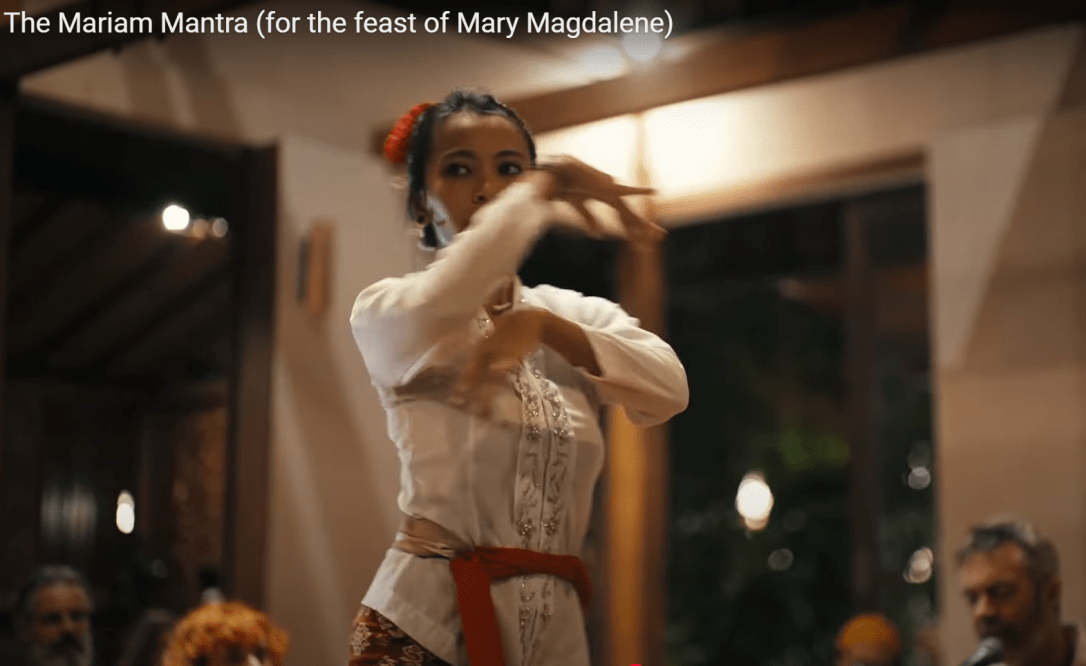
I was born into Christianity, in the Anglican tradition. It took me until my 50s to look into the content of those Gospels that were excluded from the official canon. One of those is the Gospel of Mary Magdalene. Upon studying it, I composed a mantra that draws from one of its phrases about the sacred interbeing of all that exists. I performed the mantra at a musical gathering, or Kirtan, which occurred on the day of the feast of Mary Magdalene (July 22nd, 2025). The band had not heard it or rehearsed it before, but as we had Ezca dancing with us, I wanted to record the occasion – and the video follows below. The result is a bit messy, musically, but I think it conveys some of the feeling of the moment. The chords and words of the mantra follow at the end of these reflections.
I’ve learned that the modern world first learned of Mary’s Gospel in 1955, when it was published in English. That came from documents in the Coptic Sahidic language, discovered in Egypt in 1896. Written in the 5th Century after Christ, its use of the local language suggests that early Christians in the region had been following Mary’s teachings.
In her Gospel, Mary teaches a Christianity of the heart – not of dogma or church power, but of directly experiencing unity, or cosmic, consciousness and how that flows into compassion. She explains that the kingdom of God is within, and that salvation lies in awakening the divine within ourselves. She invites us to seek and trust our inner knowing of what feels universally loving and true.
The Gospel of Mary was not included amongst the texts that became the official New Testament of the Bible. That might be due to limited circulation of the text at that time, but was certainly due to its theological differences with an emerging orthodoxy.
Although other Gospels identify Mary as the first person to discover Jesus had risen from death, Mary’s own Gospel does not mention a bodily resurrection. Instead, it includes Mary’s mystical experience of what Jesus had been teaching her after his death. In addition, her Gospel conveys the importance of salvation through inner awakening rather than submission to teachings from an external authority.
The words in this song draw from one passage in her Gospel, which reads: “All of nature, every form, every creature both existed and exists in and with each other. And again they will dissolve into their own roots.” That is describing the sacred interbeing of all that exists, including the cycle of life and death. I convey that with the English lyrics: “All is in and with each other, a sacred flow through one another. The infinite divine resides inside, inside of here.”
The Sahidic Coptic “euōn” (pronounced eh-ooo-OHN) means “they exist” and “euīn” (pronounced eh-ooo-EEN) means “together” and “evol” (pronounced eh-VOHL) means “within.” We sing these words repeatedly to echo how the Egyptian Christians were celebrating Mary’s teachings over two thousand years ago. That pronunciation is roughly what would have been heard in Egypt at the time. However, her Gospel does not mention the word “Magdalene” nor the town of Magdala – those identifiers were found only in the official ‘canonical’ Gospels.
I felt moved to write the Mariam Mantra as part of my inquiry about the persons and aspects of divinity that have been subjugated by patriarchal religious institutions. I had learned that some leaders in the Catholic Church invented the story that Mary Magdalene was a prostitute, without that being in the Bible. The patriarchal allergy to her spiritual leadership was even foretold in her Gospel. After sharing insights from her vision, we read that Peter objected: “[Jesus] didn’t speak with a woman without our knowledge and not publicly with us, did he? Will we turn around and all listen to her? Did he prefer her to us?” Then Mary wept and said to Peter, “My brother Peter, what are you thinking? Do you really think that I thought this up by myself in my heart, or that I’m lying about the Saviour?” Levi said to Peter, “Peter, you’ve always been angry. Now I see you debating with this woman like the adversaries. But if the Saviour made her worthy, who are you then to reject her? Surely the Saviour knows her very well. That’s why he loved her more than us.”
Rather than invite, welcome and learn from mystical experience, the men in charge of early Christianity preferred devotees to work hard to memorise passages and defer to the men with status in a hierarchy. Some gained such status for their superior powers of recall and discipline rather than their capability to experience states of cosmic consciousness. They helped to impose a view of salvation that is external, male-mediated, and partly fear-based, rather than internal, accessible to all, and love-based. By suppressing the mystical and feminine dimensions of their emerging community of faith, they shaped a disembodied and hierarchical religion which led to centuries of violence.
Recent decades have seen a rise in interest in Mary Magdalene. That reflects a positive trend in recentering both mysticism and feminine spirituality. However, some of the interest in her teachings reflects a patriarchal obsession with women’s sexuality and their relationships with men. We do not know if Jesus was romantically involved with Mary, or was married, or if they had children together. And that doesn’t matter for us to recognise the power of teachings conveyed in the Gospel of Mary.
A good book for understanding the Gospel of Mary in the context of Christian history and philosophy, is “Mary Magdalene Revealed” by Meggan Watterson. Her book doesn’t just reveal Mary to us – it points towards a Christianity grounded in experience, led by love, and open to all. It left me curious to learn more about Mary’s teachings on the seven powerful encumbrances on our incarnated souls.
Whatever our religious affiliation or interest, we can all seek to restore and spread cultural attention to the sacredness of all existence, including its feminine dimensions. That would be important at any time, but seems even more relevant as all kinds of systems are fracturing around us. Therefore, it is something we will discuss in future Metacrisis Meetings.
I hope you watch the video and enjoy the dancing by Ezca, who draws from ancient wisdom traditions to explore feelings from the music and its meanings.
I look forward to playing this mantra, with more practice, on future feast days of Mary Magdalene. If you want to do the same, the chords and lyrics follow below. Maybe I’ll record a version as the Barefoot Stars, depending on time and money for that.
Thx, Jem
The Mariam Mantra
Words and lyrics Jem Bendell. Chords are shown in square brackets within the lyrics:
[Em]Oh Magda[C]lene, [C]Oh Magdalene, [C]Mari[Em]am, [Em]Mariam
[Am]eh-OO-ōn eh-oo-EEN, [Em]eh-OO-ōn eh-oo-EEN
[Am]eh-VOHL [C]eh-VOHL [Em]eh-VOHL
[Em]Every creature, and every form, all in nature, and all that’s born
The [C]infinite divine re[Em]sides inside, inside of here
[Em]All is in and with each other, a sacred flow through one another
The [C]infinite divine re[Em]sides inside, inside of here
Pronunciation Guide (approximate): From the Coptic pronunciation (Sahidic dialect) Magdalene is transliterated as Mag-da-LĀY-nāy and Mary (Mariam) as MAH-ree-ahm. Capitals means emphasis on that syllable and dash over the vowel means the longer way of speaking e.g. ōn sounds more like own. So: eh-OO-ōn ah-OO-ōn NAYM eh-VOHL eh-oo-EEN.
Discover more from Prof Jem Bendell
Subscribe to get the latest posts sent to your email.
