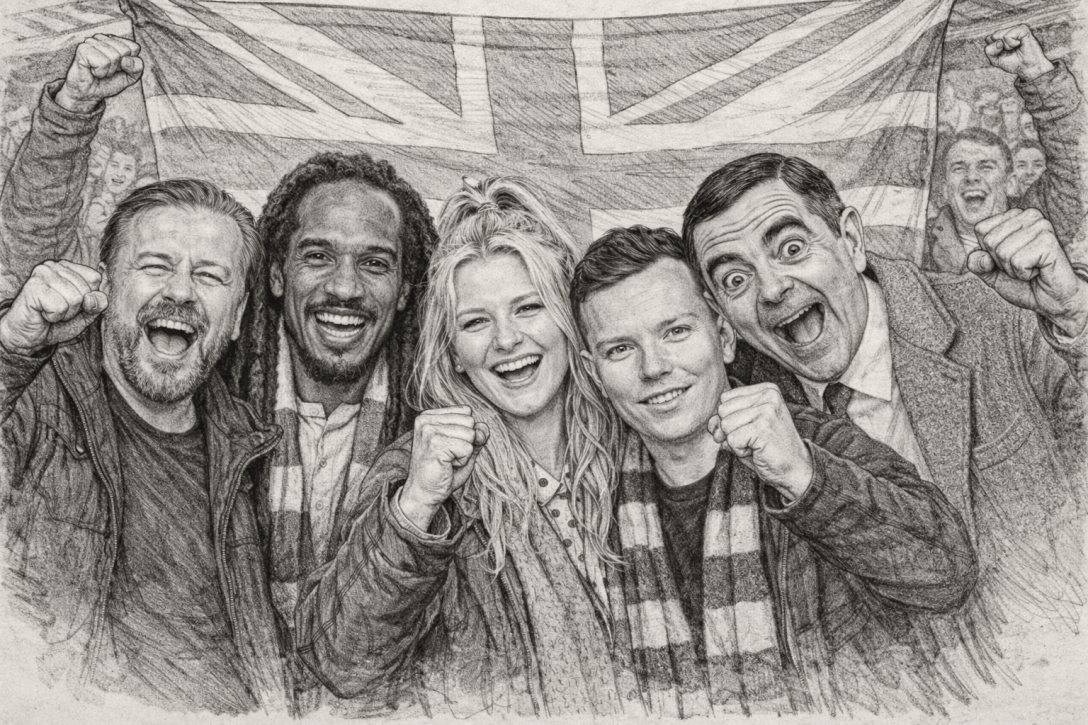
I have a strange habit when I am bored. It involves Ricky Gervais. Or rather, some video clips of him on stage. I must have watched him hosting the Golden Globe Awards a dozen times. The film stars are in their tuxedos and gowns, knowing the camera is panning across their faces. Ricky expresses shock at being invited to host again, then takes a sip of beer at the lectern, and tells his audience they shouldn’t try to lecture us on anything, as “most of you have spent less time in school than Greta Thunberg”. He then cracks a joke about Jeffrey Epstein, and as the groan spreads, tells them: “Shut up. I know he was your friend.” The camera cuts to shocked faces in the audience – rather prophetic editing, in retrospect.
When I watch it, I don’t just smirk. I don’t just recognise it as familiar. I also feel an involuntary pride. That mockery of pomp, deflation of status, and saying what’s uncomfortable. It is a comedy directed at the powerful, and I instinctively place that as something I call “British.” Which is a bit odd, if I think about it. Because it isn’t the pride of seeing a sibling succeed, or a friend flourish at something I helped them work on. The pride arises from my imagined common identity with the kind of attitude and behaviour Gervais is engaged in. It is a story about an “us” that I feel is being embodied by him. But the emotion arrives without analysis: a flash of identification with a national characteristic I like. I know other Brits don’t feel the same way and share an identity around completely different characteristics. And that’s what’s so malleable about our common identities and, therefore, national pride. This got me thinking about ‘patriotism’ today, as someone who emigrated from the UK and now looks back at the country during an era of economic decline, ‘metacrisis’, and even systemic breakdown, which I outlined in the book Breaking Together.
From here in Indonesia, I often watch my clips of British comedy with a mug of milky tea in hand — a ritual that feels quintessentially British. I noticed that Sonny Green opens his poem “What England Means To Me” with mention of a ‘cuppa’ with Nan. Recently, on “Britain’s Got Talent,” he received a fantastic reception for his poem about a kind and curious pride in one’s country. Like Sonny, I also remember having tea with my Nan, and that one of her favourite phrases was that she’d not do something “for all the tea in China.” We knew the British cuppa was harvested in India from plants that originally grew in China. Just as we knew that much of what we know as “British” are assemblages from around the world, which then came to feel native. It’s an awareness of connection and interaction at the heart of our history that I’ll return to: as it’s essential to an authentic national story.
In recent times, I hear more people back home saying we need to feel more pride in Britain or the country will lose its way. Research shows a continued decline in standard of living, and a rise in the view that the future will be more difficult than the past. That’s one reason for a perceived loss in confidence. In comparison with today, the past can seem rosy. But it’s not possible to reverse the clock. Instead, we can look honestly at what we value, and what we want to restore in our ways of living. In that process of cultural reflection, I think we can be grateful, positive and proud of what and who we truly are, while not confusing and belittling ourselves with dishonest boasting about our country. I think that’s why Sonny’s poem on Englishness is such a hit with audiences today.
Feeling ‘pride’ in the perceived quality or behaviours of a group one identifies with is an interesting phenomenon, and not one that any thoughtful and ethical person should accept without reflection. To begin with, any national identity is a social construction: a story about who “we” are, told often enough, through institutions powerful enough, that it begins to feel natural. Before the consolidation of nation states in the eighteenth and nineteenth centuries, people conceived of themselves primarily through other frames, such as kinship and ethnicity, allegiance to a monarch, adherence to a religion, or attachment to a region. These, too, were constructed and maintained through narrative, ritual, and coercion. If we forget that our own national identity is made rather than given, we stop interrogating how it is being made in our own time. That means we become susceptible to those who narrow its meaning for their own ends, and we surrender our capacity to help shape the stories that orient collective life toward humane and constructive purposes.
It is also striking how selective our pride can be. Out of the countless experiences that form our sense of belonging within a country, we elevate some to the status of national virtue and ignore others. What is it about comedy, for instance, that does not only make me feel at home, but inspires some pride? Where does that affect originate? Is it a subtle compensation for anxieties about my own life, or about the future? Is it a delusion of borrowed glory? Probably! But it is also a form of self-respect and self-encouragement to celebrate and uphold what I believe in (in this case, having a laugh while resisting pomposity and questioning power). The leap from comfort to pride is something we can all be mindful of. Because then we can retain a bit more agency over our emotional life, rather than treating any ‘pride’ in what feels familiar and positive as an unquestionable good (or uncritically accept it when we are told to feel proud).
Key to this inner move towards pride is our very human capacity to feel joy for another’s joy, to swell with warmth at a stranger’s accomplishments and acclaim. This vicarious happiness helps to weave us into a collective, allowing us to celebrate as one. And yet, this openness of spirit, makes us vulnerable to manipulation. We can feel pride when Britain wins many gold medals. But what if that is a distraction for why the fields where children played have been sold and the cost of a sports kit or the bus to training are now a luxury? If we marvel as British music tops the global charts, do we ignore how few of us now play instruments at home, that the school choir is a memory, and we have become a nation of listeners, not makers? Our capacity for vicarious joy is beautiful; but when it is used to blind us to the exploitation which reduces the richness of our own lives, it becomes our constitutional weakness.
Patriotism, as devotion to one’s country, is not of one kind, as it is an ideologically shaped experience, involving the influence of powerful institutions. Therefore, stories about what to be patriotic about can be empowering or distracting, uniting or dividing. Some forms of patriotism promoted by elites, and their hired hands in politics, can be a way to distract us from reality, so we don’t act as true patriots in protecting our communities and country from real threats. Over in China, many thousands of years ago, Lao Tsu warned everyone about this process quite concisely: “When a nation falls to chaos, then loyalty and patriotism are born.” Living in Asia and looking back at Britain over the last few years, I’ve been curious about what kind of loyalty and patriotism could help the country alleviate its decline, and even turn some of that around, in the context of unavoidable global difficulties. Rather than leaving our pride in Britain to be spoken about by pompous elites and grumpy fools, I think there is the chance to make patriotism great again, starting with being honest about the past and present of our country, and recognising we get to decide what we do and don’t feel proud about. The audience reaction to Sonny Green points to that widespread craving for a patriotism that makes sense, rather than the one that seems to excuse elite privilege, racial discrimination, and unnecessary foreign wars.
With that intention, and an awareness of the social construction of national identity, I wondered what me and my fellow Britons could feel positive about, in a way that might offer an opportunity for meaningful pride. Perhaps because I was born in Portsmouth, and travelled the world in childhood due to my father being in the Navy, my mind immediately turned to the fact we are an island nation. I saw the potential for some pride about the history of a great weaving of both local and distant peoples and their gifts, as an alchemy of the whole world that was made possible by the seafaring capabilities of anyone who travelled to, and from, the British Isles. With that background in mind, I wondered on what basis I might feel positive about how Britain is evolving today in the context of global trends — something which depends on our current actions, which arise from internal dialogue and contestation. In this essay I am sharing my initial reflections, to invite your own ones on this matter of having pride in identity and pride in nation.
A whole world in Britain
Living outside the UK, I realise there is much about the British Isles one can be impressed by. For a start, despite Britain only being less than 1% of the world’s population, people around the world speak English. It is partly the legacy of the Empire, and the subsequent dominance of the US, but it is still a remarkable feature of modern life. It’s a language with subtleties that provided the tools of our bards from Wordsworth to Zephaniah, and Shakespeare to Sonny Green — many of whom then developed it further. But when appreciating the cultural reach of English, we can also recognise this language was the product of an international mix. It was forged in the meeting of Angle and Saxon, Jute and Dane, seafarers from the marsh-fringed coasts of northern seas, who adventured across the swells. Then came the language of the Romans, then the Normans, adding to the mixture we speak today as English. Some of those Italians also brought us stories from the Middle East of a forgiving God. As that took root across Britain, spires sprouted towards the sky, shaping both landscape and culture.
One thing I miss about Britain is the way we do Fish n’ Chips. Whenever I return home, I look forward to ordering a haddock, chips and mushy peas. Once over the shock of the very ‘modern’ price tag, I can enjoy the taste of nostalgia. Remembering how happy my Dad sounded when one of us went to pick up our order from the chippy, is part of my experience today. But hey, let’s not forget facts. The reason we aren’t stuck with fish and boiled turnip, is because the Native Americans learned to cultivate the potato before the British sailors brought it back for us. I’m making a serious point here: it’s a mix of things from everywhere that shaped the UK today. And that isn’t just about language, food and drink. Our politics also imported ideas from abroad. The fact we have rights and democracy today is due in part to our ancestors’ curiosity about the ideas developed and fought for in France. From across the English Channel came their incandescent ideas of liberty and fraternity. Recognising that we are sovereign people helped kindle the long evolution of our own politics, our own hard-won rights, which, in turn, influenced others around the world.
So if we feel a thrum of pride for Britain, can it be a greater pride, for the world that made Britain? And if we choose to focus on what the greatest Britons did within these islands, then let’s focus on the true heroes, who shaped our society the most. We could start with Ada Salter, the first woman Mayor in London, who in the early 20th century advanced social housing, public health, urban greenery, and women’s political participation. She embedded dignity and beauty into one of London’s poorest districts — showing what could be done everywhere and for everyone. Figures like her, emerging from labour movements, co-operatives, nonconformist chapels and trade unions, were instrumental in building the institutions that structure modern British society: municipal housing, sanitation systems, welfare provision, and democratic local governance. The elites want us to focus on the royalty, military, and war leaders, but it was the grassroots reformers who altered mortality rates, living standards, education levels, working standards, and political enfranchisement. In this sense, the texture of daily British life — from clean water (!?) and public parks to voting rights and affordable homes (!?) — owes everything to these working-class organisers and reformers and nothing to do with the ruling classes.
When thinking of national pride, we can also have deep respect for the many ordinary men and women who fought in actual defence of the UK. When fascism spread across Europe in the 1930s, and much of the continent fell under occupation, people from the UK, alongside allies, fought in the Second World War. There was painfully remarkable bravery in the skies above southern England and on the beaches of D-Day. I remember the tales of one of my grandfathers, who landed on the beaches in Normandy, and my other grandfather who was sunk twice in one day in the Mediterranean (yes, the rescue ship went down too). Yet even here, caution is needed. To make military struggle the centrepiece of a patriotic story would be to narrow our moral imagination to moments of organised violence, however defensive or necessary. The decision to elevate these moments as the defining essence of “who we are” is not a recital of historical fact, but an ideological choice about what to celebrate and what to ignore. Instead a mature patriotism can honour courage under fire without allowing war to become the primary theatre in which national worth is staged.
A Britain in the whole world
It might be a byproduct of the complex history of the Empire, just like the ubiquity of English, but I am happy to marvel at how a country as small as the UK has created so much that the world has adopted and enjoys today. For instance, this summer, when the world switches on to the World Cup, I’ll marvel at how the world plays a game we invented, and continue to lose at. Years ago, when I played cricket with the kids outside a church in Kochi, India, I quietly smiled at how something from English county culture could travel so far and wide. Nowadays, when I play my harmonium at a kirtan, I know, but don’t mention, it was the British who introduced the instrument to India. In any case, the role of British music is fairly widely recognised. From the pop rock of the 60s, to the progressive rock of the 70s, and the synthesiser pop of the 80s, innovations from Britain reshaped sounds around the world. More people are aware of that than how the computer was first conceptualised and then built by Brits, that the World Wide Web was invented by a Brit, as was the concept underpinning Artificial Intelligence. At least many people know about our comedy. The most famous character, spotted on TV screens on cross country buses in South America, inter island ferries in Asia, and immigration waiting rooms here in Indonesia is not Ricky Gervais. It’s Mr Bean. Yep, the weird looking clown with a pathologically fragile ego and inability to form a sentence is one of the cultural exports with the most reach – and that makes me proud. How. Delightfully. Weird.
I know that there is an imperial shadow to the popularity of some British culture worldwide — we don’t know how widespread our reach would be if we had not had an Empire. As I stood by the well in Jalianwalla Bhag in Amritsar, looking back to where the British armoured car opened fire on everyone, including women and children, I knew that there is no merit in trying to downplay the violence of the British Empire, either by saying it wasn’t as bad as others, or that much good came from it. But what of that good? Sure, I love the trains in India. But nothing balances the scales when the racist voluntary mass murder of innocents weighs on one side. Just as we need not be proud of every thread in the world’s great tapestry of cultures and nations, we need not be proud of every thread in our own. To cherish a country and its culture is also to have wrestled with it, to have resisted its failings and struggled for its better expression. We do not need to be the wardens of an airbrushed past. Instead, it is part of my personal and collective pride that British people study our history, including the mistakes and horrors that occurred. It’s the same impetus for some of us to question our country’s international relations today. That criticality is essential to my current sense of identity as my country of birth continues to be led by hypocritical instigators and appeasers of violence abroad.
Although I think it important to look critically at the history of where we are from, I don’t think we personally carry any shame for the cruelties of an Empire we did not build. Our ancestors, for the most part, were not the architects of that power, but its raw material. Yes, some of our ancestors did OK. One of mine even made it from Yorkshire shepherd to mill owner. But most of my ancestors and yours toiled in the shadow of the ruling class that drew the maps of colonies, marshalled armies, and counted the profits of exploitation. Our ancestors were exploited here, even as others were exploited abroad.
British values can be aspirations not yet consistently upheld, nor exclusively
Despite complicated histories, many people think that the values that a country claims to uphold are what we can feel both pride and allegiance to. It can be useful to identify such values as collective aspirations. When a fellow Brit speaks of ‘fair play’ and ‘tolerance’ as values they consider positive national qualities, I can regard that as benchmarks for analysis rather than shaky boasts about reality. We are a people who have, at our best, aspired to these things, and we can continue to aspire to them. That can involve celebrating each other for the embodiment of such values. Recently, for instance, many British muslim citizens voted for a female plumber representing a party led by a Jewish gay man. Their shared values and interests, around peace, tolerance, fairness, and a healthy environment, transcended the differences which others want to divide us by, to send a Green MP to Parliament.
However, I fear a regressive magic if people claim that specific values are self-evident in Britain today. Like any country, the UK does not uphold values consistently: the fair play that governs the cricket pitch does not govern the zero-hours contract; and the tolerance we celebrate is extended selectively, both at home and abroad, requiring our ongoing resistance against authoritarians and warmongers. The regressive magic is accentuated by those who ignorantly claim that certain values belong to their country alone. I say ignorant, as looking at nearly any other country and you will see some similar principles. Kodo fairplay in Japan, reciprocity in Pacifica cultures, tolerant pluralism (historically) in India. Many of the values we wrap in a flag are actually the common inclination of humanity. I mention the possessive praise of virtues that we only intermittently practice as being a ‘regressive magic’, as it creates the context for people to think and act in negation of such values. For if we agree they are both essential and endangered, then anyone who claims there is a threat to them can demand our loyalty, sacrifice, and suspension of dissent. So the politician stands before Parliament and warns that “British values” such as tolerance, are under siege from immigration — never mind that tolerance should involve living alongside the stranger, and fairplay should involve due process not discrimination. Their rhetoric can work because we truly appreciate the values being mentioned, and can be hoodwinked into thinking they are our country’s alone. The tragedy is that the real threats to these values — the gross exploitation leading to poverty, inequality, the corrosion of community, the decline of public life — are not brown folks in boats, but power ceded to the rich folks within.
I have this regressive magic in mind when I hear people claiming that we should give more attention to the role of the European and British adoption of Christianity in subsequently shaping the rule of law in countries around the world. Their wish to frame some of modernity’s core principles of human rights, bureaucratic fairness, and universal compassion as uniquely Christian-based requires a poorly selective reading of history. They overlook the ethical philosophies flourishing in Asia centuries before Jesus Christ or the subsequent evolution of Christianity in Europe. To give just a couple of examples, the Tao Te Ching advised rulers on compassionate governance and “placing themselves below the people” around 500 BCE, while the Buddhist emperor Ashoka promoted religious tolerance and social welfare in the third century BCE. The wish to claim moral authorship of values now espoused globally, points to a cultural insecurity. For good reason, as the uncomfortable truth is that Christian societies, for much of their history, have been agents of violent colonialism and military aggression. To claim that compassion and justice are Western gifts to the world is not only historically inaccurate, it compounds the racism that is required to justify the abuse of peoples today.
It takes me a whole essay to explore such ideas, but poetry can embody them in a few lines. Sonny Green’s Englishness is “neighbours saying “Happy Eid, mate,” and Muslim mums saying “Merry Christmas, love.” By celebrating the neighbourliness of people whose ancestors originated around the world, it’s obvious we don’t need to be proprietary about the values of tolerance and respect. We can remind ourselves it’s the kind of people we want to be, individually and collectively. I remember meeting Sonny when he was a teenager, staying in Stoke Newington. When I asked him what he did, his eyes smiled as he told me he was following his joy. And then he encouraged me to follow mine. I’m not sure I did that, but I remembered his vibe and followed him on Facebook. As a bard who did the hard yards, rhyming to share his lived experience, and inviting us to follow our hearts, as more people discover his work, it can help our conversation on the direction of Britain today.
A peaceful patriotism for regeneration
If you and I dislike racism, as I expect, then that is an aspect of our identity we can be proud of, despite some of our fellow citizens confecting stories of superiority to feel a fragile pride. Our patriotism can be an honest and relational one, where we recognise the world’s gifts woven into modern Britain, and neither feel guilty for the sins of the dead, or try to excuse them. We can be proud not of a perfect inheritance, but of our affinity with the people who participate in the building of what is good, just, and true, today.
I’m speaking of the locally rooted, but globally aware, grateful but curious, patriotism we can express today, freed from delusion and the tactics of division. That peaceful patriotism is the only kind which is not a symptom of societal decay. Confident and happy people in a healthy society do not parrot the fictitious and divisive forms of patriotism. Instead they speak like English poet Sonny Green, and applaud those who do likewise. It might be painful to explain that to some of our friends and family, but our own peaceful patriotism could motivate us to have difficult conversations with them. Our peaceful patriotism could help us explore what we can do to help British citizens, of all kinds, to feel safe, supported, and contributing to society. Freed of confected pride and fake enemies, we can look at the real threats to our wellbeing, such as the takeover of our neighbourhoods by transnational capital. Moreover, a peaceful patriotism might encourage us to tell national stories that help us adjust in solidarity, during these times of increasing hardship, societal disruption, and even the collapse of old ways of living – something that is within the work I do at the Metacrisis Initiative.
And guess what? Humour is one of the best things to help alleviate the stress of difficult times. Maybe Britain could become a world leader in ‘doomer humour’. So, let’s hear it for Ricky, Sonny, and the rest, while telling Yaxley-Lennon to F-off back to the Canary Islands to spend his Elon-gotten gains. In the meantime, from Indonesia I’ll be tuning in to Great Britain, drinking tea while watching some of my favourite bands, bards and comedians.
Ta ta for now, Jem x
—
What England Means To Me: Spoken Word & Poetry: Amazon.co.uk: Green, Sonny: 9798242282698: Books
Discover more from Prof Jem Bendell
Subscribe to get the latest posts sent to your email.
