Fashionably Hated: on social change, media and the self

I thought my mum and dad, and my colleagues’ family and friends, might be proud. It would be the 2nd time a report I co-wrote appeared in the Financial Times. The last one was Deeper Luxury, which 3 years ago helped kick off more engagement in CSR by some luxury brands. The new report is on jewellery, and the result of 18 months work, mostly pro bono by myself and my dedicated and inspirational colleague Ian Doyle. But I haven’t sent my relatives the FT link. The article patronised us, with arguments that our co-publishers Fair Jewelry Action have debunked point by point. Fortunately the report has been well-received in the industry press, with Diamonds.net doing a succinct overview.

When I read the FT article I was surprised. Surprised at how much I laughed! I thought I cared about being respected. We all do a bit, don’t we? But reading it seemed cathartic. For some years now, with my colleagues at Lifeworth Consulting, we have been trying to persuade some in the industry to be more ambitious in their responsible enterprise goals. We have got somewhere with some brands, but mostly its the start ups who get it and they don’t have funds to pay for our help. Managers from the big brands, however, often depress me with their fancy lunches, seminars and excuses. We offered this study for free to help those in larger firms who really want to lead, and we got trashed.

I recall the enlightened perspective of Chris Marsden when he worked at BP in the 1990s: “if Greenpeace didn’t exist Id have to invent it.” Not that we are Greenpeace – our report is far too boring, as its for industry and focuses on giving specific advice on business strategy. I suppose for every Chris Marsden there are a thousand corporate cogs. There are many proud cowards in luxury brand management.

A lesson I see for myself and anyone who works in social change within a professional context is to never confuse being respectful with being respected. To respect others and hear them out, understand their situation, is key, but to worry about being respected is imprisoning. We need more people in social change who don’t give a xxxx about being disliked and will risk their own situations to seek and then live by their unfolding truths. Its this sense of liberation that made we want to share experience here. Its important because there are now so many events of the eco-chattering classes about how to achieve systemic change, from Tallberg to Davos and beyond. By giving the mic to those with status they perpetuate the idea that those having a high status role have an insight rather than an affliction, and that calling for bigger changes is a means of change rather a way to let off steam by blaming others and situations before returning to normal life. Instead, we have to risk our acceptability, our respectability, our livelihoods, and the expectations of our families, in our daily lives at work, if we are to really explore how we can create systemic change.

But the FT article also made me realise something about journalism today. Real investigative journalism is disappearing from the mainstream press. I don’t mean the kind of illegal snooping on people to get gossip to print in tabloids, that has caused a lot of trouble in the UK just recently. I mean proper investigative journalism where issues of public importance are looked at in detail. Nick Davies did that at the Guardian to expose the phone hacking scandal, so it still exists, but is rare. The system of mainstream journalism, where owners want profits, desire happy (luxury brand) advertisers, and journalists need access to brands, and to pump out stories quickly to develop their online traffic for new ad revenue, means that the time and resources for investigative reporting have been crushed. Research has even found that many (mostly freelance) fashion journalists are also on the payrolls of PR firms and individual brands.

In that context its tough for a fashion journalist like Vanessa Friedman to write about our 58 page study one minute, and speculate on the Duchess of Cambridge’s dresses the next. The absence of investigative journalism is so accepted now that journalists can even complain about others not investigating enough, such as Vanessa complaining we didnt investigate further about Burmese rubies, without spotting the irony. Why don’t the journalists look into it?

INSEAD Professor Mark Lee Hunter told me the other day that investigative journalism is so undermined by the economics of media right now that non-traditional journalists, from bloggers and NGOs, will have to develop the skills of investigative reporting if we are to maintain some effective public discourse. He has produced a handbook with UNESCO to help. Perhaps hybrid models of media, where mainstream publications work with investigative bloggers, helping to guide and ensure their approach and credibility, will be one way of coping. What Jo Confino and colleagues are doing at Guardian Sustainable Business could be one indicator of such a situation. Other publishers may prefer to pretend they have it all under control and can produce credible articles without resources. Such pride will eventually turn them into PR agents’ megaphones.

These changes are bigger than any one person. Some may get all self-righteous about individuals at News of the World. But rather than single out individuals, we need to push for reforms in media ownership rules, so that there is diversity of owners as well as organisational types, with not-for-profit and community media having important roles to play.

We all get influenced by our colleagues and the day to day work. For instance, at Lifeworth Consulting, our desire to be helpful to people leading change in the industry may have blinded us somewhat. Rather than further investigating the issue of Burmese rubies, which was not our aim, or within our capability, when we found evidence that the EU embargo might be being broken, we should have referred this particular matter to law enforcement. Therefore I have started making the relevant enquiries about which parts of law enforcement should be informed.

So on reflection it is good that Vanessa Friedman paid the report some attention, despite the flaws we see in her article. I’m told the key thing in fashion journalism is you must not be ignored. In the rough and tumble of somewhat gossipy and cutting reporting: what doesn’t kill you… makes you more fashionable. So my real regret is that Vanessa didn’t speculate on what suit I might be wearing at my next speech.

If you are in the industry, or write about it, please read our report ‘Uplifting The Earth: The Ethical Performance of Luxury Jewellery Brands’

How an NGO report inspired a business woman to reinvent luxury

Can an NGO report inspire a new enterprise? An enterprise which after just 3 years is booming and winning business awards for turning waste into luxury accessories? The WWF report Deeper Luxury helped Kresse Wesling identify a market niche, turning waste firehose into high-end design. You can hear Kresse explain how she sees creative opportunities where others see trash, in her TED talk. Her success with Elvis & Kresse demonstrates how a shift in perception uncovers new opportunities. Given how the big brands mostly grumbled about the Deeper Luxury report when we launched it at the end of 2007, its gratifying to see how such ideas can be generative in the right hands.

With Fair Jewelry Action we recently followed up the report with “Uplifting the Earth” which maps out a progressive agenda for the jewellery industry. Once again, we heard grumbles from incumbent brands about our analysis, and it is the newer, smaller brands who are leading the way with innovations in responsible sourcing.

So let incumbent executives can grumble… the future is for people like Kresse. Indeed, it’s time for more “disruptive luxury”. Which is the name of my talk at the launch of the world’s first sustainable luxury awards, in Buenos Aires this coming November.

Where is the Movement?

This week is the 10th anniversary of the mass protest against the G8 in Genoa, Italy. Hundreds of thousands of protesters called for a systemic change in the global economic system, forming something called an ‘anti-globalisation’ movement by the mass media, or what was known by many activists as the global justice movement. In Genoa, behind huge metal barriers, leaders met while anti-aircraft missile launchers scanned the skies. We thought it a bit of an over-reaction; but we didn’t have the benefit of memos about Bin Laden. The (now proven) agent provocateurs helped the black block protestors create conditions for police to then brutalise many peaceful protesters. One protester, Carlo Giuliani, was shot and killed by a policeman. The violence led many people, myself included, to question whether they wanted to be involved in such demonstrations in future. Perhaps that was the intention of the reactionary elements in the Italian government. Yet there was another limitation to the protests. The movement had become defined by the media as the protest, because the cameras showed up at demonstrations. Yet a movement is motivated by the values and awareness of people, and that exists all year round, not just during a protest. It was the values and vibrancy of the activists that was key, and expressed in many other ways all year round, such as choices of work, ways of working in the community.

10 years on its a good time to look back, recall the mood and spirit of the activism, and see how the vibrancy of that time throws light on the choices many of us have made since. To conjure up a sense of the feelings involved back 10 years ago, here is a snippet from my last book:

“Rolling onto my back, I lay my head on a rucksack, staring into the night sky. The tarmac still pushes up through my sleeping bag, but somehow it feels more comfortable this way. I think of the few times I have slept out in the open, in fields after parties, or on beaches while travelling—times when I could revel in the sense of floating through the immensity of space, secured on the edge of a cosmic plan, or comic fluke, called planet Earth. But tonight I can’t drift away with thoughts of the infinite expanse of space. Police helicopters hover above, their cones of light traversing the car park like manic stilts. Dreaming is not permitted. It’s the G8 Summit in Genoa, 2001. I stretch my neck. My face feels sticky with the residue of vinegar I was told would help me during tear-gas attacks. Are we being searched for or spotlighted, I wonder? If they shine their lights on us for long enough, perhaps they’ll discover what they’re looking for? Perhaps we’re all here to discover what we’re looking for—something different, something possible? I can’t sleep and turn to Rik, a guy I met on the streets during the day. ‘D’you want to hear my poem?’ he asks. ‘Yeah, why not . . . ?’

Possessed by possessions
Lord and Master of all we owe
Belonging to belongings
It’s a disaster, I know
Chained to the mundane
Our reference frame is physical
Every day the same old same
Nothing metaphysical
And if God’s not dead
He must be mad
Or blind
Or deaf and dumb
Or bad
Still smarting over Christ, perhaps
The way the people have been had
But in our defence
I’d like to say
We nearly chose the proper path
But lost the plot along the way
You’ve got to laugh
It’s not our fault
It’s just the toys we made
Made such a lovely noise
And girls and boys
Are high and dry
Time to bid
All this
Goodbye.”

Rik Strong’s The Sermon, which he recited to me as we ‘bedded’ down in a carpark during the demonstrations at the G8 Summit in Genoa, captured some of the emotion that drove many of us to protest. There was certainly a lot of anger at the suffering being caused by economic systems, and the lack of accountability of political systems to the people. There was also an angst about something more deeply wrong about modern life. Western society didn’t relate to how we felt inside. Publicly people didn’t seem to care for each other, yet we knew that deep down they must do—surely? For us there had to be more to us than working, shopping and looking out for Number One. This was a holistic critique, and one that connected professional and lifestyle, the political and personal.

Yet 10 years on its difficult to say exactly what or where “the movement” is now. Many people who were active in protests back then have this nagging thought: We were everywhere, we went everywhere, but we got nowhere. What was it that led to the weakening of what seemed at the time to be a global awakening?

The level of violence certainly turned many away from protesting. But there were other factors that helped to corrupt some of the creative spirit. As the old Left woke up to the new wave of anti-capitalism sentiment and became involved with groups such as ‘Globalise Resistance’ they brought with them their hierarchical we-know-what-you-really-want-and-how-to-win politics. For some, this was a politics of envy not personal liberation. This led to splits and aggressive criticism from those who rejected instant political solutions freeze-dried in the 19th Century. And so egos clashed. When, during a demonstration in Brighton I mentioned to one activist ‘leader’ that his organisation was critiqued in a Schnews pamphlet, he just asked “was I name-checked?” Meanwhile career-conscious band-wagon jumpers leapt like crazy on to talk shows and into best-seller lists and newspaper columns, and misrepresented some of the core democratic anti-hierarchy values that permeated much of the organising and the aspirations of protesters.

But the biggest impact was 9/11. Soon after, the protest groups refocused on anti-war campaigning. The mass media closed ranks around the march to war. The critical analysis became more about the dreadfulness of one President, rather than a more informed critique of the whole system and its alternatives. The “war of terror” knocked the global justice movement aside, by making activists focus on symptoms, not causes.

For many people, the political philosophy that was shared by activists from very different walks of life, concerned about different issues, was a sense of everyday democracy, where all processes, whether political or economic, should be open to their participation and mutual control. John Isbister has noted that “an ideal democracy would give a voice to everyone who is affected by a decision. The real democracies with which we are familiar cannot reach this
standard.” For example, poor children are affected by welfare systems but have no vote. Women in poorer countries are affected by family planning funding decisions in the United States but have no vote in their elections. Instead, we can remember that democracy is an aspirational goal, for situations where individuals and communities participate effectively in shaping the social limits that define what is possible for them, without impairing the ability of others to do that for themselves. The goal is therefore an everyday democracy where all organisations enable participation. It is also inherently a global goal, because it is an organisational response to a universal principle of people being able to pursue their individual freedoms.

The 1960s student leader Gregory Calvert has reflected that in their student movement they came to understand that their commitment to democratic principles came from the heart, and had a spiritual dimension. Activism inspired by this consciousness seeks to challenge large incumbent unaccountable institutions, whether in the public, private or civic spheres of life. What excited many people in the process of campaigning, was that they were connecting to a sense of purpose greater than themselves, a story of a common humanity. It filled a need, because there was, as there remains today, some angst about the purpose of our lives, the story of our existence. For some people our story of existence is one of a secular, scientific, mechanical world without meaning. For some it is the story of a God creating us to struggle to return to ‘Him’. For many people that story seems more like a fairytale – a nice idea, something they don’t really believe but find it helpful to entertain the idea, perhaps once a week or so. To others this story seems like a nightmare with a “blind, deaf, dumb, mad or bad” God. Thus Thomas Berry, writing in 1990, felt that we had lost faith in the story of our relationship with a God and, therefore, who we are; “We are in trouble just now because we do not have a good story. We are in between stories. The old story, the account of how the world came to be and how we fit into it… sustained us for a long period of time. It shaped our emotional attitudes, provided us with life purposes and energized our actions. It consecrated our suffering and integrated our knowledge. We awoke in the morning and knew where we were. We could answer the questions of our children.”

This faltering between stories has sometimes been talked about as the ‘death of God’. Hence the angst and spiritual void captured in Rik Strong’s The Sermon. Set against this angst there was a real energy and hope, perhaps similar to the hope felt by people in the recent protests in the Arab world. On the streets of Genoa the T-shirts read “Another world is possible” – a world that would enable us all to be all we could be. In our hearts we felt that world already existed, but we didn’t really have a way of speaking in chorus so that the rest of society could hear us and join in the singing.

So what is this new story? I picked up some ideas from discussions of activists 10 years ago….

First, is creativity. In the west pop-culture gurus like Pat Kane were talking of a play ethic to replace the work ethic. By this he meant that the most natural, and perhaps highest, state of being is to play – to be creative, to be expressive, to test, try, experiment, to have fun in becoming all we can be. As Jean Paul-Sartre said, “As man apprehends himself as free and wishes to use his freedom, then his activity is to play.” The parallels with eco-centric thought on the irrepressible diversity of the natural world are clear. Pat suggested that this play ethic comes from the new generation of young professionals, who: “have shaped their identities through their… cultures of play – a whole range of self-chosen activities that have anchored them in a different orientation towards a meaningful life. These are the backpackers of Alex Garland’s The Beach, using cheap flights and travel literature to make the world their playground. The ultimate playfulness is to help each other to play together.”

Second, is a global consciousness, a sense of a common community of mankind. For many people nationalism is no longer a belief system and just a bit of fun, to be enjoyed in an ironic sense. Nationalism is being replaced for many by a planetary patriotism – we might call this Planetism. This means a deep concern for the health and well-being of the planet and all its peoples. Another aspect to this Planetism is a spiritual reawakening, as people see a common essence to all the world’s spiritual teachings, no matter how twisted they may be through religious institutions. This reawakening has been helped in secular society by the club culture, as ‘ravers’ grew up but couldn’t (or wouldn’t) “forget those blissed-out moments of transcendence, when drugs and beats blurred the boundaries of their selves”, according to Pat Kane. These states of consciousness were something that ecocentrist Thomas Berry pondered. If the universe is not alive in a psychic spiritual sense as well a material one, then “human consciousness emerges out of nowhere… an addendum [with] no real place in the story of the universe” he wrote. Thus the potential for a common storyemerges amongst the diverse traditions of eco-centric, religious and secular thought – an autonomous yet interconnected spirituality that supports self-expression. The new story of humanity is about our growing understanding of our relationship to our planet, including all its people and their spiritual selves. Therefore it is the story of our relationship to ourself – who we really are. The new story is that there will be infinite stories to unfold. Thus, in protests around the world people were saying one No and many Yes’s. “We’re not going to play your games anymore – thrill to your icons, your hip soundtracks, your latest double-stitch or lycra mix. We’re going to play our own games” wrote Pat Kane. And so play we did, from our use of the web to co-ordinate global protests, to the subversion of advertising, from the rave atmosphere of street parties, to the humour of slogans, from the creation of alternative currencies, to the launching of our own social businesses.

So what happened to this story of global creativity? What happened to the anger at a controlling exploiting system? What happened to the confidence that rejected the legitimacy of incumbent institutions and leaders and the old politics of left and right?

The rent. The mortgage. The debt. The pension plan. The fear of being left behind. The insecurities that make us want to be accepted and respected in the mainstream. The temptation from the story that integrating our hopes into the mainstream is the best way to live our values, to honour our memories of higher states of consciousness by our cold-light-of-day choices.

And so, if there’s anything to learn from the last 10 years, its the need to change the system that creates this apparent necessity for compromise. Jessie J may write cool music, but it IS all about the money, money, money, because if we don’t change the monetary systems, we will be subject to the incentives and disincentives that draw us into stultifying compromise. We cant rely on mass levels of mindfulness to escape the day to day corroding pressures that arise from debt-based monetary systems. Redesigning the way money is created, to remove the debt burden from our governments, economies, communities and own families, will be key to unleashing a creative globe of local and international democratic communities.

Leadership beyond leaders

I recently had lunch with someone who worked with a global network of young leaders and also a group of elder statesmen and women. With such an intergenerational exposure to leaders and leadership I had to ask what she thought leadership is. After some discussion I was surprised at how many people working in fields that convene or praise “leaders” don’t think through what leadership means, let alone responsible leadership. Instead, more obvious and visceral things seem to identify leaders: fame, role, impact, novelty and personal connections being key. Maybe I seemed a bit disappointed, so my lunch companion asked me what I thought a leader is. Id read books about leadership but none of the theories were fresh in my mind, so with the benefit of a poor memory, I made something up that describes the characteristics of people I admire and thus the qualities I seek to express myself (in my better moments). After lunch I decided to type up the ideas here…

There is a whole bunch of other things that are important and help comprise a great character (born leaders?), or a skilled professional (trained leaders?), but here are the 5 key attributes I identified. Leadership involves:

* Inspiring people to believe in their greater selves,
* Showing them a pathway for enacting that,
* Encouraging them to participate in a community in the process,
* Practically helping them along the way, and then,
* Reminding them of their commitment.

Leadership is expressed, not held. With these attributes in mind, no one is a leader per se, but anyone can exhibit leadership. That is because leadership exists in relation to others and contexts.

I’ll expand a bit… Inspiring people to believe in their greater selves is key because its the most incredible thing you can do for someone, to unleash their hopes and dreams and sense of dignity and ability. Usually the result of encouraging someone to think of their greater or higher self is for them to connect to a purpose beyond their immediate worries or insecurities, and be an agent for something useful in the world. It is deep and lasting impact, and important at an existential level.

Showing them a pathway for enacting that is important, as unless people can relate their aspirations to their immediate predicament, this can lead to frustration and disillusionment. By providing a practical example of how to take a first step, this makes an abstract idea seem tangible.

Encouraging them to participate in a community is important, as it is through engaging others that we can achieve results, learning what we bring, and how we are valued, when acting from our higher aims and sense of purpose.

Practically helping them along the way is important, as true leadership needs to involve some substantive contribution rather than simply exhortation and advice. Introducing people to people, providing them with new responsibilities or opportunities for experiences and training, and defending them when they stumble while advising them on what to do as a result, are all important if the initial inspiration is to stabilise into a new way of being.

Reminding them of their commitment is key. I almost said “holding people accountable” but that sounds too much like a positional role. Instead, what’s important is that if someone is impacted positively by your actions and advice, and you see them act differently as a result, then you have a bond. They will remember. In my own experience I have often belittled the impact I’ve had on others, not wanting to take things too seriously or create an impression of hierarchy. This means I’ve not accepted this aspect of leadership and perhaps this means that Ive missed the opportunity to play that useful role for people… to help them reflect on whether they are living their commitments or not today. Perhaps it takes a maturity that I’ve not had, to take on all this final aspect of leadership, which assumes an “elder” role… To do it in a way that is also humble, and still playful, could be my personal holy grail.

After lunch I looked back at some of the literature on leadership and it appears much discussion on leadership does not emphasise these attributes. Could it be our somewhat individualist, egotistical and patriarchal culture means we focus on powerful or charismatic individuals? Or that our organisation-centric and hierarchical forms of work mean we focus on those people who best get people to serve organisations, rather than their own higher callings?

Perhaps. And these limitations also then play out in discussions of what “responsible” leadership might be. Many speak of responsible leadership in terms of an individual being a fearless do-gooder confident in their own moral frameworks or, more introspectively, seeking fulfilment beyond accomplishment or, more simply, looking after their immediate subordinates.

I’ll venture that ‘responsible leadership’ is the expression of the five relational qualities I identified above in ways where the intention and effect is to help people who will be influenced as a result. i.e. if leadership concerns ones immediate relations with others, responsible leadership concerns one’s wider relations with communities influenced by those being “led”.

Sometimes a focus on responsible leadership can distract us from systemic issues. As if individual leaders acting in the public interest could change the world despite ingrained racism and sexism, structured inequality, corporate-owned mass media, consumerism, compound interest and financial speculation (to list some of my pet peeves). So its important when thinking about responsible leadership to think in movements and systems. Therefore our key interest, research, education, advice and advocacy should be about how we can cultivate such leadership in everyone, and what aspects of our culture, politics, economics and organisations undermine these qualities of leadership that anyone could naturally express!

In outlining these attributes of leadership I’ve probably been inadvertently rehearsing a leadership theory found in a 1950s management text or 4th century BC spiritual text. If so, please advise, as I could then cite the ideas of a known “leader” who defined leadership this way. As Im involved in the Globally Responsible Leadership Initiative (GRLI.org) I could then also feed this stuff into their work in a way that could be valued academically (as you dont get points for a bad memory freeing up mental space for a new schema!).

Or if these are new ideas and we need a new management fad name for them, tweet me a suggestion (@jembendell http://twitter.com/jembendell). Perhaps Relational Leadership? Connective Leadership?

Thanks,
Jem Bendell

Flattery before a fall? How top biz schools must step up

Ive been on the road for the last few years, but wherever I go Ive foind people love name dropping Harvard Business School, INSEAD, Said Business School etc. Although about 10 years ago I decided my academic connection would be with biz schools not other parts of the Uni sector, I never really acknowledged this obsession with biz school brands. When I was at Uni, being snooty about business schools seemed peculiar to me, as most academics and students of top universities looked down their noses at the business schools and departments for not teaching “proper” subjects. I recall my contemporaries at Cambridge scoffing at one of our cohort switching to business studies at the University’s new business school, then called Judge Management Institute. Back then it wasn’t considered something a smart person would do. Well maybe he could scoff at us now.

In recent months I’ve been looking into what business schools have been doing to play a useful role in society. I discovered that business schools originally had a very progressive role, in democratising access to senior roles in business. However today it appears that some of the elite schools are the laggards in real enquiry and social change. Perhaps they’re too self absorbed. It seems there’s nothing worse for your performance than being widely admired.

I discovered some great innovations in progressive business education in France, India and South Africa. And to summarise, I outlined 16 steps that responsible business schools should take. These I developed from a variety of experiences, conversations and experiments, including some work with the Pro Vice Chancellor of an innovative Uni in Australia that I’ve worked with for some years now. Im hoping they will feed into a number of initiatives Im involved inm and still others Im not, to help shift more schools towards being enablers of truly responsible and transformative leadership. Read more at http://www.lifeworth.com/consult/2011/05/sixteensteps/

Democracy is for lovers

As a vibrant election campaign comes to a close, it looks like I wont be able to use my favourite jokes when giving talks in Singapore in future…

Whenever asked about politics, as a visitor I had said…

“I’m sorry i dont know much about Singaporean politics…

….apart from that there isn’t much.”

or…

“One thing i quite like about your system is that, unlike where Im from, your politicians can’t blame the previous administration!”

Democracy is becoming more complicated in Singapore, and so at least in future foreign experts wont find it as convenient to say uninformed sycophantic nonsense about being culturally open when speaking about different political systems. (if you are reading, yes, you know who you are – you called it professional, I call it cowardly).

So while Brits vote against greater democracy, Singaporeans embrace it more. The world revolves and I know where my hopes now lie.

No, it’s not for haters: democracy is for lovers.

A course in sustainable luxury

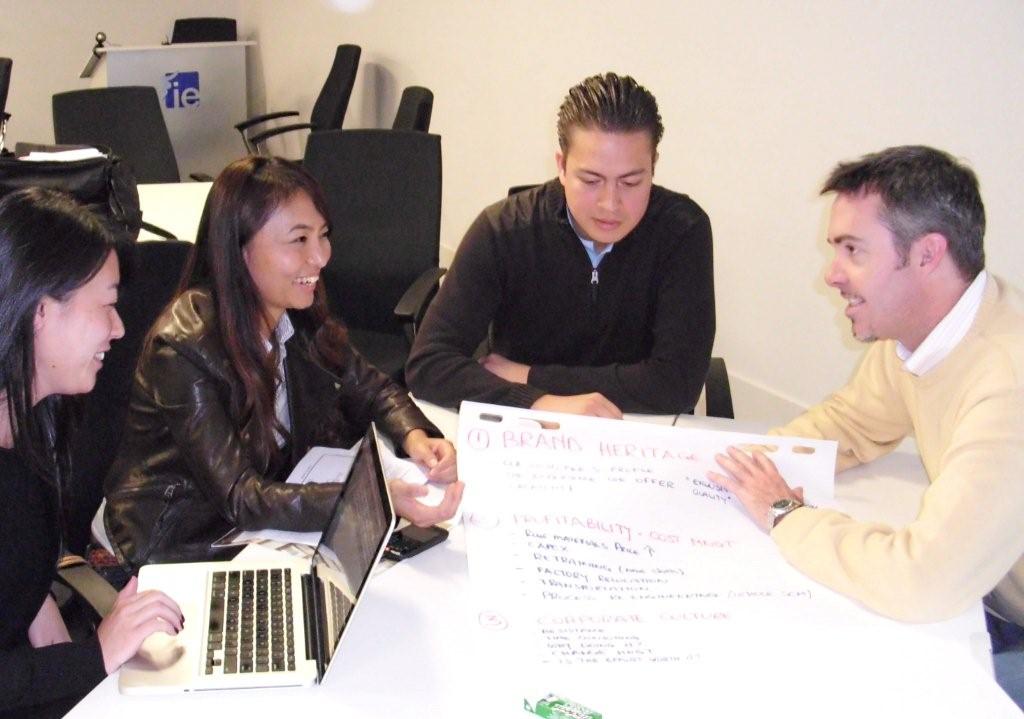
The evolution of sustainable luxury, as an idea and a practice, continues, as Ive just finished teaching the first 2 days of the “sustainable luxury and design” MBA module at IE Business School in Madrid.

It was a diverse class from all corners of the world.. and of course a fun place to teach it.

Thanks to Nicky Black (Corporate Citizenship Manager of De Beers), for sharing insight into her work at a busy time of year (she is working on their next report to society, and got some feedback from the students on that).

I dressed up for the occasion…

Sean Ansett, the Corporate Responsibility Director of Burberry, also travelled to Madrid to discuss what his team of 17 are doing on these issues. It was fun to see how Sean has developed his long experience in CSR to relate it to the needs of a premium brand.

Here he is in motion in class…

These sessions were somewhat introductory, and in the next sessions in April I’ll be able to work with the students more…

More info what next is on The Authentic Luxury Network.

Follow this via http://twitter.com/jembendell

Nestle shares value by 0.0146%

Nestle ‘shared value’ prize, 500,000CHF. Nestle profits in last year, 3,420,000,000CHF. A value sharing of 0.0146 of a percent of profit. Tax deductable of course.

So the question really should be the extent to which Nestle is changing the way it does its normal business. As I noted in the Journal of Corporate Citizenship in 2008, despite the rhetoric about “shared value” being a new strategy for core business, the numbers do not add up.

“Given that many of the examples offered by companies of how they can address social challenges through business are in practice making less of a rate of return than that expected from the business as a whole, are not scalable, and are dependent on government or NGO subsidy through partnership, we may question whether they really embody a new strategy. Perhaps they could be more appropriately understood as an advanced form of an established strategy: effective public relations through corporate philanthropy.”

In the two years since I haven’t seen much indication of a systematic attempt to change strategy.

As time goes buy, will more people have to conclude it isnt possible for a giant to be anything but greedy?

Or do you think there is real change within, real opportunity from, our largest multinationals?

Debate it at justmeans.com or below. And if you deserve support, then apply for the prize! (Think of Robin Hood).

Tweet @jembendell

How not to be a crap professor of business ethics, CSR or sustainability

I sometimes show my students the Daily Show’s John Oliver interviewing a Columbia University professor of business ethics. In it he asks the professor what he is doing about the ethical character of business students in the light of the financial crisis. The professor outlines courses that teach cases about corruption and the choices people have to make. Oliver says “that’s great, when are you going to start teaching this?” The professor replies “Um, we’ve been teaching it for thirty years”. After a confused pause, Oliver asks “Would you say you are very good at your job?”

By treating business ethics as something one learns how to debate in the abstract, and the various different explanations people give for their actions, has done very little to build the moral character of graduates from business schools, at least according to the studies that show student values pre and post graduation. It also does little to equip them with the insights, evidence and approaches to lead ethical business, rather than simply respond to ethical dilemmas. So can sustainability, social responsibility and the like be taught? As there’s a debate on a Linked In group, and I’m in the midst of designing an MBA module for IE Business School on sustainability, I took the opportunity to clarify my insights on the matter. So, here goes…

Teaching social and environmental responsibility in business needs to focus on:
– both standalone courses and integration into existing subjects
– both critical as well as practical perspectives
– both firm-centred and issue-centred perspectives
– both “content” and “consciousness” i.e. where the latter is about how we perceive ourselves, our careers, our organisations, our societies, etc.
– both class-based and work/action-integrated approaches
– both lecture and facilitated group learning with reflective exercises, role play, etc.
– both insight from publications and the tutor’s personal professional experience (and/or those of guest lecturers)
– both case studies and cross-cutting analyses

I make these distinctions as much present teaching in this field is only standalone, practical, firm-centred, content focused, class-based, lectured, text-based and with case studies for light relief. Such teaching, on its own, without the other stuff I mention above, is largely useless at educating people. Worse, it can encourage people to think that this field is something one is proficient in by simply recounting various arguments and a few models – a superficial confidence that impairs real insight and change.

Therefore I recommend the “whole person learning” track of GRLI which has a free book to download, written by the late Bryce Taylor.