2015 Publications

In 2015 my research focused on currency innovation, leadership and corporate social responsibility. I shared some of this research via publications. Here are the links…j-wn2CSbMMczqXXYTG5TFemn3De1qB1wC1UgJVIKg34,5WewfNosQC6fP5dUNe-oD1hg7Icy5uBVH1QSITeVogE

My published academic outputs from 2015

On monetary reform and currency innovation…

Ruddick, W., Richards, M. and Bendell, J. (2015) ‘Complementary Currencies for Sustainable Development in Kenya: The Case of the Bangla-Pesa’ International Journal of Community Currency Research, 19.  ISSN 1325-9547. Download here.

Bendell, J., W. Ruddick and M. Slater (2015) Re-imagining Money to Broaden the Future of Development Finance: What Kenyan Community Currencies Reveal is Possible for Financing Development, Working Paper 2015-10, United Nations Research Institute for Social Development (UNRISD), Geneva. Download here.

On leadership…

Bendell, J and R Little (2015a) ‘Searching for Sustainability Leadership’, IFLAS Occasional Paper No. 1, University of Cumbria, UK. Download here.

Bendell, J. and R. Little (2015b) ‘Seeking Sustainability Leadership’, Journal of Corporate Citizenship, Issue 60, pp. 13-26(14). Download here.

On corporate social responsibility…

Bendell, J. (2015) ‘What if we are failing? Towards a post Crisis agenda for the Global Compact’, in McIntosh, M. ed (2015) Business, Capitalism and Corporate Citizenship: A Collection of Seminal Essays, Greenleaf Publishing, Sheffield. Download here.

UNCTAD (2015) Enhancing the Contribution of Export Processing Zones to the Sustainable Development Goals, United Nations Conference on Trade and Development (UNCTAD), New York and Geneva. Co-authored by J. Bendell. Download here.

My mainstream articles about this research

On monetary reform and currency innovation…

Bendell, J (2015) From castle to cage: what to do about the housing crisis? Open Democracy, 22 April 2015. Download here.

Bendell, J (2015) What happens to democracy in a cashless society? Open Democracy, 8 April 2015. Download here.

Bendell, J (2015) Could electronic parallel currency ease Greece’s big cash freeze? New Scientist, 6 July 2015. Download here.

Bendell, J (2015) 4 sinister threats that loom for the cashless society, New Scientist, 3 June 2015. Download here.

On leadership…

Bendell, J (2015) To save growth, we must leave fossil fuels in the ground, World Economic Forum, 30th November. Download here.

On corporate social responsibility…

Bendell, J (2015) Could enterprise zones help us achieve the Global Goals? World Economic Forum, 14th December. Download here.

But not just official publications…

Like many of us, I blogged on these issues both here and at www.iflas.info and also shared my research via 12 public talks in 5 countries.

To be able to do this research and share it I’m grateful to colleagues at the University of Cumbria, UNCTAD, UNRISD, Impact International, WEF, Grassroots Economics, Community Forge, New Scientist, Greenleaf and Open Democracy.

It is difficult to know what the impact of my publications are. Citations, like via Google Scholar, give you a bit of a feel for that (ooh, an i-10 index of 35!), but that takes time.

Looking back on 2015, I think the main impact on people’s learning and unlearning via the Leading Wellbeing Research Festival and the free online course on Money and Society (which starts again on Feb 21st 2016).

Cutting Love – 4th Quarterly

Every 3 months I send an update. In my 4th I focus on listing some links for resources and events, before a few thoughts on “cutting love.” You can sign up to receive this Quarterly Bulletin.

First up, the culmination of a year’s efforts, today the UN publishes a paper I co-wrote on how Ewtonterprise Zones can contribute to the new Global Goals for sustainable development. These zones are popular with some governments, from India to the UK, but they aren’t without criticism, in terms of what they achieve. Now with changes in trade rules, Zones are going to have to come up with new ways of staying competitive. We argue that embracing social and environmental excellence is a clever response. I explained this in my article for the World Economic Forum. I was pleased to present the preliminary findings at the public forum of the World Trade Organisation (WTO) in Geneva in October, and the report is launched this week in Nairobi at the ministerial. You can read it here (pdf). I’m grateful to Dr Tony Miller at UNCTAD and also for colleagues at the University of Cumbria for supporting me to do this work.

In September I stepped back from Director of the Institute for Leadership and Sustainability (IFLAS) so I can focus on my research and teaching as a Professor of Sustainability Leadership (as part time) as well as new role with an impact investing fund. I’m pleased Dr Caroline Rouncefield is the Acting Director and joins an Institute with 5 MBAs growing well (over 2000 international students), as well as co-delivery of an MSc in Strategic Policing and a new MA in Sustainable Leadership Development. One of the last projects I worked on was to initiate a partnership with the National Trust, to promote innovation in the heritage and conservation sectors, which was recently launched with some fanfare. Our Deputy Director Dr David Murphy will lead on the project for IFLAS.

Trimantium Capital are the Impact Investors that I’ve joined the board of. Headquartered in Melbourne, Australia, it is making waves for attracting hundreds of millions of dollars into a fund directed at financial services and health technology with a clear social and environmental purpose. As the Paris climate summit started, I shared what some of us impact investors are thinking about the future of fossil fuels, in a WEF article.

Looking ahead from the winter, at IFLAS we will turn our efforts towards to the IFLAS Spring School, for two weeks in both London and the Lake District. It kicks off our new MA, but can also be attended as a stand-alone course. Lots of mid-career execs do our courses and become co-conspirators on future projects. The Spring School will also involve a reunion of participants in the Leading Wellbeing Festival, on April 9th in Ambleside, which will also be the annual meeting of the Cumbria Environmental Network. If you are interested in the new MA or the Spring School, please fire off an email to iflas@cumbria.ac.uk

Some of the ideas behind the MA are contained in a co-authored paper just published by the Journal of Corporate Citizenship (JCC). I’m grateful to Richard Little at Impact International for having schooled me in critical leadership thinking these past 3 years. I also presented the paper at the International Leadership Association in October and will share some similar ideas at the ‘Lead in Asia’ conference in Bali on the 21st January.

The 2nd cohort of our Mass Open Online Course (MOOC) on Money and Society went well, with around 100 people completing all 4 assignments over the month. That means they can now progress to the Certificate of Achievement in Sustainable Exchange, with the 5 day residential happening in our London Docklands Campus in April (as part of that spring school I mentioned). This labour-of-love for me and course co-tutor Matthew Slater, this free course is “bloody brilliant” and “mind bending”. The next cohort starts on Feb 14th and runs for a month online. Read more and sign up here.

Since my last update I was pleased to receive an award for my past work on cross-sector collaboration for sustainable development. The award made the local news, and my paper on the future of such partnerships (think disruption and revolution) is available here.

That’s nothing compared to being made an honorary fellow of the University of Cumbria. In November, my friend Funmi Iyanda became the first African Woman to be recognised in this way by the University and gave a powerful speech in Carlisle Cathedral. Her talk really reflected our ‘transmodern’ times, where we purposefully and playfully mix old and new ideas from all corners of the world to discover ways of rethinking progress today. Read her super speech here on the IFLAS blog, which is now also home to a regular series of articles on leadership themes.

In October I was pleased to host Professor James Wilsdon’s at our Lancaster Campus to discuss the future of how we are going to be assessed as academics. James is the chair of the Campaign for Social Science. As the University sector has been blasted by austerity measures over the past years and will continue be, James does important work reminding everyone why it’s good that we do what we do and how to do it better. Britain has an incredible heritage of intellectual leadership of international importance, based on the country’s love of learning and its institutions of research and education. Sadly we have now become the most expensive place in the world to get a degree, while many Universities cash in on their heritage in the form of sponsored buildings and uninspiring pack-em-in courses.

Unfortunately just the week after the celebrations in the Cathedral, a large part of Carlisle went underwater due to a storm that damaged many towns, villages and roads in Cumbria. The increased frequency and intensity of extremes of weather is in line with predictions from climate models. The events in Cumbria made climate change that much more personal, as explained in a first hand account by IFLAS Advisory Board member Becky Willis. The beginning of climate chaos is already upon us, with weird weather fuelled by a raised global ambient temperature of 0.8 degrees Celsius over the past century, along with seas warmer by 0.7 agrees and higher by 8 cm, on worldwide averages. The most concerning thing is the extremes, with the north-pole being about 5 degrees warmer than hundred years ago. After the floods people have begun to ask why the investment in flood defences and watershed management wasn’t increased in line with the known growing threat from a disturbed climate. The answer, again, is austerity. The floods are a reminder that you can’t ignore nature because of your politics.

Looking across the country, the cuts in government spending can be seen as cuts in a nation’s commitment to its shared assets. Whether it is flood defences, education or care for the disabled, all the things being cut are the things that reflect a country’s capacity to love itself: to care for its towns, its people, its culture and its future. When a government is cutting back on love, people must fill the void, as has been the case in Cumbria, with a wonderful community spirit emerging. If you want to help support people who have been flooded, please see the Cumbria Foundation or Spirit of Cumbria.

Although an agreement in Paris is important, the key is implementation. To make changes quickly, finance and trade ministers will need to shift incentives, hence the reason for my WEF blog. Ultimately we will need to redesign of our monetary systems, to allow us to thrive without requiring exponential economic growth, as I explain in the free intro to my last book.  A COP21 climate agreement is a piece of the puzzle; but the puzzle is already burning. We will have to live with the weather that’s coming and that calls for us to go deeper in our discussions and planning, as I described for Open Democracy earlier this year.

If any of these topics interest you, then do engage in the Sustainable Leaders linked in group, or see my latest musings at www.jembendell.com

I hope you have a good holiday wherever you are,
Jem Bendell

You can sign up to receive this Quarterly Bulletin.

Explaining UK Parliament on Syria: Or, what did Stella say?

The UK’s Parliament just voted to attack Daesh targets in Syria, which will involve bombing densely populated cities, and with no expressed plan for how this will enable decent people to retake control. The Kurdish forces arent anywhere near, the UK says it wont collaborate with the Syrian government, and the rebel groups are disparate and many allied officially or informally with Daesh.  Maybe the secret plan is to secretly collaborate with Russia and the Syrian government, as that would be too awkward for the Government to admit given that they wanted to bomb the government army just a couple of years ago. So it’s a bit of a mess.

Instead of the recent focus on airstrikes, Britain would have been best to make a concerted effort to show solidarity with the victims of terrorism in France and elsewhere by:

a) allying with other states on cutting funds and arms to Daesh
b) delivering better coordination of intelligence and policing across the EU
c) making amends for helping cause the rise of Daesh by accepting hundreds of thousands of Syrian and Iraqi refugees asap

So what happened?

Could it be that tabloid-regulated politicians, lacking context on commercial drivers of militarism, with a racist lesser-level of concern for the lives of Middle Eastern civilians, voted to be treated nicer on telly?

Well, we can only understand the politicians in the UK through understanding the role of mass media in the UK. The media has constantly sought to keep a focus on superficial and reactionary debate, relegating thoughtful analysis to a few columnists who have niche followings.

Some politicians feel these types of critiques of their thought processes to be churlish and and not respectful of the depth of their thinking. Yet it is not cynical, it is scientific. There is masses of research from social pyschology, linguistics and critical sociology that shows how dominant discourses are shaped through mass media and act on us at a subtle level so that we think we are coming up with our own ideas and feel good about ourselves. We create explanations and narratives to personally cope and progress within dominant narratives in our society. That is why education must always involve attempts at creating critical consciousness, so that more of us become aware of the way dominant duscourses, combined with interest in one’s self esteem, shape our perceptions of issues.

So of course some politicians have an emotionally difficult time convincing themselves of ethical reasons for being able to look good on telly and tabloid. An apparently quite decent chap, Tim Farron looked particularly sweaty, as if different bits of his soul had been squabbling all night. Yet it does appear many politicians have voted suitably in line their own career strategies. For Conservative MPs that’s easy, just stay within the herd of the Tory mainstream. In the case of Labour, some career trajectories require it to return to a wishy washy party of right wing foreign and economic policy with some slightly lefty social initiatives to get the party activists engaged and Guardian readers onside. Why respond to how the majority of one’s constituents and party members are against something when you can switch the focus onto a few abusive people? I wonder if Stella and Chukka’s future autobiographies could copy paste Blair’s autobiography description of the anti-war electorate as a “demonic rabble”. A greater critical consciousness amongst MPs might help them to realise what thought processes they are going through. Sadly most I meet want to talk about “narrative” as if what is right and true is what can be explained quickly to a journalist. Yet the question of narrative should come second, once you have worked out your views.

Some MPs have claimed that they were swayed by last minute oratory (as if they were neutral on fighting fascism before 930pm on December 2nd 2015). It’s not a claim that stacks up if you look at their pre-debate focus on how to make any bombing as caring as possible and suggests once again that MPs play loose with the truth if they spot a handy narrative like “Hilary moved me” (not Clinton folks, we have our own ‘warmongering’ Hilary too :-)). It was quite depressing to see skills of oratory and rhetoric used in a mendacious way in Parliament today. Everything that Hilary Benn said could have led to a conclusion to do something helpful rather than counterproductive bombing without a credible plan. That MPs who voted for the Iraq invasion of 2003 and still havent apologised profusely and slopped off to the back benches, were able to step forward to influence views on Syria shows once again how remiss the mass media has been in holding rulers to account.

What is worse, they still get to pretend to know and respect international law! The UN Charter forbids military action against or within other member states unless invited by that member state, in this case by the Syrian government, or unless an explict resolution is passed mentioning chapter 7 of the Charter. The resolution 2249 says “take all necessary measures, in compliance with international law, in particular with the United Nations Charter” .. Yes, the UN Charter! None of the Security Council members mentioned military action in their comments on the resolution. I learned about this stuff as I was working at the UN in 2002 and 2003, when these matters were high on the agenda. So, as the Syrian government didnt request it, MPs voted for an illegal bombing. We know from the past 14 years that the Foreign Office plays fast and loose with international law… but MPs shoudnt’ be so gullible, unless they want to be.

What is heartening is that despite propagandist mass media, the majority of Brits were against this action for the reason that to sacrifice civilians without having a coherent plan for how to achieve stability in Syria is an unethical judgement to make and likely counterproductive in our efforts against terrorism at home and abroad. Fortunately the lives of British service men and women arent likely to be endangered if good coordination is achieved with the other counties involved, but there is still a risk.

The other glimmer is that hundreds of MP voted against the suck-a-bomb-and-see plan, including the leader of the opposition. They are not cowed by the tabloids. Now the push from them and the public needs to be towards A, B, and C above, and to prepare against the racist hysteria and anti-democratic agenda that will be promoted when the next Daesh murders occur in the UK. We might also press for any strikes to be focused on oil exports, rather than in the cities.

A broader challenge is how to transform British media, as for all the talk of “strong leadership” from MPs and the media in the UK, we just witnessed how many of our politicians arent able to lead themselves, let alone others. So I remain convinced that those of us who mobilise critical social theory in our research, education and training, in all walks of life from politicians to business managers to the police, have important work to do.


Towards a Multi-Currency Eurozone

The New Scientist magazine has published my views on the creation, in Greece ,of parallel currencies to the Euro, at both local and national levels. Unfortunately the mainstream financial press continue to mislead the public about the potential for a multi-currency system.

Even the basics are poorly reported, such as how the major bailouts for Greece were for the creditors, mostly German and French banks, not for the Greek government or citizens (as even the IMF recognises). But when it comes to the possibility of governments issuing their own parallel currencies, mainstream journalists move into a mode of lampooning and scaremongering.

Typically we see reports of banking analysts scoffing at proposals for new Government-issued currencies as ‘extreme measures’ of ‘money printing’ that are ‘liable to devaluation.’ It is only possible for such views to sound credible because most of us do not understand the way the banks currently create our money. In advanced economies, well over 90 percent of money is issued by commercial banks when they make loans. As the Bank of England had to correct economists last year: new loans are effectively new money. This process is difficult to justify when a bank’s privilege to create money from nothing and lend it to government for a nice profit starts to clash with democracy, as it may now be doing, given the protests against austerity. The mainstream media continues to avoid representing the informed views of those who completely reject a system where banks create money from nothing and use it to buy government bonds and charge interest on them, even at a 44% interest rate, as happened in 2012. It is why in 2011 at a European Broadcasting Union organised TEDx event I called on over 300 people in media to offer more insight on monetary issues.

In the last few years, the fame of the digital currency Bitcoin has helped people to see that there are alternatives to official money. However, the answer for Greece and other countries facing austerity is not Bitcoin, or any currency that the average citizen has to buy with their scarce funds of official money. Instead, what is needed are new currencies that turn the future value that citizens can produce into a form of IOU today: the types I mention in the New Scientist article. There are many such innovations around the world, with particularly exciting initiatives in Kenya, as I explained at the United Nations recently.

The former finance minister of Greece, Yanis Varoufakis, is aware of some of these innovations. He told the Telegraph “If necessary, we will issue parallel liquidity and California-style IOU’s, in an electronic form. We should have done it a week ago.” Better still, he should have done that on Day 1 in office. But it seems the mainstream financial press cant deal with such imaginative ideas. Immediately the Wall Street Journal reported various unnamed sources as guessing the government sacked him for that idea. That’s strange, when previous (less left-wing) Greek governments DID EXACTLY THAT IN 2010, when they issued IOUs for payments of medical supplies as I explain in the New Scientist article. Instead, it seems he stepped aside for the reasons he implied, to stop personality issues being the cause for, or excuse for, a lack of agreement.

Why are the mainstream media so allergic to currency innovation, especially if led by a government? Is it

a) they haven’t got a clue about monetary economics or the history of currency

b) they are so immersed in the delusion that money is wealth that to consider how communities and governments can create their own money threatens their whole world view of how society should function

c) they are deliberately trying to undermine government and community currency innovation in order to please some in the banking sector who do not want nations to escape the debt-enforced transfer of wealth to the few, via austerity and privatisation

d) all of the above

I hope Yannis now has some more time to work on alternative currencies. It is important way beyond the borders of Greece. As I say in the New Scientist:

Although people are focused on what to do in Greece and the Eurozone now, the implications are far wider, inviting all of us to think about the kind of monetary systems we want in a 21st century where humanity seeks to transition to a fairer, more sustainable world….

…Once the Greek government joins their citizens and entrepreneurs in creating alternative currencies that can exist alongside the euro, we will see the emergence of truly multi-currency societies. It would be apt as the birthplace of money, with the drachma over 2500 years ago, for Greece to lead the way into this future.”

In preparing the article I’m indebted to my friend and colleague Tom Greco, who has been in Greece for the past month working with communities, business networks, local governments and some members of the national administration to create a circulating exchange medium on the basis of future tax revenues. He calls them “Tax Anticipation Warrants” but I prefer to dub them The Greco, The idea is this currency:

1. Be spent into circulation by the government,

2. In a form that can be circulated,

3. As payment at par with the euro,

4. To employees, pensioners, contractors, and suppliers,

5. In amounts no greater than anticipated tax and other revenues in a six month period.

6. That they not be given legal tender status,

7. Nor be redeemable for euros,

8. But only in payment to the government for any taxes and dues, at par.

9. That they carry an expiration date to be one or two years after their first issuance.

10. But be exchangeable at par, prior to expiration, for any new warrants that the government might issue in the future.

Godspeed to Tom and other volunteer alternative currency designers in Greece and elsewhere.

Excited? Bamboozled? Take our free course starting 23rd August. www.ho.io/mooc

Quarterly Updates – sign up

I have started producing quarterly updates… yep 4 emails a year on what Im doing. In each on Ill be linking to written outputs and forthcoming events. You can sign up here: http://eepurl.com/beciEb

Here is the text of the latest update:

I want to update you on the festival we are organising this summer on the shores of England’s largest lake. The full programme, which includes over 80 experts, plus lots of outdoor activities is now out: download here. As it is during the summer holidays, we are providing a free children’s programme of professionally run outdoor activities – and babysitting. Half the places have now gone, so book now if you are interested.

The research festival is preceded by a 6 day course on sustainable leadership that I’m teaching. We have some wonderful people joining the course.

In the past months I’ve been on secondment to the UN, and as I’ve been in Geneva I presented my research at a couple of events. In April I presented to the UNECE about the monetary cause of the house price crisis that is affecting many cities. I explained, based on my work in ‘Healing Capitalism’, that the more consolidated a nation’s banking system is, the more their lending is focused on real estate, and so this leads to the asset price inflation of housing. Solutions must involve re-balancing the process of new money creation by commercial banks. That can be achieved by promoting more local banks that focus on lending to businesses (e.g. breaking up RBS) and introducing credit guidance so we move away from a situation where over 80% of new credit creation is for real estate. Other options include removing from commercial banks the priviledge of creating money. Given that, according to research, most politicians dont even realise that commercial banks create over 90% of a nations’ money supply, we have some way to go before sensible policies even begin to be considered. I wrote about these issues in Open Democracy.

In May I presented my research on currency innovation to UNRISD. I drew upon a paper that was published earlier this year where we provide a case study of a local currency created in a slum in Kenya that has already boosted trade by over 20% without indebting anyone nor requiring foreign aid. I noted how the current Financing for Development discussions at the UN have completely overlooked monetary issues and currency innovation. As a result of the discussions, recommendations for including complementary currencies are being submitted to UNDESA.

We had a great response to the Money and Society free online course (a “MOOC”), with over 300 people registering and around 100 completing all assignments and graduating to the alumni forum. Some of the participants joined us on the Certificate of Achievement in Sustainable Exchange in London. The next offering of the free online course starts on August 23rd and runs for 4 weeks, taking about 5 hours of work time per week. Read more about it, and the accredited course, here. Sign up for the MOOC via martin.pyrah@cumbria.ac.uk
Some of my research to develop this MOOC led me to look at trends in financial technology (fintech). In March, I was asked to speak about ethical implications at the main annual conference on fintech in the City of London. I warned that as we move to a cashless society, we risk becoming dependent on oligopolies that have shown themselves to be susceptible to political pressure. I argued that the issues are so important to the future of democracy that the UN, via the ITU, should be involved, not only banking regulators. I wrote up my speech here.

I was out of the country for the UK election, but followed it with interest. As the results came in, I wondered what some contemporary management theories might imply for the future of the opposition parties. So I shared an idea for a Liberal Green Alliance in Open Democracy.

If any of these topics interest you, then do engage in the Sustainable Leaders linked in group, or see my latest musings at www.jembendell.com

In the coming quarter I will be shuttling between Cumbria, London and other locations due to speaking engagements (see below). I hope to see you at the Leading Wellbeing festival in July.

Upcoming talks and workshops:

Upcoming talks and workshops in 2015

Ive finalised my calendar for talks and workshops for the first half of 2015. To find out more information or book a place, follow the links provided.

March 18th-21st London, UK: Lecturing on Sustainable Exchange masters module.

A talk in 2014
A talk in 2014

March 19th London, UK: Panellist at Tomorrow’s Transactions Forum.March 30th Geneva, Switzerland: Disruptive Leadership, talk at Hub Geneva.

May 16th-17th Copenhagen, Denmark: Keynote on Leadership, Transition World opening summit.

June 7th New York, USA: Transforming Money, speech at the Global University of the Entrepreneur’s Organisation.

June 16th Ambleside, UK: Disruptive Leadership: Innovating major changes for sustainability, Open Lecture at Institute for Leadership and Sustainability, University of Cumbria.

June 17th and 18th Carlisle and Lancaster, UK. Engagement and Influence: How to Communicate Your Work, a workshop at the University of Cumbria. Request attendance via iflas@cumbria.ac.uk

July 10th-15th Lecturing on the Certificate of Achievement in Sustainable Leadership.

July 16th Ambleside, UK: Opening Address at Leading Wellbeing Research Festival, July 16-18.

Sept 7th to 11th Ambleside, UK: Workshop on Values-Inspired Leadership, at Impact International.

If you would like me to keynote or run a workshop from September onwards, let me know with an email to jb [at] jembendell dot com.

Why are the British Museum and BBC misinforming us about money?

I love the British Museum. An awe inspiring collection of amazing cultural artifacts housed in a wonderful building.

Could anything better ever come from mass theft?

In researching my Institute’s forthcoming free online course on Money and Society, I visited the Museum’s exhibition on the history of money, that is sponsored by Citibank. I was pleased to see that the Museum presents clay tablets from ancient Sumeria as the first examples of money. Over a few thousand years old, these tablets show the earliest known accounts, with promises of beer and other crucial daily items! Despite this, my Museum guide moved swiftly on, to suggest that ancient coins from Lydia were the first forms of money. Was this just one misinformed volunteer? I searched online and found two videos made by the museum and the BBC (see below). They show that the British Museum staff and BBC editors are probably misguided, and definitely misguiding their publics.

They assume money has to be a thing, a precious metal, rather than an agreement about a unit that can enable exchange.

The Sumerian tablets show to us that records of promises are the first forms of money we have on record; that doesn’t mean the commodities that were being promised were the money. Promises, i.e. credit, is the first form of money we can discover from digging things up!

The BBC video for schools also invents another fictional story when they say that Emperors put their faces on coins for ego reasons. Maybe they had egos but that isn’t reason. The origin of coins is that the Emperors made a certain object a currency that they then required as taxes/tribute in order to force a population(s) to provide real good and services to soldiers, who would be given the coins as the armies/authorities controlled the mines and the mints. Unless the coins were then demanded as taxes from the population, the population probably wouldn’t bother wanting them and therefore might not give the soldiers any food, drink or hospitality. So coins were born through war and oppression. The practice continued through the European empires, where colonial powers demanded taxes from Africans, Asians and others be paid in a currency the Europeans invented and controlled.

In a few thousand years people wont be able to dig up the trillions of credit there is in our current economy, but they may find some 20 pence coins. Will they conclude we all traded with 20 pence pieces?

In my research for the course, I’ve discovered how much nonsense is presented about the history and nature of money, by our professional economists, business and finance journalists. One key nonsense is the idea that money was invented to cope with the difficulties of bartering goods. That was a story invented by economists like Adam Smith, who simply invented this history of money emerging from barter as it suited the emerging discipline of economics.

What might the avoidance of the real history of money and banking be about? Do we not want our kids, or the general public, to understand how money and banking evolved, with a lot of push, secrecy, squabble and shove?

The problem is that the projection of current assumptions onto the past, combined with the limits of what we can dig up, and the self-convenient fictions of orthodox economists, collectively maintains a view of money that restricts our sense of what money is or what it could be. At a time when we are ravaging our communities and planet in service of these things we call “money” and “debt” this is delusion that must be exploded now.

It’s why I think our free course is important. After taking it you might wonder if the British Museum and Citibank are distant cousins. Our course starts next week!

Funded PhD on Sustainability in the UK Lake District

Full Time Postgraduate Research Studentship, University of Cumbria, England

Deadline for submission 12 noon Friday 24 October 2014.

The Faculty of Education, Arts and Business is pleased to invite applications for one full-time PhD student scholarship. The research student will be based in either the Institute of Education or in the Institute for Leadership and Sustainability.

13.5K stipend per year, PhD fees paid up, and a £500 field costs allowance per year.

To commence January 2015 for three years. UK and EU applicants only.

The Institute for Leadership and Sustainability welcomes applications for research in either of two fields in which we are actively engaged via research, teaching, conferences and advocacy.

  • Sustainable leadership development – which we understand as the practice of enabling people to development their ability to lead change in organisations and society towards greater social fairness, personal wellbeing and environmental sustainability
  • Currency innovation for sustainable development – The University became known worldwide in early 2014 for becoming the first public University to accept bitcoin. This relates to our research on how new thinking on currencies and exchange systems can provide opportunities for economic resilience and sustainability.

In both areas we particularly welcome action research or similar approaches, that draw upon both sociology and management studies. Your supervisor for either topic would be Dr Jem Bendell, a Professor of Sustainability Leadership, who teaches, researches and advises on both topics. With over 300 senior managers from circa 100 countries attending our sustainable leadership development programmes each year, we have good networks for both research and dissemination.

Notes for Guidance

The research outline is indicative of your scholarly aptitude and should provide sufficient evidence to convince the interview panel that your proposal is soundly based and that you are able to develop an appropriate research study with supervisory support. The outline should not exceed six pages of A4 double-spaced typescript and should comprise the following sections:

  • rationale;
  • aims;
  • summary of relevant published studies;
  • tentative research question;
  • proposed design and methodology including time-scale of study and indications of feasibility;
  • bibliography;
  • expected outcomes or implications of the proposed research.

In considering the proposal the admissions panel will be looking for evidence that an applicant has sufficient grasp of current research in the field to allow the formulation of a feasible research question. The proposal is not expected to be definitive.

Candidates for research degrees must be good honours degree graduates of a recognised university in the UK or comparable university overseas, or persons with equivalent qualifications who show evidence of exceptional ability, or who have demonstrated their ability in graduate studies. The successful candidate is also likely to have completed a masters degree.

Application Submission

Your application which should comprise the application form and a research proposal should be sent electronically to linda.shore@cumbria.ac.uk. You should also ask your referees to complete the reference form and return it to linda.shore@cumbria.ac.uk by the same date. Also copy jem dot bendell @ cumbria dot ac dot uk

Deadline for submission 12 noon Friday 24 October 2014. Late applications will not be considered.

Financial Freedom: Text of Speech at Guardian Activate Conference

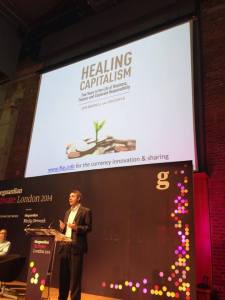
Today I spoke at the Guardian newspaper’s Activate conference in London. The audience was mostly comprised of VCs, Financial Tech specialists, Sharing Economy start ups, and others interested in the potential of tech to disrupt the way we pay and co-rent. Here, below, is the text of the speech.

guardian

“Thanks for the introduction, Stephen. Yes, I founded at an institute for leadership and sustainability, in the Lake District. A land known for hiking, sheep, poetry, rabbits… and bitcoin. Earlier this year we became the first public university to accept the crypto currency. We decided to accept bitcoin to learn by doing, as we teach a Masters-level course on currency innovation. In the course we explore how currency systems and sharing platforms might help sustain our communities and environment. But what Ive come to understand is that if we want to shape the future of money then first we must understand the present nature of money. So before I tell you what I’m excited about, let me explain what I’m grumpy about.

About 97% of money we use is created by private bank lending, which comes with interest. When we borrow, the money is created by the bank, not taken from savings. The amount owed to banks, which is the amount borrowed plus the interest, is always more than the amount borrowed. It means that collectively we are in debt forever, so inequality is inevitable.

With this system of money creation, banks decide who gets the new money and for what. So about 80% of new money is created for property loans. That inflates the price of property, so house prices are 8000% higher than in 1950. That’s not market forces, but the result of our monetary system. I know many people who are in jobs they hate, or who have ignored a vocational calling, because of the mortgage. Some people I know have got ill because their mortgage locks them into a certain lifestyle. Unless we start out with a lot of capital, it’s less a property ladder than a property prison.

But what to do about it?

I take inspiration from a South African anti-apartheid campaigner. In the 1970s Tim Jenkin was imprisoned for 12 years for his activism, to be served in a high security jail in Pretoria. Given the injustice of the system Tim considered it his duty to try to break out of jail. Which he did after 18 months, and fled the country. Fast forward to 2003, Tim had returned to South Africa. He saw that people are oppressed by the current monetary system, and he wanted to free them.

He created Community Exchange Systems with free open source software. They now have 50,000 users, in over 700 locations worldwide. Instead of units of ‘money’ being issued into circulation according to a policy or algorithm, peers extend credit to each other. It means people who have little money but have time, skills and resources, can start helping each other and trading with each other, without official money. This is “collaborative credit” as it involves members of a network trusting each other rather than a bank. Collaborative credit doesn’t come with interest demands or create asset price inflation. There are over a thousand such systems worldwide, but they are largely under the radar of the media, VCs or philanthropists.

Bitcoin has opened minds the idea that fintech can help us transact in alternative currencies, but there’s a long way to go. Now we need to understand how currencies can be designed to support communities and the environment. Bitcoin fans often speak of financial freedom, yet the issuance and distribution of bitcoin makes Thatcher look like a communist. Moreover, it is delusional to believe that money should be a thing of value, rather than a way of keeping score amongst people and organisations doing useful things for each other. We can’t eat money, we can’t eat gold, we can’t eat bitcoin. The real wealth is our lives, communities and environment. We need currency systems that support such wealth, not undermine it. We need positive transformation of our monetary systems, not just disruption.

People like Tim Jenkin have launched collaborative credit systems without financial backing. Now fintech and sharing economy start-ups have a role to play, but to do so they need to design business models that will empower people not make them captive. I hear some people in fintech and the collaborative economy looking to exit to a major multinational. That might let their founders and shareholders escape the prison of the mainstream monetary system, but leave that prison with new walls and stronger guards.

We need a considered dialogue about how to prevent monopolistic practices, protect users, and involve them in the governance of new systems for sharing, currency and payment. It starts with recognising our purpose here is greater than feel-good projects, funky start-ups, or getting rich. We have the potential to design systems that will shape economies, societies and environments for decades to come. So why not make that issue our business?”


To read more about Collaborative Credit, see my article on the Guardian website. Ill tweet the video of the talk when its available (@jembendell)

You can download the introduction to Healing Capitalism for free.

The Punch and Judy Academic Show

Punch: Hey Judy, I’ve been looking at academic journal articles on the critical issues facing humanity.

Judy: Do you have a headache yet?

Punch: Don’t start Judy, I’m serious. I see lots of effort has gone in to these articles to say very few things. Does demonstrable effort, in terms of volume of things one can report on assessing, trump a spirit of inquiry that arises from a heartfelt concern for truth?

Judy: Yes, it seems to at times

Punch: Why?

Judy: If we want to publish academically we need to use accepted approaches to knowledge claims.

Punch: Why?

Judy: To be heard and, ultimately, to be paid. Especially if we don’t want to have some man’s hand up our arse, making us fight each other, then I need to progress in the University sector, and become a Professor myself.

Punch: So the noise created by this incessant publishing is because noise needs to be created according to the interests of the noise creators, rather than the need for a particular meaningful signal within that noise?

Judy: Yes Mr Punch, but we hope for some signal to emerge.

Punch: But you acknowledge that the signal is secondary to the industry of noise creation, which is managed and curated by the chief noise creators, who have sought such roles knowingly, and thus are motivated more by becoming chief noise makers than signal finders, and thus actually drown signals amongst their noise?

Judy: Perhaps, Mr Punch.

Punch: So why do you get out of bed in the morning Judy?

Judy: Because I have to pay our rent, Mr Punch, you lazy clown, and I want to prove that a female puppet can succeed. I also think that despite the noise creation industry, there is some useful signal produced

Punch: so usefulness is a secondary issue?

Judy: I guess, yes

Punch: So if that’s the case, why do you work so hard?

Judy: To stay out the way of you, Mr Punch? But seriously, because I started out motivated by the idea this work was really important, and I still hope it is.

Punch: So you fear you might view your work as un-important, or at least not important in the way you are approaching it now?

Judy: You have got more sophisticated in your attacks on me Mr Punch. So you want me to give up and be a housewife again?

Punch: Ah, now that’s the way to do it! But seriously, you could just give yourself time to reflect on what kind of intellectual work you might believe in, rather than just continue a habitual charade.

Judy: You think we are maintaining a charade, as if we are just characters in a story?

Punch: Aye, puppet.