The Professional Implications of Collapse: Deep Adaptation in Organizations

As modern societies experience further disruption and decline, how can our work in organizations help more of us ‘break together’ not apart?

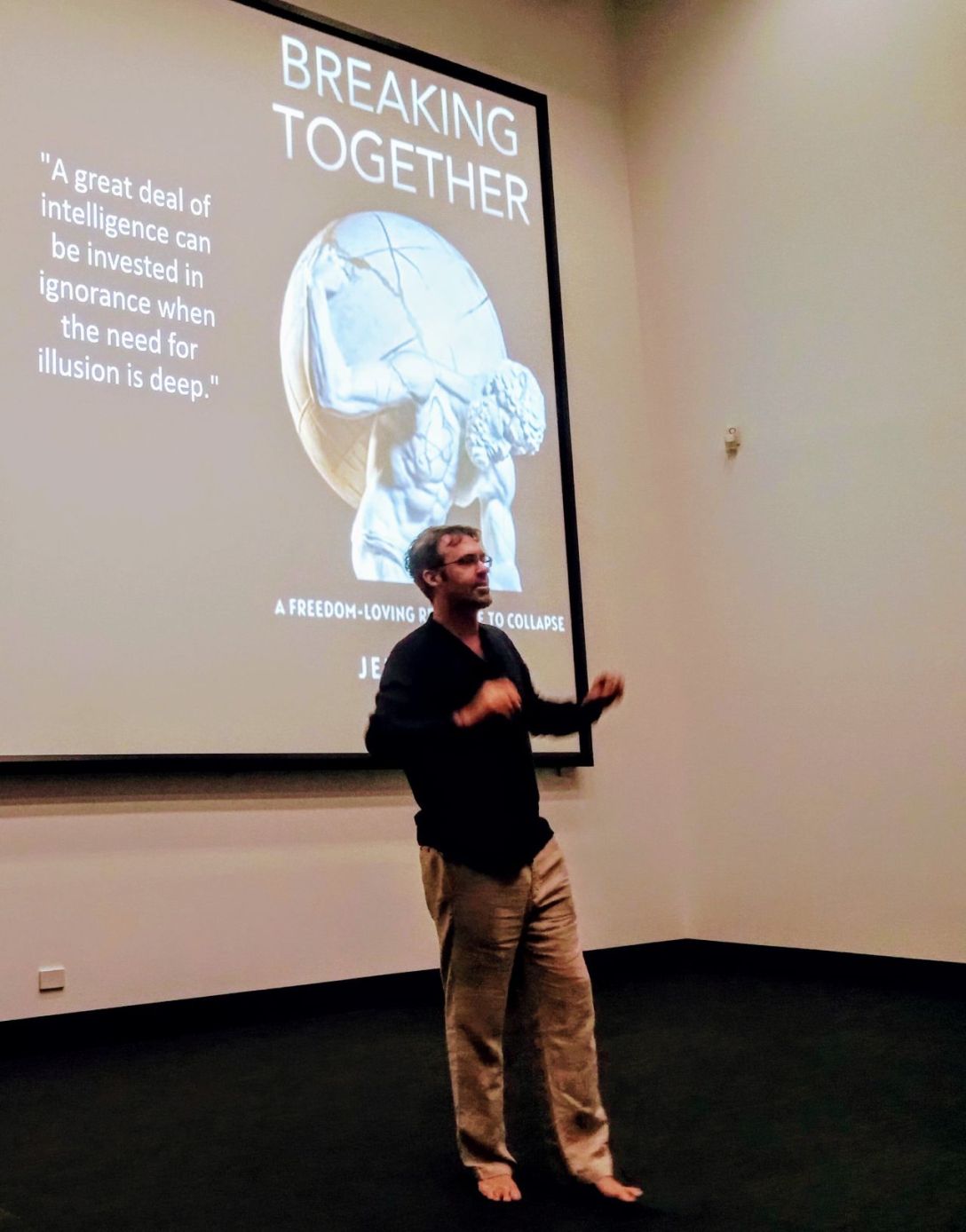
Once people reach the conclusion that societies are not just being continually disrupted but that we are in a situation of actual breakdown, not everyone can quit their job and do something new. After doubt transitions into shock, grief, and anger, not everyone can ‘go wild’ like many ‘doomsters’ do. Nor would we want everyone to! How to integrate an acceptance of societal collapse into one’s professional job in a large organisation is therefore a huge issue. However, until now I did not find anyone in the field of organisational development who could try that. This intransigence even existed amongst experts on ‘sustainability’ and so moved me to write an article last year that summarised the ways they were maintaining their denial. However, five years after the Deep Adaptation (DA) movement took off, it appears that the situation is opening up a bit, as I noted in the latest DA Review. The recent engagement with both DA and my new book ‘Breaking Together’ by world-leading sustainability advisors and trainers R3-0.org, is another indicator of change. Some management consultants may prefer to speak of a polycrisis of ongoing disruption, rather than the unfolding collapse of industrial consumer societies – but an opening has appeared, nevertheless. Therefore, in this essay I will offer some initial ideas for how to work on societal collapse risk, readiness, and response, within organisations.

Continue reading “The Professional Implications of Collapse: Deep Adaptation in Organizations”

It’s a big world out there (beyond the limits of English media)

The fact that so much of the world now speaks English has made it convenient for me, as a British man, to interact with people around the globe. Last week, for instance, I was with over 100 climate professionals and activists from across Asia, and the whole retreat (here in Bali) was in my native tongue. The prevalence of the English language means that I can learn about the experiences of people from different parts of the world. In addition, they can more easily learn from each other. But as we enter an era of societal disruption and collapse, the prevalence of English reflects a dominance of systems and cultures which is unhelpful. In Breaking Together, I describe this as Imperial Modernity: “the interlocking set of political, economic, and cultural systems that shape our everyday lives to favour the accumulation of power by elites.” It is why I am interested in learning more about responses to environmental change from outside English-speaking countries, and the ‘West’ more generally. Although living in Indonesia helps, my desire to engage beyond my usual circles is one reason why I am travelling on a book tour this year. 

I lived the majority of my adult life outside the UK, where I was born. Over the years I have noticed that people from English-speaking countries are more likely than people from elsewhere to assume that their framings of philosophies, politics, problems, and suchlike, are both ‘common sense’ and universal. They are also more likely to express an opinion on what is right or wrong in other countries. However, my view is that just because the world speaks English does not mean the English-speaking world contains or defines everything that matters in the world. 

Continue reading “It’s a big world out there (beyond the limits of English media)”

Speed matters more than size, when considering impacts of climate change

“But the world’s climate was as hot as this in the past.”

Do you hear this a lot? I do. The obvious answer is “sure, it was especially hot when our planet was just a chunk of molten rock spun out from the Sun. But back in terra logica, the main issue for ecosystems and agriculture is the SPEED of climate change.”

The problem with this issue of the speed of change is that consensus in climate science moves very slowly. The more funding that went into climate science, the greater was the amount of research and people to find consensus amongst. That meant the key signals, like the 2017 paper predicting 1.5C by 2025, went largely unnoticed by institutional climatology – and was certainly not acted upon.[1] 

In a 2021 chapter with Dr. Rupert Read and a top German climatologist, who chose to remain anonymous, we explained the limitations of mainstream climatology for telling us the real situation. We pointed to how, in fast moving crises with high hazards, there needs to be an ability to identify salient information rapidly. This even has a name: post-normal science.[2] 

Continue reading “Speed matters more than size, when considering impacts of climate change”

Watch the Blessing Ceremony at Bekandze Farm School

I made (very) short film about the resilient and regenerative farm school that we recently launched here in Indonesia. The film focuses on the spiritual side to farming in Bali. The script of the voiceover follows below the video. The crowdfund is an essential part of the effort to become a catalyst in the local area. Please consider helping by learning more here.

For most of us, food is the tasty, or tasteless, substance on our plate. Something we need to quell an ache from hunger, or to provide us a moment of pleasure. Some of us buy fresh ingredients and cook. But even then, food is still about consuming. Therefore our food stories aren’t stories that involve a divine living world that is nurturing us within itself. 

Continue reading “Watch the Blessing Ceremony at Bekandze Farm School”

Major life changes become the least risky option

Last month, I spoke with the participants in a course hosted by the American cultural commentator Daniel Pinchbeck. The course was all about regenerative attitudes and initiatives. Before a Q&A, I was asked to share four key ideas that would be relevant to the lives of the participants. As I’ve talked about it so much already, I decided to skip the evidence basis for taking societal collapse seriously, and spoke about the changes I am seeing in myself and others, and how that might inspire them. The four things can be summarised as:

  • You don’t escape this
  • You have permission to go wild
  • You can’t avoid losing things
  • You can gain what’s most important.
Continue reading “Major life changes become the least risky option”

Stubborn optimism in an era of collapse

The weak but well-funded arguments for techno-optimism in the face of climate chaos have kept on coming. The latest were a series of articles in mainstream press about a book that claims renewable energy will sustain societies while stabilising the global climate. Brazilian researcher Claudia Gasparovic, offered a rapid debunking of the book’s arguments, in a post on LinkedIn. Similar arguments were put to the book’s author by journalist Rachel Donald for Mongabay. The weakness of techno-optimism on climate change was something I explored in my book Breaking Together. If you read Chapter 3, you will know that the idea modern societies can maintain current consumption patterns by switching to entirely renewable energy is one founded upon blindness to material dimensions of energy generation and storage. If you read Chapter 4, you will know that energy and carbon dioxide are two issues within a far broader problem of the ecological overshoot by modern societies. If you read Chapter 5, you will know that the momentum of change in our oceans and atmosphere, coupled with the dramatic loss of cooling aerosols and cloud-seeding forest cover, means we are already within a scary situation with climate. 

Continue reading “Stubborn optimism in an era of collapse”

Clouds of suffering can have silver linings – reflections on childhood.

I know that when I’m anxious I’m not the wisest or kindest version of myself. Because that is the same for most of us, collapse-anticipators fear how people might make difficult situations a lot worse by delusional or aggressive responses. There are multiple ways of trying to help ourselves think and act more kindly and wisely in future. One way of psychologically preparing ourselves that has stood out for me recently is an examination of our deep stories – about who we are and our role in life. Once we notice such stories, we can choose whether we want to continue living by them or not. One way of discovering such stories is to re-examine our childhoods. I decided to share with you my recent process on that, and what I discovered. That’s partly as an encouragement for you to do the same, and partly for my own benefit of healing through normalising something by sharing it. If such reflection is not new to you, then perhaps this essay will encourage you to try again, as new things can be found depending on our current mind-states and exposure to different philosophies. 

I recently hosted documentary film makers at a meditation retreat in a Buddhist temple, here in Bali. They are exploring what can happen when people perceive it’s too late to avert the collapse of modern societies. So they were asking questions about how I became the person I am. It’s the kind of reflection on formative experiences that I ask the participants in my leadership courses to do. But personally, I’d not reflected for a while. As Buddhism includes an understanding of the role of suffering in life, being at the temple meant that I reflected on that. So I dived into my past suffering and how it might have shaped me.

Continue reading “Clouds of suffering can have silver linings – reflections on childhood.”

Crowdfund – Organic Farming Education for a Resilient Bali

We have launched our request for financial support for Bekandze Farm School, in Indonesia, to help small holders switch to organic and resilient farming methods.

If you have read my book Breaking Together, or simply seen the recent science and news on the environment, then you know we have entered an era of increasing disruption. Like many people, I want to respond in ways that reduce harm and create possibility. That is the aim of this new farm school in Indonesia. Already, we are helping more local farmers switch to organic and resilient forms of agriculture, as a basis for re-localising and regenerating the rural economy. But to establish ourselves as a viable training centre, with a lasting impact locally, and to communicate that globally, we need your help. 

Continue reading “Crowdfund – Organic Farming Education for a Resilient Bali”

Laughing off the apocalypse?

There was an interesting interview with Gavin Schmidt recently. He is one of the most senior climatologists in the world, heading up NASA’s department on climate science. Refreshingly, unlike the other senior climatologists, he didn’t sidestep how recent weather was not predicted by mainstream climatology. He told the American science celebrity Neil deGrasse Tyson that climatology significantly underpredicted current warming. He said there was “total failure” to predict what happened in 2023. See for yourself, for 3 minutes from 4 minutes in.

Gavin is one of the more approachable of the senior climatologists. He provided specific written criticisms of my 2018 Deep Adaptation paper. That was in stark contrast to others who misrepresented it, and me, so as to discourage people from considering that the party is over for modern societies.  

Continue reading “Laughing off the apocalypse?”

Bali Weather Breaks Records – Why Farmers Know but Instagrammers Don’t

As I type these words on January 25th 2024, we are breaking another all-time temperature record here in Bali. It is 32C degrees in the Ubud area, above the previous record of 31C for this day in history. The average maximum was once below 30C (see the image above). So when does such unusual weather indicate a new climate regime, rather than just a few unusually hot days? That should be a matter of scientific analysis, not ideological posturing. If we are analytical, the answer depends on the data on long-term trends and the possible reasons for such trends. As I have recently become an organic farmer, this information is even more important to ascertain, because it influences what and when to plant, as well as how much protection from water and temperature stress we should invest in. So I am going to share with you what I found out about Bali’s weather, and what this means for those of us who live in this region. I also think it has implications for people everywhere, so wherever you are, please read on…

Continue reading “Bali Weather Breaks Records – Why Farmers Know but Instagrammers Don’t”