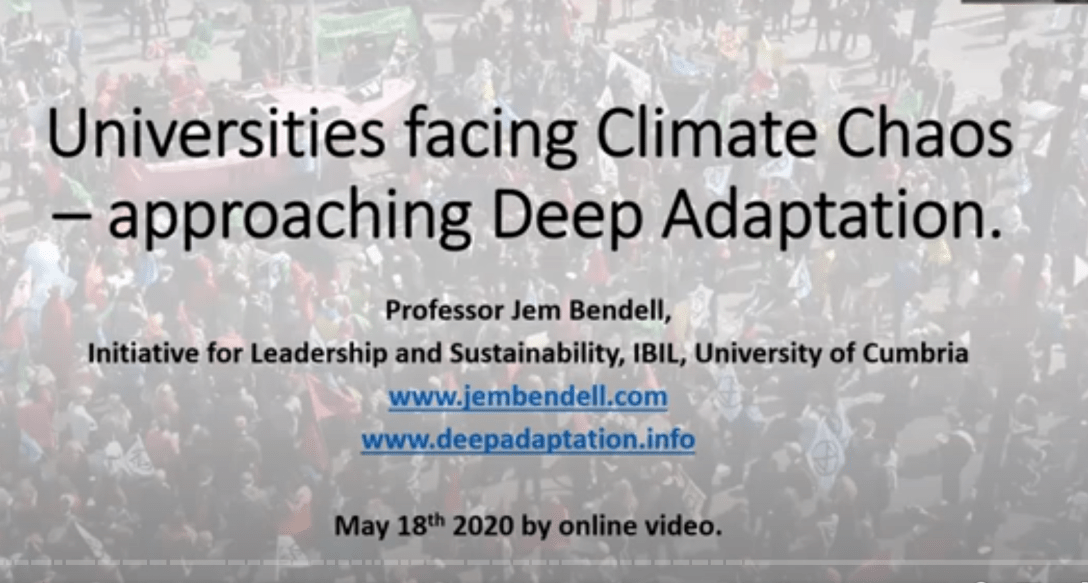
A year ago I took (very) early retirement from academia, and was given the title Emeritus Professor upon leaving. Looking back, I am grateful for the academic freedom I enjoyed at the University of Cumbria. Although there were exacting demands for generating income through MA and MBA courses, the University had a tradition of critical inquiry, interdisciplinarity and experiential learning. Without that freedom I could not have developed my understanding in a range of fields to be able to write the book Breaking Together – and to teach leadership the way I do today. I had always been a polymath and read philosophy about ways of knowing. I was fascinated by the pros and cons of the ways that different academic disciplines constructed their focus, forms of evidence and criteria for conclusions. Therefore, I developed a form of ‘critical interdisciplinary research analysis’, where one interrogates research from different disciplines with a prime focus on real world salience and an awareness of there being limiting assumptions within any field of inquiry. Unfortunately, academia militates against this approach by incentivising career researchers to specialise. Meanwhile, many non-scientists defer to the claims from institutionalised specialists and their peak bodies. That is an understandable reaction, although pretty lazy when coming from scholars and public commentators on our environmental predicament. As the reality with climate change appears to be far worse than what was predicted, some of that deference will reduce, along with the hostility towards better analyses. If you are interested in this matter, please see (or listen to) Chapter 7 of Breaking Together.
Continue reading “Goodbye Academia”Tag: academia
The Punch and Judy Academic Show
Punch: Hey Judy, I’ve been looking at academic journal articles on the critical issues facing humanity.
Judy: Do you have a headache yet?
Punch: Don’t start Judy, I’m serious. I see lots of effort has gone in to these articles to say very few things. Does demonstrable effort, in terms of volume of things one can report on assessing, trump a spirit of inquiry that arises from a heartfelt concern for truth?
Judy: Yes, it seems to at times
Punch: Why?
Judy: If we want to publish academically we need to use accepted approaches to knowledge claims.
Punch: Why?
Judy: To be heard and, ultimately, to be paid. Especially if we don’t want to have some man’s hand up our arse, making us fight each other, then I need to progress in the University sector, and become a Professor myself.
Punch: So the noise created by this incessant publishing is because noise needs to be created according to the interests of the noise creators, rather than the need for a particular meaningful signal within that noise?
Judy: Yes Mr Punch, but we hope for some signal to emerge.
Punch: But you acknowledge that the signal is secondary to the industry of noise creation, which is managed and curated by the chief noise creators, who have sought such roles knowingly, and thus are motivated more by becoming chief noise makers than signal finders, and thus actually drown signals amongst their noise?
Judy: Perhaps, Mr Punch.
Punch: So why do you get out of bed in the morning Judy?
Judy: Because I have to pay our rent, Mr Punch, you lazy clown, and I want to prove that a female puppet can succeed. I also think that despite the noise creation industry, there is some useful signal produced
Punch: so usefulness is a secondary issue?
Judy: I guess, yes
Punch: So if that’s the case, why do you work so hard?
Judy: To stay out the way of you, Mr Punch? But seriously, because I started out motivated by the idea this work was really important, and I still hope it is.
Punch: So you fear you might view your work as un-important, or at least not important in the way you are approaching it now?
Judy: You have got more sophisticated in your attacks on me Mr Punch. So you want me to give up and be a housewife again?
Punch: Ah, now that’s the way to do it! But seriously, you could just give yourself time to reflect on what kind of intellectual work you might believe in, rather than just continue a habitual charade.
Judy: You think we are maintaining a charade, as if we are just characters in a story?
Punch: Aye, puppet.
