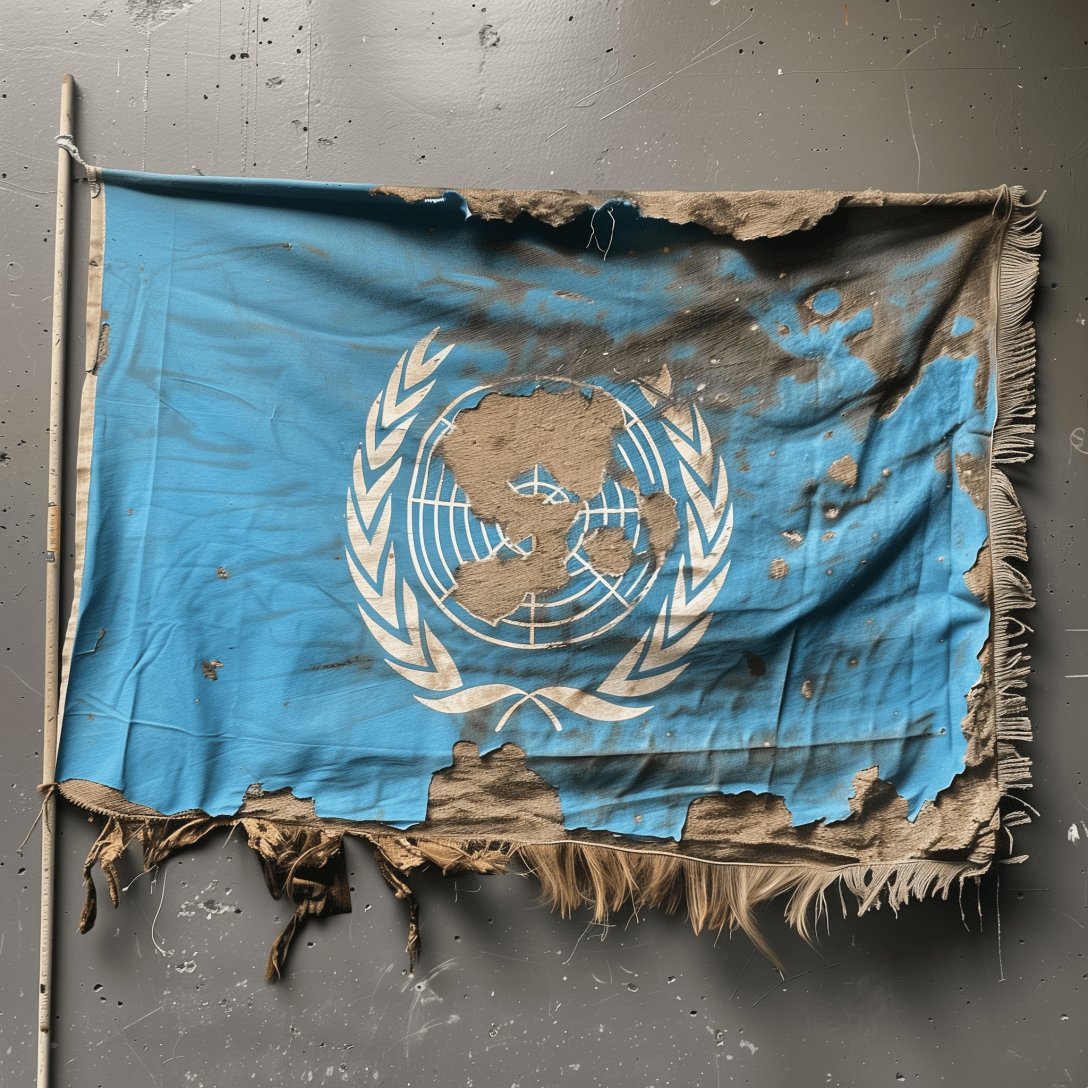
Should the UN just sod off?

If we conclude that current difficulties are aspects of an unfolding collapse of societies around the world, what might we want to see from officials in the United Nations system?

That was a question posed to me recently by an initiative which recognizes something of the scale of the challenges faced and wants to communicate that to professionals involved in international affairs. They include not only international civil servants, but also governmental officials in foreign relations, international development and environmental issues.

Having worked in the UN system in various research roles, as well as with international NGOs, I recognize the conclusion that because we have global problems, we need globally coordinated action. Since the 1990s, I wrote a lot of published papers with that in mind, including some reports for the United Nations. But years later, I now see the hope people have in the UN system in contrast to the reality of its ineffectiveness and the growing suspicion that parts of it, such as the WHO, have been hijacked by a global managerial elite (who have bad ideas on most things). I have come to see that although many international civil servants do important work on the ground in some countries, many of them in the headquarters are involved in a deadly charade, where their status, income, and emotional stability lead them to lie to themselves and to the public about our planetary predicament, its causes and what to do about it. This is exemplified by their continued lie that ‘sustainable development’ is possible, despite years of data now proving the critiques from decades ago that it was capitalist-friendly ideological tosh. For one year I discussed and corresponded with various professionals in the field of sustainable development about why they continue the charade and heard what I described as their ‘deadly sins of denial’ in an article for Brave New Europe.

Continue reading “Should the UN just sod off?”

No More Warnings Needed – an intransigent managerial class must be sidestepped

Six hundred and seventy-four scholars from 53 countries, believe that “Only if policymakers begin to discuss this threat of societal collapse might communities and nations begin to prepare and so reduce its likelihood, speed, severity, harm to the most vulnerable, and to nature.” Each signatory, with doctoral degree, endorsed a public warning on societal disruption and collapse due to environmental change. They cover more than 20 major academic disciplines, including ecology and climatology, thereby conclusively demonstrating that preparations for societal collapse are being taken seriously by experts from around the world. The announcement of the final list of signatories concludes a 3-year initiative to promote awareness of the scientific basis for exploring how to reduce the damage from societal disruption, breakdown, and collapse, due to environmental change.

Continue reading “No More Warnings Needed – an intransigent managerial class must be sidestepped”

The Emperor’s New Lab Coat

Mainstream media are ignoring a scientist who is whistleblowing the climate profession.

During the five years since new kinds of activism brought the climate issue into the headlines like never before, the topic has more clearly become one where people respond due to their preexisting worldviews. It’s not just believers and sceptics, but there are those who think technology can save us, those who think it’s too late; those who think the science is clear, others who think it is open; those who believe humans will muddle through and those predicting human extinction. Climate scientists themselves now range from those emphasizing ‘we can do this’ to those that express their grief and outrage by gluing themselves to buildings. Meanwhile, misleading narratives are amplified by a variety of vested interests, including fossil fuels, nuclear, and clean tech. Climatologist Dr Wolfgang Knorr is an unusual voice in this cacophony because he has been ‘blowing the whistle’ on the climate science itself and how it is being communicated. His perspective hasn’t found wealthy supporters or mainstream platforms, and so his voice hasn’t been much heard, which is why I want to bring it to your attention here.

Continue reading “The Emperor’s New Lab Coat”

Volunteer for our Regenerative Farm School, Remotely or in Bali

It’s crazy how fast things grow in the tropics! When we founded Bekandze Farm in early 2023 we thought we could make a small but meaningful contribution to local food security and environmental care, by promoting and supporting the development of regenerative agriculture in our small patch of Bali. Sixteen months later the infrastructure is in, the garden is thriving, and the training is in full swing. But it hasn’t just been the plants that have been growing – our vision for the project has been growing too!

When we started Bekandze Farm – Regenerative Training Center we knew there was a need, but we had little idea how great that need was. Nor did we realise how vast is the opportunity to have a positive impact on how food is grown here, not just in Bali but throughout Indonesia. When we advertised for staff we attracted applicants from all over Indonesia hungry for an opportunity to develop their professional skills in regenerative agriculture. When we promoted our first free farmer training program we fielded enquiries from isolated farmers on far flung islands throughout Indonesia eager to take up the opportunity to connect learn from regenerative farmers in other parts of the country. And when we were approached by one of only two vocational high schools still teaching agriculture in Bali to help them stop the hemorrhaging of students out of agricultural studies into tourism, we knew for certain that we were on the cusp of something far greater and more impactful than we had envisaged.

Continue reading “Volunteer for our Regenerative Farm School, Remotely or in Bali”

Was this the most expensive degree in the history of Universities?

Ten years ago today, the first payment of public university fees in Bitcoin was processed – and live on stage at a festival in Paris. Bitcoin is currently around 60,000 dollars each. Back then, on May 7th 2014, it was around 430 dollars each. Would that make it the highest fee ever paid for a degree? Is the Bitcoin worth 400 or 60000? That’s a philosophical argument one could debate forever – or at least in a PhD thesis.

The payment of 1 BTC (as an instalment for the full course fee) was made live during a panel on the future of currency. The PhD student was Leander Bindewald (on the right in the picture above) and he went on to complete his thesis on the discourse of money (see below for a close up of the payment screen).

I was Leander’s supervisor, and had arranged for the University of Cumbria to be the first public University in the world to accept cryptocurrency for payment. One can only wonder what might have been if the University had decided to retain the Bitcoin rather than convert it immediately into pounds. At least I’d have met my income target (finally). At 6 BTC for a graduate certificate (see below), that would be 360,000 dollars at current market rates. Wow… although studying with me might have been priceless 😉 Today I am happy to keep teaching a similar course after leaving academia (quick plug: ‘Leading Through Collapse’ happens online in September and in person in California in October).

Continue reading “Was this the most expensive degree in the history of Universities?”

What’s to blame for collapse?

Although I’ve been immersed for years in the news and scholarship on the unsustainability of modern societies, it is difficult to keep all of that information at the forefront of my mind. Not only is it a ‘heavy’ topic, it uses a specific part of my mind, and perhaps my body and soul, to critique, synthesise and communicate on such issues. So after doing a dozen podcasts and talks since my book came out, I paused to make more time to develop my organic farm school and play music. I’ve also been enjoying teaching again, both online (join me?!) and in person (including the Bay Area in October). Looking back at the various interviews, I think the first one I did to mark the launch of Breaking Together is the one to watch. Dave Derby of Lowimpact invited a focus on what is most at fault for driving the collapse, as a starting point for discussing what we can do to soften the crash – for ourselves and others. That meant we explored the role of an expansionist monetary system, and alternatives to ‘green’ authoritarian panic as the science darkens and societies are disrupted. You can watch us discuss that here. But as many people prefer to read, I’ve checked the transcripts and compiled them into one document in this blog post.

Continue reading “What’s to blame for collapse?”

The Doom Vindication Blues

Although there are many potential benefits from accepting societal collapse, there is nothing inherently beneficial about being right about one’s expectations of catastrophic change. Having held more accurate assessments than the majority doesn’t reduce the pain about what’s happening or what’s to come. It doesn’t compensate for the alienation experienced with those who would not see, or even condemned our clarity. It doesn’t compensate for the pain of witnessing the lost opportunities for people to process this reality for themselves. If there is any benefit in being right, it comes from how we acted with our awareness until now. Has it influenced us to do more of what we consider wholesome, and less of what we consider unwholesome? Has it meant we have tried to develop our capabilities for coping better as life becomes more difficult? Perhaps, also, to help others develop their own capabilities? You know the basics – mindfulness, letting go of old habits and expectations, and having a way to make sense of life in an era of collapse. For some of us, we can experience a liberation from past compromises and the permission to ‘go wild’. Without evolving ourselves in such ways, then feeling we were right could generate a further alienation, through a pointless sense of superiority. And what we definitely don’t want is to be isolated in our pain as things unfold, in the same way many of us have been isolated in our anticipation. So, when our outlook is confirmed by current observation, it is a time to assess whether we have made good use of our knowledge. Then, if not sure, to commit to try again.

Continue reading “The Doom Vindication Blues”

Speed matters more than size, when considering impacts of climate change

“But the world’s climate was as hot as this in the past.”

Do you hear this a lot? I do. The obvious answer is “sure, it was especially hot when our planet was just a chunk of molten rock spun out from the Sun. But back in terra logica, the main issue for ecosystems and agriculture is the SPEED of climate change.”

The problem with this issue of the speed of change is that consensus in climate science moves very slowly. The more funding that went into climate science, the greater was the amount of research and people to find consensus amongst. That meant the key signals, like the 2017 paper predicting 1.5C by 2025, went largely unnoticed by institutional climatology – and was certainly not acted upon.[1] 

In a 2021 chapter with Dr. Rupert Read and a top German climatologist, who chose to remain anonymous, we explained the limitations of mainstream climatology for telling us the real situation. We pointed to how, in fast moving crises with high hazards, there needs to be an ability to identify salient information rapidly. This even has a name: post-normal science.[2] 

Continue reading “Speed matters more than size, when considering impacts of climate change”

Major life changes become the least risky option

Last month, I spoke with the participants in a course hosted by the American cultural commentator Daniel Pinchbeck. The course was all about regenerative attitudes and initiatives. Before a Q&A, I was asked to share four key ideas that would be relevant to the lives of the participants. As I’ve talked about it so much already, I decided to skip the evidence basis for taking societal collapse seriously, and spoke about the changes I am seeing in myself and others, and how that might inspire them. The four things can be summarised as:

  • You don’t escape this
  • You have permission to go wild
  • You can’t avoid losing things
  • You can gain what’s most important.
Continue reading “Major life changes become the least risky option”

Stubborn optimism in an era of collapse

The weak but well-funded arguments for techno-optimism in the face of climate chaos have kept on coming. The latest were a series of articles in mainstream press about a book that claims renewable energy will sustain societies while stabilising the global climate. Brazilian researcher Claudia Gasparovic, offered a rapid debunking of the book’s arguments, in a post on LinkedIn. Similar arguments were put to the book’s author by journalist Rachel Donald for Mongabay. The weakness of techno-optimism on climate change was something I explored in my book Breaking Together. If you read Chapter 3, you will know that the idea modern societies can maintain current consumption patterns by switching to entirely renewable energy is one founded upon blindness to material dimensions of energy generation and storage. If you read Chapter 4, you will know that energy and carbon dioxide are two issues within a far broader problem of the ecological overshoot by modern societies. If you read Chapter 5, you will know that the momentum of change in our oceans and atmosphere, coupled with the dramatic loss of cooling aerosols and cloud-seeding forest cover, means we are already within a scary situation with climate. 

Continue reading “Stubborn optimism in an era of collapse”