A year ago I took (very) early retirement from academia, and was given the title Emeritus Professor upon leaving. Looking back, I am grateful for the academic freedom I enjoyed at the University of Cumbria. Although there were exacting demands for generating income through MA and MBA courses, the University had a tradition of critical inquiry, interdisciplinarity and experiential learning. Without that freedom I could not have developed my understanding in a range of fields to be able to write the book Breaking Together – and to teach leadership the way I do today. I had always been a polymath and read philosophy about ways of knowing. I was fascinated by the pros and cons of the ways that different academic disciplines constructed their focus, forms of evidence and criteria for conclusions. Therefore, I developed a form of ‘critical interdisciplinary research analysis’, where one interrogates research from different disciplines with a prime focus on real world salience and an awareness of there being limiting assumptions within any field of inquiry. Unfortunately, academia militates against this approach by incentivising career researchers to specialise. Meanwhile, many non-scientists defer to the claims from institutionalised specialists and their peak bodies. That is an understandable reaction, although pretty lazy when coming from scholars and public commentators on our environmental predicament. As the reality with climate change appears to be far worse than what was predicted, some of that deference will reduce, along with the hostility towards better analyses. If you are interested in this matter, please see (or listen to) Chapter 7 of Breaking Together.
Studying for a PhD can seem like a terrible idea. All that isolated reading and writing, and for what: to disappear into your own world of abstraction? Well it doesn’t have to be that way. Three or more years to explore questions that are deeply important to you, in ways that draw upon a range of scholarship, is an incredible once-in-a-lifetime opportunity. So I look for people who are less concerned about a career in academia or getting the letters PhD, and more interested in inquiry. I am seeking 2 new PhD students to start next year in the general field of “leadership” or “leadership development” or methods by which individuals can support social change through organisations or networks.
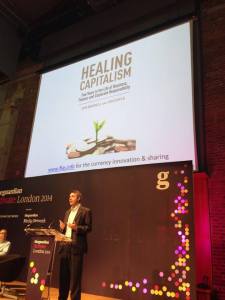
TALKING ABOUT MY BOOK
I will say more about the PhD in a moment. In the past quarter the future of money and investment was a significant theme of my work. 60 people completed the 4th cohort of our free course on Money and Society. Alumnus of this online course are gathering in Indonesia in December. The next cohort starts in February and you can enrol here. Back home, this summer we hosted retreats for the Finance Innovation Lab and the Positive Money campaign, two initiatives that share our view that the financial system must be transformed to enable more fair and environmentally friendly economies.
The impact investment group I work with has made a significant move forward with a 100 million dollar investment for one of its ventures, to bring a tech smart approach to the Australian superannuation (pension) sector. The potential to enhance business analytics and engagement on environmental, social and governance factors is large. Trimantium also plans an IPO for a business that helps incumbent firms to embrace the disruptive potential of digital technology.
I published a few articles on spirituality, leadership and politics in the Huffington Post. My next keynote is in November, at Griffith University in Brisbane, on the topic of the kinds of leadership we won’t need to stop making the climate crisis worse. You might need to read that sentence again.
Now back to that PhD opportunity. At the University of Cumbria, it doesn’t cost a fortune, you engage a contrarian intellectual tradition of the Lake District, and can come on our great leadership courses but don’t have to be based here all the time, nor do it full time. You also receive a PhD accredited by Lancaster University (a top research Uni). We don’t have funding to offer at this moment. If interested, please write one page only on what issue you are interested in, what literature you know of that relates to that, and why you want to do a PhD. Before that, please read some of my thoughts on “sustainability leadership” here.
In Q4 I will be focusing on a new research project on perceptions of world leaders on what forms of leadership, and leadership development, are necessary to address global challenges. We are seeking an additional sponsor for the report launch at a high level event next year, so if you can help, do get in touch. Below follows a box of info on what is happening at Cumbria Uni which may be relevant if you are based nearby or passing through.
Thanks for reading, Jem
Professor of Sustainability Leadership, Institute For Leadership And Sustainability (IFLAS) and Non-Executive Director, Trimantium Capital. Next update is in 3 months.
Some relevant offerings from the University of Cumbria
The intersection of governance, ethics and investment – Julie Hutchison IFLAS Open Lecture 4th October, 530pm, Ambleside Lake District Campus, Cumbria University, Ambleside, UK. Info here. Leading Wellbeing in Rural Contexts – One Day Conference by the Brathay Trust and University of Cumbria. 1st November 2016, Ambleside, UK Info here. Participatory Mapping as a research Method – Dr Chris Loynes lunchtime research seminar 30th November, 12.00-13.00 Kitching Room, Ambleside Lake District Campus, University of Cumbria, UK Participatory mapping is an approach to collecting, interpreting and analysing data about the places people inhabit. Come and make your own maps of your landscapes and see how they can work as a research tool. Register: Letty.Ashworth@cumbria.ac.uk
The University of Cumbria is always taking applications for its suite of MBA programmes which involve specialisms in sustainability, delivered in partnership with the Robert Kennedy College. Info here.


You must be logged in to post a comment.