From a plea for pardon to an invitation to heal within a universe of unconditional love.
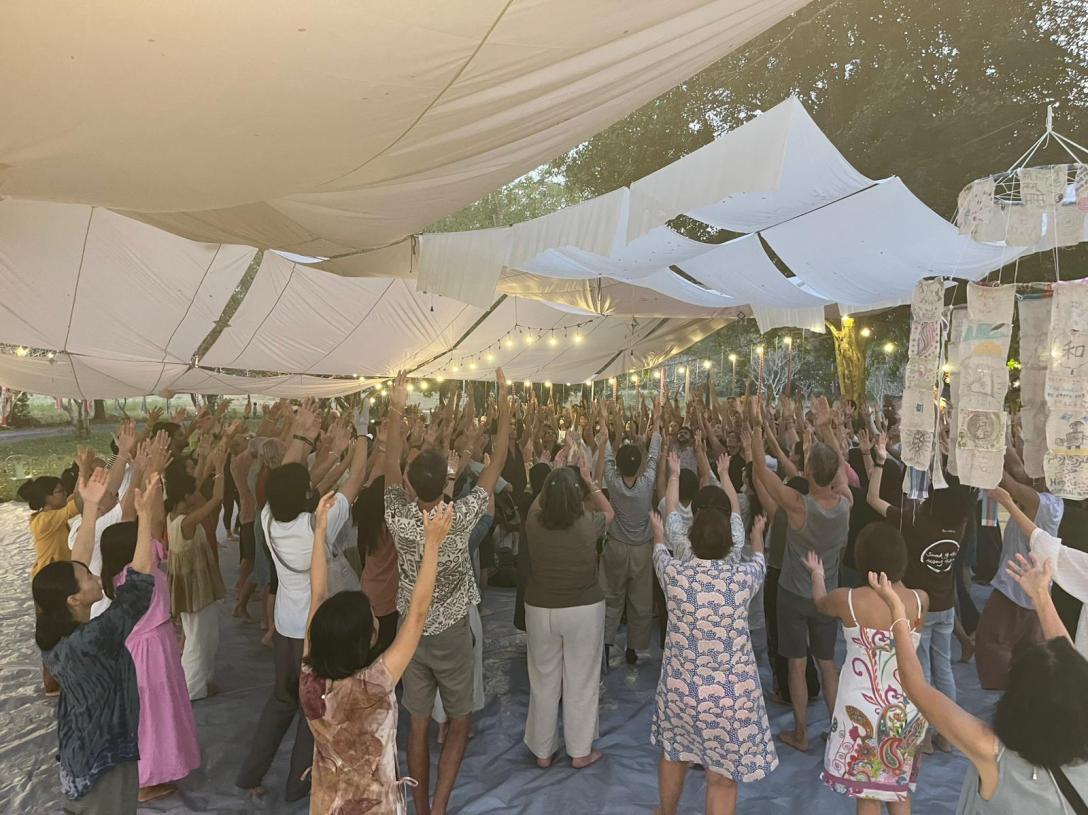
Across centuries of liturgy, the solemn chant “Kyrie Eleison”, often translated as “Lord, have mercy,” has echoed through churches and cathedrals. It is one of the most recited phrases by congregations of Christians around the world, and can convey the idea that believers are penitent persons before an omnipotent judge. I heard it regularly during my childhood, in Anglican, Catholic and Evangelical contexts. After I stopped going to church, for decades I didn’t think about the meaning of the phrase. Not until I was in a field in Thailand, with two hundred people from different faiths, as we sang and moved in prayer. That set me on a journey into the meaning of the phrase “Kyrie Eleison”, and a discovery about the loss of Jesus’s original message, as quoted in the Gospels. This realisation is opening up the possibility to reconnect with my roots in a new way, through a Christianity more mystical than the institutions of religion convey.
To understand the true meaning of the phrase “Kyrie Eleison”, it helps to journey back before the Gospels. It had been a common Greek plea, where “Kyrie” invoked a divine power. They had many to consider, from Asclepius to Zeus. The word “eleison” had a poetic meaning, because it was not only the verb “to forgive”. Our dance leader in Thailand explained it sounded similar to ‘elaion’, which meant oil. In ancient Greece, as in modern times, oils were used for various forms of healing, including wounds and aches. Thus, “eleison” meant something other than a cry for forgiveness from a sinning or guilty person. Instead, it was a plea, or an invitation, to “anoint me, soothe me, and heal me.” It is important to remember that the worldview at the time, across many cultures, regarded illness as a symptom of spiritual or relational disorder, rather than a random physical misfortune. To cry out “Kyrie Eleison” was to ask the divine to restore a person’s wholeness.
This is how the phrase was used in the Gospels. The blind and the lame, or those who cared for them, called out to Jesus: “Kyrie Eleison!” (e.g. the Greek texts for Matthew 15:22, 20:30-31). Jesus himself never uttered these words. When responding to those in need, he did not demand confession or pronounce a sentence of forgiveness. Instead, the written accounts describe him healing people, such as restoring sight and curing leprosy. Whether we believe they were miracles or not, the fact that the claimed healing was unconditional is important for our understanding.
This is a context which reframes the one scene in the Gospels where Jesus explicitly links healing and forgiveness. To a paralyzed man carried to him by friends, Jesus is quoted as saying, “Take heart, son; your sins are forgiven” (Matthew 9:2). Of course, such quotations are from subjective English translations of Greek texts which refer to what was claimed to have been said in Aramaic. Nevertheless, if we read that English translation through a lens of juridical atonement, it can sound like a priestly absolution of the sinner. But understood within the context of a culture that regarded sickness as related to spiritual disorder, a different interpretation is possible. The man’s paralysis would have been compounded by the cultural belief that his condition was divine punishment for sin. So his suffering was likely intensified by shame and anxiety. In that context, Jesus’s declaration does not need to be seen as a transactional pardon from an authority. Rather, we can hear it as a therapeutic intervention. As if someone might say: “The story you are telling yourself — that you are being punished and separate from wholeness — is false. You are held in a field of grace. Take heart by releasing yourself from anxiety.”
Discussing this idea with a friend, I recalled how my own shoulder injury had been made worse by my reaction to it. For months I held the shoulder tight to my body and took only shallow breaths. I also began to imagine the rest of my life would be compromised as a result of the injury, which within a culture of achievement, was my own version of adding insult to injury. Therapeutic methods like Grinberg go directly to this matter of how we can help ourselves to heal. Looking back, I know that consciously changing my anxiety around my affliction helped my process of healing.
My interpretation of Matthew 9:2 aligns with Jesus’s core teachings on forgiveness elsewhere in the Bible. He is often quoted saying that non-judgment is a fundamental quality of the reality he called the “Kingdom of God” (according to English translations) and that by embodying that quality in ourselves it becomes our reality. “Forgive, and you will be forgiven,” he taught (Luke 6:37). “For if you forgive others their trespasses, your heavenly Father will also forgive you” (Matthew 6:14). I do not regard these statements as a celestial quid pro quo, but as a spiritual reality of resonance. By releasing others from our judgments, we release ourselves from a self-imposed prison of blame and shame. Forgiveness, in this light, is the psychological and spiritual equivalent of healing oil (elaion); it is the balm that dissolves the internal strife that exacerbates our suffering. That message found in many other religions, including Buddhism. It is one I’ve written about before, in the context of the tragedy befalling societies and species due to ecological damage.
The translations of “Kyrie Eleison” into the Latin “Domine, miserere nobis” and the English “Lord, have mercy” removed its healing, oil-based connotation, to leave a penitential concept — where we are inherently bad people asking for forgiveness from a divine male authority. Any doubt about that was removed by the Book of Common Prayer, through the phrase “Lord, have mercy upon us miserable offenders”. Such statements can obscure the original teachings of Jesus, that we are pre-forgiven, by living in a universe of acceptance and grace, which we can tune into by reading his own teachings.
When hearing such a perspective, some people object that we can’t regard bad behaviour as existing without consequence. However, such a view downplays a range of truths. First, by not believing in a divine, ultimate, and perpetual judgement, we do not disregard the need for rules of conduct and accountability in our present communities. Second, much poor behaviour arises from feelings of inadequacy, which are related to stories of not being good enough. Third, a negative judgement of a whole person, and even their soul, ignores how any of us experiencing the same nature, nurture, and circumstances, as someone else, might behave in similar ways. Fourth, there are often consequences within the hearts and minds of people who behave poorly.
Looking into the history of the phrase “Kyrie Eleison” I began to sense the seriousness of the loss of meaning which I have just described. The original sayings of Jesus conveyed a message that is found in mystical teachings across religions, about the universe being characterised by unconditional acceptance. So when people called “Kyrie Eleison” to him, he responded with the message of unconditional love. Over time, that turned into a very different idea: that Jesus can be the forgiver of inherently bad people if they believe in him enough. That distortion also created the possibility for some Christians to claim that they forgive others while believing that God will potentially be judging and punishing them in the most extreme ways imaginable (via eternal hell fire). Maintaining such a belief does not appear to be experiencing a universe of unconditional love. This matter goes to the heart of a theological difference: it is through understanding his teachings and allowing them to change us that Jesus saves, not through us choosing to believe he is a demi-God. The latter view was developed by St Paul, a Roman citizen who was in conflict with those who had known Jesus and were following his teachings. That latter view can generate conflict between people who attach their identity and purpose to stories of different demi-Gods. So rather than becoming sucked into battles between belief syndromes, we can tune into the deeper teachings and consciousness in myriad spiritual traditions. It is beneath dogmas of supremacy, where any religion can invite us towards the One Joy of resonating with universal unconditional love.
You might imagine that I was pleased to discover that we can regard “Kyrie Eleison” as an invocation to the divine principle of healing. And that Jesus’s response was to remind us that non-judgment — toward ourselves and others — brings some relief. Well, yes, I was pleased enough to write this short essay for Christmas! But when I brought the phrase “Kyrie Eleison” to some friends to sing in a circle of mystical dance, I noticed the awkwardness. Many of us have turned away from Christianity due to the patriarchal self-loathing conveyed in the phrase “Lord, have mercy”. And my friends had come to sing, not hear a lecture on the distortion of Jesus’s teachings through the ages. So I introduced the song with something like this:
“Originally, the phrase “Kyrie Eleison” was an invitation for the divine to heal us. And in the Bible, when hearing such requests, Jesus responded not only by healing, but by reminding us that we live within a universe of unconditional love. So we need not add extra upset to our frailties, mistakes and misfortunes. Or those of others. When we sing this invitation we are also welcoming the answer — that on the very deepest level, everyone is whole and healed. But if you have a different understanding of the phrase, you can also connect with that as you dance.”
A bit wordy, but an academic’s old habits die hard! Sharing my inquiry into the possible meanings of scripture, as I begin to lead ‘Dances of Universal Peace’ with my friends, feels like a beautiful way to bring such teachings into my life. That doesn’t assume that spiritual wisdom is only found in past teachings, rather than present experiences and revelations, but it allows for the possibility of reconnecting with tradition. That seems important, as so many of us are alienated from our religious cultures, due to the distorted messages we were taught, and the hypocrisies we witnessed, which sadly continue within many institutions. To reconnect with our roots, there will be more digging into what is true and good within scripture. I was pleased to do that for the Mariam Mantra, earlier this year, and look forward to more explorations.
Top photo taken at DUP International Gathering in Thailand, 2025, by Chiyo Hiraoka.
—
Learn more about the Dances of Universal Peace, or tune in to my dance mentor Jilani, who has been leading online sessions for some years now (which grew out of Deep Adaptation!).
I look forward to seeing some of you at the next Metacrisis Meeting, on Jan 5th and 6th, on celebrating and refining the ways we are responding to our collapse awareness.
If you are in Bali, you might love our silent meditation retreats at the main Buddhist Temple on the island. We sing in the evenings. The next starts Jan 2nd, for 3 nights. You can find out more and join the whatsapp announcement group.
We’ve not created any circle dance movements for the Mariam Mantra yet, but will do so by the time her feast day comes around again…


You must be logged in to post a comment.