I begin the final section of my chapter on Energy Collapse with the subtitle “I also hate this conclusion”. Because I did not want to discover that modern societies cannot continue their energy trajectories by simply displacing fossil fuels with new technologies. But that is what the sum of the relevant research shows us. In addition, the pursuit of the total electrification of economies will have hugely damaging effects on the biosphere, due to the mining involved. This is the awkward reality that most Western environmentalists are ignoring. The ‘green’ capitalists are extremely happy for us to keep ignoring that reality, as then any pressure for action translates into more money and pleasure for them. But if activism is about our personal commitment to higher goals, whether using moderate or radical tactics, then it must start with a fair assessment of reality and possibility. Otherwise, how is such activism not simply a mix of self-aggrandisement and emotional distraction by keeping busy?
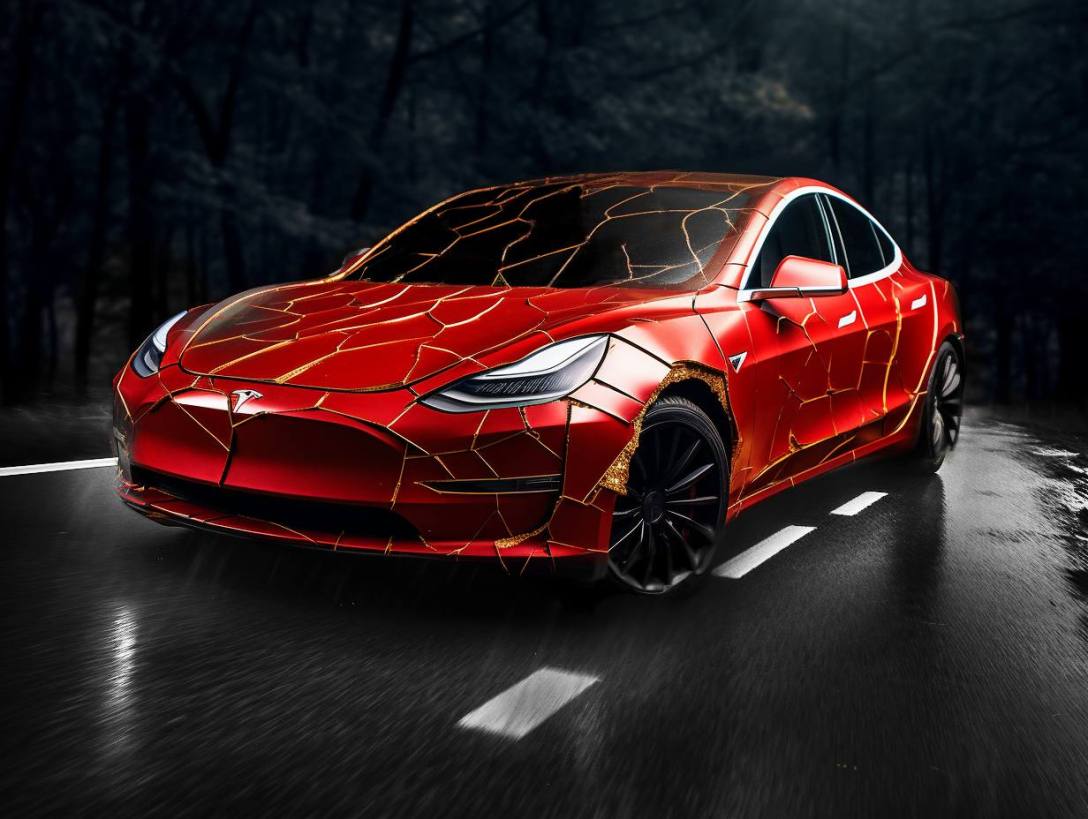
The book Breaking Together is now available in audio, and Chapter 3 on Energy Collapse can be heard for free on soundcloud. To convey some of the arguments, below I share the first and last sections of the chapter. The image of the Kintsugi Tesla is from the Kintsugi World art project which accompanies the book.
Subscribe / Support / Study / Essays
—
I was wrong about Elon. Or to be more precise, I was wrong about Tesla, the car company—not the physicist. Back in 2007, I included Tesla Motors in a report for the environmental group WWF, as one of a handful of companies that would be shaping our future. I was particularly impressed with how the company was tackling the stigma about driving electric vehicles and using a sportscar style and luxury pricing to shift those perceptions. I read that Elon Musk was not interested in having millionaires driving electric sportscars, but in transforming the whole car industry. I included the company as a case study in an academic paper on my theory of the ‘elegant disruption’ of entire economic sectors.[i] However, what I didn’t look at closely was whether it would be possible for the same level of personal car ownership and usage to continue by replacing cars that had combustion engines with new cars using electric motors and batteries. Instead, I just marvelled at how much Tesla Motors expanded and how the attitudes of my petrolhead friends changed so quickly. If I had been motivated to make money, I might have been quite a good stock picker. Instead, I can just feel jealous of my friends who read my report and, unlike me, had a stockbroking account. Researching for this book helped me to discover that my past enthusiasm for electric-powered cars was misplaced. I now know that they are no solution for the immense ecological footprint of the resource and energy demands of forms of personal mobility that involve hauling a huge chunk of metal around with us. By looking at the rarer types of metals required for the batteries, as well as the energy demands, I discovered that the future will not be one where everyone is driving their own private electric cars—airborne or otherwise. That’s even if governments wanted it to be our future and were elected to deliver it. Because it’s physically impossible. Worse, the perceived ‘sexiness’ and fame of electric cars is promoting a fraudulent promise of an ‘ecomodern’ future. In this chapter we will see that for modern societies there is no way forward that does not involve an energy descent, with the pervasive impacts such a descent will have on our basic needs, let alone the aspirations we formed within a mass consumer culture.
It is the energy use of industrial consumer societies that really sets them apart from all other known societies, both current and past. And it is this very energy use that is at the root of so many of the problems that are bringing them down. Researching this foundation of modern societies led me to realise four hard truths. First, the economies of industrial consumer societies are inextricably and causally linked to energy consumption, the vast majority of which comes from fossil fuels. Second, the way such societies currently organise productive activity means that it is not possible to significantly reduce energy consumption without causing massive disruption and declines in living standards. Third, replacing fossil fuels with other sources of energy is not technologically, economically, or politically possible at the pace being proposed to curb climate chaos. Fourth, because expansionist monetary systems necessitate increases in energy demand, modern societies are already experiencing the effects of a decline in the global production of crude oil since 2015. The symptoms of that we saw in Chapter 1. The end of the era of cheap crude is therefore one of the factors now breaking modern societies. The hardness of these four truths is in how they reveal that our way of life cannot continue and is already in decline – and that it’s all down to energy. [You can listen to the full chapter 3 here. The chapter concludes as follows…]
I also hate this conclusion
The energy dependence of our way of life is a far more inconvenient truth than most environmentalists I know wish to acknowledge. I did not want to accept it. And as I reached my conclusions, I wondered how they would ‘come across’ to professionals in my field. Not only is there a large amount of venture capital now invested in renewables, but so many hopes ride on them, where the technologies are playing a role in the psycho-social justification for calm obedience to current economic and political order.[ii] As I have chosen a different way of living and working, I can take the professional risk of sharing these inconvenient views to await the opprobrium. But to avoid any misunderstandings, I will now attempt a summary of what I believe the significant lessons are from examining the energy foundations of modern societies.
Fossil fuels are key to the way modern humans live and cannot be removed swiftly without terrible consequences for people’s basic needs, which would amount to a societal collapse. Trying to remove fossil fuels swiftly would lead to political reactions that might even hasten such a collapse. A significant push to decarbonise economies in a more-organised and socially-just way is sadly compromised by the expansionist monetary system which demands continual increases in energy consumption for economic stability. That means that rather than displacing fossil fuels, renewable energy sources are still only additional to ongoing fossil fuel use. If fossil fuel use is deliberately restricted through policy, then the expansionist demands of the money system mean that the new renewables will not be sufficient to meet the demands for economic growth, and so there will be a financial collapse. If no such policies are forthcoming and modern societies seek to maintain a mostly stable amount of fossil fuel consumption with a booming additional complement of renewable energy, then the decline in standard of living will likely continue, due to the peak of conventional oil production having been reached, and other sources of energy offering a lower energy return on investment. In addition to that ongoing decline, the ongoing expansion of industrial consumer societies would continue to deplete and pollute their environmental foundations and therefore lead to a harder collapse at some point.
These considerations mean that we can’t decarbonise at either the rate demanded by activists, or the rate pretended by politicians. So, when they argue with each other, it is really a pantomime that distracts us from reality. That does not mean we should not try to cut and drawdown emissions. But it means we need to tell the truth. That truth is that we live in a hydrocarbon civilisation which is coming to an end. There is no technological escape. Modern societies need to power down. Unless the expansionist monetary system is changed or collapses, the possibilities for reducing the crash by even just a little are non-existent.
In 2007 I was naively hopeful, and wrong about Elon. Like me, both he and many other people paying attention to the energy and environmental crises will come to learn the truth of the matter: that the rich must power down. And unless they are ‘encouraged’ to do so by the rest of the world, they are unlikely to do so. The few middle-class people preaching degrowth will not make the necessary difference. The implication for strategies is something we explore in the second half of the book.
[i] Bendell, J. & Thomas, L. (2013). The appearance of elegant disruption: theorising sustainable luxury entrepreneurship. Journal of Corporate Citizenship, 52, 9-24.
[ii] For instance, consider the organised backlash against ‘Planet of the Humans’ film, or the labels of extremism directed at the authors of ‘Bright green lies: How the environmental movement lost its way and what we can do about it,’ by Derrick Jensen, Keith Lierre and Max Wilbert (2021).
Donate to keep Jem writing / Read his book Breaking Together / Read Jem’s key ideas on collapse / Subscribe to this blog / Study with Jem / Browse his latest posts / Read the Scholars’ Warning / Visit the Deep Adaptation Forum / Receive Jem’s Biannual Bulletin / Receive the Deep Adaptation Review / Watch some of Jem’s talks / Find Emotional Support / Jem’s actual views on Covid
Discover more from Prof Jem Bendell
Subscribe to get the latest posts sent to your email.

Just finished reading Katherine Blunt’s book California Burning (right
after yours). Just one more lucid illustration of exactly the societal
challenges Breaking Together discusses.
Harold
John, this will lead to both the written article and the audio version. I’m still looking for it.
The audio version of this chapter is https://soundcloud.com/jem-bendell/energy-collapse?si=04f5d620e252419ab883731247bcfd65&utm_source=clipboard&utm_medium=text&utm_campaign=social_sharing
Dear all,
Would love to read the ebook – Kindle, Bookshelf, or Tolino. Can’t buy it on Amazon. Idea, when it is downloadable – or will subscribers to the blog receive a pdf?
Cherish your feedback.
Thomas
The book is available here: https://schumacherinstitute.org.uk/product/jem-bedell-book/
and will be free on this site from july 10th
[…] I also hate this conclusion (on net zero) […]
[…] in attention to my account. Or perhaps new Twitter doesn’t like my views on the unfortunate limits of renewables and electrification to transition humanity to sustainability. Another possibility is that the account was hacked […]
[…] seeking further global domination of our financial lives by private monopolies and that he markets the lie that renewables will power high consumption lifestyles. Those cheering for his opponents don’t realise they are also seeking […]