Beyond Mattering
Do I matter?
Is that my driver?
If I matter, then I matter,
With no question, no trying.
To accept I matter, without condition,
Is something I could feel from within,
But can I?
Perhaps with the help of a mantra,
On losing my need to matter.
So, let’s make it now:
I shall not need to matter
But it’s welcome when I do
And I won’t need to have mattered
But it’s welcome if that’s true
Neither will I need to be heard to know
Or known for who I am
For that would be joining a very pointless queue.
But there go those bells from the temple
Durga doesn’t quite agree
She’s sending me some edits
To this mantra on feeling free.
So, let’s try again:
I really won’t matter much
But it’s welcome when I do
And I haven’t mattered much
But it’s welcome if that’s true
I won’t be heard that much
Or much known for who I am
For that’s an endless queue.
I write these words to clarify
And remind my future self
But will I share these words somewhere?
Or leave them on the shelf?
Oh, this need runs deep
To matter
To matter
To ‘share’ to matter
But Durga’s bells remind me
that sharing can be okay
Because, after all
It just won’t matter.
Not much, anyway.
(June 2020, edited June 2023, by me)
Where does the activist urge come from? It is a good thing? Does it contribute to positive outcomes? I’ve been reflecting on these questions again over the past year as I’ve explored with activists what their focus might be now that climate change is upon us and societies are fracturing in the way I described in “Breaking Together”. A reassessment of one’s own potential contribution is also a recurring theme on my leadership courses: why and how could I engage in the world for change if my past approaches begin to feel meaningless? Becoming more aware and quizzical about what might be motivating us is central to any such inquiry. Although the desire to contribute to, or lead, positive change is a natural and welcome response to life, I have become aware of the pitfalls. As I began to notice my inner world a little better, I identified a subtle craving to matter in this world. That craving is a way of trying to cope with my own pain at witnessing suffering and its persistence. In conversations with fellow activists and leaders over the years, I have discovered that many people seek personal influence on public concerns in part due to a similar craving. That means socially-concerned people can aid power and oppression, even if espousing a radical critique or higher values. I spoke of this danger at my book launch, sharing how my past craving to help a world I thought was in a desperate situation meant I almost responded positively to the billionaire paedophile Jeffrey Epstein when he offered me funding in 2013. This topic has also arisen recently in my private correspondence with influential thinkers within the environmental movement on the matter of genocide and international humanitarian law. That motivated me to want to share with you some further thoughts on what I have experienced on the paradox of good intentions for the public good. That includes how we might try to ‘manage’ that paradox when we seek to be true to ourselves and contribute meaningfully in an era of societal disruption and collapse.
From the age of 14, I was always assessing what is good and bad about the world and exploring how I could help change things for the better (partly due to my personal circumstances). The result is that I have been an activist both before, during and after my work in academia. It’s been part of my identity and has led me to have a varied life, where my vocation – not my personal life – was the prime driver of my decisions. That means I have strong affinity with people who choose to get stuck in with trying to make a difference. It might seem odd to hear it, but I am even more impressed by people who apply themselves to a cause when they know they are unlikely to succeed. That describes many of the activists today who know just how bad the environmental predicament is. In the movement known as ‘deep adaptation’, there are people who do not feel motivated to campaign for changes in government policy and those who do. I have always encouraged an open dialogue about the many ways of responding, and welcomed people deciding to respond as activists, rather than focusing on how they might protect themselves from increasing disruptions as societies break apart.
One thing upon which I have always encouraged focus is non-violence. That is for two reasons, at least. First, because throughout history it is from amongst people who have an activist spirit that leaders emerge to then shape society for good or ill as they seek, gain and apply power. We all know the many positive and negative examples of such leaders across the ages, where some advanced a whole nation whereas others killed millions. Therefore, although environmental activists are few and far between, how they evolve over time may have an influence on societies in an era of disruption and collapse. A second reason for promoting non-violence is because of what psychological research tells us can happen when people become terrified, including when they don’t realize they are. Leaders can numb themselves to difficult emotions, and grasp at any semblance of agency in the face of disaster (write about the scholarship on this in Chapter 13 of Breaking Together). As environmental leaders become rightly terrified of the predicament we are in, they can try to suppress that with delusional stories of agency, which tend to require less concern for other people experiencing violence. That is foretold by the increasing tolerance of violence in the rhetoric of some senior environmentalists; whether it is scientists arguing that climate activists should ditch their commitment to non-violence, or green philosophers arguing that ‘vanguard elite’ should aim to seize government to enforce change, or that an ongoing genocide can’t be our decisive concern as we seek environmental change.
I recently returned to a valley I once lived next to, and walked down to an ancient tree by a temple that I visited when I was seeking calm or inspiration. As I touched the tree, I remembered how I used to think about the essence of the Hindu goddesses Kali and Durga in those first years when I was exploring the evidence for societal collapse and how to talk about that publicly. That inspired me to look up a poem I had written in mid-2020, just as a coordinated backlash to the Deep Adaptation movement was beginning. I included it at the opening of this post.
The poem speaks about an egoic craving to matter. I mention the goddess Durga in it, not only because I was living next to a temple dedicated to her, but because I had begun to notice my traditionally masculine way of seeking to matter – at scale and through ‘intellect’. I had discovered that patterns associated with that craving could become more intense when my emotions were strained. My pattern was to study hard, think hard, strive for breakthrough ideas, write them up well, and share them widely. Such a pattern can occur habitually as a way of distracting oneself from feelings of insecurity, whether physical or about self-respect and public image. I was discovering that the cravings of the ego for safety and reputation (perhaps as a mistaken proxy for safety) can be harmful, and that patriarchal cultures both accentuate that craving as well as the way it is expressed through ambition for scale and the application of intellect.
The ‘surrender’ to reality that I wish to convey here goes even deeper. Just as nature can’t be controlled, or even fully understood, so what’s right and wrong, good and bad, can’t be fully understood either: certainly not in a generalizable way for all circumstances. That was something I conveyed in a poem I shared previously, inspired by reflecting on the Hindu goddess Chamundaye. Although a divine feminine of the uncompromising kind, ripping away the pretentions of our egos, can bring attention to this, it is also offered to us in other spiritual traditions. In particular, Buddhist teachings invite us to see the way our ego craves to matter, and the problems with that. It is why the one book I have recommended every to activist or change agent is “The Engaged Spiritual Life: a Buddhist approach to transforming ourselves and the world” by Donald Rothberg.
Subscribe / Support / Study / Essays / Covid
The matter of an ongoing American-funded genocide
The reason I bring up these issues today is the bombardment of Gaza, and the reactions of some of the leaders in the West who otherwise appear to be critical of the way modern societies are oppressing people and destroying the planet. More bombs have been dropped on Gaza since October 2023 than all those dropped on cities in the 2nd World War. The territory has been almost entirely demolished, including its key infrastructure. Hundreds of thousands of people are starving because of the bombardment and blockade. Most of the world objects and governments from the Global South are taking both Israel and its backers to international courts. Despite this, various influential people in progressive and environmental movements have been ignoring the issue or effectively downplaying it. One of the most well-known environmental leaders doing that is the US Presidential candidate RFK Jr. I believe that the ways in which people react to him behaving that way hold lessons for how we can seek to be responsible change agents or leaders in an era of disruption and collapse, so I will delve into it further now.
The candidate RFK Jr has been controversially correct on multiple issues and suffered from misrepresentation and ’hit pieces’ by the commentariat that try to keep the Left in check, like those writing for the Guardian. But on Gaza, RFK Jr has been persistently idiotic and callous in his comments. This has caused consternation amongst some of his funders, advisors and promoters. Like me, they thought that he couldn’t continue being so callous. But he has. Since ‘plausible genocide’ was recognized by the international judges in January 2024, anyone substantively helping political leaders who defend the actions of the Israeli government, in the countries that fund or arm them and block international attempts to stop them, has clearly decided that genocide is a secondary issue (and therefore strategically tolerable) to whatever other aims they have for their country or the world. People who make that choice and have a public profile are signalling to others that such enabling of leaders who support genocide is acceptable. Therefore, they not only rob the anti-genocide movement of a voice but dampen the possibility of others to raise their own.
My guess is that people wouldn’t render it a secondary issue if Israelis were the target of genocide and politicians were saying that’s not true or merely unfortunate. Only racism can explain this difference, whereby some peoples are more easily regarded as naturally unfortunate than others (thanks to imperialism). Faced with this situation, what might the male ego do? Drawing on my past experience, I know that if one craves to matter and to alleviate any feelings of shame, then it will set us to work on intellectualizing its justifications for maintaining access to power, or to potential power. With the necessary intellect and hard work, stories will be possible to find to augment the ego for a time.
One of the intellectual tactics we have seen is called ‘both-sides-ism’, which occurs when the mere fact that there is more than one side to an issue is taken to mean that there is a reason to remain agnostic about, or deprioritize, the issue. In the Palestine-Israel situation, this has included saying the situation is complicated, with fault and hurt on both sides. A recent example of that from influential commentators in the ‘deep green’ space has been to claim that the only way to peace is for both “sides” to forgive the other for everything. On first glance, that might sound like a wonderfully principled and caring position. However, because that scenario is unlikely to happen and a genocide is currently underway, implying an equal fault to both “sides” for not fully forgiving the other is a gross error. Instead, we don’t need a child to forgive anyone before they are blown to bits. Nor anyone.
In order to complete the mental gymnastics, some commentators have even called for international law and legal process to be scrapped in the case of Israel and Palestine, to ‘allow’ an imagined general amnesty. Therefore, the principles that human rights and justice should apply to every human being, no matter where they are born, are jettisoned to try to square the circle of genocide. Yet there is no way around it: intellectualising about a genocide and its causes or resolution, while enabling a political leader who backs it, is itself enabling the genocide by undermining the struggle against it, while also undermining international law and human rights in general.
Pontificating on what could be done in an imaginary world to solve the conflict while helping to deprioritize it at the heart of the political system that funds it is not a good look. I struggled to find an analogy. But let’s try. Imagine a communications advisor to Josef Stalin as he bid to become leader of the USSR. The advisor writes a pamphlet for his friends on how it would be ideal if people who liked Leon Trotsky could forgive and forget, so they might avoid being sent to Siberia. Perhaps the pamphlet might mention that Winston Churchill described Stalin as “endowed with a capacity for deep and cool affection” and that an American journalist reported on his kind heart. Friends reading the pamphlet might be suspicious. Because when people claim that politicians have a good heart, despite their utterances and policies, it is an appeal to something other than logic. Whether politicians are nice to their friends is not relevant to those affected by their rhetoric and policies.
Explanations for why we need to tolerate appalling views of people like RFK Jr typically mobilise the elitist delusion that massive social change occurs because of ‘great men’. We are taught this myth from birth within Imperial Modern societies because it serves to infantilize the public and distract us from sober analysis of – and efforts toward – social change. There is a huge literature on this subject of ‘leadership’ and I recommend a free chapter if you want a quick dip into that. It’s why in the course ‘leading through collapse’ we begin with debunking this delusion and how it distorts our efforts at social change.
As someone who studies discourse in society I can see the danger of more influential environmentalists normalising a deprioritizing of crimes against humanity. For people who like to think of the cultural milieu as consisting of stories that are (like) living beings, then they might worry that a ‘mass-murder-aint-so-decisive’ creature is being unleashed into the environmental movement.
I discussed the tragic situation with Aleka Vial, from Fundación Hypatia. She writes the foreword for the Spanish version of my book, Cayendo Juntos, which comes out in October with Nova and Editorial Digital. She drew parallels with how our everyday interactions can suffer from a lack of openness. “Much of the oppression and destruction we are witnessing in the world today, as well as any difficulties in our personal lives, arise from us pretending that we know so we act with neither awareness nor real curiosity. We always use our mind and its limited capability for logic to hide from emotional pain – and even from love. Instead of just allowing the emotions, and saying to ourselves and each other that I’m sorry, I still don’t know how to love openly and how to live from that. I think truths can only be perceived by a humble heart.”
There is a tragedy in a person becoming someone who, as collapse slowly unfolds, would relegate genocide to an awful but secondary issue. You may have noticed that apart from giving some context by mentioning RFK Jr, I am not naming other people I am criticizing. That is a deliberate choice, because I am talking about a pattern of behaviour that is potentially within us all. Therefore, I don’t want to reduce this to a complaint about a few individuals. Instead, I try to make the point that the road to hell is paved with desperately good intentions (as well as lazily bad ones). As anxiety grows in the people who are most aware of the planet’s ills and most self-defining as agents of positive change, the potential for them to tolerate or enable crimes against humanity will grow. So Gaza goes, so goes the world. So someone’s response to Gaza goes, so might more of our responses to humanity in general.
Yet people can change. Over the months, some heterodox intellectuals have changed their views. Initially, they were using their intellectual talents and desire for being ethical to explain why we should not actively work against the bombardment. But over time they switched. Some have realized that October 7th might have been allowed to happen (at least by some leaders in Israel), that it was made far worse by friendly fire, then it was lied about to make it more heinous than it undoubtedly was, all to provide cover for the wholescale destruction of Gaza to eventually drive out the population (in one way or another). I realize some readers might be shocked at those statements, but click on the links to view the backing for them. I would also ask any reader to recognize that international human rights justices agree with most of the thesis that I have just outlined.
Although people can change, there is a more structural lesson to take from the terrible situation in Gaza, and the way the Western leadership have been so poor, or even complicit. For it is a clear indicator that a dying empire won’t be the well spring of initiatives and coalitions to reduce harm during the collapse of industrial consumer societies. That is why I’ve become more interested in anti-imperialist approaches, like the one that Gail Bradbrook is involved in, that I presented in my previous blog.
In conclusion
A desire to be useful to others and the world and to live according to what one considers to be right can be a wonderful thing. But if it involves craving to matter to the world’s problems then it can become distorting and counter-productive.
I live this paradox myself. Why have I spent many weeks of my time learning about the Palestine-Israel conflict, corresponding with people about it, including environmental thought leaders, and then choosing to write up this essay? There is a cost, as I could have spent the time fundraising for the organic farm school and talking with potential volunteers. And I don’t expect this essay will achieve much, while it also risks alienating some allies. The compulsion I felt to write up my thoughts on this topic is because of what I see coming – which is much unnecessary violence of attitude, policy and action, coming from people panicked by their unacknowledged intuitive sense of the demise of modern industrial consumer societies. I don’t think I can make much impact on this desperate turn away from empathy and respect for the dignity of everyone on Earth, but it feels right to have shared my warnings and advice on the matter.
Clearly, I am still in recovery from the pattern I described at the start. Perhaps I always will be. For part of me has not accepted that more knowledge isn’t necessarily good nor inevitable. Otherwise, I wouldn’t have worked so hard for 2 years on a book. I might have simply cried with friends and colleagues about how my sense of my possible agency to curb the lies, suffering, injustice and ecological destruction in the world creates an unbearable feeling unless I act on it. And then not acted on it. After which I might have discovered what might exist on the other side of that despair.
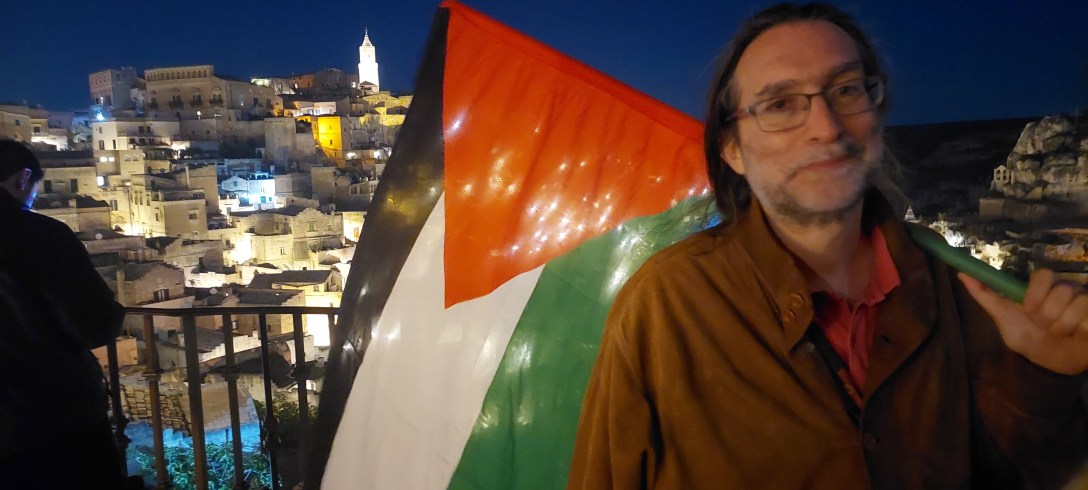
I’m already in a process of changing what I do. An activist urge to express and engage remains, but I am surrendered to my actions not mattering. I take new heart in, and feel great solidarity with, people who find multiple ways to act on their values, both in creating the beautiful locally, and resisting what’s horrible, whether local or global. That was how I felt as I marched with the Palestinian flag through an Italian town with my colleague Matthew Slater, before we were escorted home by the carabinieri. I also have a greater acceptance that everyone is living their own journey, and although we each might challenge each other, I won’t be judging people as inherently good or bad. In writing this essay I have realized I have benefited from decades of fellowship with people who have been trying to better the world, whether locally or more broadly. We have explored our situations and motivations on an ongoing basis, and helped each other evolve. Recognizing that gives me renewed motivation to keep offering free places to activists on our leadership courses and organizing future alumni gatherings.
In the coming weeks and months, I might share a few more essays on the nature of activism in an era of collapse, as it is something I still feel a compulsion about! In doing so I will continue to warn, drawing on my own experience, as well as ancient wisdoms, that “people who believe in themselves and what they are doing can make really bad choices when they are so convinced of their need to make the world a better place.”
Photo is of Matthew on his march in April 2024.
Donate to keep Jem writing / Read his book Breaking Together / Ask JemBot a question / Read Jem’s key ideas on collapse / Subscribe to this blog / Study with Jem / Browse his latest posts / Read the Scholars’ Warning / Visit the Deep Adaptation Forum / Receive Jem’s Biannual Bulletin / Receive the Deep Adaptation Review / Watch some of Jem’s talks / Find Emotional Support / Jem’s actual views on Covid
Discover more from Prof Jem Bendell
Subscribe to get the latest posts sent to your email.
