I invited Malika Virah-Sawmy to share her reflections on the changes in approaches to international solidarity at a time of rising poverty and political disquiet in Western nations, as well as the degradation of the global environment. I met Malika through working on Deep Adaptation, and she served for a time as a holding group member of the DA Forum. I hope you find her perspective important for your own efforts.
Witnessing the political saga in many Western countries over the past year gives the impression of deep political upheaval. As inflation persists and family budgets become increasingly strained, frustration is manifesting in various ways. Elites are promoting narratives that shift attention away from exploitative economic systems. That means migrants like myself, refugees, and even bureaucrats are blamed – but never the rich. It leaves me wondering what politics will rise after people wake up to this false dawn promised by the xenophobes and anti-bureaucrats. Because it can’t take that long for people to realise their pay hasn’t increased and their bills haven’t decreased as a result of backing the opportunist politicians. At that point, the path might be open for more meaningful engagement with the difficulties in this era of ‘permacrisis’. If you are not satisfied with the ideas from your political leaders and pundits, then I’d like to offer an outside perspective. It is a view that might not only help citizens in the West, but also help people in less wealthy regions of the world.
Dropping the delusion of sustainable development
I come from Mauritius. It is a country that has also faced a cost-of-living crisis and rising rates of poverty, contributing to the ejection of the government last year. We were in the international news recently when the US government complained about the UK giving back the sovereignty of one of our islands, which hosts their military base. That kerfuffle is a reminder of the history of our country which, for centuries, was forced to export its resources to the colonial rulers – the Dutch, the French, then the British. Just as they enabled the exploitation of workers in Western nations, the elites enabled even more aggressive exploitation of people in the hotter, and financially-poorer, countries of the world.
When countries declared independence, it did not stop the colonial relations, as the terms of trade and finance continued to be controlled by powerful nations. To cover for this exploitation, we were told the story of ‘development’: agree to the rules of the global economic game, and our nation would advance. After some decades passed and that development seemed to be imbalanced and environmentally destructive, we were told the new story of ‘sustainable development.’
Like many educated and motivated people of my generation from across the Majority World, we chose to accept this story as we sought a positive impact. Working in ‘sustainable development’ there has been a temptation to ignore the flaws in the idea that we can exploit the environment and ship everything overseas for a harmonious outcome. We have been encouraged to over-sell the success of our endeavours to defend the status quo. Now, more of us in this field see that this charade is over, as there is global backsliding on all targets, alongside the declining commitment in the West to either environmental or humanitarian aims. Therefore, the sudden and savage cuts to humanitarian assistance in recent months come as no real surprise, but confirm that we are entering a new era which invites our imagination about how to live in solidarity.
My understanding of the people who read this blog is that many of you live in the West, and are unusually concerned about social and environmental issues. As I believe that you have a contribution to make for positive social change, both globally and locally, I want to invite some reflections that might support you in that.
One world, one exploitation
Now living in Germany, I am very aware of the economic difficulties faced by many people in Western nations, including in my own neighbourhood. This is no longer unusual. Jem Bendell, who invited me to put my thoughts on paper, tells me that the poverty statistics in the UK are shocking, with about a third of children living in relative poverty. That is despite the rest of the world shipping their resources to the British Isles, as they have done for centuries. How is it that Britain allows hundreds of thousands of its children to go hungry, despite a large transfer of food, fuel and labour from the rest of the world? The obvious answer is the powerful systems both producing and justifying deep inequalities. The obvious lie is that the poverty is because of the immigrants who staff the trains, the hospitals, the taxis, the farms and the kitchens.
I once viewed decolonial work as focused on healing, repair, and redistribution between the Global North and South. However, I now recognize that the fractures also run through the Global North itself. The colonial wound is not only something inflicted on distant lands; it festers within the Global North, in its own communities disempowered by the same structures that dominate the Global South.
At the same time that some indicators of inequality are trebling (in 2024 itself, the wealth of billionaires grew at a rate three times faster than the previous year), the overshoot of Earth’s capacity to support high consumption lifestyles is worse than ever. If everyone on Earth lived like the average person in OECD countries, we would need approximately 3.5 planets to support us all. We are overshooting the capacity of this world to provide us food, water, fibre, fuel, metals, and more. We are also overstressing its ability to cope with our wastes, including plastics, toxics and greenhouse gases. These pressures are being made worse by unnecessary wars and greedy corporate speculation. That means at some point the foundational systems for our societies start to break, as chronicled in Bendell’s book Breaking Together.
It is understandable that members of an average family in Europe and North America feel they need and deserve a larger share of the ‘economic pie.’ But the old story of growing that economic pie so more of us can get what we deserve is no longer viable. That old story seeks to make inequality a secondary concern to economic growth, but it has overlooked the reality of over-exploiting our planet. It overlooks the increasing disruptions to production systems around the world, upon which so many countries depend. Much of what we eat, heat and turn on, comes from somewhere else in the world. Therefore, there is the risk of ‘hard landings’ for many communities that are already on the economic edge and don’t have the potential for more self-reliance. With that in mind, is it not reasonable to seek a bigger share of a smaller ‘pie’ so we don’t suffer if the rest of the world sends our country less of its resources? If greater equality allowed wealthier countries to meet their citizens’ needs with fewer of the world’s resources, the pressure on our exploited planet could be eased. In this way, making exploitative systems in the West more just and fair would benefit people everywhere. Global justice, then, can begin at home.
Localisation as global solidarity
I share these thoughts because I think the time has come to ditch the mistaken ideology of ‘sustainable development’, not only for international cooperation but for how we live in our own neighbourhoods. That’s because we can’t keep the ‘show’ of modern society on the road by exploiting and polluting the world even more. We can’t keep pretending that the massive problems will be fixed with new technologies, or by increasing that proverbial pie. Instead, it’s time to heed the warnings of hundreds of scholars from around the world who conclude that societal collapse is now inevitable, or even underway, and that we must increase our preparations. In practice, that means more of us can prioritise how we can survive, and even thrive, with less consumption. There is much to celebrate and replicate, where people are taking back control of their energy supplies, food production, and suchlike. Many examples are shared in various portals like Low Impact and Resilience.
The prize for engaging in efforts at greater economic equality and community self-reliance can be a better kind of solidarity wealth: one that is born and made of reimagining what wealth is and restructuring how wealth is generated, distributed, and controlled. It’s not just about redistribution—it’s about changing the fundamental rules of the economy to focus on solidarity, cooperation, and wellbeing (of all), rather than more profit and more consumption.. It is a kind of wealth that is rooted in a conscious freedom from the damaging stories of self, society and nature that are foisted upon us constantly by mass media. These approaches can evolve into a new politics for an era of collapse, as Professor Bendell wishes for in Breaking Together.
If you choose to focus on participating in the solidarity economy and supporting community self-reliance, then unlearning the colonial influences that shape our minds and lives can be an important part of your journey. It’s not just about adopting new values, but recognizing how we’ve internalized colonial addictions and ideas of success, so we can move away from them to embrace ways of living based on shared well-being, mutual support, and self-determination. I know people who work in community enterprises and initiatives who are enlivened by their understanding that their localisation efforts are expressing their solidarity with people around the globe. There are also opportunities for projects that foreground this dimension. For instance, I run a solidarity experiment between Europeans and refugees in Africa’s largest refugee camp, where we learn and unlearn how to engage in collaborative and reciprocal process, while facing the power and privilege that separate us. We’re not just building new economic systems, but also decolonizing ourselves along the way. If you are interested in exploring these issues at a deeper level, where you grow as a natural ally of a more just and peaceful world during this era of permacrisis and collapse, I would be delighted if you consider joining an online course I’m co-running this April. Unlike some explorations of how to free ourselves from colonial and patriarchal patterns, we won’t regard these matters as distinct from the practical work in communities experiencing economic distress.
You can see our course here, warmly supported by the Schumacher Institute. You can also read and apply directly via our website event.
Malika Virah-Sawmy is a facilitator, a coach, and researcher dedicated to nature connection, rewilding, North–South healing and reconciliation, and co-creative practices. Formerly she worked for many years as a consultant and researcher for international agencies and academic institutions in the field of conservation and sustainable development, including climate policy. She was a Holding Group member for the Deep Adaptation Forum and signatory to the Scholars’ Warning on Societal Disruption and Collapse.
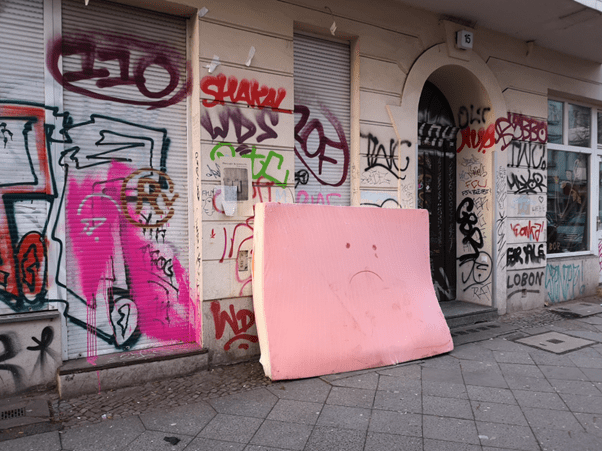
The image is a scene from Malika’s neighbourhood in Berlin (Picture: Johannes Ebeling)
Discover more from Prof Jem Bendell
Subscribe to get the latest posts sent to your email.
