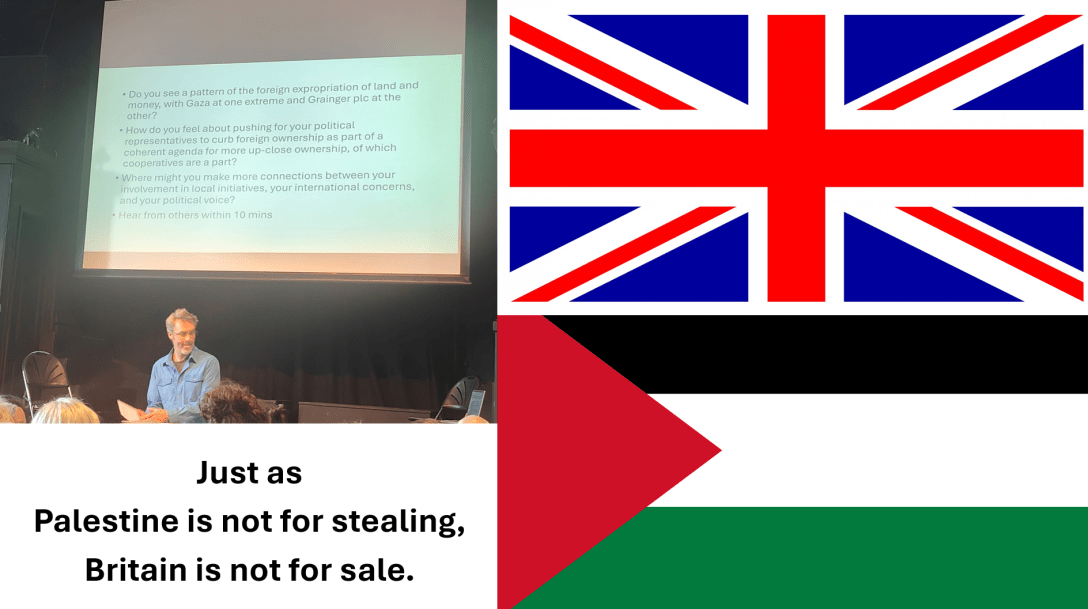
The transcript of a speech delivered in Stroud, UK on 13th Sept 2025, by Professor Jem Bendell.
“Britain’s not for sale and Palestine’s not for stealing – defending and restoring citizenship ownership in the face of collapse.”
I am pleased to be back in ‘The People’s Republic of Stroud’. I first saw that phrase in the background of a talk entitled ‘heading for extinction’ by Gail Bradbrook back in 2018. People in the town of Stroud played a key role in the formation and growth of Extinction Rebellion, which sparked a new wave of environmentalism, bringing wider attention to the climate crisis. I mention that today, as I’m interested in connections between more commonly-owned assets, on the one hand, and a political voice on the other. Only with both of those do we increase the chances of coping better with a creeping collapse of the systems and opportunities we once had.
Today is unusual for me, as I am going to talk about politics. I have never given a speech before that is explicitly about politics. In the first half of 2017, I worked in front line politics with Jeremy Corbyn and his team. I advised on strategic communication, co-wrote speeches, and some of the manifesto. I went on to train some of the current backroom staff for PM Keir Starmer, including Morgan McSweeney. But I have never given a political speech myself. I feel now is the time to do that, because of what’s happening in Britain right now.
Since the start of Extinction Rebellion, things have been getting both worse and weirder. Climate is changing faster than anticipated and people are becoming deluded about it faster than anticipated. Part of that is due to the understandable alienation people feel from experts and authorities, and the elitist form of environmentalism that has come to dominate both policy discussions and budgets. Within that context, whatever we do which returns power to communities will be increasingly important. Let’s check on that…
Do we agree that the people best placed to look after something are those who use it, benefit from it, and rely on it for the long term?
That’s the idea at the heart of the cooperative movement, and of promoting citizen ownership more generally. So let’s never be quiet about how both ‘commoning’ and cooperative ownership are specifically about the fairness of ownership of property, assets and enterprises [Footnote 1].
That is important both in principle and in practice in this increasingly difficult context. It’s important in principle because the increasingly remote and extractive forms of ownership are a significant systemic cause of the worsening and ‘wierdening’ of everything. And it’s important in practice, because both big corporations and the big government agencies are meeting people’s needs and aspirations less than before – and will continue to decline in that role.
History teaches us that any serious attempt at socio-political change must involve both practical action and political voice. So I want to pose a question.
Would you be happy if, in 10 years from now, there are a few more cooperatively owned houses, shops and pubs in your area, but that the sector of cooperatives and the availability of resources held in common, physical and digital, has not grown at all?
That would mean this country would be even less resilient than now.
If that would not be good enough, then we need to think politically. Which means that there needs to be a clear political philosophy and voice about the role of the commons, and about more fair and up-close ownership in general. We need to be clear about the importance of more citizen ownership of the assets in this country – both physical and digital.
So we can celebrate the activity of people in cooperatives and the commons, as we are doing this weekend. But we shouldn’t think that means we can ignore the political context around us, how that is changing, and what we might be able to do about it. Yes, we work locally, but we would be unwise to consider that a replacement for political engagement, rather than a complement to it.
Instead, we can seek that the state helps, not hinders, efforts to scale up citizen ownership. For that to happen in a meaningful way, we need to revive the politics around citizen ownership for a new context of societal disruption. It means we need a political agenda that is relevant and relatable to real interests, as well as being internationalist and divorced from techno-feudal and techno-authoritarian trends.
In this talk, I’ll explain why a revival of commons-related politics needs to happen, with a couple of examples of the incoherence of not only current cooperative politics in the UK, but also the wider political class. I believe that if we don’t articulate a politics of reviving the commons which also speaks directly to the mainstream of politics today, we will become a self-involved side show, mis-selling our good projects of cooperatively owned pubs, shops and houses with a fanciful claim about wider social change.
Traditionally the Cooperative Party have been regarded as representing the interest in community ownership within British politics. Representatives of the Cooperative Party of the UK state that they are proud of being distinct to the Labour Party; that they partner with Labour in a form of conscious marriage rather than a forced one.
There are some good policy initiatives coming from the Cooperative Party, such as securing the legal right to lock assets within a cooperative, to stop greedy ‘carpet baggers’ who try to demutualise them. That is a reminder of the potential role of a ‘partner state’ in supporting commonly-owned assets.
If the new “English Devolution and Community Empowerment Bill” becomes law, then it will be a small success for the Coop Party in strengthening the community right to buy assets of particular community importance. But that doesn’t mean there will be the financing to do that, especially in the face of inflating land prices. So, the Starmer government’s scrapping of the Community Ownership Fund might be more consequential.
In truth, you only get crumbs from the fat cats when you choose to sit at their feet.
So I want to propose today that we need a new kind of commons politics for this era of societal disruption. One that is radically coherent and relevant to people, both home and abroad.
To do that, let’s look at the fundamentals. Commonly owned property is good because it means the property is owned by the people who contribute to it, who benefit from it and are therefore committed to it over the long term. This is the obvious benefit of more up-close ownership, rather than distant ownership. It’s just like citizenship of a country. Such citizenship is good because it means rights and privileges of being a citizen of a country are for the people who contribute to it, who benefit from it, and are therefore committed to it over the long term.
Exactly the same political philosophy means we can become concerned about the purchase of British property by foreign persons and foreign corporations. If they are not citizens, or the shareholders of corporations are not citizens, then their acquisition of property in the UK represents international capital raising the prices of housing and rents for British residents. Which means they are helping to extract money and time from British residents into the international money system. This is the opposite of the kind of up-close ownership that the commons and cooperative movements recognize as important [Footnote 2].
That is why it is important that foreign ownership of British land and housing has doubled, at least, since 2010. That’s not including the recent upswing in house buying by companies that are owned or financed by international capital. Bankers call that investment, but it’s actually economic dispossession. People have woken up to that when the foreign-owned water companies take away our money but leave us with the sewage. But there is a far wider exploitation occurring.
For the last few years, I have lived in Indonesia. As a foreigner I am not allowed to own land. For my organic farm, I needed to buy a lease, for land that in future will return to the family who have lived there for generations. In 60% of the countries of the world, foreigners can’t buy land. They account for over 75% of the world’s population. So, unlike British people, or other Europeans, or Americans, over 75% of people on this planet are not directly competing with international capital for the price of a roof over their head, or for the price of business premises, or for the price of land to grow their own food [Footnote 3]. That is because such countries have a more recent experience of foreign capital seeking to exploit people and extract wealth. They know they need to fight against economic dispossession. But today, former colonisers, such as the UK, are being colonized by the Frankenstein they birthed – which is the transnational capitalist class. Known colloquially as ‘globalists’. [Although some far-right commentators use that term, we do not need to accept either their conspiratorial analysis or their covert antisemitism, and instead use the term to describe any member of the (multi-racial) transnational capitalist class – Footnote 4].
Restricting foreign ownership of land is a logical complement to an ethos of promoting more up-close ownership. A citizen ownership agenda is a logical complement to support for the commons. However, the political imagination has been so distorted in many western nations that such an idea might be dubbed racist. That’s despite people from ethnic minorities being disproportionately the ones struggling with the rising cost of rents. Where data exists, ethnic minorities in the UK experience overcrowding rates roughly 5 to 8 times higher than the national average.
Neither the Cooperative Party nor the traditional parties have any substantive policy proposals on this matter. The closest to anything was the 2% surcharge on stamp duty for foreign buyers, brought in by the Tories – which raised some revenue but did not curb the growth in foreign ownership. And guess what, Reform UK has no proposals on this, despite its rhetoric about defending Britain. Why? Because they are run by bankers who say what appeals to a disgruntled public while ensuring that the transnational capitalist class will continue its exploitation of us, the general public.
If we care about the commons, then we are caring about the economic rights and privileges of citizens. If being a citizen is meaningful, then it involves having the preferential right and opportunity for economic control in the country where you have your citizenship.
We should not be quiet about that because of fearing being shamed by the fake progressives and fake leftists who dominate British media and politics [see the footnotes for further on that]. And we should challenge the fake nationalism from Reform UK. Moderate immigration can be welcomed and celebrated, but not the economic dispossession of British citizens by foreign capital.
Why am I talking about this at a Festival of Commoning? Because we won’t move out of the ineffective do-gooder ghetto unless we become ruthlessly coherent and relevant in our analysis and proposals.
Which brings us to the most extreme forms of economic dispossession. The term we give to that is ‘settler colonialism’. There is a lot of evidence to support the claim that the history of Israel has involved the theft of land by foreigners and their international capital – a form of contemporary colonialism. Some of the resistance to that process by some Palestinians has caused great suffering to innocents. But decent people will never accept the view that non-combatants are jointly responsible for the actions of governments or militia.
According to the legal experts, the British government and some British corporations are enabling war crimes. That includes making and supplying the armaments required [Footnote 5].
The field of so-called ‘responsible investment’ has been silent about profiting from those war crimes. To take a notable example, Blackrock has large shareholdings in firms that supply arms to the IDF. That even includes a direct stake in Elbit Systems, which, in this country, manufactures the means for forcibly moving and killing innocent civilians. To the legal experts, that looks like profiting from both economic dispossession and genetic dispossession.
When the shareholders, directors and staff of Blackrock choose to profit from enabling genocide, they reveal who they truly are, and what the system they administer truly is. Both they and their system function with the same extractivist and destructive logic, everywhere, including within Britain.
BlackRock is one of the largest shareholders in Grainger plc, the UK’s largest listed private-rented-sector landlord. These firms seek to profit from ever-higher rents. Which means on the first day of every month, they are sucking the lifeblood out of Britain. So I’ll say it again: making it harder to own your property, or afford a roof over your head, is a form of economic dispossession.
Rising housing costs are making it too costly for young people to move out of their parents home, plan for the future, and consider starting a family. Research finds it is one the most important reasons for why young people aren’t having kids. So by killing the very idea of babies, this is a form of genetic dispossession. It’s imposed by global capitalists who are shrinking the sense of possibility of the younger generations in Britain, whatever their race or creed.
We haven’t heard any flavour of media or political party explain it like that. But from Gaza to Gateshead, global capitalists are advancing the economic dispossession of citizens. In Gaza, the violence is extreme and overt. But in the areas of Britain where everyone goes into debt and rental servitude, there is a subtle and covert form of violence. It is one where parents go hungry so they can feed their kids, or where people get sick in the winter due to a lack of adequate heating.
Life in Britain seems a different world to Gaza, and in many ways, thank God it is. But we are all being subjected to processes of the economic dispossession of citizens by global elites. Abroad we see the violent transfer of economic control. At home we see the peaceful transfer of economic control. And when we object to either, the state becomes violent to our rights and our bodies. Firms like Blackrock are helping armies to kill babies in Gaza but are also helping to kill the very idea of babies in the minds of young Britons. [Footnote 6]
It should come as little surprise that members of Britain’s political class who enable colonial exploitation abroad are also enabling it at home in Britain.
The common factor here is that the political class, all of them, whatever their rhetoric, are not helping families who have been embedded in a place for generations, with their ability to ward off international exploitation and economic dispossession. They don’t prioritise ordinary people having the capabilities to care for ourselves, and each other. Instead, they are acting as the servants of monied elites.
That is why this political context is so central to any effort to build the commons and cooperative sectors in Britain and beyond.
All 43 MPs of the Cooperative Party voted to ban a non-violent civil disobedience group as an actual terrorist organization.
Whatever else their vote might indicate, for us here today, it suggests they aren’t coherently understanding that up-close ownership begins with the principle of not being forced off your land. So it points to the need for a new political movement around the commons and cooperatives.
The darkness isn’t on just one side of the political spectrum. Reform UK have had no interest in trying to stop our government’s support for an ongoing colonial genocide. And Reform UK have no policies on the foreign ownership of British land. So they don’t care about you owning the land where you live or the Palestinians owning theirs. That demonstrates they are fake advocates for more national control, and will instead preserve the bankers’ exploitation of everyone, from Britain to Palestine.
Of course, it is not inevitable that all the MPs remain that way, once they realise their treachery. To help that happen we can become clearer about how our various interests form one coherent agenda. I am inviting us all to make more explicit that the political interest we have in reclaiming control of economic life is a universal one. That means we want political support for that at home and abroad. It’s neither racist to condemn Israel nor is it racist to demand Britain is not sold off to non-citizens. I want to invite us to feel confident in saying that ‘Just as Palestine is not for stealing, Britain is not for sale’. Within that context, we get to explain why more up-close ownership, in the form of cooperatives and common resources, is so central to the future.
If we don’t combine practical action and political voice, with up-close ownership, citizen ownership, as a foundation stone for that, then Britain will continue on its path towards a nation of renters and debt-slaves. Ours will be a country run by bankers and elites who use our citizens’ capabilities to genocide others, while waving the flag and telling us who to fear and who to blame.
Instead, we could help to make citizen ownership the foundation of resilience in a turbulent future.
Let’s not get stuck amidst the rubble of the old ways. Let’s decide to be those green shoots that appear in the cracks. Through both practical action and political voice.
Footnotes – added after audience questions
[1] A significant part of what defines “the commons” is the social relations of ownership and governance around a resource (such as land, water, fisheries, forests, knowledge, etc.), whether codified in law or maintained through custom. Key is that such resources are not held by private individuals or by the state, and a community stewards them. Scholars have stated this explicitly, across political economy, law, anthropology and history. That includes Elinor Ostrom, Carol Rose, James Boyle, David Bollier, Silke Helfrich, and Arun Agrawal. In recognising the commons in that way, they align with the analysis of historians that the enclosure of traditional common land was a form of theft that enabled capitalist expansion, both in Europe and colonised territories. Anyone who argues that the concept of the commons and commoning is not about the nature of ownership, is either being modernist and limiting their notion of what constitutes ownership to a bureaucratic form, or is trying to undermine the potential challenge to capitalist power from a revival of the commons and the cooperative sector. In either case, we can be dismissive of anyone who seeks to confuse people on this matter – and question their intentions if they persist and influence others.
[2] There are a variety of reasons why the price of residential property is increasing, and why the price of rents are increasing faster. For instance, one reason is banking regulation, and the lack of credit guidance to banks. However, spiralling foreign ownership, including from corporations, has become a major contributing factor. People who object to any focus on whether rich individuals are foreigners i.e. non-citizens in a particular country, or whether corporations and capital are foreign, reveal a lack of understanding of the nature of racism and anti-racism. Citizenship has meant something significant since the invention of the nation state and in most countries today anyone of any race or creed can become a citizen. Therefore, being pro-citizenship is not racial, unless existing within an ethno-nationalist state (which people have objected to since slavery and object now about contemporary apartheid systems). People who are repulsed by criticism of foreigners, need to understand their repulsion is for the unfair victimising of individuals with limited power – such as asylum seekers. Criticising foreign ownership is neither unfair, as it causes myriad problems, nor is it about people with limited power. Therefore, to be repulsed by criticism of foreign power reveals a lack of serious commitment to the dignity of every human being, whatever their race or creed, and instead a greater interest in maintaining the ‘mood music’ of one’s preferred in-group. Maintaining an illogical repulsion and then shaming others from that basis will undermine the opportunity for a serious leftwing politics – if persistent, it could be regarded as a tactic of movement sabotage.
[3] The data sets for this calculation are many, and therefore I used AI to find and compile the data. I recommend you use your own preferred AI to see if you get the same results (beware of people who casually dismiss this data as only AI – as it is just doing computational work from multiple reputable sources):
Countries where foreign freehold ownership is typically allowed (or fairly accessible) → ~60–80 countries (including EU nations, much of North America, Japan, Korea, etc.)
Countries with conditional ownership (e.g. condos only, limited zones, company workarounds) → ~30–50 countries
Countries that outright prohibit freehold ownership of land by foreigners → ~80–100 countries (many in Asia, Africa, Latin America with limited exceptions).
[4] Some far right commentators use the term ‘globalist’ to describe members of an international cabal, and some even imply that is a Jewish cabal. When doing so, they distract us from how the term ‘globalist’ can more accurately describe members of a ‘transnational capitalist class’, which is comprised of people from most races and creeds, who benefit from international capitalist systems extracting wealth from citizens around the world. The term ‘globalist’ is useful for indicating how many members of that transnational capitalist class imagine ordinary people to be to blame for the problems of the world and for themselves to be the potential saviours of the world – if they can better manipulate and coerce public behaviours. I am against such ideology, which I regard as narcissistic pathology and counter-productive, and have a chapter on resisting the ‘fake green globalists’ in my book Breaking Together. People who object to use of the term globalist, such as by claiming it is an antisemitic trope, are pushing anti-capitalist analysis to the margins, by requiring us to use technical jargon or to never personalise the critique. Such people are either inadvertently helping global exploitation by hampering the mainstream understanding of leftist critique, or they are deliberately weaponising accusations of antisemitism to police the Left so it doesn’t develop a popular agenda against exploitation by international finance. None of my many Jewish friends are bankers, and I consider it anachronistic and peculiar to associate Jewish people with international banking in the current era, where finance is truly global.
[5] The argument that focusing on violence against Palestinians rather than other violence around the world is revealing an antisemitic bias is, in fact, itself a racist argument that only finds a hearing within racist, white supremacy, cultures. People who stand against war crimes of all kinds are naturally appalled at what is happening in Palestine. International legal opinion confirms the scale and intentionality of the ongoing atrocities. Those atrocities are enabled by some Western governments and their corporations. To make the argument that to focus on this unusual and urgent situation is due to antisemitism is to display a callous insensitivity towards the suffering of particular types of innocents – likely due to racist diminution of their relevance.
[6] The issue here is systemic influences on choice. On the one hand there is the need to resist encroachments on reproductive rights and related facilities. On the other hand, that should not be used to ignore the way that the cost of property and cost of living are compromising the aspirations of young couples. To make this point is not pro-natalist but is pro-choice in its fullest sense, which includes people not having their thoughts about raising a family compromised by their financial situation. This point may be painful to hear for some parents who have chosen abortions partly due to financial reasons, with explicit or not. I realise that, empathise, but believe we must not avoid difficult truths.
Discover more from Prof Jem Bendell
Subscribe to get the latest posts sent to your email.
