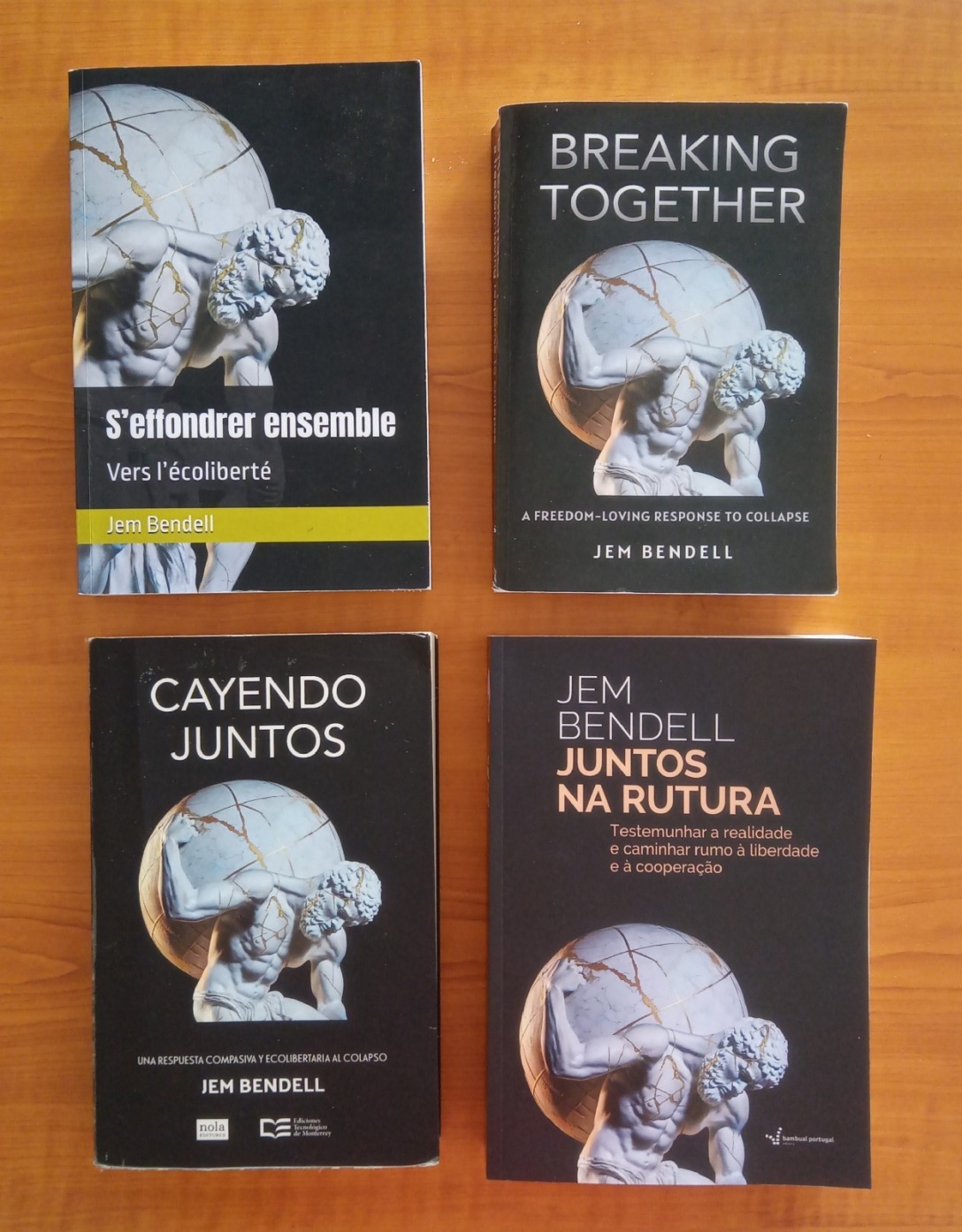
Portuguese is the fifth language that my book Breaking Together is available in. Many at the launch in Lisbon last month travelled from the countryside where they are working on community resilience. For them, the book Juntos Na Rutura provides a useful explanation to others about why they are promoting community economics. One of the interviews around the launch was with the Portuguese degrowth network, which is available on video.
After that inspirational boost, my next speech was to a more general audience in the UK, and I discovered how my analysis on the causes and implications of societal collapse can be easily misconstrued. Therefore, I wrote a summary of the foundational concepts in my work, including concepts like Deep Adaptation, the Metacrisis, the Great Reclamation and Ecolibertarianism, to appear here on my homepage. In addition, I worked with a colleague to prepare a summary of some ideas in each chapter of Breaking Together, which I publish below.
That summary serves as a backgrounder for the next Metacrisis Meeting on November 3rd with the former coordinator of the Deep Adaptation Forum, Kat Soares. We will be discussing the future of the phenomenon, perhaps movement, of people trying to be socially useful in the face of societal disruption and collapse – that thing some of us call ‘deep adaptation’. Kat is currently coordinating a sensemaking around what the Forum has been doing (shared your views yet?).
Upgrade to join the Metacrisis Meetings
Every month there are participatory meetings where Jem hosts relevant experts. The times will be 10am UTC/GMT and 11pm UTC/GMT on Monday 3rd, for 2 hours. The first is suitable for Europe/Africa/Asia, and the second is suitable for the Americas and Australia.
For free meetings on related topics, check out the DA Forum.
—
One of my interviews in Portugal last month:
Summary of Each Chapter of Breaking Together (2023)
If wishing to quote from the book, please use the book, not the following third-person summaries. The image above shows all current translations apart from the Hungarian.
Introduction – Facing Collapse with Honesty
In the introduction, Professor Jem Bendell frames the book’s central thesis: that societal collapse is no longer a distant possibility but a lived reality for many. He begins by reflecting on his earlier “Deep Adaptation” paper, which argued for acknowledging the inevitability of climate-driven societal breakdown. The widespread reaction revealed deep denial and resistance within academia, media, and politics. In this book, Bendell expands his scope to explore not only climate but the converging crises of economy, energy, biosphere, food, and culture. He stresses that collapse is not merely an external threat but something we are already experiencing, to lesser or greater degrees, through deteriorating health, economic instability, political strife, and ecological disruption. He situates collapse as both material and cultural: it is about the breakdown of the stories that modern societies tell themselves about endless growth, technological progress, and inevitable improvement. He clarifies that his goal is neither despair nor false hope, but a sober reckoning that opens the possibility of renewal. The introduction also outlines the book’s dual structure: the first half diagnoses collapse across key systems, while the second half explores freedoms that can be reclaimed within collapse to try to soften the process and plant seeds of the new. Bendell acknowledges the difficulty of confronting collapse directly – grief, fear, and resistance are natural – but insists that honesty can lead to liberation. By refusing to deny reality, we create space for wisdom, compassion, courage, and creativity. Thus, the introduction sets the tone: a call to move beyond illusions and face collapse as an inescapable yet potentially transformative condition. (Free audio).
Chapter 1 – Economic Collapse: A Time of Limits and Contradictions
This chapter argues that the economic model underpinning industrial consumer societies has reached its breaking point. Bendell identifies key indicators that show deterioration since around 2016: declining life expectancy, falling real wages, stagnant productivity, and setbacks on most of the UN Sustainable Development Goals. He stresses that economic growth is structurally required by modern monetary systems, yet biophysical and social limits mean it cannot be sustained. Development, once presented as inevitable progress, is shown to have stalled or reversed for much of the world. The contradictions between the promises of capitalism and its outcomes have become stark: debt burdens grow as living standards erode, and inequality fuels political instability. Globalisation, once hailed as the driver of prosperity, now reveals fragility through disrupted supply chains, rising costs, and diminishing returns on investment. The chapter concludes that economic collapse is not a future scenario but an unfolding process. Rather than an abrupt crash, Bendell portrays a drawn-out unravelling, where systemic contradictions accumulate until they destabilise the foundations of everyday life. This chapter sets the stage by establishing that the global economy – long treated as a domain of endless expansion – is in fact in irreversible decline, undermining the legitimacy of mainstream economic narratives. (Free audio).
Chapter 2 – Monetary Collapse: It Was Made Inevitable
Bendell traces the role of monetary systems in ensuring inevitable collapse. He explains how modern economies depend on debt-based money creation, which requires perpetual growth. The 2008 financial crisis exposed structural weaknesses, but responses merely deepened long-term risks: quantitative easing, near-zero interest rates, and massive asset purchases inflated bubbles while transferring wealth to elites. This paved the way for ongoing instability. During the Covid-19 pandemic, central banks and governments supported large corporations through corporate bond buying and other nefarious policies, facilitating corporate acquisitions and resource grabs, especially in the Global South. Bendell terms this the era of “peak fiat,” where trust in money as a store of value erodes. He highlights how geopolitics – such as China’s accumulation of gold and experiments with alternative payment systems – signals fractures in the dollar-dominated order. Inflation, inequality, and declining confidence are seen as precursors to potential monetary regime change. Importantly, Bendell argues that money is not neutral: it encodes expansionist and hierarchical logics, shaping culture and politics in ways that perpetuate ecological destruction. Reclaiming monetary power is therefore essential but extremely difficult, as elites remain deeply invested in preserving their advantage. The inevitability of monetary collapse underscores the vulnerability of all other social systems dependent on financial stability. (Free audio).
Chapter 3 – Energy Collapse: And Problems with Net Zero
Energy is the lifeblood of industrial consumer societies, and Bendell shows how dependence on high-energy fossil fuels creates vulnerabilities. He emphasises that energy use has not been decoupled from economic activity, so that “green growth” is thus far an illusion. Net zero policies, while rhetorically ambitious, mask the practical impossibility of maintaining current livelihoods and lifestyles without fossil fuels. Renewables, though valuable, cannot replicate the scale, density, or reliability of hydrocarbons. Nuclear energy is also shown to be limited by safety, waste, costs, and public distrust. Bendell discusses “peak oil,” noting that conventional crude production has plateaued, while unconventional sources carry higher environmental and economic costs. Industry lobbying, disinformation, and “greenwashing” distort public debate, obscuring the reality that energy scarcity is already undermining standards of living. The conclusion is stark: modern societies cannot transition smoothly to renewable energy while preserving economic growth and consumer lifestyles. The future is one of contraction, not substitution. Acknowledging this reality is critical to preparing for fair social adjustments, yet elites continue to cling to narratives of technological salvation. (Free audio).
Chapter 4 – Biosphere Collapse: Killing Our Living Home
This chapter expands the scope from energy to the biosphere, reminding readers that humanity is inseparable from ecological systems. Bendell documents accelerating biodiversity loss, mass species extinctions, soil degradation, deforestation, ocean acidification, and pollution as symptoms of systemic overshoot. He highlights how deforestation historically contributed to past societal collapses and may also increase pandemic risks today by exposing humans to novel pathogens. The Covid-19 pandemic is presented as an example of how ecological disruption feeds into global crises. Bendell stresses that humans are part of the biosphere; our health, food, and culture depend on ecological integrity. The collapse of ecosystems thus directly threatens human survival, not only indirectly through climate change but immediately through failing systems of sustenance and health. The chapter warns that as nature dies, so too will societies, unless radical shifts in values and practices occur. Unlike economic collapse, biosphere collapse is not reversible through policy reform or technology alone – it reflects a fundamental breakdown in the relationship between human societies and the living planet.
Chapter 5 – Climate Collapse: Cascading Failures
Here Bendell reviews climate science while focusing on overlooked dynamics. He revisits greenhouse basics – CO₂, methane, and feedback loops – but emphasises how mainstream institutions like the IPCC systematically downplay worst-case scenarios by excluding data and feedback effects. The chapter highlights accelerating warming, melting permafrost, destabilising ice sheets, and intensifying storms as signs that climate destabilisation is already well underway. He stresses that climate change is not a gradual linear process but a cascade of interlinked failures: shifting seasons, disrupted food systems, rising seas, and societal dislocations. Bendell critiques climatology’s past caution, and warns of the manmade warming factors that are additional to carbon gases, such as declines in cloud seeding by forests. Policy prescriptions such as carbon markets or net zero pledges are shown to be counterproductive distractions. The chapter insists that the only honest response is to accept massive disruption from climate chaos will intensify, while still acting to slow further damage. This realism, though unsettling, provides a basis for integrity and courage rather than false hope. (Free audio).
Chapter 6 – Food Collapse: Six Hard Trends
Bendell identifies six converging trends making international food system collapse inevitable. First, agriculture is hitting biophysical limits: soil fertility, water availability, and nutrient cycles are under strain. Second, the biosphere that supports farming is being poisoned and degraded through pesticides, fertilisers, and habitat destruction. Third, industrial food systems are dependent on finite fossil fuels for fertilisers, machinery, transport, and storage. Fourth, climate chaos is already disrupting yields through floods, droughts, heatwaves, and shifting pest populations. Fifth, global demand for food is growing due to population and rising meat consumption. Sixth, globalised supply chains prioritise efficiency and profit over resilience, making them brittle under stress. Together, these trends mean systemic vulnerability: a shock in one region can cascade globally. Bendell warns that reliance on a few staple grains, concentrated in regions vulnerable to jet-stream-driven weather disruption, increases risk. While local and regenerative agriculture could mitigate breakdown, policies continue to reinforce dependency on fragile industrialised and international systems. (Free audio).
Chapter 7 – Societal Collapse: Recognising Reality and Cultural Decay
In this summative chapter, Bendell synthesises earlier evidence to argue that societal collapse is already underway. He critiques efforts to keep “too late” a taboo in public discourse, noting how institutions and scholars bend science and language to sustain illusions. He highlights cascading conflicts, governance failures, and crumbling legitimacy of political and legal systems. The “cultural cement” that once bound societies – shared trust in institutions, teamwork in workplaces, belief in progress – is eroding. This ‘uncementing’ manifests in declining mental health, fraying social bonds, widespread disillusionment, opportunistic political movements, and authoritarian governance. Bendell insists that denial of collapse is not neutral; it perpetuates harm by preventing adaptation and postponing regeneration. Recognising collapse, though painful, is a prerequisite for dignity and the possibility of resilience. The challenge now is to imagine responses that are neither nostalgic retreats nor authoritarian impositions, but grounded in honesty about unfolding breakdowns and difficult prospects. (Free audio).
Chapter 8 – Freedom to Know: Critical Wisdom in an Era of Collapse
Bendell turns from diagnosis to epistemology, emphasising the need to think freely and critically in response to the collapse of the world we once knew. He describes this as critical wisdom, which includes the dimensions of logical reasoning, critical literacy, mindfulness and intuition. He explains that critical literacy is the ability to question narratives, recognise manipulation, and discern power dynamics in knowledge production. For that approach, he critiques “anti-radical environmentalism,” where mainstream movements internalise establishment constraints and dilute transformative demands. Concepts like progress, hope, and resilience are often framed in ways that restrain action. Bendell also examines anger: while natural, it can be manipulated into authoritarian or destructive responses unless channelled with wisdom. He critiques the misuse of critical theory, noting how identity politics is obscuring its original liberatory intent. Ultimately, he encourages readers to cultivate their own journeys toward wise action. Liberating ourselves from manipulative narratives opens the space for authentic engagement with collapse. (Free audio).
Chapter 9 – Freedom from Progress: Humanity Is Not on Trial
This chapter challenges the ideology of progress, which frames history as linear advancement from primitive to modern. Bendell argues that this narrative devalues indigenous cultures and obscures alternative ways of living. He critiques the prejudice embedded in progress: portraying some societies as backward legitimised colonialism, exploitation, and cultural erasure. Bendell highlights “keystone cultures” – societies where humans maintained ecological balance for millennia – as evidence that human flourishing does not require industrial consumerism. Recognising our own indigeneity, even within modern contexts, can help us reconnect with ways of being both prior and beyond consumerist values. In an era of collapse, clinging to progress narratives prevents us from valuing diverse paths of renewal. By rejecting the trial-like framing of humanity as needing to prove its worth through technological advancement or being judged for the ecological destruction wrought by modern societies, Bendell invites a deeper appreciation of cultures rooted in reciprocity, humility, and ecological harmony. (Free audio).
Chapter 10 – Freedom from Banking: How the Money-Power Drove Collapse
Bendell deepens his earlier analysis of money, exposing how banking systems are not just technical arrangements but drivers of ecological and social harm. Debt-based interest-bearing money creation by private banks, as the source for most of our means of exchange, fuels environmental destruction, inequality, and cultural alienation. He describes how monetary systems routinise oppression: environmental damage is externalised, while social hierarchies are reinforced through debt and dependency. The “money-power” – the complex of banks, investors, regulators, and cultural norms – operates like an empire beyond nation-states, shaping politics and values globally. Bendell traces how this system underpins patriarchy and modernity, privileging commodifiable and transactional activities while devaluing care, community, and non-market life. Ultimately, he identifies current money systems as a root cause of “omnicide” – the killing of all. Escaping its grip is extraordinarily difficult, but recognising its power is essential to imagining alternatives. The chapter frames monetary reform and currency innovation not just as technical but as societal liberation. (Free audio).
Chapter 11 – Freedom in Nature: A Foundation for Ecolibertarians
This chapter explores philosophical and spiritual dimensions of freedom. Bendell engages with debates on free will, examining objections from neuroscience and physics alongside perspectives from religion and spirituality. He concludes that relative freedom is intrinsic to nature itself: evolution depends on the capacity for choice within constraints. Recognising this natural freedom provides a foundation for ecolibertarianism – Bendell’s term for a political ethos combining ecological limits with commitment to personal and collective liberty. He contrasts ecolibertarianism with ecoauthoritarianism, warning against technocratic or coercive “green” regimes. Visions of ecofreedom are presented as diverse: from community-based autonomy to spiritual practices that honour interdependence. Bendell situates ecolibertarianism as both critique and renewal of environmentalism, seeking to reclaim freedom as central to ecological politics.
Chapter 12 – Freedom to Collapse and Grow: The Doomster Way
Here Bendell reflects on the personal and political paths available in the face of, and during, disruptions and collapse. He describes “personal collapse” as the process of letting go of identities and illusions tied to industrial consumerism, allowing space for intuition, creativity, and renewal. Time is needed for this personal disintegration and reconstitution, but it can open doors to deeper meaning. He highlights pioneers of ecolibertarian economics experimenting with community economics and regenerative practices. He sketches a “doomster agenda” that embraces collapse not as failure but as an opportunity for transformation. Positive policy agendas are possible – such as supporting local resilience, dismantling harmful subsidies, and protecting freedoms – but they must be grounded in acceptance of overall contraction of resource consumption. Bendell stresses that there is no deliverance: collapse cannot be prevented. Yet within this inevitability lies the chance to grow into new forms of life, culture, and politics aligned with ecological reality. (Free audio).
Chapter 13 – Freedom from Fake Green Globalists: Resistance and Reclamation
The final chapter confronts the political landscape. Bendell warns that elites are responding to collapse with authoritarian and technocratic schemes under the guise of “green globalism.” These include centralised surveillance, carbon markets, geoengineering, and digital finance systems that entrench corporate power. He likens rulers to dangers greater than pandemics, for their manipulations threaten both freedom, justice and ecological integrity. Bendell calls for critical wisdom in resisting authoritarianism externally and internally, avoiding the traps of distraction, dilution, or co-optation. He outlines principles for meaningful dialogue and policy: rooted in honesty, fairness, and liberty. The “great reclamation” he envisions is not nostalgic nationalism nor top-down control, but a reassertion of community autonomy and ecological reciprocity. This resistance is essential to preserving human dignity in collapse. Ultimately, Bendell positions freedom – intellectual, cultural, and ecological – as a compass for navigating the turbulent years ahead. (Free audio).
Conclusion – Living Free in Collapse
In the conclusion, Bendell reflects on the journey the book has taken: from diagnosing systemic collapse to exploring freedoms that remain important. He reiterates that collapse is not a matter of if, but of how. The timing and severity may differ across regions, but the converging crises of ecology, economy, and culture guarantee that the industrial-consumerist way of life cannot continue. Yet, rather than finality, collapse can be understood as a threshold. Bendell encourages readers to cultivate dignity, honesty, compassion and freedom amidst decline. He emphasises the importance of community and reciprocity as practical foundations for resilience. Spiritual and philosophical dimensions are also central: by letting go of illusions of progress and control, we can rediscover deeper meaning in relationship with wider nature and each other. Bendell warns that elites will continue to exploit crises to consolidate power through authoritarian and technocratic measures. Resistance is therefore essential – not in pursuit of saving civilisation as it was, but in defending freedoms and nurturing seeds of renewal. He closes with an invitation: to embrace collapse as part of the human condition in this era, and to meet it not with anxious denial or prolonged despair, but with courage, humility, and creative freedom. The conclusion thus affirms that while collapse is inevitable, how we live through it remains open – and that is where possibility resides.
—
Discover more from Prof Jem Bendell
Subscribe to get the latest posts sent to your email.

[…] Bendell, “Breaking together” […]
[…] Deep Adaptation-Agenda (-> https://en.wikipedia.org/wiki/Deep_Adaptation) und seinem Buch Breaking Together. Im Kern stehen dabei die vier […]