This is a guest article from Tyler Sycamore Hess, the Ceremonial Chef.
“We really did have everything, didn’t we?” says Leonardo DiCaprio’s character during the final scene of “Don’t Look Up.” There is a small group engaging in an elegant last supper, while the extinction-causing comet hurtles toward Earth. The table is beautifully set. The wine is poured. They feel gratitude and camaraderie, at the end of the world.
But what if we could feel such emotions at dinners that create new worlds, not just lament the passing of the old?
My mission as a chef and educator is to craft dinner experiences that begin from that premise, that we can create a better future through intimate relationship with our local ecology and food system. We don’t only ask each other to “look up” at graphs and headlines about growing threats to our way of life. We invite people to look down: at the soil under our feet, the water moving through our watershed, and the hands that plant, harvest, mill, and butcher in our local communities.
When climate change shows up on your plate
Long before cooking dinner parties, I had immersed myself in studying climate risk and societal collapse by designing my own curriculum in college centered around these subjects. Beginning on a path to law school, I quickly shifted course to learning sustainable agriculture, as a personal apprenticeship for being useful in the coming times.
My first years managing farms showed me both how fragile, and how regenerative, our food systems can be. Now, as a chef working closely with local farmers wherever my dinners take place, I continue to witness the reality of growing climate instability. Irregular rains flood the tomato plants before they ripen, late frosts erase whole fruit crops; heat waves reduce the expected yield of hay.
For now, imported food smooths over these shocks, but at the cost of fragile global supply chains and ever-rising prices. “Buying local” is no longer a lifestyle choice — it’s a part of risk management in this age of systemic disruption. Yet individual consumer choices alone won’t keep small farms alive, particularly when competing with the transnational grocery chains. We need cooperative structures that enable communities to support nearby producers at a meaningful scale, and re-weave relationships that meaningfully expand regional production.
Ceremonial suppers: looking down together
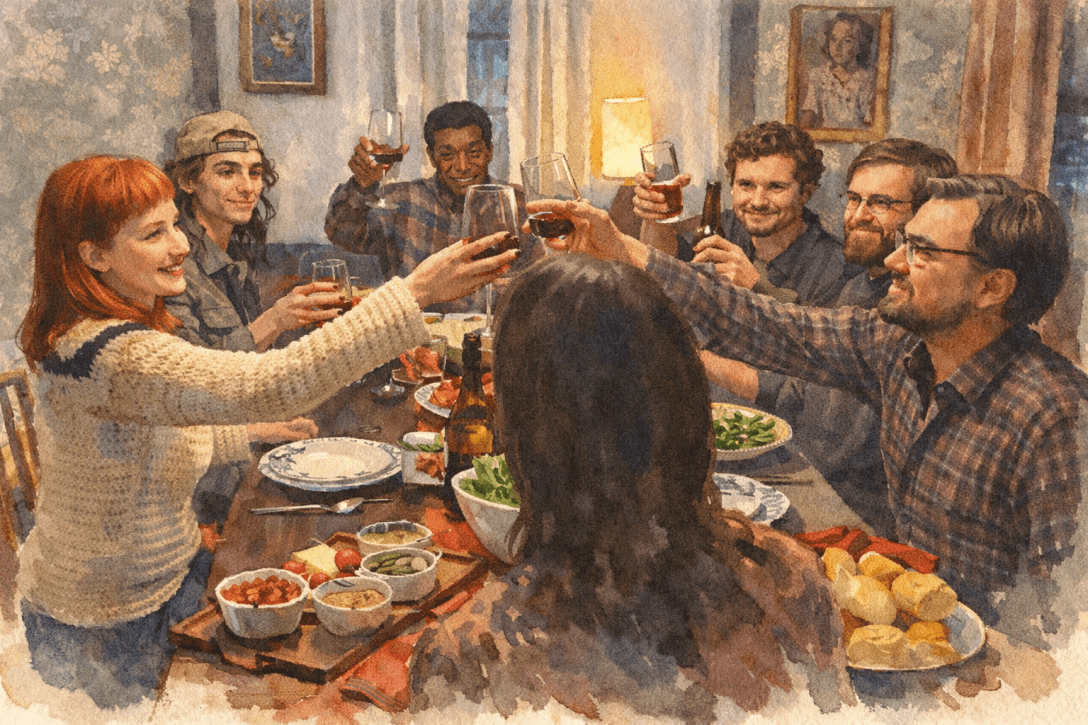
That is the heart of “Soil to Soul” – a Ceremonial Supper Club, designed as an immersive, land-based, ritualistic dinner party, that highlights the seasonal offerings of nearby farms. Guests taste the sweetness of carrots pulled that morning, bread from locally milled grain, and, if they want it, meat from animals raised on the hills just beyond the table. Those animals are not shipped hours to a certified slaughterhouse, but butchered on the land where they grazed. People gather in celebration, and even in prayer, to honour the bounty.
The farmers aren’t just suppliers; they’re present at the dinners as hosts and teachers. They describe the soil conditions, pest pressures, and financial risks that accompany every ingredient on every plate. We talk openly about how many of our calories currently depend on global supply chains and distant monocultures — and what it might look like to shift even a portion of that diet back into local soils, and that financial capital back into local farmers.
This event is a shared meal, not a lecture. This is a participatory ceremony, not a spectator event. Intention guides the experience, and integrates the lessons. We are meaning-making creatures. Thus, there are beeswax candles, hand-carved spoons, freshly fired pottery, and joyful children, live music and smoke from the fire. People could be pressing apples, picking their own salad, grinding masa from local corn or grilling a steak over the fire. It’s a participatory ritual of re-enchantment with bioregional bounty. The conversation is grounded in pleasure and beauty, even as it touches precarious topics and deep grief.
I have found that this experience itself becomes an invitation: what if we ate like this more often? What if our meals represented a web of interdependent relationships? What if we related to food as kin instead of commodity?
When you tear bread made from local grain while listening to the miller describe a drought year, climate change stops being an abstract “issue” and becomes tactile, personal, and specific. And maybe then, your direct sensual experience motivates you to support the regeneration of your local food system, not from a conceptual place of a graph about CO2, but from an embodied place of pleasure, connection, and remembrance.
From one dinner to a bioregional food hub
At the end of each Supper Club, we don’t only send people home with a nice feeling and beautiful photos. The gatherings double as “Community Supported Kitchen” hubs: guests sign up for meat shares, bulk grains and flours, seasonal preserves, and other staples from the farms that fed them that night.
Commitments are made through handshakes and direct payments with the farmers at the meal, not through anonymous online checkout screens. A family commits to a regular supply of meat chickens, and an egg share for the year. A local café decides to switch to regional flour. A neighbour offers freezer space so they can share a whole animal with friends.
Money begins to flow toward whole-diet, regenerative production, not just occasional “local specials.” Farmers gain more predictable demand. Households gain real relationships and contingency plans for when the corporate supply chains destabilise. Each supper becomes a gateway into a bioregional food commons, not just an event.
From the outside, these dinners might look nostalgic or exclusive — a pastoral fantasy for people who can afford a ticket. Yet this is a model meant to be accessible, not a luxury selfie opportunity. Thus I see these events as essential prototypes: small, concrete rehearsals for economies organised around watersheds rather than extractive global networks. They represent practical ways to act on our awareness of societal breakdown and collapse. We don’t know how deep and rapid the disruptions to our societies will become. But we do know that we can try to create the relationships, personal and economic, that might ease the difficulties ahead, through joyous ceremonial meals that heal our local ecologies.
That is why I was pleased to see Jem Bendell, the originator of the ‘Deep Adaptation’ framework, add the R’s of Reclamation and, just recently, Regeneration. If we can reclaim some of our food systems, we can try to regenerate local food cultures, and the productive environments they steward and depend upon.
Will it work to prevent everything from collapsing? Unlikely. Yet what I know for sure, is that the conversations of possibility at these dinners, the real relationships that form through ritual, help neighbours to explore the opportunity for regenerating their local food system. This activates a curiosity of their role, and stimulates agency for their greater collapse-preparedness.
How can a collapse-informed chef steward their local food system?
For this to be more than a beautiful experiment, we need people who can steward it: chefs who understand soil health, farmers ready to share their craft, and organizers who can make a buying club feel like a lovely ceremony rather than a chore. Chefs, in particular, are a powerful intervention point — they decide what to buy and from whom, shape community food culture, and can end up convening people more than any other profession in the food system.
I’m in the early stages of shaping a school of practice around this insight: a pathway for training the next generation of food leaders to think in terms of watersheds, supply chains, and story — not just recipes or Michelin stars. My aim is to help chefs, farmers, and hosts design menus around place and season, build trust with producers, and turn shared meals into invitations for long-term commitment and community resilience.
This vision launched during my Chef Residency last fall at “Fable Farm” in central Vermont, hosting the first “Soil to Soul” Ceremonial Supper Club during Fall Equinox. We gathered artisan wine-makers, organic gardeners, grass-fed beef ranchers, and local artisans to ritually celebrate and honour the seasonal abundance of their local community. What we launched there is ready to expand.
Throughout this year, I’ll be prototyping more of these ceremonial supper clubs in different bioregions. If this vision resonates and you’re seeking support to anchor a similar supper series or to deepen your own practice as a chef, farmer, or organizer, you’re welcome to reach out via social media or substack. My hope is that these tables become many, and that no one has to hold them alone. So many are already doing this sacred work that have inspired me on this path. I’m ready for more collaborators to refine this vision and bring it forth.
Whereas the apocalyptic film ‘Don’t Look Up’ closes on an ending, I am here to cook up a new beginning. Around our tables, we are not waiting for impact. We are looking down, at the land that has always sustained us, and might continue to, if we could begin to care for it again — from soil, to soul.
Jem: As someone who learned at Bekandze Farm how difficult it is to develop an organic fresh produce business within current market dynamics, I think Sycamore’s project is a useful one to attempt in more areas. It could also meet the hunger that people have to act on their collapse awareness. If you found the ideas stimulating, then consider joining myself and Sycamore for a conversation on regenerative actions in the next Metacrisis Salon, on Monday April 6th – details below.
Subscribe to the Metacrisis Initiative
For $8 a month or $80 a year, you can join monthly salons, a regular peer-mentoring group, and community chat, on how to live well and love during metacrisis and collapse. Also free for young professionals from the majority world.
Discover more from Prof Jem Bendell
Subscribe to get the latest posts sent to your email.
