“Has the collapse begun?”
“What is your revised schedule for societal collapse?”
I’ve been receiving these kinds of messages in my inboxes over the last 6 weeks, since the wider impact of the US-Israeli assault on Iran began to unfold. These haven’t been queries from top officials or mainstream journalists, who we might expect to reach out to ‘collapsologists’ for advice on deeper approaches to the field of ‘contingency planning’. Instead, I’m being asked by podcasters and people who follow my blog. So what do I reply?
I’ve often said that a rising cost of living is the obvious way that most people will experience the creeping collapse of industrial consumer societies. In the decade prior to 2026, that was already happening due to market capture by monopolistic capital, corrupt monetary policies, and the damage to production from ecological depletion and climate destabilisation. Now it’s also happening due to avoidable conflicts, such as in Ukraine and the Gulf. That is not to downplay any one tragic situation; but by pointing to the rising prices which then necessitate a change in our living standards, emotional states, and life goals, I am trying to help more of us to see how collapse is not a sudden event in the future. As detailed in Breaking Together, societal collapse is not defined by pace: it is defined by the fact that declines and breakdowns are irrecoverable, so a previous state cannot be returned to. At some moments, and in some places, there may be a lurch forward, or then an easing, within the broader trajectory of decline. For instance, according to the Human Development Index, a very slight reversal in the decline in some indicators occurred over the last two years in much of Africa and Latin America. However, a downward trend line is likely to occur there, as elsewhere, as the knock-on impacts from energy and fertiliser availability sadly combine with temperatures unprecedented in human history, later this year.
Over time, I have realised that if we wrongly imagine all collapse as a sudden event, it is not only intensifying our attention — it can make some of us postpone action, if we imagine it as a spectre occurring at some point in the future. Although we are in the midst of a global collapse of a way of life — which the global data indicated started sometime around 2015 — it may take a long time to unfold. That means we need to get on with our lives rather than just be frozen, angry, or entertained, in front of our screens. That is one reason why I am using the term ‘metacrisis’ in my work, to describe intersecting crises that relate to a deeper crisis that cannot be fixed. I am pleased that the Metacrisis Initiative is developing to help people explore how to live well and usefully in this context, through our monthly salons, peer mentoring and community chat.
The need for more of us to explore positive responses to metacrisis and collapse is also why I am pleased to see some of the leading podcasters on these matters, such as Nate Hagens, turn to discuss what we do about it. Many of the suggestions from people in this field are similarly focused on how to live well and usefully, rather than become bewildered, paralysed, defensive or aggressive. That was the intention behind me proposing the initial Deep Adaptation framework, nearly 10 years ago. Some advice, such as that in Dark Mountain co-founder Dougald Hine’s last book, clearly mirrors that early Deep Adaptation framework.
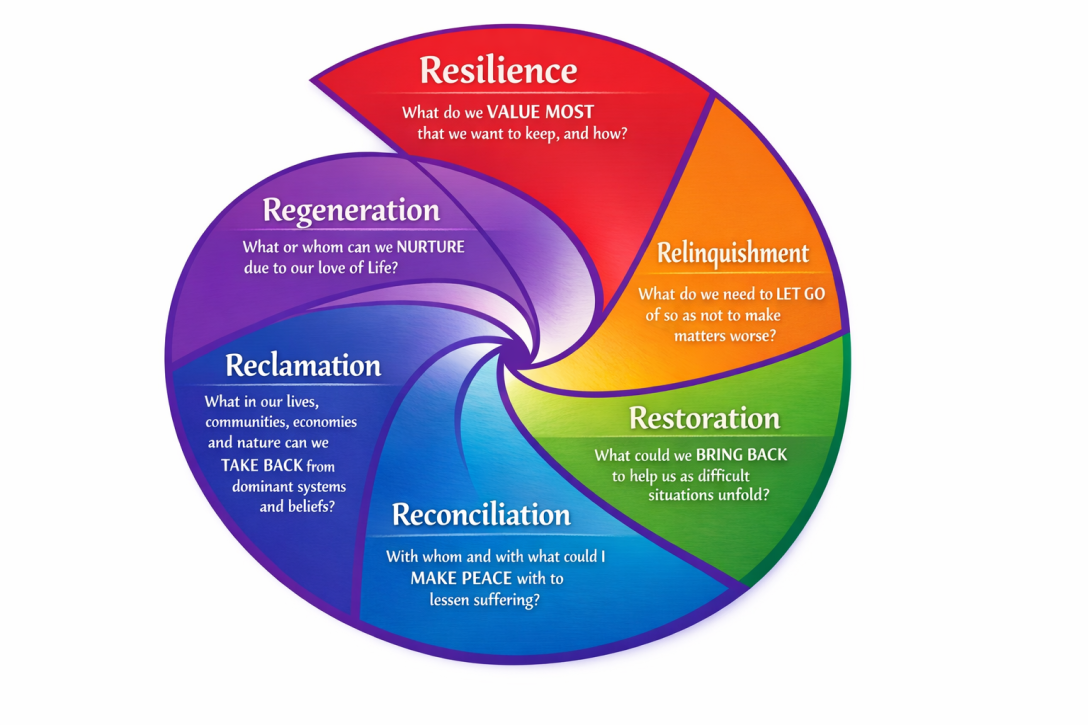
With the addition of the 5th and 6th questions to the Deep Adaptation framework, I think the framework will more effectively incorporate all the types of personal reflections and community conversations that people are having as they become collapse aware. These new Rs invite more attention to community-wide social action to increase possibilities within collapsing systems. They neither require nor invite denial of our predicament, but broaden how we find paths for our own positive action within a metacrisis and collapse. They are particularly relevant to how I have heard younger generations discussing potential responses to the situation.
1. Resilience
What do we VALUE MOST that we want to keep, and how?
2. Relinquishment
What do we need to LET GO of, so as not to make matters worse?
3. Restoration
What could we BRING BACK to help us as difficult situations unfold?
4. Reconciliation
With whom and with what could I MAKE PEACE with to lessen suffering?
5. Reclamation
What in our lives, communities, economies and nature can we TAKE BACK from dominant systems and beliefs?
6. Regeneration
What or whom can we NURTURE due to our love of Life?
I wrote about the 5th R of Reclamation in the book Breaking Together, and the 6th R in an essay on Regenerativity. For a fuller summary of the first 5 Rs, I recommend my previous essay on the framework.
A number of people who find the Deep Adaptation framework useful for their work have proposed new Rs and I presume more might be suggested in future. I’m happy to see the framework being used and adapted for positive purposes. However, I have defined the 3 additional Rs for the same reason I first outlined in the original Deep Adaptation framework. That is, I wish to encourage the type of reflections and conversations that aren’t that normal within either a progressivist culture and mindset, or a defeatist one. For that purpose, I now consider them a complete set, so won’t be proposing any more.
As the origin of this framework is within environmental awareness and concern, I have chosen to represent the 6Rs of Deep Adaptation with a widely recognisable symbol of life, which reminds me of some shells on the beach as I was thinking about these ideas.
I know that some people who appreciate the DA framing, and associated communities, can be hesitant to move beyond a focus on emotional coping of people in general, the collapse-aware in particular, or just themselves and their acquaintances. But if we want to embody and enable loving responses to our predicament, we can value our persistent desire to serve Life over our wish to avoid personal anxiety. We can also honour the fact that different generations have different emphases on how to become more collapse ready. Each of us will gain more from different questions in the DA framework at different times, and that is fine: as we don’t have a blueprint for how to live in a world where so much of what we knew to be real and true is now fracturing.
It was with this understanding that we can all benefit from moments of challenge or reassurance, striving or allowing, that I produced the Oracle Cards for challenging times.
Please share this updated framework within any Deep Adaptation groups and initiatives you are part of. If you can edit the Wikipedia page on Deep Adaptation, I’d welcome it being updating with this complete model of the framework. And if you know how to make videos: please do one on the framework… it seems it is how most people receive their information these days 🙂 Thx, Jem
Discover more from Prof Jem Bendell
Subscribe to get the latest posts sent to your email.
