Breaking Together for free – and my launch speech

So that cost is not a barrier to people accessing the analysis in my book Breaking Together, today the ebook becomes free to download. The book is also available as paperback, hardback, kindle and audiobook. My speech at the launch of the book is now online (see the video below, along with a rough transcript). We will be discussing the themes in the book in London on July 20th and Berlin on August 1st. Then I’ll disappear again to the organic farm school I am developing with fellow doomsters. If you, or someone you know, are feeling difficult emotions about this topic, or the recent climate news, then neither of you are alone. I recommend visiting deepadaptation.info and connecting with that community, or finding a relevant Deep Adaptation Guide. Please consider forwarding this information to anyone who might benefit from peer support on this topic. Thx, Jem 

Glastonbury Town Hall, June 18th 2023.
Continue reading “Breaking Together for free – and my launch speech”

From doom-scrolling the latest climate news to doom-sensemaking

As temperature records are broken around the world, some of the most senior ranking climate experts are quoted in mainstream media as expressing their grave concern. Because what is happening is worse than those climate experts predicted some years ago. They don’t say that though – misleading journalists to think that current temperature anomalies are not outside the projections from past IPCC reports. Many of them criticised and even vilified the more ‘alarmist’ readings of climate science over recent years. That includes my own Deep Adaptation paper, published 5 years ago this month. As I explain in Chapter 5 of my new book, now available as a free audio, the analysis in that paper aligns with observations of climate changes in 2023. In 2018 some NASA scientists privately agreed with me, before their bosses publicly dismissed my ‘alarmist’ conclusions after they had reached millions. Why is it that generalists like me were able to see what top climatologists would not express publicly? If we don’t inquire into the institutional and psychological reasons for their public reticence, then those same patterns will distort our future conversations on how to respond to the unfolding situation. That is not a minor concern, as psychological theories suggest that aversion to painful emotions and deference to incumbent power could become toxic to society.

Continue reading “From doom-scrolling the latest climate news to doom-sensemaking”

Why Growth became God

Since last week, I’ve been reading a few chunks of my book Breaking Together to my Dad, in hospice. That means I must choose the bits that might be worth listening to! One passage tells of an experience at Davos, when I was being encouraged to regard increasing rates of GDP as an evangelical quest. You can hear me read it. The passage is from Chapter 2 on monetary collapse, which you can read in full. The book is also available in all formats and locations.

Subscribe / Support / Study / Essays / Covid

Why Growth Became God

At Davos I thought, perhaps naively, that I was mixing with the real power wielders of the world. I never felt at ease in what Mr Johnston once described as “a constellation of egos involved in massive mutual orgies of adulation.” A few tequilas at the McKinsey Party helped me to ease my awkwardness hobnobbing with people who were often described to me as really-nice-and-down-to-Earth-despite-being-who-they-are. That was the ‘high’ bar that non-famous people tended to set for the people who happen to be billionaires, film stars, CEOs, despots and such like. I learned that the appropriate response was to put on my smile of amazement and say “that’s great.” I had thought it was important that someone like me attended and tried to promote alternative ideas. Some years later, I now know that there have been hundreds of other gullible I-am-different-and-will-make-a-difference activists who tell themselves that story as they maintain fake smiles while listening to absolute garbage coming from one panellist after another and wondering which party to go to next. But at least my years of attending the summits in Davos as a Young Global Leader opened my eyes to a reality of global power. It’s a mess. Most of the people I met with powerful roles seemed incapable of acting competently in the collective interest in accountable ways. Worse, attempts to invite people to think beyond their organisation or ego just seemed to make matters worse.

Continue reading “Why Growth became God”

I also hate this conclusion (on net zero)

I begin the final section of my chapter on Energy Collapse with the subtitle “I also hate this conclusion”. Because I did not want to discover that modern societies cannot continue their energy trajectories by simply displacing fossil fuels with new technologies. But that is what the sum of the relevant research shows us. In addition, the pursuit of the total electrification of economies will have hugely damaging effects on the biosphere, due to the mining involved. This is the awkward reality that most Western environmentalists are ignoring. The ‘green’ capitalists are extremely happy for us to keep ignoring that reality, as then any pressure for action translates into more money and pleasure for them. But if activism is about our personal commitment to higher goals, whether using moderate or radical tactics, then it must start with a fair assessment of reality and possibility. Otherwise, how is such activism not simply a mix of self-aggrandisement and emotional distraction by keeping busy?

The book Breaking Together is now available in audio, and Chapter 3 on Energy Collapse can be heard for free on soundcloud. To convey some of the arguments, below I share the first and last sections of the chapter. The image of the Kintsugi Tesla is from the Kintsugi World art project which accompanies the book.

Continue reading “I also hate this conclusion (on net zero)”

Alternative approaches to combat respiratory viruses – freedom from the failing corporate-induced orthodoxy of the early 2020s

Faced with ongoing risks from Covid-19, as well as future pathogens, all responsible citizens have an interest in what actions might combat respiratory viruses in future. That is whether actions are in addition to, or instead of, the approaches that have largely failed since 2020, despite the hiding of that fact by government authorities and mass media. Low levels of awareness about complementary or alternative approaches to combatting respiratory viruses has meant that many people assume that anyone critiquing the orthodoxy on Covid-19 must have less concern for public health, rather than being more concerned about it. Such lack of awareness is due to the corporate takeover of medicine, government, media and the digital sphere, which is hiding relevant expertise while promoting false moral narratives to elicit disdain towards people with heterodox views. Despite the resultant vilification, some experts have been so concerned about public health that they have been assessing whether other approaches might work better, as well as having fewer negative impacts on health and wellbeing. As I am often asked what I suggest would be a smarter response to the Covid-19 pandemic, as well as future epidemics, I am summarising some of my understanding in this essay.  

Subscribe / Support / Study / Essays / Covid

Continue reading “Alternative approaches to combat respiratory viruses – freedom from the failing corporate-induced orthodoxy of the early 2020s”

Should scientists moonlight as ideologues?

This is an edited excerpt from Chapter 7 of ‘Breaking Together’ where I get a bit technical on the nature of the scientific method and how unscientific some natural scientists and other experts have become when they discuss our societal predicament. Listen to the whole of this chapter on “recognising collapse and cultural decay” for free on Soundcloud. The release coincides with the availability of the paperback from the Schumacher Institute. Further ordering info follows at the end of this excerpt.

Subscribe / Support / Study / Essays

Much of the discussion about risks and processes of societal collapse involves arguments about what people think is useful to believe, or how they wish to feel about the future. Such discussion is about people’s own identities and worldviews, involving lots of assumptions and logical fallacies. It can get quite nasty and resort to demonisation of individuals, condemned for being too negative. However, returning to the basics of scientific method can help to cut through this ‘noise’.

Continue reading “Should scientists moonlight as ideologues?”

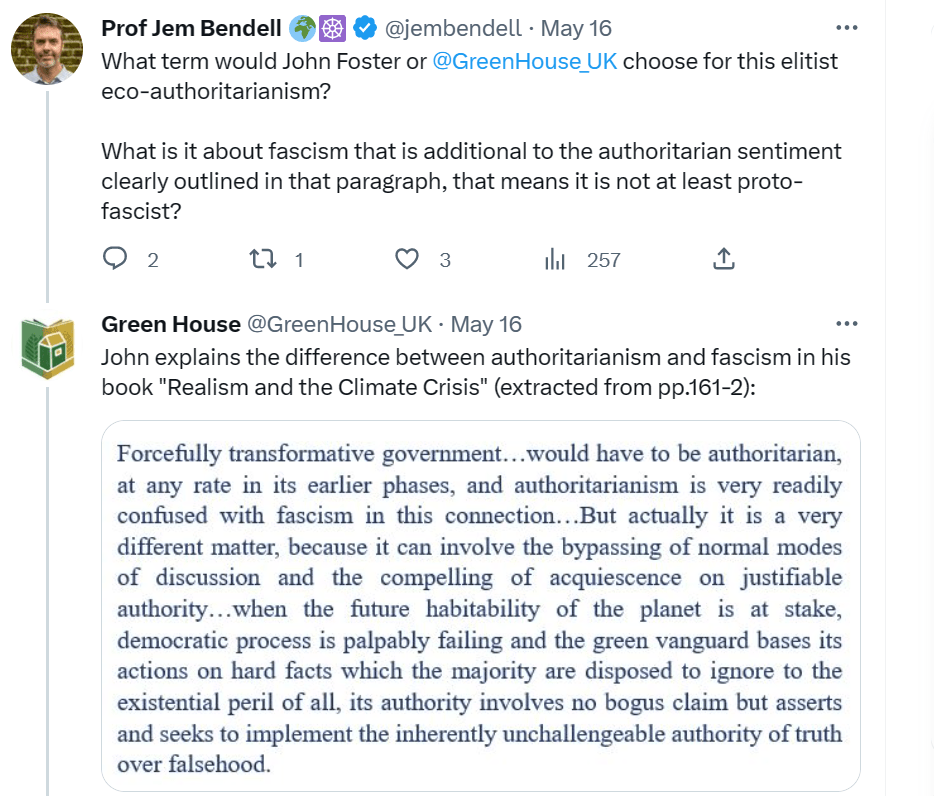
Why we must ALL challenge authoritarian views in green politics

Lancaster University academic, John Foster: “Forcefully transformative government… would have to be authoritarian…” “…if [Dr] Bendell wants to send GH [the Green House UK thinktank] an argued objection to what I said in my piece, GH will publish it along with a response from me. This is too important an issue not to encourage responsible debate on it.”

The following in an edited excerpt from the chapter “resisting the fake green globalists” in the book “Breaking Together: a freedom-loving response to collapse.” I am sharing it here in response to the Green House think tank supporting the views of the academic John Foster, which I quote further below. They invited a more substantive dialogue than possible on twitter. That seems appropriate as the thinktank claims to be “leading the development of green thinking in the UK” and has influential people on its board. The concepts I mention in this excerpt, and the evidence for them, are argued in detail elsewhere in the book, which is currently available as paperback/hardback/kindle, and will be available as a free epub download from The Schumacher Institute (TSI) from July 10th 2023 (as TSI always notes, these views are the author’s not the institute’s).

Subscribe / Support / Study / Essays

Continue reading “Why we must ALL challenge authoritarian views in green politics”

Getting more serious about food system breakdown

Combativeness and moral disdain pervades recent public discussion of environmental problems. It is not just one ‘side’ that resorts to such tactics. Take food and agriculture as an example. Some people speculate that eco-totalitarians will successfully force us to eat bugs and goo, whereas others oddly claim that anyone defending farmers is a far right extremist, obstructing the technological salvation of humanity and life on Earth. The AI generated image above is poking fun at the piety that’s in an unnecessarily binary discussion – as if we must all be steak lovers or steak haters, food tech fanatics or small farm purists. The famous climate activist Greta Thunberg has not descended into those silly binaries. Which is good, as they are unhelpful when we need a plurality of ideas on what to do about the unfolding breakdown of global food systems, as I chronicle in detail in Chapter 6 of my book “Breaking Together”. This blog coincides with the release of that chapter as a free audio (it is also available free from my University). 

Continue reading “Getting more serious about food system breakdown”

Atlas Mugged

The following is an extract from the book ‘Breaking Together: a freedom-loving response to collapse’, where I discuss the potential meanings of the ‘Kintsugi Atlas’ image on the book’s cover.

Subscribe / Support / Study / Essays

The matter of the collapse of industrial consumer societies is not only extremely inconvenient for those of us who are enjoying its conveniences, but also deeply challenging philosophical and spiritually. After a few years of soul searching about aspects of our culture that are implicated in this tragic situation, I arrived at the paradox of our desire to ‘be someone’ and help each other. One way of describing this paradox is with Greek Myth. The image on the cover of this book is an adaptation of the oldest surviving statue of Atlas, a character from Greek mythology. From the 2nd Century before the Christian Era, it depicts him straining to hold up an orb, which in the contemporary era has been widely misunderstood to represent planet Earth. That misunderstanding may have begun in the year 1585 with the use of the word Atlas by Flemish cartographer Gerhardus Mercator, to describe his collection of maps of the world. On the inside cover of his book, there was a drawing of Atlas having removed the orb from his shoulders and mapping it in his hands.[1] With her famous book ‘Atlas Shrugged’ Ayn Rand may have misconstrued the orb as representing our world, and therefore used it to symbolise the weight of the world’s problems (such as parasitic bureaucrats) on otherwise strong and free people.[2]

Continue reading “Atlas Mugged”

Evidence and theory for how monetary collapse has been made inevitable

“At 8:30 p.m. on 23 March 2020, then British Prime Minister Boris Johnson announced a stay-at-home order effective immediately, backed up by the subsequent regulation three days later. The stated aim was to “flatten the curve” of the rate of infections. So, he launched the slogan “Stay Home, Protect the NHS, Save Lives” and said that the lockdown would be reviewed every three weeks. This was unprecedented and came as a surprise to the public. But a week earlier, on March 17th, the Governor of the Bank of England, Andrew Bailey wrote to the chancellor Rishi Sunak outlining a similarly unprecedented measure, which would direct tens of billions of pounds directly to large corporations:

“The new Covid-19 Corporate Financing Facility (CCFF) will provide funding to businesses by purchasing commercial paper of up to one-year maturity, issued by firms making a material contribution to the UK economy. It will help businesses across a wide range of sectors to bridge across the economic disruption that is likely to be associated with Covid-19, supporting them in paying salaries, rents and suppliers, even while experiencing severe disruption to cashflows. The Bank will implement the facility on behalf of the Treasury and will put it into place as soon as possible.”

Continue reading “Evidence and theory for how monetary collapse has been made inevitable”