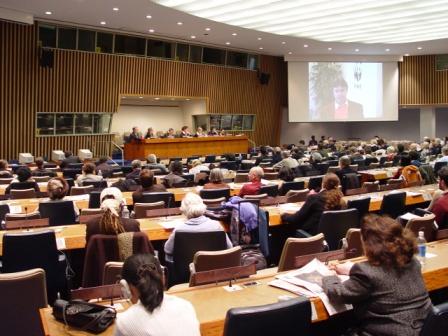
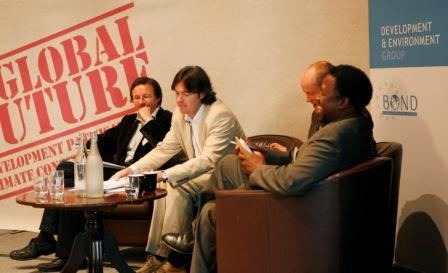
 Last week, during a nervy pre-speech wee break, then UK Environment Secretary, David Miliband walked in to use the adjacent urinal. “Ah, Dave, I’ve been meaning to talk to you about water privatisation…” I didn’t say. Introductions in toilets aren’t my thing. We were sharing another platform that day, giving plenary talks at the Development and Environment Group of BOND on the topic of development in a resource constrained world. Mr Miliband has been key in promoting sustainable consumption in the UK; often talking of the need for us to live within the means of our One Planet. Now that he has been promoted to Foreign Secretary we will hopefully hear of the need for One Planet Politics, that recognises the limits of and the unity within our one planet and the timeline within which we need to secure progress. No longer “foreign” secretary, but a leader of global relations.
In my talk I asked the audience the following simple questions.
- Hands up if you work in international development (all hands went up)
- Keep them up if you work on that in part due to a commitment to the principle that everyone everywhere should have the opportunity to thrive in harmony with others, to self determine their lives without harming others. (all hands stayed up)
- Now keep them up if you think that everyone everywhere, all 6 billion, could live like we do? (all hands came down).
I argued that the only way to ignore this paradox is if one works on international development due to a charity mentality, focused only on helping out some unfortunate people a bit. But if we are committed to universal principles about the dignity of everyone then we have to address this resource consumption issue, and find ways for people to develop in resource light ways, and reduce our own consumption to create resource space for others. Thus the environmental challenge is central to a rights-based approach to development.
My paper “The Consuming Issue for Development” follows below.
Information on DEG and the event, with links to follow up activities is at:
If, after reading the paper, you have any comments on the consumption challenge, please share them below. Oh, and yes, he washed his hands.
Miliband: Clean hands, cleaner world?
The Consuming Issue for Development
The climate challenge is a consumption challenge. Most of our emissions result from the products and services we consume. To tackle the humanitarian and economic crisis of climate change we must promote cleaner energy generation but also reduce the consumption of resources as a whole, both at home and abroad. Yet today humanity consumes fives times as much as fifty years ago. If everyone lived like the British, ecological footprint calculations suggest we would need three planets to support us. Indian middle classes have a higher per capita consumption of carbon than the average Brit. So it’s likely that if everyone lived like the new Asian middle-classes, the success stories of development, we would need at least three planets.
Does international development assistance arise from a commitment to the principle that everyone should have their basic needs met, live in freedom with dignity and pursue their aspirations? In that case it would appear that international development assistance has been based on a lie. Because it would be physically impossible for all the world’s poor to achieve higher wellbeing in ways as resource-intensive as the new Middle Classes in Asia and elsewhere. Resource-heavy development is, by objective measures, only a possibility for a minority or for the short-term. Therefore it is an elitist and undemocratic view of social progress. So how can all of humanity live well in a way that will endure? Our challenge is to find ways to improve human wellbeing within the limits of the Earth’s resources; to stop living as if we have another Planet to go to. That is the only authentic approach to a universal principle of social development.
As the United Nations Environment Programme (UNEP) policy framework for sustainable consumption recognises, we can no longer focus only on managing the specific impacts of consumption, such as avoiding certain areas or controlling types of pollution.[1] Instead, we must reduce overall demand for resources. That does not mean more efficiency, but demand management. For instance, more efficient fridges can mean fridges that are cheaper to run, and thus multiple fridge households and no reduction in overall resource demand.
This should not mean reducing wellbeing. Instead, it means a reduction in the actual resource through-flow of economies. This will require the ‘dematerialization’ of systems of production-consumption (i.e. physical efficiency of those systems), and the ‘optimization’ of systems of production-consumption (i.e. better management, planning, and changed attitudes and behaviour in those systems). This requires a shift in economic paradigm from the linear ‘take, make and waste’ approach to resources to a circular ‘make and remake’ approach.
Such a shift will need strong leadership from government and business. It is a common misconception that sustainable consumption is about shopping by individuals. In fact personal shopping is the least important factor in sustainable consumption. Business is the biggest consumer of resources, and can provide alternative products and services, and government is the biggest guide of this. The UK’s Sustainable Development Commission’s Sustainable Consumption Expert Roundtable report ‘I Will If You Will’, demonstrates not just that the individual consumer is not to blame, but that governments and business must themselves initiate and facilitate broad change.
Poor people want jobs not hand outs. Thankfully the sustainable consumption challenge could create mass employment opportunities. The European Trade Union Confederation has found that “less dependence on natural resources can be coupled with more intensive use of labour.”[2] To achieve a low-carbon high-employment economy, governments will need to shift taxes from employment to resources and help people gain skills for a sustainable economy.
In many cases, the poor may need to increase their consumption of resources to improve their quality of life. This means rich consumers must reduce their consumption rapidly towards a more fair allocation of resources, both within and between states. For any increases in poor people’s quality of life to endure they must be based on more resource-efficient solutions. It makes little sense to help people today by ruining their, and our, tomorrow. Thus redirecting resource consumption into more sustainable infrastructures and products is key. For example, the same amount of energy might be required to build a train system as a system of airports and roads but the former will create a level of mobility with less ongoing energy demands.
In summary, we need a ‘Global Step Change’ in consumption. We must step:
- more lightly, by reducing the total level of resource consumption involved in meeting our needs and aspirations;
- more carefully, by reducing our demands on sensitive ecosystems and exploited people;
- in the right direction, by increasing the proportion of resources that go into creating enduring means of meeting human needs in resource-light ways;
- together, by increasing our support for others to meet their needs and aspirations through stepping forward more lightly, carefully and in the right direction.
Hilary Benn’s ‘Preface’ to the 2006 White Paper acknowledged the interconnected and interdependent nature of our global society and the scale of global challenges faced. The full implications of this are now beginning to be realised. They include achieving sustainable consumption in the UK, to reduce Britain’s pressure on the atmosphere and other countries’ resources, as well as to create incentive for sustainable innovations in factories and farms around the world. They also include achieving sustainable investing and banking, so that finance flows to sustainable enterprise around the world. As the Development and Environment Group (DEG) of BOND commented on the White Paper, it is time for DFID to play “a stronger leadership role at home in representing the interests of the world’s poor.”
Assuming we can agree that changes in the development model are required:
- What are the most appropriate roles of civil society and government in bringing these changes about?
- How should government spending (as defined in comprehensive spending review and public service agreements) be adjusted to reflect the challenges identified?
- Could DFID call for a rapid intellectual and practical retooling of the worldwide international development community to integrate the climate challenge into all their work? Could it require organisational strategies for that retooling as a prerequisite for any future grants?
- How might DFID draw from its experiences with British companies through groups like the Ethical Trading Initiative (ETI) to encourage sustainable innovation in the supply of products and materials from the Emerging World to British companies? How might it engage private financial institutions in this regard?
- Could DFID actively support efforts to achieve more robust global environmental governance, such as a World Environment Organisation to replace UNEP?
- What other processes are there that we should be aiming to influence to reflect our positions?
[1] UNEP (2001), Consumption Opportunities: Strategies for change, a report for decision-makers. Geneva: UNEP.
[2] http://www.etuc.org/a/3356 and http://www.etuc.org/r/753