How ready are you
to accept
what you think
is stupid?
Category: Uncategorized
Summary of stats on my blog in 2011 from wordpress

The WordPress.com stats helper monkeys prepared a 2011 annual report for this blog.

Here’s an excerpt:
The concert hall at the Syndey Opera House holds 2,700 people. This blog was viewed about 8,600 times in 2011. If it were a concert at Sydney Opera House, it would take about 3 sold-out performances for that many people to see it.
Bonfire Banking

 As Brits ritually remember Guy Faukes’ attempt to burn down the Houses of Parliament in 1605, it’s worth remembering when Parliament did actually burn down, why and with what implications. It was 1834, and money was involved.
The British economy had a few types of currency back then, one of which was called “tally sticks”. These were used by the Exchequer to record credits and debts and thus acted as money.
But banks didnt like these tally sticks, which meant the government could issue their own money as they pleased. They wanted to be the ones to create money, by issuing their own notes, and to charge interest on loans of notes and coins.
So they lobbied Parliament and got the tally sticks abolished in 1826. A few years later some were still being used. That wasnt good enough for the banks. They wanted them gone. A decision was taken to burn them. Where? In the stoves of the Houses of Parliament. When? In a rush. Why? Who knows, but the histories we read tell of how the chap burning them wanted to go home early, and put too many sticks in the stove.
As a systems thinker, Im always a bit suspiscious of the pilot error, lone gunman, individual madman view of historical events. But who knows? It was handy for the bankers that if a fire broke out from burning these pesky sticks and it burned down the Parliament, that the government would have to go into debt to the banks’ own forms of money to build a new one. There was no more tally stick money to go back to, to buy the materials and pay the workmen. So the government borrowed 2 million in bank money, to build a new Parliament. Its good to have your government owing you money, paying the interest, keeping you happy.
Reading this history, I wondered… would it make more sense to burn a different effigy on bonfire night?
(thx to Cairan for alerting me to the tally stick burning history. happy bonfire night!)
World’s First Sustainable Luxury Awards – A reason to Spring in Buenos Aires!

I’m delighted to be helping curate the Sustainable Luxury Awards in Buenos Aires, November 4th, 2011. Its organised by the Center for Study of Sustainable Luxury (CSSL) and the Authentic Luxury Network.

Innovation in creating luxury goods and services that promote positive social and environmental outcomes is growing. To recognise and support the pioneers in sustainable luxury, new international awards are being launched in 2011. These inaugural awards will take place on November 4th in Buenos Aires, Argentina, and will help profile leading brands in Latin America, and beyond. If you would like to nominate a brand, provide support for the event, or request information on attending the awards, please email María Fernanda Tacchini . Nominations close at the end of August.
Awards will be made for the best sustainable luxury: clothing and accessory company, jewellery or watch company, tourism company (including hotels), transportation company (including cars), beauty company, breakthrough/innovative company, and best researcher. The members of the jury are: Dana Thomas (author of the New York Times bestseller Deluxe: How Luxury Lost Its Luster), María Eugenia Girón (author of Inside Luxury and former CEO of Carrera y Carrera), Renata Mutis Black (founder of Seven Bar Foundation which partners with luxury for social change); Ana Laura Torres (coordinator of the Sustainable Textile Center); Professor Jem Bendell (co-author of Deeper Luxury and consultant in sustainable luxury); Eduardo Escobedo (United Nations officer working on cosmetics and clothing for biodiversity conservation) and Summer Rayne Oakes (environmental model, author and entrepreneur).
The day before the Awards night, Dana Thomas, María Eugenia Girón and Jem Bendell will lecture on developments in sustainable luxury. Information will be given to those who register for the awards.
It should be a great and meaningful party.
For more information on the organisers, see http://www.lujosustentable.org
To connect with other professionals in sustainable luxury, see http://www.authenticluxury.net
Democracy is for lovers
As a vibrant election campaign comes to a close, it looks like I wont be able to use my favourite jokes when giving talks in Singapore in future…
Whenever asked about politics, as a visitor I had said…
“I’m sorry i dont know much about Singaporean politics…
….apart from that there isn’t much.”
or…
“One thing i quite like about your system is that, unlike where Im from, your politicians can’t blame the previous administration!”
Democracy is becoming more complicated in Singapore, and so at least in future foreign experts wont find it as convenient to say uninformed sycophantic nonsense about being culturally open when speaking about different political systems. (if you are reading, yes, you know who you are – you called it professional, I call it cowardly).
So while Brits vote against greater democracy, Singaporeans embrace it more. The world revolves and I know where my hopes now lie.
No, it’s not for haters: democracy is for lovers.
A course in sustainable luxury

The evolution of sustainable luxury, as an idea and a practice, continues, as Ive just finished teaching the first 2 days of the “sustainable luxury and design” MBA module at IE Business School in Madrid.
It was a diverse class from all corners of the world.. and of course a fun place to teach it.

Thanks to Nicky Black (Corporate Citizenship Manager of De Beers), for sharing insight into her work at a busy time of year (she is working on their next report to society, and got some feedback from the students on that).
I dressed up for the occasion…

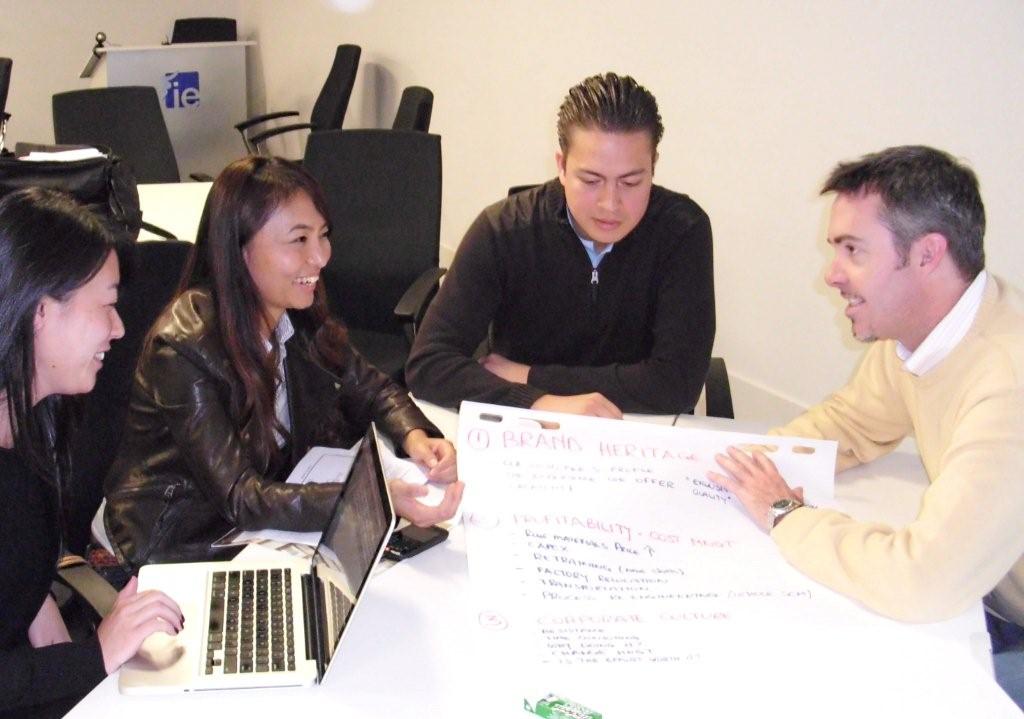
Sean Ansett, the Corporate Responsibility Director of Burberry, also travelled to Madrid to discuss what his team of 17 are doing on these issues. It was fun to see how Sean has developed his long experience in CSR to relate it to the needs of a premium brand.
Here he is in motion in class…
These sessions were somewhat introductory, and in the next sessions in April I’ll be able to work with the students more…
More info what next is on The Authentic Luxury Network.
Follow this via http://twitter.com/jembendell
If someone calls someone a cynic what does that make them? (hint, look it up)
Only cynics call people cynics. Why? By definition, cynicism is to assume negative intentions in others. Therefore to think someone is a cynic is to assume they have a negative view of others. It is to assume that they are being negative.
To dimiss either skepticism or critique as cynicism is to ignore the perspective and characterise the individual as negative, and thus to exhibit cynicism oneself.
We need skepticism and deep critique for inquiry and so it is mistaken to believe it to be either professional or moral to characterise these as purely emanating from a person’s negativity. Rather, the opposite is true – skepticism and critique are the beginnings of freedom, truth and effective action. Moreover, we even need some cynical thinking when evaluating the opinions, actions and inactions of those with power to affect others. That cynicism of never simply trusting in the moral character of the powerful is at the heart of modern notions of democratic rights, accountability and the separation of powers in a nation. Cynicism of those in power is an agent of progress, whereas cynicism from those with much power, or in search or praise of power, is an agent of tyranny.
The happiness epidemic
My colleague at Lifeworth Consulting, Janna Greve, sent me this on an email. Couldn’t find it on the web, and I like it, so am posting here.
Beware; Epidemic of happiness
A worldwide epidemic is spreading at astonishing speed. The WOW: the world organisation of well-being forecasts that billions of people will be infected within the next 10 years.
Here are the symptoms of this disease:
1) A tendency to follow ones own intuition rather than act under the pressure of fears, standart opinions and conditioning from the past.
2) Total disregard for such behaviours as passing judgements on others, on oneself, and being interested in whatever entails conflicts.
3) Total loss of the ability to worry (this represents one of the most serious symptom).
4) Constant pleasure in delighting in things and beings as they are, thus leading to our completely giving up the desire to change others.
5) Intense desire to transfrom oneself to positively handle ones thoughts, emotions, physical body, material life and enviroment, so as to constantly develop ones health, creativity and love potentials.
6) Repeated bouts of smiling, a smile which means thank you and gives a feeling of unity and harmony with all lives.
7) Constant opening to ones inner child, simplicity, laughter and joyfulness.
8) More and more frequent moments of conscious communication with ones non-dual soul… Being, which fosters a very pleasant feeling of fulfillment and happiness.
9) Taking pleasure as behaving as a healer who brings joy and light rather than as a critical and indifferent person.
10) The ability to live alone, with a partner, as a family or in society with a sense of flowing harmony and an equal footing, without acting as a victim, a tormentor or a saviour.
11) Feeling responsible and happy to offer the worlds ones dreams for a plentiful, harmonious and peaceful future.
12) Total acceptance of ones presence on earth and will to choose at every moment beauty, goodness, truth and life.
If you want to go on living in fear, dependency, conflicts, illness and conformism, avoid all contact with persons presenting these symptoms.
This disease is extremely catchy.
If you already show symptoms, you must know your condition is unrecoverable.
Medical treatment may momentarily cause some symptoms to disappear, but cant stop the inevitable progression of the harm.
No anti happiness vaccine exists.
Since this epidemic of happiness induces in people the loss of the fear of dying, which is one of the central pillars of modern materialistic societys beliefs, social unrest may break out, such as strikes of the desire to strife and being always right, rallies of joyful people to sing, dance and celebrate life, circles of sharing and healing, bouts of laughter and sessions of collectively letting off steam and unwinding emotions.
Each time we think we have achieved something, on the spiritual level, life quickly reveals there is still quite a lot of work to do… thank you
> so, if you know where it originated from, leave a comment.
Free Your Mind… from your Mind
“Our most intimate relationship is the one we have with our own minds. I was in a very dark place for a long time. Then one day I realised a simple thing. When I believed my own thoughts, I suffered. When I didn’t believe them, I didn’t suffer. Everything changed for me that day.”
– Byron Katie
“Make a list of [your] darkest, most aggravating, shameful beliefs – the poisonous, top secret, horrible judgements we reveal to no one – then choose the greatest shame of all and apply the four questions and turnaround”
1.Is it true?
2.Can you be absolutely sure that it’s true?
3.How do you react when you think that thought?
4.Who would you be without that thought?
“[Then] invert the original thought and give three examples of why this “turnaround” is as true as, or truer than, the original belief.
“According to Katie, any painful thought subjected to this inquiry loses its power to hurt us, since most of what foes on between our ears is a pack of lies.”
I did it, it helped.
All quotes excerpted from Mark Matousek’s book pg 127/8
More on him at http://www.markmatousek.com/
Globalising Trusteeship


On April 13th, ninety years ago, a British General ordered the firing on people peacefully protesting the repression of India. Mohandas K Gandhi was so moved by the massacre in Amritsar that he called for a special week to be observed every year – a Satyagraha Week. “Satya” means truth, “Graha” means both ‘involved in’ and ‘global’. Gandhi used satyagraha to describe a non-violent way of life, that does not participate in oppression wherever it occurs, and challenges it in non-violent ways. It became synonymous with India’s liberation movement.
Due to the work of Varsha Das and her colleagues at the Gandhi National Museum I was reminded of Gandhi’s teachings, and began re-reading what he said and did about life, politics and economics. As you probably are yourself, I was familiar with his famous phrases including that “we must be the change we want to see in the world’. But as I read on, I realised his views are very relevant to the current global economic crisis and the work I do on sustainable enterprise and finance.
The recent G20 failed to launch a deep reconsideration of the global economy, and some of its precepts, such as current concepts of property and a consumption-led economy. I suppose the pressures on the leaders for more-of-the-same were immense. But it has become clear that is up to us to begin a broader dialogue. Gandhi called for the Satyagraha Week to be one of fearless yet convivial dialogue about the truth of society and to redouble our efforts to live by that truth. Reading that affirmed some of the work I did this past year, with the Global Finance Initiative. After consultations with finance professionals and stakeholders in dozens of countries we concluded with a recommendation that dialogues on changes in financial systems are required that are:
- Foundational, addressing profound questions about the purpose of the financial system and the principles that direct its actions;
- Comprehensive, encompassing the connections between accounting systems, currencies, regulatory systems, economic structures and all parts of the financial system;
- Inclusive, with processes reaching beyond traditional insiders, to engage responsible investors, multi-stakeholder groups working on finance issues, asset owners, labor, NGOs and critical academics, and be truly global;
- Systemic, connecting financial stability to the real economy, social equity, and environmental sustainability.
This dialogue could be part of a global truth-seeking — a ‘Global Satyagraha’. Beyond his views on dialogue and truth-seeking, MK Gandhi’s views are relevant to the future of the global economy and our work on responsible enterprise and finance in at least four ways: economic equality, appropriate technology, self-reliance, and trusteeship.
Challenging both the caste system and negativity between religions, he promoted the equality of all peoples, which meant non discrimination in employment and economic affairs. He also believed that technology could be good if did needed work, but bad if it put people out of work. This philosophy led him to spend many hours working on the spinning wheel, a technology that was appropriate to the economic level of villagers across India at the time. Another important aspect of the spinning wheel was how it generated self-reliance. Gandhi spoke of ‘swadeshi’ or economic self-sufficiency, as the only way that India would achieve self-determination. He called on his country-people not to pay into the system of empire by buying foreign clothes. In our current context the implication here is not simply that we produce for ourselves, but that we seek to become independent of systems of exploitation for our own livelihoods and lifestyles.

These aspects of Gandhian economics are well documented and discussed. Like many business folk the world-over, many Indian executives do not see the relevance of these approaches to modern business, viewing them as anachronistic. Yet, in a resource-constrained and climate-threatened world, where hyper-inequality fuels violence, the need for principles and practices of equality, appropriateness and self-reliance to pervade business is clear.
What stunned me was the resonance of his views on ‘trusteeship’ with the latest thinking within the corporate responsibility movement. More of us have come to understand that we need to redesign the systems of corporate governance and finance in order to create more sustainable and responsible economies, and that business executives can and should engage in public policy debates to promote that redesign. In my latest book, I develop the concept of “capital democracy” to describe an economic system that responds to this understanding. I write:
“In a democratic society, property rights should only exist because people collectively decide to uphold them; they are not inalienable but are upheld by society as a matter of choice. Therefore, if society confers us the right of property, then we have obligations to that society. Today property rights have become so divorced from this democratic control that they are undermining other human rights. A reawakening to a basic principle is required: there can be no property right without property duties, or obligations. From such a principle, it should not be left up to the powerful to decide if they are responsible or not, or if they are carrying out their obligations or not. Instead, the focus shifts to the governance of capital by those who are affected by it” (Bendell, et al, 2009, Pg 33 to 34).
The Mahatma’s view of trusteeship is the same, but elegant in its simplicity. It arises from an understanding that everything is owned by everyone, and wealth is owned by those who generate it. Thus the one who controls an asset is not an owner but a trustee, being given control of that asset by society. Gandhi wrote “I am inviting those people who consider themselves as owners today to act as trustees, i.e., owners, not in their own right, but owners in the right of those whom they have exploited.” In the Harijan paper his views on trusteeship of property were later documented to clarify “It does not recognize any right of private ownership of property except so far as it may be permitted by society for its own welfare” and “under State-regulated trusteeship, an individual will not be free to hold or use his wealth for selfish satisfaction or in disregard of the interests of society.” He also wrote that “for the present owners of wealth… they will be allowed to retain the stewardship of their possessions and to use their talent, to increase the wealth, not for their own sakes, but for the sake of the nation and, therefore, without exploitation.” All those years ago the Mahatma was proposing an economic system that many people are only beginning to conceive of today. If you have my book, I apologise for my prior ignorance of Gandhi’s trusteeship concept. If you don’t have it under your trusteeship yet, hey, it’s still worth reading!
Sangeeta Das of the Gandhi Smriti Museum revealed to me how some Indian industrialists supported many of Gandhi’s ideas and applied some to their own business. Upon reading the views of some current Indian business leaders I see the concepts of equality and trusteeship have informed their voluntary corporate responsibility efforts. However, I am left with a sense that the concept of trusteeship has much untapped potential as an economic system, codified into public policy and regulation. The current crisis demonstrates the need to globalise trusteeship, or capital democracy, as an approach that can be debated and interpreted into new principles and policies for economics, finance and enterprise. In addition it is clear that concepts of appropriate technology and self-reliance have much more to offer both to corporate strategy and public policy than currently the case. I wonder whether Indian business leaders could play a role in bringing this insight to the world.
The life of Gandhi is important not only for his views on economic systems but also on how to bring them into being. In my book I argue that the global challenges we face mean those of us who work to make business better must start thinking and planning like a movement. “The corporate responsibility movement is a loosely organised but sustained effort by individuals both inside and outside the private sector, who seek to use or change specific corporate practices, whole corporations, or entire systems of corporate activity, in accordance with their personal commitment to public goals and the expectations of wider society.” (Bendell, et al 2009, pg 24). As a movement leader, we could learn from Gandhi’s mastery of symbolic communication combined with personal authenticity, his embrace of both dialogue and direct action, his respect for people no matter the differences, and his demonstration that we must ourselves disengage with systems that uphold a lie. More of us can mobilise our networks and knowledge for transformative ends. And if it means changing our lives to be less economically dependent on the status quo, then that’s what we must do.
The recent violence from authorities against protesters and bystanders (and the truth) at the G20 is yet another reminder of the need to learn how to engage in a transformative non-violent movement that provides people diverse ways to participate while sucking energy out of violent systems. On the 90th anniversary of the hundreds who died in Jallianwala Bagh, we can remember how their memory inspired millions in the pursuit of truth and freedom.
I will be discussing some of these ideas in a webinar, online, and seminar in Geneva, called: “The Corporate Responsibility Movement: Where are we going and why?” Seminar: Thursday May 14, from 12.30 to 14.00 Swiss time, Uni Mail, 40 bd du Pont d’Arve, Geneva, room MR 150 (ground floor, opposite the cafeteria). Register: csr@unige.ch. Webinar: Tuesday May 19, from 16:30 to 18:00 UK time, organised by CSR International. Venue is “online”. Register: clemence@csrinternational.org http://www.csrinternational.org/?p=273
Thx to Suzy, Satjiv, Inderpreet, Nandita, Varsha and Sangeeta for unwittingly guiding my serendipitous journey in India.

You must be logged in to post a comment.