A new role for the UN in an age of collapse

Not long ago, I sat across from a UN civil servant at a quiet café in Geneva. She had worked for over two decades in the UN system, from humanitarian relief to climate diplomacy. As she stirred her coffee, she confessed: “I feel disappointed, bewildered. Sometimes I wonder if anything we do makes a difference anymore. Her voice was tired, but not bitter—more like someone watching a dam crack and realising she only had her teaspoon to stem the flood.

She is not alone. In conversations across UN agencies, I’ve been hearing similar expressions of despair. As institutions strain under the weight of cascading crises—climate chaos, ecosystem breakdown, spiralling inequality, violent conflict, and the abandonment of international law—many international civil servants find themselves in a moral and professional no-man’s land. They are loyal to the ideals of the UN, yet unable to reconcile those ideals with what they now see daily: the world is not just “failing to meet the SDGs“—it is unraveling.

Continue reading “A new role for the UN in an age of collapse”

No More Warnings Needed – an intransigent managerial class must be sidestepped

Six hundred and seventy-four scholars from 53 countries, believe that “Only if policymakers begin to discuss this threat of societal collapse might communities and nations begin to prepare and so reduce its likelihood, speed, severity, harm to the most vulnerable, and to nature.” Each signatory, with doctoral degree, endorsed a public warning on societal disruption and collapse due to environmental change. They cover more than 20 major academic disciplines, including ecology and climatology, thereby conclusively demonstrating that preparations for societal collapse are being taken seriously by experts from around the world. The announcement of the final list of signatories concludes a 3-year initiative to promote awareness of the scientific basis for exploring how to reduce the damage from societal disruption, breakdown, and collapse, due to environmental change.

Continue reading “No More Warnings Needed – an intransigent managerial class must be sidestepped”

The Emperor’s New Lab Coat

Mainstream media are ignoring a scientist who is whistleblowing the climate profession.

During the five years since new kinds of activism brought the climate issue into the headlines like never before, the topic has more clearly become one where people respond due to their preexisting worldviews. It’s not just believers and sceptics, but there are those who think technology can save us, those who think it’s too late; those who think the science is clear, others who think it is open; those who believe humans will muddle through and those predicting human extinction. Climate scientists themselves now range from those emphasizing ‘we can do this’ to those that express their grief and outrage by gluing themselves to buildings. Meanwhile, misleading narratives are amplified by a variety of vested interests, including fossil fuels, nuclear, and clean tech. Climatologist Dr Wolfgang Knorr is an unusual voice in this cacophony because he has been ‘blowing the whistle’ on the climate science itself and how it is being communicated. His perspective hasn’t found wealthy supporters or mainstream platforms, and so his voice hasn’t been much heard, which is why I want to bring it to your attention here.

Continue reading “The Emperor’s New Lab Coat”

Would even an infinite fund on loss and damage be enough?

This is the Editorial of the final Deep Adaptation Quarterly of 2022.

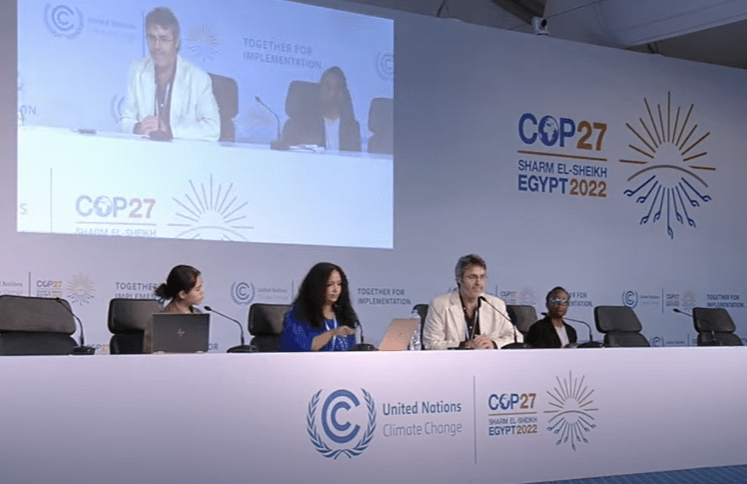
The COP27 climate conference announcement of a new fund, of unknown quantity, for the loss and damage occurring due to climate chaos, means it might appear that politicians and bureaucrats are finally getting real about how bad the situation is. So could they be catching up with the ‘Deep Adapters’? Unfortunately, no fund will ever be able to recompense the loss and damage that is being suffered – and will be suffered – from the impacts of climate and ecological breakdown. No international currency, bank, or payment system will likely survive the extent of disruption when impacts of global heating really kick in. I am just back from my first and last climate conference, and not only experienced it as an exercise in denial but one that is made impenetrable by the numbers of people and resources maintaining it in myriad ways. Even critics of COP27, and climate policies more generally, have their budgets, wages, skills, and status tied to the story of ultimate salvation from climate chaos. A consequence of this denial is not looking at the root causes of our predicament. Which might also be a reason for the denial. So let’s go there…

Continue reading “Would even an infinite fund on loss and damage be enough?”

Capitalism Versus Climate Justice – thoughts on my first and last experience of climate COP

In the run up to COP27 climate conference, The Economist magazine declared it has become impossible to limit global warming to an average of 1.5 degrees Celsius above pre-industrial levels. Many analysts of the relevant science have said as much for a few years. We were dismissed as too negative and so our ideas on what to do were therefore marginalized. Sadly, warming beyond 1.5C means that climate change will become far more damaging to societies. Even worse, due to a range of amplifying feedbacks that are impossible to have certainty about, no one can credibly claim anymore that human actions to cut and drawdown carbon, while still important, will certainly work to stop or reverse the changes. When people take that situation to heart, it can challenge the societies and systems that brought us to this point. For many, it is a fundamentally radicalizing realization. Although The Economist cited my views in one of their articles, rather predictably it didn’t provide space for the kind of criticism of capitalism and the global order that can ensue.

Continue reading “Capitalism Versus Climate Justice – thoughts on my first and last experience of climate COP”

Decolonize the World Health Organisation (WHO)

There is now much peer-reviewed science on the medicinal benefits of various natural foods. Which is obvious as humans have been healthy and recovering from disease since… um… well… prehistory. 

So science is playing catch up with traditional and community knowledge on how to help stay healthy and recover when we get sick. But that wisdom is studiously ignored by medical bureaucracies that have been trained to only accept large clinical trials of the type that (mostly Western) pharmaceutical companies can pay for. It means that esteemed institutions like the World Health Organisation (WHO) mostly ignore what is being done with healing plants in many countries. Worse, their staff devoutly and proudly ignore it as a matter of professional and personal identity as being strictly “scientific.” I know that because I worked as a consultant with them before. And there is evidence that millions are suffering as a result of their conceit. 

Continue reading “Decolonize the World Health Organisation (WHO)”

Cutting Love – 4th Quarterly

Every 3 months I send an update. In my 4th I focus on listing some links for resources and events, before a few thoughts on “cutting love.” You can sign up to receive this Quarterly Bulletin.

First up, the culmination of a year’s efforts, today the UN publishes a paper I co-wrote on how Ewtonterprise Zones can contribute to the new Global Goals for sustainable development. These zones are popular with some governments, from India to the UK, but they aren’t without criticism, in terms of what they achieve. Now with changes in trade rules, Zones are going to have to come up with new ways of staying competitive. We argue that embracing social and environmental excellence is a clever response. I explained this in my article for the World Economic Forum. I was pleased to present the preliminary findings at the public forum of the World Trade Organisation (WTO) in Geneva in October, and the report is launched this week in Nairobi at the ministerial. You can read it here (pdf). I’m grateful to Dr Tony Miller at UNCTAD and also for colleagues at the University of Cumbria for supporting me to do this work.

In September I stepped back from Director of the Institute for Leadership and Sustainability (IFLAS) so I can focus on my research and teaching as a Professor of Sustainability Leadership (as part time) as well as new role with an impact investing fund. I’m pleased Dr Caroline Rouncefield is the Acting Director and joins an Institute with 5 MBAs growing well (over 2000 international students), as well as co-delivery of an MSc in Strategic Policing and a new MA in Sustainable Leadership Development. One of the last projects I worked on was to initiate a partnership with the National Trust, to promote innovation in the heritage and conservation sectors, which was recently launched with some fanfare. Our Deputy Director Dr David Murphy will lead on the project for IFLAS.

Trimantium Capital are the Impact Investors that I’ve joined the board of. Headquartered in Melbourne, Australia, it is making waves for attracting hundreds of millions of dollars into a fund directed at financial services and health technology with a clear social and environmental purpose. As the Paris climate summit started, I shared what some of us impact investors are thinking about the future of fossil fuels, in a WEF article.

Looking ahead from the winter, at IFLAS we will turn our efforts towards to the IFLAS Spring School, for two weeks in both London and the Lake District. It kicks off our new MA, but can also be attended as a stand-alone course. Lots of mid-career execs do our courses and become co-conspirators on future projects. The Spring School will also involve a reunion of participants in the Leading Wellbeing Festival, on April 9th in Ambleside, which will also be the annual meeting of the Cumbria Environmental Network. If you are interested in the new MA or the Spring School, please fire off an email to iflas@cumbria.ac.uk

Some of the ideas behind the MA are contained in a co-authored paper just published by the Journal of Corporate Citizenship (JCC). I’m grateful to Richard Little at Impact International for having schooled me in critical leadership thinking these past 3 years. I also presented the paper at the International Leadership Association in October and will share some similar ideas at the ‘Lead in Asia’ conference in Bali on the 21st January.

The 2nd cohort of our Mass Open Online Course (MOOC) on Money and Society went well, with around 100 people completing all 4 assignments over the month. That means they can now progress to the Certificate of Achievement in Sustainable Exchange, with the 5 day residential happening in our London Docklands Campus in April (as part of that spring school I mentioned). This labour-of-love for me and course co-tutor Matthew Slater, this free course is “bloody brilliant” and “mind bending”. The next cohort starts on Feb 14th and runs for a month online. Read more and sign up here.

Since my last update I was pleased to receive an award for my past work on cross-sector collaboration for sustainable development. The award made the local news, and my paper on the future of such partnerships (think disruption and revolution) is available here.

That’s nothing compared to being made an honorary fellow of the University of Cumbria. In November, my friend Funmi Iyanda became the first African Woman to be recognised in this way by the University and gave a powerful speech in Carlisle Cathedral. Her talk really reflected our ‘transmodern’ times, where we purposefully and playfully mix old and new ideas from all corners of the world to discover ways of rethinking progress today. Read her super speech here on the IFLAS blog, which is now also home to a regular series of articles on leadership themes.

In October I was pleased to host Professor James Wilsdon’s at our Lancaster Campus to discuss the future of how we are going to be assessed as academics. James is the chair of the Campaign for Social Science. As the University sector has been blasted by austerity measures over the past years and will continue be, James does important work reminding everyone why it’s good that we do what we do and how to do it better. Britain has an incredible heritage of intellectual leadership of international importance, based on the country’s love of learning and its institutions of research and education. Sadly we have now become the most expensive place in the world to get a degree, while many Universities cash in on their heritage in the form of sponsored buildings and uninspiring pack-em-in courses.

Unfortunately just the week after the celebrations in the Cathedral, a large part of Carlisle went underwater due to a storm that damaged many towns, villages and roads in Cumbria. The increased frequency and intensity of extremes of weather is in line with predictions from climate models. The events in Cumbria made climate change that much more personal, as explained in a first hand account by IFLAS Advisory Board member Becky Willis. The beginning of climate chaos is already upon us, with weird weather fuelled by a raised global ambient temperature of 0.8 degrees Celsius over the past century, along with seas warmer by 0.7 agrees and higher by 8 cm, on worldwide averages. The most concerning thing is the extremes, with the north-pole being about 5 degrees warmer than hundred years ago. After the floods people have begun to ask why the investment in flood defences and watershed management wasn’t increased in line with the known growing threat from a disturbed climate. The answer, again, is austerity. The floods are a reminder that you can’t ignore nature because of your politics.

Looking across the country, the cuts in government spending can be seen as cuts in a nation’s commitment to its shared assets. Whether it is flood defences, education or care for the disabled, all the things being cut are the things that reflect a country’s capacity to love itself: to care for its towns, its people, its culture and its future. When a government is cutting back on love, people must fill the void, as has been the case in Cumbria, with a wonderful community spirit emerging. If you want to help support people who have been flooded, please see the Cumbria Foundation or Spirit of Cumbria.

Although an agreement in Paris is important, the key is implementation. To make changes quickly, finance and trade ministers will need to shift incentives, hence the reason for my WEF blog. Ultimately we will need to redesign of our monetary systems, to allow us to thrive without requiring exponential economic growth, as I explain in the free intro to my last book.  A COP21 climate agreement is a piece of the puzzle; but the puzzle is already burning. We will have to live with the weather that’s coming and that calls for us to go deeper in our discussions and planning, as I described for Open Democracy earlier this year.

If any of these topics interest you, then do engage in the Sustainable Leaders linked in group, or see my latest musings at www.jembendell.com

I hope you have a good holiday wherever you are,
Jem Bendell

You can sign up to receive this Quarterly Bulletin.

An immigrant walks into a bar…

An Eastern European Immigrant to the UK (aka: human) walks into a bar: “A key reason I came to the UK was because of education for my kids. I grew up in communist Hungary but the education was so much better than the values they are teaching now.”

Me (slightly pissed human): Why do you say “but”? Why not “so”?

Immigrant: …… (Silence, maybe confused.)

Me, point maybe made: “So you like the UK for its schools?”

Immigrant: “Yes, but it was tough at first with my different landladies in Oxford. I realise they don’t differentiate between types of foreign residents. Its crazy foreigners can get benefits. But most of us don’t. I don’t think people know that EU migrants to the UK are a net economic benefit to the UK. I think its crazy you have a system that funds people to not work and have babies, that can be taken advantage of by foreigners, so then we all get the blame.”

Me: “Why isn’t it something to celebrate about Britain that we look after the basic needs of vulnerable people and all babies?”

Immigrant: “Well its impossible to pay for everything”

Me: ” Where did you get the idea we can’t afford that? We afford to give billions more to bankers, including many foreigners, for bail outs, than to single mums. I don’t think your landladies have considered Eastern European bankers in London having been a net drain on the economy. So where are they getting their bad impressions from? They’ve been given a narrative of blame. Are you joining that?”

Immigrant: “But don’t you think you need to tighten up as Britain is an island with only so much space. You can’t have all these people coming for benefits”

Me: “Ah, space. You means house prices and rents? UK population growth in the past decades was less than the amount of new housing built. The cost of housing is driven by our banking system where about 80 percent of new money is created as loans for property purchases. Immigration is a not a significant factor for the systemic problem of cost of housing in the UK. The fact you haven’t heard much about that reflects the mass corporate media and BBC agenda to ignore systemic political issues.”

Immigrant: “Something is wrong when my husband finds its easier to sign on for unemployment benefit than open a joint account to access our own money. Your benefits system is too easy.”

Me: “Maybe banks should be more efficient: it sounds like they could learn from job centres! We might improve the benefits system but its a secondary or non issue for the state of the UK right now. You sound like you tried to find common ground with your landladies but end up blaming others less fortunate than yourself. It seems there’s a cascade of blame on every one lower than them on the power ladder. I remember there was a kid at school who was bullied and who tortured insects”


Reflections

This was a very educated lady, works at a top University. My reflection is that once narratives of blame are maintained by mass media then a spirit of wanting to connect to people living in societies with such narratives can then lead us to find complementary narratives to the power structure that those main narratives of blame protect. We all peck the smaller bird.

My speech at the UN on the housing crisis:

https://www.opendemocracy.net/jem-bendell/from-castle-to-cage-what-to-do-about-housing-crisis

Future lines of debate and action on climate

Last week’s climate summit and week of side events in New York got people talking about climate change. But I looked at the 400,000 person march with a heavy heart. The climate science has moved on. It was hinted at by Leonardo DiCaprio in his speech to the UN, when he mentioned the plumes of methane rising from the ocean floor. What’s been happening in the Arctic the last few years is far beyond even the worst case predictions. It amounts to localised 5 degree warming already, and the summer pack ice disappearing in the next few years, when just 7 years ago we were told by scientific consensus that might happen in the 22nd century. The warming in the Arctic has been exponential. There are signs that this is already affecting the frozen methane on the sea floor, leading to methane release into the atmosphere. Over 20 years, methane is 84 times more potent than CO2 in greenhouse effect. Mass release of methane is a mechanism that scientists have known for years was the cause of the last mass extinction, the Permian, which ended 95% of species on Earth. (For videos on this, see Last Hours, or 10 minutes of this)

Given this information, the future debate about climate will be very different to what was considered appropriate in either the conference centres or on the streets of Manhattan last week. It is this future debate that we need to explore ourselves, urgently, even if politicians, businesses, and mainstream environmental groups are not ready to yet.

On the sidelines, I’m seeing four future lines of debate and action on climate: profound change, emergency response, local resilience, and transcendence.

Profound Change is the theme we heard from Naomi Klein, Leonardo DiCaprio and others in recent weeks. The argument is that the efforts to incorporate climate concerns into current economic systems has failed to have any significant impact on aggregate carbon emissions. The arguments that such approaches are “pragmatic” and “non-ideological” no longer have any evidence to support them. Instead, the only intellectually or morally sound environmentalism is now an explicitly revolutionary one, that seeks to change our political economic systems. Ideally, peacefully – I’ve not heard of any one calling for armed struggle! Klein’s new book (This Changes Everything) explores this Profound Change analysis.

Emergency is another approach to the latest climate science, whereby people think that a Profound Change in political or economic system is not sufficient, as we are now on course to experience abrupt climate change within the lifetimes of humans already borne. Therefore, such as emergency paradigm starts with calls for urgent geoengineering to cool the arctic to save our civilisation and even our species. The argument is that the risks are now so great that we have to take the risk to geo-engineer. The call becomes one not only of scientific research and experimentation, but also for intergovernmental frameworks for implementing such an approach and dealing with possible damaging consequences for some peoples and regions. This emergency approach can also trigger discussion about how to deal with climate-induced collapses in societies, including humanitarian responses and security responses. For instance, this could include new roles for atomic energy agencies to bring nuclear plants to cold shut down in situations of social and economic collapse. Authors exploring these ideas include Mark Lynas (The God Species) and several writers in The Ecologist. While people thinking within the emergency paradigm are often talking about physical adaptation, such as higher sea walls, they are not often discussing deeper psychological adaptation to climate change, which is where two other lines of debate come in.

Local Resilience is a third approach I have been hearing on the sidelines. This is when people consider that it is too late to avert a collapse in the current civilisation due to catastrophic climate change, even if profound change occurs in our economic systems and geoengineering is underway. A belief in near-term collapse leads to people focusing on what forms of life could be sustained, what values and aspirations might help up in a transition to that different way of life. This isn’t the well-known agenda of transition to a post carbon world, but a transition to a way of life where basic facets of our current societies no longer exist, such as the nation state, industrial agriculture, pharmaceutical drugs, and so on. The film Collapse introduced the world to the late Michael Ruppert, who expressed this view quite eloquently. Some of the more radical elements of the Transition Towns movement give space to this line of argument, as do authors like John Foster (After Sustainability), Charles Eisenstein (The More Beautiful World our Hearts Know is Possible), and projects like Dark Mountain, that encourage new cultures to emerge to help in this traumatic transition ahead. A key insight from this approach is how to not make things worse through attachments to ways of life and values. Are brands, properties, or nationalities so important? There are many things that we hold to be true and important in our societies which we need to be better at letting go of.

Transcendence is the name I’ll offer for a fourth line in the emerging debate on climate. It is when one allows oneself to consider that near-term extinction of the human race is now probable. Obviously to most people that is a harrowing and saddening thought. In my experience most people, like myself, attempt various forms of denial when faced with this idea. Many consider it would imply fatalism and risk states of despair, depression and inaction. However, those who do accept this analysis, at least for reasons of intellectual and emotional exploration, are finding a range of different insights result. For people like me, who since 15 years of age defined self-worth in terms of contributing towards sustainability and protecting the climate, this process can be extremely destabilising, involving some grief. Yet despair can be transformative. It can lead you to transcend your previous sense of self, and allow a new one to emerge, less framed by attachment to notions of self-worth or progress. Others may find they stop working on sustainability altogether. Others may enter depression, especially if they cannot cope without a story of self-efficacy. This line of debate is difficult for me to describe at this time, but appears to emphasise that we reflect on fundamental questions about the meaning of our lives and the meaning of life itself. Some will turn to religion for answers, and yet others will find existing religious explanations as fundamentally limited in how they address such dilemmas. The writings of Carolyn Baker (Collapsing Consciously) explore these issues, by deriving insights from hospice care. I think the writings of others who study what we learn from suffering will also be helpful in this line of thinking, such as those of Mark Matousek.

I recently brought these hidden debates on climate science into the classroom with our mature students at IFLAS. Most have been engaged for years on matters of social and environmental progress. None of the four perspectives I outline above suggest that “progress” has a future. As such, these ideas can destabilise one’s sense of self. I’ve always believed that real education is of the heart and soul as well as the mind… I just didn’t think it would have to involve such a difficult topic. I’m informed that the potential trauma from certain perspectives on climate science is not something that therapists have been widely discussing or have experience with treating. The climate category on “Therapy Today” indicate something of the state of the debate in this profession. I realise many people will shy away from this debate, and instead return to positive things such as the price of solar falling below that of coal. At a subconsious level people who do that will know they are simply changing the subject from what the latest climate science is suggesting about the changes we are already locked in to. Denial may be tenacious, but wont last.

I’ve mapped out here 4 lines of debate on climate science and action that were largely hidden during last week’s events on climate change in New York because I find them bubbling up in more and more conversations, and after broaching this subject I feel a responsibility to provide further information. There will likely be more lines of debate. There are also insights that can be blended from each. For instance, perhaps some forms of geoengineering could be supported by those who think that it’s too late to save this civilisation or the human race. One thing I am convinced about already is that many of our current institutions, including things as basic as our monetary institutions, are not designed to help us address this tragic new agenda. I am also convinced the more that senior decision-makers are attached to the idea of being good and self-efficacious, and being seen to be such, the more they will make things worse for humanity. Instead, we need people to approach this difficult time with greater humility, equanimity, gratitude, inquisitiveness, compassion, love, playfulness and hope. I am also convinced that the institutions we have created in our political, economic and social sphere have not promoted such qualities within them or to the top roles. So the greatest leadership challenge I see today is therefore one of unlearning a lot of deluded notions about self, success, and progress.

If this stuff is new to you, I recommend you talk to someone about it.

Im not a therapist.. If you think you might benefit from talking to one, here are a couple of links relevant to UK readers:

http://www.itsgoodtotalk.org.uk/therapists/

http://www.emdrassociation.org.uk/home/index.htm


Economic governance is key to any useful outcome from Rio2012

Readers of my blog will note that at the beginning of the year I reflected on the coming Rio2012 Earth Summit, and what it could be useful for. Since then the preparatory committees have got somewhat lost in definitional issues about what the “green economy” really is… oh, the farce of humanity’s efforts to do something together for our common future.

Dark grumblings aside, during the year Ive been doing some work on the economic governance needs for more sustainable development. Some of the results of that are out, with the UNCTAD World Investment Report discussing public policies for scaling CSR (I helped with the research that went in to it), and a new journal article just out where we go into some depth on a new paradigm of collaborative economic governance for sustainable development.

The UN Non Governmental Liaison Service published my opinion piece about the need to focus on economic governance, in their “Road to Rio 2012” publication. But it was in a publication from Singapore, for the region’s enthusiasts in social enterprise, corporate responsibility and voluntary sector, where I let summed up some basic points…

“If Rio 1992 was about governments calling non-state actors to act, Rio 2012 may be about non-state actors calling on governments to join them in creating greater change.”

“…the continued lack of major global progress towards sustainable development, towards true integration of environmental and developmental priorities, should make us question [the] lack of attention to economic systems and
government roles.”

“Twenty years after Rio, with the old debates and fears of the Cold War well gone, we should be able to show more maturity in exploring how systemic flaws in our economic systems could be changed to improve social or environmental outcomes.”

“…it will take effort and courage, rather than mere intellect, to articulate and implement a global policy agenda that tackles some of the economic causes of social and environmental problems.”

The pdf of “Towards Rio 2012 And Collaborative Governance For Sustainable Development” is available from Singapore Management University at http://bit.ly/ukwagD