Coaching in a time of polycrisis: enabling post-heroic leadership of adaptive communities

As more people experience anxiety from a polycrisis of intersecting societal disruptions, some even anticipate societal collapse, while the unfortunate have already been experiencing breakdowns in their own societies. In such circumstances it can be normal to look to people in senior positions to solve the problems. Conversely, if we currently hold a senior position, it can be normal to look to ourselves to have the answers and offer reassurance. But just because it is ‘normal’ does not mean it is logical. Research on leadership has identified our human propensity to over emphasize the importance of senior role holders when we think times are tough (or when things are fantastic, but never when things seem just ordinary). Aggrandizing the importance of supposedly good or bad people at the top of a hierarchy is itself a reason for such widespread bad leadership – something that Richard Little and I discussed in a chapter in a book that asked why there are so many bad leaders. Instead, we can all take more time to understand systems of social organizing and help people to collaborate for positive outcomes. With the right support, senior leaders can help, not hinder, that process. Where might such support come from? Most senior executives are coached. Indeed, coaching is not only a large business sector, but potentially highly influential in how senior leaders better grapple with the developing polycrisis and spreading breakdowns of systems in societies. In a recent seminar I gave on the opportunity for coaches to make a difference, hosted by the Climate Coaching Alliance, I was joined by coaches Katie Carr and Matthew Painton. They specialize in supporting people who are seeking to integrate their awareness of likely or unfolding societal collapse. I am delighted Matthew will be discussing these topics in a Deep Adaptation Q&A later this month. Ahead of that, below he shares his thoughts on how coaches can respond to the current situation. Over to Matthew…

[Search for more or Subscribe]

Let’s face it, coaching and (non-clinical) therapy are privileged modalities – it requires disposable time and income to undergo elective processes of self-improvement. Generally, it is people who are already doing relatively well, or who have high expectations of themselves and of life who tend to engage expert, non-clinical, support and attention. But we could also say that every human being on earth, without exception, deserves to be seen, to be encouraged, to have wise and dedicated allies, to be ‘brought-on’, and to have close attention from someone with faith in their wholeness and potential, who will help them cope and develop into maturity in this complex and challenging world. In an ideal world, sustained and skillful attention from someone who is competent and dedicated to our well-being, as coach, mentor, counsellor, therapist, elder or tutor would be freely available on demand. But in this market-driven world such attention has become an artificially scarce commodity. 

Continue reading “Coaching in a time of polycrisis: enabling post-heroic leadership of adaptive communities”
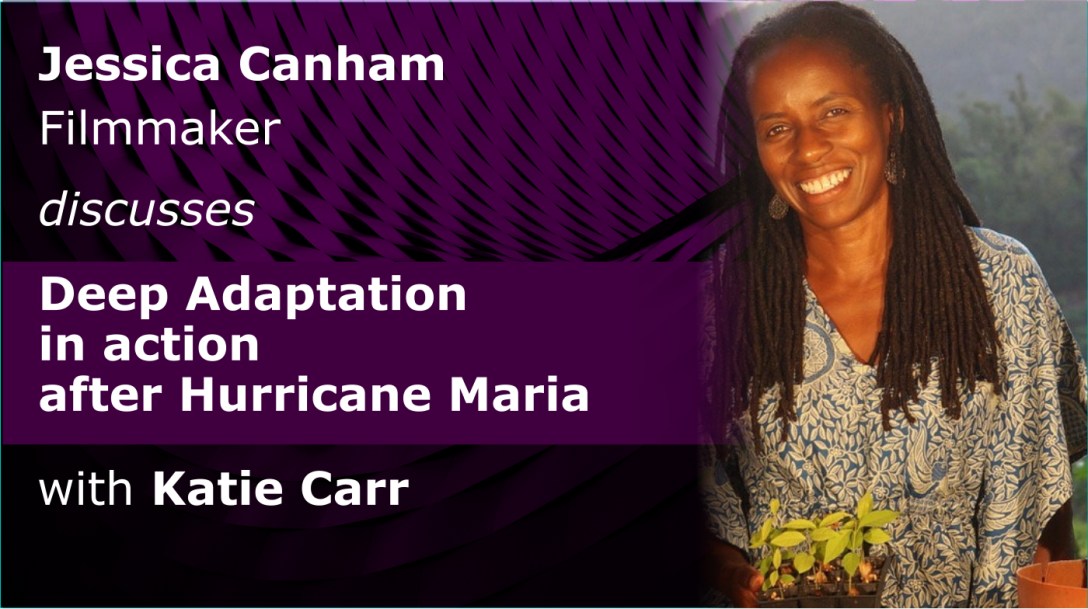
Deep Adaptation in the Caribbean

In this month’s Deep Adaptation Q&A, host Katie Carr speaks with Jessica Canham about Deep Adaptation in the Caribbean and possible implications for elsewhere.

Jessica is a member of the Deep Adaptation Forum, a film-maker. She is based in her ancestral island home of Dominica, in the Eastern Caribbean. She shares about her experience of ‘deep adaptation in action’ during and after Hurricane Maria hit the island of Dominica in 2017, when communities responded by sharing food, shelter, practical and emotional support – in ways that Jessica sees are virtually non-existent in modern western societies.

Along with her partner Tim, she has created documentaries from the Caribbean and South America, for international broadcasters with an emphasis on culture, environment and social justice stories. Her current documentary film project, “LOVE In Action”, focuses on the stories of revolutionaries working on the front lines of our climate and ecological crisis.

Having survived the devastation and collapse caused by Hurricane Maria hitting the island in 2017, Jessica continues to work to strengthen and maintain resilient, healthy local communities. On her mountain rainforest property, she has created and manages a transformational retreat centre Caapi Cottage Retreats where the focus is on nature connection.

Other recent videos from the Q&A series include the coordinator of the Deep Adaptation Forum (DAF) sharing her journey from sustainability to DA and also a socialist politician on his engagement with DA. The Forum is also hosting interviews with people either from or who identify with communities that have already experienced societal disruption and collapse – including indigenous peoples. More discussion of a less-or-non-Western approach to DA included Vanessa Andreotti in discussion with me – Jem Bendell. If interested in this theme I recommend reading about Deep Adaptation in India or listening to a talk I gave in Glasgow in 2019 as I engaged with local groups on climate justice ahead of COP26. You may also be interested in the growing arguments from activists and scholars that we need to ditch the ideology of sustainable development and become more realistic about the deteriorating situation – something I wrote about for the United Nations here.

To receive invites to future Q&As then subscribe to the Deep Adaptation Quarterly.

Grateful for Meg Wheatley

I recently gave a talk to the Climate Coaching Alliance about how to support people, professionally, who are beginning to integrate an awareness of the bad-to-worse scenarios of climate chaos into their work and lives.

In the coming weeks I will share the insights I gained from engaging with business and life coaches on this topic. But for now I want to give a shout out to the coaches, therapists, facilitators and guides who are already aware of how much has already been lost, how difficult things are and are set to become. Understandably, most business coaches and life coaches are not yet alive to these issues. They need to go through their own journeys on this issue for themselves. Which makes a network of coaches who are ‘collapse aware’ so incredibly necessary. The professionals you find in this network will not pathologize your outlook and you won’t need to worry about traumatising them! If interested, have a look at  http://guidance.deepadaptation.info

Continue reading “Grateful for Meg Wheatley”

Don’t be a climate user – an essay on climate science communication

“A great deal of intelligence can be invested in ignorance when the need for illusion is deep.” – Saul Bellow

Jem Bendell, for the Deep Adaptation Quarterly, August 2022. 

As the heatwaves swept across Europe this summer, mainstream Western media gave some more attention to global heating. With 40+ degrees Celsius in the UK, for instance, many people were unnerved. They wanted to know more about what is happening and how bad it might become. This meant climate scientists were featured in the media. Then a curious thing happened. Some of those scientists began to ‘cherry pick’ the science to promote a particular narrative that the danger will cease to increase if specific policies are pursued. They presented their view as following science, and some experts then admonished people who pointed out the scientific limitations of that perspective. Does this mean there is now an ‘establishment story’ on climate change? If so, why, and what does it preclude?

Continue reading “Don’t be a climate user – an essay on climate science communication”

What has the UN Disaster Risk Reduction agency got to do with you?

I was interviewed this week by the Independent newspaper about why more than 100 scholars from around the world issued a public letter to delegates at the UN’s event on disaster risk reduction. This provides more depth than my opinion piece in the newspaper.

Q – What was the impetus behind this letter?

Jem – The impetus for this letter is a widespread experience that many of our fellow professionals working on social and environmental issues privately know that we have been using a failing approach, with all the indicators heading in the wrong direction, but that they are hesitant to say so in public. We perceive that is because they are not yet clear on how to make sense of that failure or what might come next. They also see professional risk in criticising both capitalism and the story that our world will improve with more technology and investment. Whereas more people in the general public now sense that our systems are broken, many experts in establishment institutions continue to think they must remain upbeat in public. But signatories to the letter clearly think that attitude could undermine the needed reckonings and radical changes.

Q – Who are the signatories?

Continue reading “What has the UN Disaster Risk Reduction agency got to do with you?”

Telling Uncomfortable Truths to Progressives

Despite us having learned to be human within capitalist societies, more of us are breaking free from its limiting ideologies. Those ideologies include deep stories about dominating nature, competitive humans, constricted knowing, and perpetual material expansion, which surround us nearly all the time. That is why those ideologies also express themselves within social movements, political agendas, and some of our friends’ social media postings about latest fixation of legacy media. And as those ideologies shape our habits of thought, to separate ourselves from them can be difficult. Which is why it is so heartening to witness more people breaking free and beginning to live differently – and now calling on others to do the same. Whether staying in their jobs and promoting different ways of working, or quitting to make time to create local cooperatives, permaculture projects, emotional support groups, or to promote needed technologies and public policies, many people are improving their lives and those of others.

Continue reading “Telling Uncomfortable Truths to Progressives”

It’s time they heard from you on societal breakdown

EDITORIAL for the Deep Adaptation Quarterly, Issue 10, April 7th 2022.

Over the past months, a few new terms have appeared in the news as pundits seek frameworks to explain what is happening around the world. I have read that we are in a period of polycrisis, or permacrisis, or even World War 3. There are various reasons offered for why more of us are experiencing tougher and increasingly anxious circumstances. Since the pundits work for legacy media organisations, the explanations we hear are anything other than the death throes of global capitalism as it hits natural limits. And since they speak from within the ‘Overton window’ of respectable conversation, neither do we hear that our situation can be described as the beginning of the breakdown of industrial consumer societies. Instead, a superficial, distracting, and sedating hope of returning to something more ‘normal’ is a compulsion for them. So I am pleased to greet you here in this Quarterly, outside that narrow scope of perception. 

Continue reading “It’s time they heard from you on societal breakdown”

Where Wisdom and Geoengineering Meet

More climate scientists say emissions cuts are not enough and we face imminent catastrophe unless deliberately altering the climate. What are the options and challenges? I interviewed Dr Ye Tao who is proposing we use massive amounts of mirrors to reduce harm in the short term.

By Jem Bendell

In 2018, Dr Ye Tao was a Harvard engineer working on nanoscale magnetic resonance imaging. He read the Deep Adaptation paper on climate disaster, then cross-checked it with over a thousand peer-reviewed papers across several climate-relevant fields, and realised the growing existential risk to modern civilisation. So that included everything he was working on. He wondered what would be the point of continuing with his engineering work in such a scenario. Instead, Dr Tao decided to repurpose his expertise to try to give humanity a better chance of reducing the catastrophe ahead. Dr Tao has since been developing and promoting what he argues is a scalable, safe, green and flexible form of climate engineering. It proposes using mirrors to reflect the sun, mostly from the ground and over coral reefs at sea, to cool agricultural land, save fresh water, and preserve ecosystems. He arrived at this idea after analysing and debunking the science and economics behind other approaches to geoengineering (which is also known today as ‘climate repair’ and ‘climate restoration’). 

Continue reading “Where Wisdom and Geoengineering Meet”

Don’t blame Putin or Covid for your sky-high grocery bill

Today I launched my essay about the biggest scam in human history, which is the Central Bank buying of corporate bonds. The essay is available on the P2P Foundation website. I am delighted a promoter of radically democratic economic alternatives published the essay, as the scale of the ‘Quantitative Sleazing’ scam is an indicator of how it is hopeless to attempt reform of the monetary system. The multi-millionaires and their relatives in charge of the relevant financial institutions will continue to risk the collapse of monetary systems while enriching themselves and making us poorer through high inflation. You can read the full essay Responding to Inflation From a Pandemic of Quantitative Sleazing – P2P Foundation or browse below the twitter thread I produced to summarise some of the issues arising.

[Search for more or Subscribe]

Don’t blame #Putin or #Covid for your sky-high grocery bill. Blame the elites who collude with the biggest scam in history, involving #CentralBanks and their friends in finance, under the cover of the pandemic. A thread on #QuantitativeSleazing…

Continue reading “Don’t blame Putin or Covid for your sky-high grocery bill”

Hoarding Green Righteousness Will Not Get Us Far – dialogue will

Looking at how some people in the West use the term ‘climate justice,’ I wonder if we are seeing the latest in middle class Western instrumentalization of the suffering and injustices of the world, for the purposes of further self-appreciation. That can occur because of the way commentators within the contemporary Western environmental movement have been inculcated in the hierarchical ideology of the Professional Managerial Class. Within that ideology, there is an instinct towards what Professor Catherine Liu calls ‘virtue hoarding’ where any issue of moral consideration is material for adding to one’s story of being an ethically superior self, who needs to impose one’s ideas on other people, particularly the working class. As decolonial scholar Professor Vanessa Andreotti explained in her Q&A with me, there is a lot more ‘composting of our shit’ from modernity that we need to do first before being useful in promoting either justice or healing after centuries of colonial domination.

Perhaps an example of this phenomenon is the discussion emerging around a rather ‘uppity’ damning of the Deep Adaptation movement that was published in The Ecologist Magazine. In an open letter by one of the authors on the receiving end of their ire, Matthew Slater wrote the following to the author:

Continue reading “Hoarding Green Righteousness Will Not Get Us Far – dialogue will”