Nestle shares value by 0.0146%

Nestle ‘shared value’ prize, 500,000CHF. Nestle profits in last year, 3,420,000,000CHF. A value sharing of 0.0146 of a percent of profit. Tax deductable of course.

So the question really should be the extent to which Nestle is changing the way it does its normal business. As I noted in the Journal of Corporate Citizenship in 2008, despite the rhetoric about “shared value” being a new strategy for core business, the numbers do not add up.

“Given that many of the examples offered by companies of how they can address social challenges through business are in practice making less of a rate of return than that expected from the business as a whole, are not scalable, and are dependent on government or NGO subsidy through partnership, we may question whether they really embody a new strategy. Perhaps they could be more appropriately understood as an advanced form of an established strategy: effective public relations through corporate philanthropy.”

In the two years since I haven’t seen much indication of a systematic attempt to change strategy.

As time goes buy, will more people have to conclude it isnt possible for a giant to be anything but greedy?

Or do you think there is real change within, real opportunity from, our largest multinationals?

Debate it at justmeans.com or below. And if you deserve support, then apply for the prize! (Think of Robin Hood).

Tweet @jembendell

How not to be a crap professor of business ethics, CSR or sustainability

I sometimes show my students the Daily Show’s John Oliver interviewing a Columbia University professor of business ethics. In it he asks the professor what he is doing about the ethical character of business students in the light of the financial crisis. The professor outlines courses that teach cases about corruption and the choices people have to make. Oliver says “that’s great, when are you going to start teaching this?” The professor replies “Um, we’ve been teaching it for thirty years”. After a confused pause, Oliver asks “Would you say you are very good at your job?”

By treating business ethics as something one learns how to debate in the abstract, and the various different explanations people give for their actions, has done very little to build the moral character of graduates from business schools, at least according to the studies that show student values pre and post graduation. It also does little to equip them with the insights, evidence and approaches to lead ethical business, rather than simply respond to ethical dilemmas. So can sustainability, social responsibility and the like be taught? As there’s a debate on a Linked In group, and I’m in the midst of designing an MBA module for IE Business School on sustainability, I took the opportunity to clarify my insights on the matter. So, here goes…

Teaching social and environmental responsibility in business needs to focus on:
– both standalone courses and integration into existing subjects
– both critical as well as practical perspectives
– both firm-centred and issue-centred perspectives
– both “content” and “consciousness” i.e. where the latter is about how we perceive ourselves, our careers, our organisations, our societies, etc.
– both class-based and work/action-integrated approaches
– both lecture and facilitated group learning with reflective exercises, role play, etc.
– both insight from publications and the tutor’s personal professional experience (and/or those of guest lecturers)
– both case studies and cross-cutting analyses

I make these distinctions as much present teaching in this field is only standalone, practical, firm-centred, content focused, class-based, lectured, text-based and with case studies for light relief. Such teaching, on its own, without the other stuff I mention above, is largely useless at educating people. Worse, it can encourage people to think that this field is something one is proficient in by simply recounting various arguments and a few models – a superficial confidence that impairs real insight and change.

Therefore I recommend the “whole person learning” track of GRLI which has a free book to download, written by the late Bryce Taylor.

Towards Rio 2012

In May 2012 Rio De Janeiro hosts a major UN conference, that marks the 20th anniversary of the first Earth Summit. In 1992 the Rio Earth Summit was the largest ever held, and helped spread around the globe the idea of ‘sustainable development’ as a common goal integrating environmental protection and poverty reduction. It also saw the UN and its member states calling on business and civil society to join in meeting the challenge, thereby encouraging more corporate responsibility and integrated approaches from nongovernmental organisations. Having discovered “sustainable development” in 1988 on the back of the Brundtland report, and just about to start a Geography degree at Cambridge Uni, I followed the Rio Earth Summit and was hopeful that it marked the beginning of a major change. I responded to the call, by working on and developing partnerships between businesses and NGOs in the following years. By 1995 I was helping develop market demand for wood certified under the Forest Stewardship Council system, and by 1996 developed an organisational concept for the Marine Stewardship Council, for WWF. In 1997 I then co-wrote a book about these novel ways of implementing the call from Rio.

Since then the field of innovation on responsible enteprise and finance for sustainable developed has grown and grown, and with that my workload, as an activist, analyst, and advisor. The FSC and MSC are now both massive organisations influencing the sustainability of forests and fisheries worldwide.

However, twenty years on, the statistics on environment and development are not particularly encouraging; consider the rising rates of deforestation, carbon emission, malnutrition and forced migration. Why? Partly because the focus on sustainable development was sidelined by a primary focus on trade liberalisation in the 1990s, on geopolitics and security in the 2000s, and because of an over-riding focus on increasing economic growth rates throughout. One reason for the lack of focus in 1992 on economic root causes of social and environmental problems was the exuberance and hopes after the end of the Cold War: discussing flaws of capitalism was seen as unhelpful and not hopeful. One reason for the focus on what non state actors can do, and thus not government, was the dominant influence of Western nations, who were embracing a laissez faire approach to state governance at that time.

Twenty years later the lack of major global progress towards sustainable development, towards true integration of environmental and developmental priorities, should make us question this lack of attention to economic systems and government roles.

In the last twenty years we have seen non state actors experiment in many new ways to advance the sustainable development agenda, with partnerships and voluntary standards emerging to promote responsible enterprise and finance. Its been exciting and exhausting. However, despite our enthusiasm, these experiments have also reached some limits of what they can achieve in promoting wider change. Leaders in business and civil society are therefore calling for government to become involved to help mainstream the innovations in sustainable development governance. If Rio 1992 was about governments calling non state actors to act, Rio 2012 may be about non state actors calling on governments to act in support of their innovations.

It is a call that may be heard, because today there are non Western nations with more recent experience of strong government leadership that have greater influence in the intergovernmental arena. In addition, twenty years on we should be able to show more maturity in exploring how systemic flaws in a our economic systems could be changed to reduce pressures for poor social or environmental outcomes.

A debate is beginning to be had in both business and civil society circles about the type of economic system we need for a more fair and sustainable world. Although often rudimentary, and often misunderstanding what capitalism is, these debates show there is growing willingness to tackle issues at the depth and scale that matches their signficance to our planet and our humanity. If it was practical not to discuss capitalism in 1992, given the shortcomings of our progress towards global sustainable development since then, it would not be practical to avoid discussing it today. Consequently we will see an agenda for innovating collaborative economic governance for sustainable development emerge over the coming years. Rio 2012 could be a useful moment in helping to globalise that conversation. However, if it becomes a huge draw on our time and attention without getting to the root causes of our enduring social and environmental problems, it could be worse than useless.

For those of us who have worked hard heeding the original call of Rio, we would do well now to organise to influence people’s awareness of what we have learned through success and failure over the twenty years.

With that in mind, I have begun reflecting on those lessons, and on how they could be communicated and learned in ways that could influence the agendas of organisations that can implement change. Because, we must not lose sight of how such summits are not in themselves implementing mechanisms.. connections have to be made from the insights and hopes of such summits to the real institutions of national and international governance.

Therefore, here are some initial ideas on what we could do:

– clarify the lessons from the last 20 years and the accuracy of the narrative I have just described above

– communicate these insights and narrative to global civil society through networks such as the stakeholder forum for the Rio 2012 summit, and get buy in

-communicate these insights and narrative to business networks active on sustainable development, such as the WBCSD, which was born by the last Earth Summit, and the World Economic Forum, which subsequently saw the light and embraced the goal.. and get their buy in

– begin deliberations and research and a devise a plan of technical assistance for a collaborative economic goverance agenda that would seek to mainstream the last 20 years of innovations in sustainable development practice and sustainable development governance

-communicate these insights, narrative and the technical advice about how to implement a collaborative economic governance agenda to mainstream sustainable development innovations, to the various parts of the UN system that are involved in Rio 2012

– engage the Brazilian government, NGO and business communities on this agenda, as given Brazil’s emergence they will play a far greater role in shaping the agenda, messaging and outcomes of the summit than in 1992

– create powerful communications products, such as TV documentaries, popular books, and celebrity campaigns and concerts that sing from this hymn sheet, rather than a dumbed down and expedient narrative, as we have seen at past summits

– remind everyone that the impact of this summit will be in the way it influences other institutions such as WTO, IMF, WB, UNCTAD, UNDP, ECOSOC and so on, and that unless the connections are made to these agents of economic governance, the summit will be a global mirage of hope in a desert of statis and despair

If you agree, and can actually do something about them, please get in touch. Given my existing commitments to other work, my only plans for engaging in this process are some work Im doing for UNCTAD. However, I will find time to discuss other ideas if you have plans to act.

If someone calls someone a cynic what does that make them? (hint, look it up)

Only cynics call people cynics. Why? By definition, cynicism is to assume negative intentions in others. Therefore to think someone is a cynic is to assume they have a negative view of others. It is to assume that they are being negative.

To dimiss either skepticism or critique as cynicism is to ignore the perspective and characterise the individual as negative, and thus to exhibit cynicism oneself.

We need skepticism and deep critique for inquiry and so it is mistaken to believe it to be either professional or moral to characterise these as purely emanating from a person’s negativity. Rather, the opposite is true – skepticism and critique are the beginnings of freedom, truth and effective action. Moreover, we even need some cynical thinking when evaluating the opinions, actions and inactions of those with power to affect others. That cynicism of never simply trusting in the moral character of the powerful is at the heart of modern notions of democratic rights, accountability and the separation of powers in a nation. Cynicism of those in power is an agent of progress, whereas cynicism from those with much power, or in search or praise of power, is an agent of tyranny.

Reflections on a year promoting responsible enterprise

Lifeworth Consulting is a social enterprise that promotes sustainable development through influencing enterprise and investment. We also run Lifeworth.com, the jobs portal for responsible enterprise. Reflecting on our year, in each of our specialist areas during 2010 we sensed people realising the need for far greater change than they currently seek in their own organisations, and some confusion about how to deal with that gap between awareness and action. We’ve been seeking to help.

We analyse, educate and advise on global changes in business-society relations and how to influence and respond to these changes in helpful ways (Enterprise Trends). Our activities and outputs in 2010 responded to this growing desire for transformation, working with the UN, GTZ as well as CSR networks in Asia to contextualise the key challenges for CSR and responsible investment in the coming years. We also analyse, educate, and advise on the specific practice of cross-sector relations, including partnerships between business and public interest organisations like the UN and NGOs (Engaging Change). We find that the desire to attempt transformational change counters some of the negative effects of growing demands for numerical scores on project effectiveness in challenging funding environment. Social change can be tough, and requires new ways to assess progress, although not ones that see a partnership’s existence itself as the goal. We brought that perspective to our work with UN agencies and NGOs during the year, as well as through the teaching of courses and publishing of papers.

Our third work programme is the focus of our corporate strategy advisory work, where we help high-end brands to develop their approach to achieving social and environmental excellence (Authentic Luxury). It is topic we were busy with in 2010, but mostly with research, lectures and media. The companies in this sector are not moving as rapidly as we had imagined they might, given the strong business case for prestige brands to out perform on social and environmental issues. We worked with a couple of companies on their CSR strategies, but are yet to see wider demand for support to develop and execute ambitious and creative approaches.

Below we summarise some of the activities, and more importantly, the resources we have produced as a result, most of which are freely downloadable via the links. In addition we highlight what’s coming next, and how it relates to the key responsible enterprise and responsible finance challenges of 2011.

Enterprise Trends

The contemporary incarnations of CSR and Responsible Investment have been around for some time. So what is its extent, worldwide? And what does it mean for the actual social, environmental and governance performance of companies and investors? It is time for some global analysis on these questions. So we worked with the UN Conference on Trade and Development (UNCTAD) to co-edit their first global overview of the state of CSR and RI communications. The main conclusion was that as commitments to CSR and RI are now so widespread yet communications on impacts so diverse and unclear, it is time to see more standardisation, with public interests in mind. I shared some insights from that at a session on the future of CSR communications at the CSR Singapore conference. During the year we conducted a study on the performance of environmental, social and governance (ESG) analysts and raters, speaking to leaders and stakeholders in this sector from around the world. My interview with UNPRI Executive Director, Dr James Gifford was recorded. In February we will publish the study, which identifies 9 flaws in current mainstream ESG practice, and makes recommendations for how to fix them, including the development of a multi-stakeholder code of conduct for ESG analysts and raters. The study will be serialised and open for discussion on the ESG Investing discussion group. In 2011 we will also continue our work with UNCTAD to map the progress of private standards for CSR and RI, and what the public policy implications may be.

2010 saw growing interest in the role of business in development. Our interest in development does not arise from companies and investors beginning to engage in this issue, but from a long standing interest in in cultural exchange, how societies progress or not, and shared global challenges. From that perspective we see potential, but also some gross assumptions from people coming at development from the business world. We released our study on this area, outlining the need for a new management system for pro-development business. That followed up a keynote at the launch of the first MDG Scan report by National Committee for International Cooperation and Sustainable Development (NCDO). We also published a major study on a key issue for social progress that has been almost entirely overlooked by CSR and RI until now – economic inequality. Given government spending cuts in many parts of the world, rising prices for basic needs, while banker salaries and bonuses remain high, matters of economic inequality are likely to gain more attention in 2011, and demand more attention from the private sector. In addition to this research work, we were pleased to help the UN, GTZ and ArcelorMittal in Liberia. My colleague Emma Irwin designed and facilitated a workshop to help executives to understand the financial and moral imperatives of integrating Human Rights into their management systems, as well as how to begin that process.

Aside from the rising interest in development, the six CSR trends I identified in my last book, The Corporate Responsibility Movement, appeared to strengthen during 2010. I presented these trends of standardising, mainstreaming, integrating, levelling, enterprising and yoyoing to special events hosted by CSR Singapore and CSR Geneva. The growing desire for transformational change inspired more people to explore ‘design thinking’ as a mechanism for developing products and business models that can help create fair and sustainable societies. My colleague Ian Doyle led an exploration of what ‘design thinking’ can offer CSR and sustainability professions, which we published in the Journal of Corporate Citizenship. I shared some of these ideas in a keynote at a workshop for youth on design thinking for social change, run by Syinc in Singapore. I reflected on how there is no magic bullet for social change, and that an ability to struggle with forces of inertia is key to our effectiveness.

If we seek transformation then we seek to understand the root causes of the problems we experience, and a vision of the kind of system we wish to bring into being. In looking back at 2009 we sensed that more people in the CSR and RI fields were having such discussions: and therefore capitalism was being debated. Our annual review of CSR was called “Capitalism in Question” and in it we offered a concept of economic system that integrates principles of capital and democracy. In 2011 we will share this further by an article in Singapore Management University’s Social Space, and in the book Healing Capitalism, to be published by Greenleaf in September, co-edited by my colleague Ian Doyle.

Engaging Change

Sensing what is needed is different from knowing how to bring it into being. A core theme of our work for decades has been the potential and pitfalls of cross-sectoral collaboration as one method for generating social change. Given the growth in cross-sectoral partnerships over the last decade since my last book on the topic, Terms for Endearment, I had decided to research the latest thinking and practice and share analysis on how to take partnering to the next level. Some outputs from this included a special issue of the leading journal ‘Business Strategy and the Environment’. Contributors to the special issue look at experiences of partnership from across the Asia-Pacific, and bring new insights into what really drives partnerships and what the future holds. With my co-editors Eva Collins and Juliet Roper, we identified a new ideology that partnership is always useful in creating change, and that struggle and conflict are unhelpful – something we termed ‘partnerism’. 2010 was also the 10th anniversary of the UN Global Compact, a cross-sectoral collaboration between business and the UN, and something I have followed since discussions with Georg Kell in 1998 about the initial idea of it. To coincide with the anniversary, the Journal of Corporate Citizenship published my reflections on how it must now address economic governance issues, which I then developed further into a series of proposals, after attending their Global Leaders Summit in New York.

How should public interest organisations attempt to have more systemic impact through their partnering with private sector? That is the subject of my next book, Evolving Partnerships, which is published by Greenleaf in April 2011. It provides tools for strategic review and planning so that UN agencies, NGOs and others can upgrade their partnering for greater social change. It should be available for ordering next month. I will continue to integrate these insights and approaches into my teaching and training on stakeholder relations and partnerships, including at the University of Geneva and Griffith University.

We are also applying our approaches to our training and strategic advisory for UN agencies. My colleague Ian Doyle led a seminar on private sector engagement for staff of the United Nations International Strategy for Disaster Reduction (UNISDR). As global value chains have become longer and more complex while natural disasters are increasing, so business continuity is becoming more important, and we believe there can be a convergence with reducing community exposure to natural hazards and increasing their resilience. We have also begun advising the International Labour Organisation (ILO) on its strategy for engaging the private sector in innovative ways. In particular we are looked at what can be done to encourage and support voluntary action against forced labour, a form of enslavement for over 12 million people today. Hopefully we will see some outcomes from this work during 2011.

The network Lifeworth Consulting co-founded, CSR Geneva, continued to bring together people from different sectors to discuss the role of business in addressing global challenges, with over 700 participants. Last year my colleague Janna Greve produced its first directory of members. In the coming year we will organise some events to help the international community better understand how to engage business, so sign up now to be informed.

Another collaborative network initiative that I helped to conceive, while at WWF-UK, gained momentum during 2010. The Finance Innovation Lab is promising because it provides a multi-stakeholder space to explore the systemic flaws and fixes of our financial system. In my advisory capacity to both the Lab the community currency charity CommunityForge, I helped CommunityForge engage the Lab, and create a new working group on the need for innovation in community currencies to promote a sustainability transition. The head of CommunityForge, Matthew Slater also happens to also be my web developer, and co-leader our innovation centre in Auroville (India) during the first part of 2010. In the coming year we will be publishing our study on why and how larger corporations can support and start using community currencies. I also hope to advise the Finance Innovation Lab on an effective approach to internationalising, given the global nature of the financial system.

Clearly we still believe in the power of partnerships, but in 2010 we were reminded of the pitfalls of attachment, where people’s sense of esteem becomes attached to the existence of a project, and the manner of its organising, rather than seeing it merely as a tool, and one that needs testing for the job at hand. No matter what tools, topics and resources are deployed, personal character is key to transformative action.

Authentic Luxury

High-end brands play a major role in the world, signalling what constitutes success and respectability, for many, across cultures. Asia continued to be the boom market for luxury brands during 2010, and thus grew their potential to shape awareness of sustainability challenges in a key part of the world. We have worked on CSR in the luxury sector since conceiving a project on this topic for WWF-UK in 2007 that led to the publication of Deeper Luxury, which stimulated a lot of media interest, including a TV documentary. In 2010 we saw the interest in this area grow steadily. Having introduced colleagues at Eco Chic Fashions and the UN with the idea for the UN’s first professional fashion show at its European headquarters, it was great the idea come together at the beginning of the year, profiling many ethical designers from around the world. I then joined the UN’s Biodiversity Platform, which is encouraging companies in the luxury sector to promote biodiversity conservation.

I was pleased to judge the Walpole British luxury association’s CSR awards, which were won by Six Senses Resorts, and give a keynote on sustainable wellness at the Wellness Summit in Singapore, which reflects how sustainability considerations are growing in the spa and wellness industries. A video of that talk is embedded below. The interest in these topics is global, as reflected by the world’s first Centre for Studies on Sustainable Luxury, in Buenos Aires, which I helped to launch. We will be working with them next year to offer courses on sustainable luxury in Latin America, launching the world’s first sustainable luxury awards, and co-developing the online professional Authentic Luxury Network.

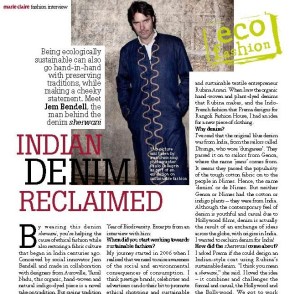
I spoke about the future of fashion in Brisbane, at the Asia Pacific Centre for Sustainable Enterprise (APCSE), which I helped to found the year before, and they recorded it. As part of the research for a book due out in October, that I have been writing with APCSE on sustainable luxury, I worked with a fashion designer and sustainable materials producer in Southern India, to create a prototype of a form of high-end global sustainable luxury. The organic, hand woven, natural dyed denim sherwani we created appeared in Vogue and Marie Claire, by way of some great photos by award winning photographer Paulo Pellegrin, modelled by yours truly (no, not a career move). I wore the sherwani to the centenary fashion show of men’s luxury fashion house Ermengildo Zegna, and after Anna Zegna introduced me to the work of artist Michaelangelo Pistoletto, then ran a workshop on sustainable fashion for textile companies and designers in at his foundation in the northern Italian town of Biella. The sheer fun of working in Italy means I really hope their efforts to encourage CSR in high-end fashion take off in 2011 and that we are able to help further.

One of our strategy clients in 2010 was a high jewellery brand based in London. That helped us to deepen our understanding of the challenges and opportunities facing the jewellery sector, which I discussed on the radio. My colleague Ian Doyle presented his insights from our research on jewellery at the Paris 1.618 sustainable luxury fair, the Atelier for Sustainable Luxury (now the Sustainable Luxury Forum), and at De Beers’ stakeholder consultation. After interviewing dozens of experts about key issues, benchmarking 10 high jewellery brands on their CSR, and identifying leading innovations, we will publish a report responsible jewellery in March.

Also in March we begin teaching the world’s first MBA module on sustainable luxury, at the leading IE Business School, in Madrid. I hope the large luxury brands will be ready to hire the students to transform their companies. However, the luxury industry is not the most innovative and efficient sector that I’ve experienced, and the current commitment from large incumbent brands has been inconsistent. Perhaps the students would do well to establish or join the kind of niche luxury brands that are in the Authentic Luxury Network – the one’s that emerge from the Zeitgeist, rather than repackage the old.

In addition to our consulting business we maintain a CSR jobs and events portal. We’ve designed it in a way that means its full of jobs and events, a useful free one stop shop. But we haven’t designed it in a way where it makes money. So in 2011 we will need to reflect on where next for the portal, after 10 years of providing CSR jobs info to the emerging CSR movement and profession. In 2011 we will open a Geneva office again, based at the new Geneva Hub. We will remain a boutique consulting outfit, only seeking a few clients in the year, working where we can plant seeds that may have a lasting positive impact. We will likely continue to do pro bono work where we get excited about the change potential. We have been doing that by staying small and limiting both overheads and financial expectations. In such a company, what is key is the creative dedication of people who believe their work should be about more than money, status or fun. Therefore I’m grateful to my colleagues who see life that way. Thanks to Ian Doyle for his consistent focus and adaptability, to Janna Greve for her positivity, Hanniah Tariq for her insights, Emma Irwin for her professionalism, Nicky Black (now with De Beers) for her voluntary support, Anne Ellersiek for her phenomenal brain and Matthew Slater for his reliability and moral inspiration.

Each year for the past nine, we have published an annual review of CSR. Not any more – the developments with web2.0 mean that we will provide commentary on an ongoing basis with our RSS feed. In addition, our next book, Healing Capitalism, will review the last few years in CSR and RI.

I believe that this year we will see many more questions raised about economic fairness, about the ethics of the use of power, and we will see increasing cynicism about how business behaves, and a growing spirit of critique. Consequently, there will be more calls for corporate accountability, and a clearer understanding that a responsible business is one that seeks more systematic transparency and accountability from business as a whole. We will also see ISO26000 becoming referenced as the definition of CSR, for good or ill. The implications of Web2.0 for business-society relations will unfold further, with particular implications for fashion brands. We will begin to realise that these new communications tools mean that everything in commerce has an alternative. Even the currencies we use.

Thanks for your interest in our work, and I hope you have success in making waves with your own. You can follow me during 2011 on twitter @jembendell.

Jem Bendell, Director, Lifeworth Consulting.

Here is that keynote on sustainable wellness:

http://www.vimeo.com/16553604

Vogue and Marie Claire report on sustainable luxury

Jem interviewed in Marie Claire
Jem interviewed in Vogue

Can jewellery give miners decent work and livehoods, promoting sustainable development? Can India reclaim denim, as an organic, handwoven, naturally dyed traditional cloth? These issues are discussed in this month’s Vogue and Marie Claire. I talked to both, while sporting the organic denim Sherwani I created with Prema of Rangoli Fashion House and Rubina of Colours of Nature, when in southern India earlier this year (and photographed by famed photographer (and great chap), Paulo Pellegrin).

One focus of my work since 2006, has been helping promote more awareness of sustainable business issues amongst elites and middle classes across the global South, particularly in Asia and Latin America. So Im pleased that this month I get to promote sustainable fashion and jewellery in both the spanish Vogue and Marie Claire in India. In one of the articles I discuss the history of denim, and how it can be reclaimed as Indian. The side benefit of this work is that, as just an academic and consultant, I get to chuckle about appearing in top fashion magazines! So, don’t just stand there, let’s get to it (strike a pose, there’s nothing to it…)

Thanks to Noela Fernandez and Aekta Kapoor for the interviews.

Some snaps of us in action at Rangoli in Auroville….

Jem and Prema plan the lining
Getting measured at Rangoli
Jem discovers how Rubina and Jesus make blue

Ann, you said that war was right to stop torture. Now you know the amount of torture and death it caused, what have you learned?

Open Letter to Ann Clwyd MP, from Dr Jem Bendell, October 25th 2010.

Dear Ann,

My name is Jem Bendell and we met in 1996 during the time when a couple of my friends were among the British hostages being held in West Papua and you offered to help. You kindly worked to get a letter written to the OPM rebel leaders from Klaus Hensch, then President of the European Parliament. The letter seems to have played a role in helping organise a release, although the release failed when the OPM leader Kelly Kwalik changed his mind during his speech. You may recall the British hostages got out, as they fled, later, when the kidnappers starting killing the Indonesian hostages, two of whom died. Thank you for your efforts back then. I remember you from then as a principled MP.

I was always surprised and disappointed at your stance on the invasion of Iraq. I was working as a consultant at the UN in 2003. I organised the writing and UN staff signing of a letter sent to all non permanent members of the UN Security Council to remind them of the principles of the UN Charter. We were concerned the UN might endorse an invasion, as that would have set a new precedent in international law, suggesting that a state with power and prejudice could launch an attack because it felt threatened. In the letter we simply reminded them of the UN Charter, which international civil servants at the UN are meant to uphold, rather than focusing on specific issues they were deliberating. The UN hierarchy did not like our efforts – security paid us a visit. Fortunately a few brave non permanent Security Council members did not cave in to the bribes and phone taps, and the resolution to authorise an invasion was not passed. This meant that PM Blair could no longer say the UN would back the coalition forces as implementing the will of the ‘international community’. It might also help in him being prosecuted as a war criminal one day, and thus serving as a warning to Western leaders in future. However, it did not stop the war, which appeared inevitable to everyone, including the millions of protestors who did not believe it when politicians said war was not inevitable. Never has there been a bigger display of the general public believing their leaders to be liars than that anti war march before the invasion.

There were few moral voices in favour of the War. You stood up and called for war to end torture. “See men shredded, then say you don’t back war” read the headline of your article in the Sunday Times, calling for an invasion. http://www.timesonline.co.uk/tol/comment/thunderer/article1120757.ece

I was wondering whether over the years you have rethought your views on how one deals with oppressive regimes and dictators. The latest leaks show that terrible abuses have been widespread since the invasion. For instance see the Guardian stories showing the level of abuse, and the official policy of the US Army to ignore it. This is aside from more than 60000 civilian deaths, documented by the US Army in the leaked information. In 2003 you talked of men being shredded by Saddam Hussein being a justification for war. So many more people have been shredded by bullets since, as well as tortured, due to the war. The depravity of killers is not the primary issue that should influence our judgement, rather the extent of the human rights abuses, the extent of the killings, and what responses will work, not make things worse. (http://www.guardian.co.uk/world/2010/oct/22/iraq-detainee-abuse-torture-saddam)

This level of violence was predicted by the anti War movement in 2003, whose analysts said it would be a long fight, with sectarian violence, and the likelihood of invading forces reestablishing a despotic government or militia in order to keep some control. They also said it would stoke hatred and trigger terrorism against the West. It appears the anti War movement had the smartest military intelligence; or perhaps they were simply not being willfully ignorant due to political and professional pressure in 2003?

When faced with evidence of human rights abuses in Iraq, you told the Chilcot inquiry earlier this year that “it is disappointing but understandable” and explained that it takes time after wars to achieve security. You didn’t express such patience about dealing with torture and death under Saddam Hussein. You told the inquiry you have made representations to the Iraqi government to uphold human rights as “one of the main reasons for going in there, to get rid of the kind of tyranny and cruelty that was going on in that country. I don’t want to see it perpetuated.” It appears from recent leaked documents from Wikileaks that you had little impact in that regard.

Some make statements such as “it was right to get rid of Saddam”, which is meaningless as it could justify any level of destruction in pursuit of that aim (would we nuke a whole country to get rid of one man? No, and so in isolation it is a nonsensical justification). Some make statements such as “its important to focus on the future” as if the future wont include other situations where we face dictators, human rights abuses, and opportunistic politicians seeking to take countries to war, and so we need to learn our lessons.

Do you now see that to deal with dictators and despotic regimes you need effective sanctions that take away the ability of a regime’s elite members of society to move or bank abroad? That those and only those sanctions are the ones that work, and we need more progress to ensure all governments, including offshore financial centres, participate in such sanctions in future, and where there are tough trade sanctions against countries who do not participate in such efforts against dictators? And that, conversely, we need to engage more with the people living under dictatorships, giving them visas for tourism, study, business etc, and funding them to study abroad, etc, as part of the process of creating a lasting change?

Ann, you said that war was right to stop torture. Now you know the amount of torture and death it has caused, what have you learned?

A lot of people died in a War that you helped to justify. You have been largely quiet in public about revelations about abuses in Iraq since the invasion. It would be a good time to say something new.

I will post this letter to my blog, and will post your reply if you permit. (http://www.jembendell.com)

Thanks, Jem
Dr. Jem Bendell

Good Cause Trouble

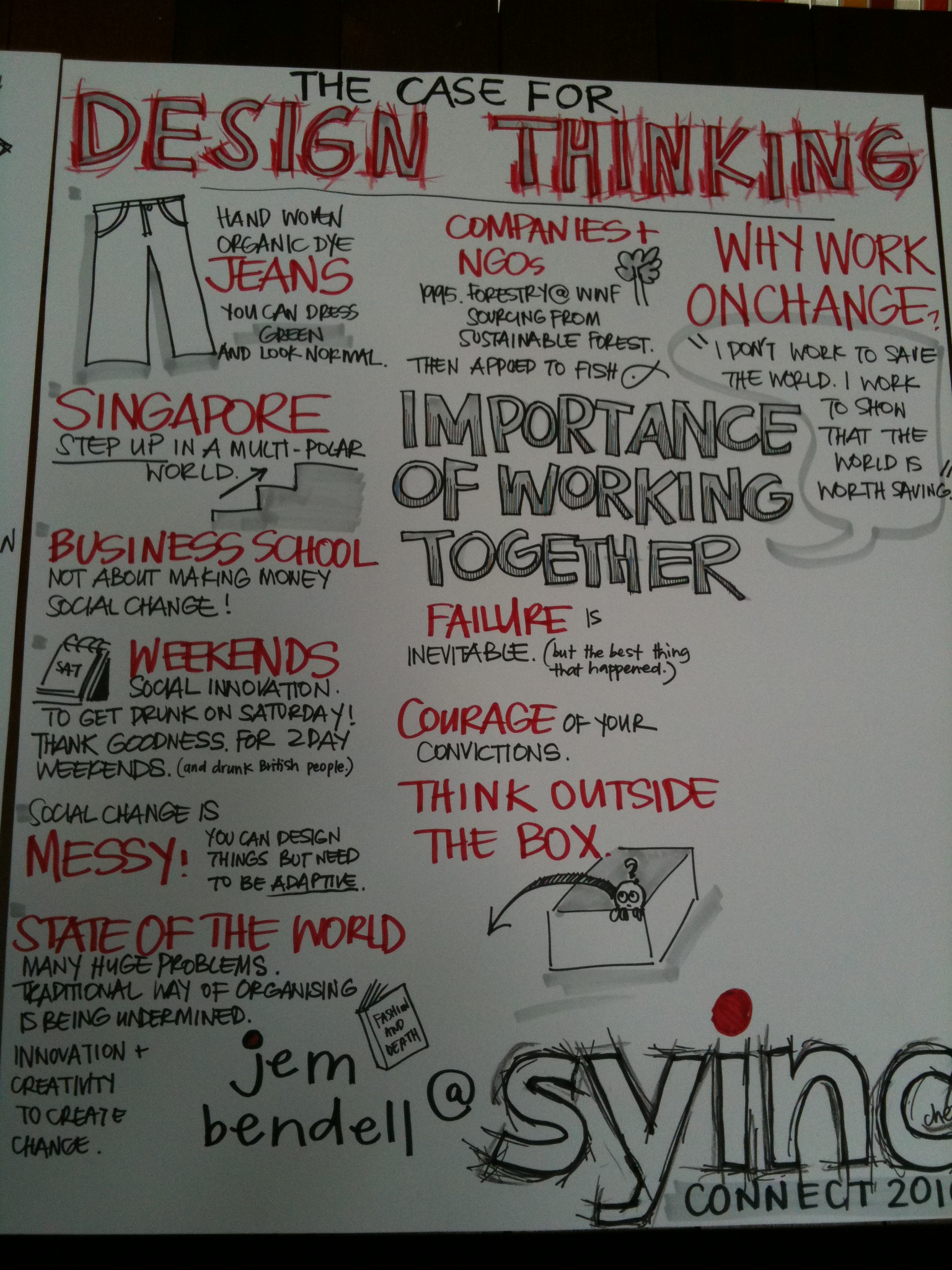
Keynote at Syinconnect, October 16th, Singapore…

I’m pleased to be here as I’m in Singapore because the world is changing fast. You are the fasting growing economy in the world and have the 4th highest GDP per capita. The people who have traditionally taken a role in global affairs and addressed social and environmental problems around the world, whether rightly or wrongly, are mostly Europeans and North Americans. That’s going to change. And that can be a good thing, but only if we see more globally responsible leaders coming from places like Singapore. We need to see more compassion and action on the state of the whole world, from newly emerged powers. So I think inititives like Syinc are so important, as they are helping you, future leaders, to explore ways of contributing to your community, and then hopefully beyond.

We’re here at the weekend. Its a saturday morning and none of you have to be at work, and your lecturers dont have to be. The 2 day weekend is a great idea, a good social innovation. Any idea where it came from? I think it important to reflect on how change happened if we are to get insights into how to make it happen. So I looked into the history of the 2 day weekend. In the early 1800s in the UK, where Im from, the was a mostly a one day weekend…Sunday, the sabbath, and it was meant to be spent observing religious ideas. But there was a problem for the religious leaders, and also the growing breed of industrialists. As it was the only day off, a lot of Brits were doing what they like to do – getting drunk. So this made them bad church goers, and also meant they often skipped Mondays because they were hungover. So the church and industrialists got together and decided to give people a half day off on saturday, so they could get drunk then, and snooze their way through church on sunday, and be ready for work on Monday. So the half day Saturdays that I hear you had as you weekend here in Singapore until about a decade ago, you can thank the drunkard Brits for.

So where did the 2 days come from? There was one Cotton mill around 1900, where half the staff were christian, so took sunday off, and half were jewish, so took saturday off. The christians got upset with other people working on sunday, so the owners said sod it, we will close both saturday and sunday. Then, in 1926 the great car maker Henry Ford decided to give his workers 2 days weekends. He realised he needed to not only pay his workers enough for them to afford the cars they made, but also that they needed reason to buy a car. If they were only ever going to work on the bus, and then to church on a sunday, why would they need a car? However, if they had a whole day free to be able to go to the beach, or countryside, or visit relatives and so, then of course theyd want a car, not just a faster horse! So there was some enlightened self interest there. But many other industrialists werent happy with Ford. And so it took a the radical Amalgamated Clothing Workers of America to start a campaign for it in 1929. The history of trade unions is such that this campaogn meant people would have been harrassed, fired, beaten up, and certainly frowned upon by some. There was a struggle for weekends to become normal. But then the depression hit and so industrialists gave in, because there wasnt the cash flow to warrant full production. The innovation in 2 day weekends then spread around the world due to international business, trade unions and the International Labour Organisation, which had been established in 1919. Thats why it was the international firms in Singapore were the ones who in past decades gave staff 2 day weekends not the 1 and a half that local firms gave until recently. So, the history of the weekend, a major social innovation, which enables you to be here right now, shows that social innovations are often messy. They come about because of fudges between institutional interests, some enlightened self interest of elites, often a lot of struggle and strife, and then champions and advocates – all types of action were involved in getting the 2 day weekend to become normal. In that process some people will have been praised, but its important to see how many people will have had to suffer in that process, at the very least, losing their job or losing approval of their parents or peers for being activists. Its a theme Ill return to.

I’ve been asked to say a few words on why get active on social issues. So why get active? Well, first up, because there’s issues. Second, because they arent being addressed in ways that will sort them out, mostly because they are being caused by the normal way we do things, think of things. Third, because u can achieve things if u choose to. Fourth, because when trying u will sometimes hurt and fail, and thats important in life. Fifth, because to be active on matters of the world is a normal way to be, its about being conscious, alive, connected and not boring. I act not to save the world, but to make my species seem worth saving and my life worth living.

So what are the problems out there? Im writing a new book and decided to shrink some issues down into one day, so produced some statistics. They’re a bit depressing. In the last 24 hours, 80,000 acres of tropical rainforest have been lost. In a day, over a million tonnes of toxic waste have been released into our environment. In just the last 24 hours, 98,000 people on our planet died of starvation, tens of thousands of them children. In one day, 137 species have been driven into extinction. These problems, these people, are calling out for our action.

The second reason to get active is because these problems are not being addressed in ways that will sort them out, mostly because they are being caused by the normal way we do things, think of things. Traditional ways of organising to address problems have been undermined by globalisation. Governments now focus on being competitive in international markets, and so look at that beyond other issues – social and environmental issues can only be afforded within that framework. This means leadership is often lacking. Our money systems mean that more cash gushes up to elites than trickles down to the many. We have market fundamentalism where everything is about making money. We have hyper modernism where anything new and techie is great, so we dont easily stop and question whats the purpose of our rushing around. We have a mass media thats jingoistic and superficial about its news, and is celebrity obsessed, so kids now want to be famous when they grow up – for whatever reason doesnt matter, they just want fame.

Then forms of action that have a strong tradition in many parts of the world – protest – dont seem to work anymore. A million people marched in London against the war in Iraq before it started and when Blair was still saying all we needed to do was put pressure on Saddam so war was not inevitable. People didnt believe it.. a million people.. we had not seen that before. But it achieved nothing. Its unclear whether online activism is much of a substitute. Its easy to say you like or dont like something, through a tweet or status update or clicking like, but its much harder to actually do something about it. So in that context we need to be much more imaginative and creative about how we act on social issues. Its not a lost cause because we are an ingeneous species, and can come up with new ways of acting.

Which is the third reason for getting active on social issues – because we can have an impact. And that is why Ive been asked here, having taken unusual paths to prompt some largescale changes. I left Uni and went to work for WWF UK immediately when I was 23, just slighly older than most of you. I joined the Forest Unit and worked with a group of companies that had committed to sourcing all their wood and wood products from sustainable forests. The group was key to developing market demand for a certification system for sustainable forests, which is called Forest Stewardship Council, or FSC. WWF had been pressuring governments to agree to do something about tropical deforestation for years, and hadnt got anywhere, so along with other NGOs they had turned their attention towards companies that were buying the products. Some NGOs attacked the companies, and WWF positioned itself as a partner to help the companies ensure their wood was from good sources. It was an open plan office, and a chap from the WWF International endangered seas campaign was there and was overhearing the work I was doing. We had a few lunches and decided to see if the same idea of certification could be applied to fisheries, and so I helped develop the concept for the Marine Stewardship Council or MSC. Today forests certified under the FSC framework are 134,595,610 hectares. 4,000 seafood products are now available with the MSC ecolabel, sold in over 60 countries around the world. I decided this was all rather important work, and so cowrote a book about it when I was 24 yrs old. That book got in the hands of the head of Kofi Annan’s office at the UN, and they decided to do the same thing at the UN, and created something called the UN Global Compact, which is the largest corporate responsibility initiative in the world now, with about 10000 members. I didnt play a useful role in these developments because im well connected, I wasnt, and didnt achieve things because im super organised, rather, other than luck, which is always important, I think its because im a bit odd – Im rather fanatical about what I do. Although I was fairly shy back then, when it came to my views on what was wrong and how we need to act, I was very bold. But that is a double edged sword.

I got sacked from WWF. I ruffled feathers and didnt play the long game. I was always thinking about how could our impact be maximised. And always wondering about whether the NGO was being compromised. I wasnt in there to get on, it didnt occur to me. I saw that the size of the group of companies that were working to buy wood from sustainable sources was limited by the resources of wwf, which were basically me and an older consultant, who had a background in Shell. It had been an interesting career change for him. He was working 3 days a week from home and managed the membership of 40 something companies. I didnt think it would be right for the companies to pay fees to WWF to cover the costs of membership, as this would compromise the independence of WWF. But I didnt think the group should not grow. I thought we should go to a thousand companies, why not? So, I suggested to my colleagues we accredit an independent consultancy to run the group, and deal with the companies, and that WWF would inspect the operations of that consultancy to ensure the standards were being upheld. The consultancy could charge a fee per member company. This was one in a number of ideas that I was putting forward, way beyond my station as a lowly newby doing data support and analysis. As Id been doing the WWF International work on the MSC I was probably a little cocky about my ideas. Because I didnt have a personal agenda I was confident in my views being good for the organisation. Well, the older consultant didnt like this from me, I was becoming a worry for him. He liked his part time job with a small group of companies. So maybe thats why he exploded one day over something very minor, and then said to our boss he couldnt work with me anymore. The boss, an ambitious guy, always travelling, much younger than the consultant, had bigger things to focus on, didnt get involved to sort it out, so fixed the problem by letting me go. Maybe that was the best decision for him and the project given other priorities. At the time it energised me even further, and I set up a consultancy and wrote the book and various articles that then helped the wider movement of corporate responsibility.

Change isnt always easy or funky. Even creatives say that. Francis Ford Copolla, the famous movie director, says the best work you do will get you attacked the most, and probably fired. The same things that made me succeed also made me fail. But thats the fourth reason to get involved in social change – to push things as far as you can until you fail. Because you need to fail in other peoples eyes sometimes to be part of a movement of people creating something new. You have to be able to take risks, not do this for your own advancement but for a bigger cause. And set backs teach you and energise you. But I do wonder whether that set back may have energised me TOO much, and made me even more fanatical about creating change, putting the other aspects of my life, and other people, to the background. Thats something you have to watch for as you get passionate about a cause.

The fifth reason to be active on matters of the world is that is a normal way to be, its about being conscious, alive, connected and not boring. I act not to save the world, but to make my species seem worth saving and my life worth living. I say that because we dont know if its too late with cliamte change. Its most likely too late for us to avoid major suffering. Unfortunately because pride and profit have shaped our response we have launched an approach to climate policy which is fundamentally flawed, called carbon markets, and will take another 5 to 10 years to be more widely accepted for the nonsense that it is. So Im not in this field with a goal attachment – save X species, stop climate change, and then go on holiday. Its about being fully engaged in life, and learning along the way. Ive had to face up to how things I considered successes might even be failures. For example, despite those grand stats I mentioned, less than 12% of global forestry is part of any certification scheme, and it has been a massive distraction for forest campaigners from other activities to try and prevent deforestation. Were we misguided? What could have been achieved if we had put all that time an effort into another approach? We dont know, but we have to keep asking the questions, and unless we do that courageously, rather than in a way that seeks to justify our selves, our choices, our nice lifestyles, then we are not really engaged in social change, we are just profiting from others concerns for that.

Change requires trouble makers. The world isnt so sorted, people havent got all the answers. So its ok to cause a little trouble sometimes. After all, that’s probably what got you your weekend, so we can be here now, working out how to push things forward some more, meeting social needs in innovative ways.

Integrating Personal and Global Wellness

(A keynote given by Jem Bendell at the Wellness Summit, Singapore, October 14th 2010).

I want to thank the team at Spa Asia and the Wellness Summit for making sustainability a theme this year. It has been rather challenging times for many in the industry these past 2 years, and that could have led some to focus purely on the near term, rather than providing a space for reflection on what it is we are doing and why. The location is also refreshing. We do not have to put ourselves in concrete jungles to be smart and serious. We are part of nature, and when we are in sight of nature we are more relaxed and thus more creative… and the science on that process is in.

I am here because I think wellness professionals can be leaders in the transition to a fair and sustainable world. You can be part of what I term in my latest book, The Corporate Responsibility Movement – A movement that is pursuing a transition to a fair and sustainable economy through new approaches to enterprise.

I was invited partly because of a report I researched and wrote about sustainable luxury, for the environmental group WWF. In Deeper Luxury, we mapped out the sustainability challenge, and how luxury brands perform, the commercial reasons why they can do more, and some examples and tips for companies. The report took off around the world. I even ended up pictured in Tatler; a dubious indicator of success for an environmentalist perhaps.

Wellness services target the same market as many luxury brands, and many wellness services are themselves luxury brands. The luxury industry has been under an increasing spotlight on its social and environmental performance. From the sourcing of metals and stones in jewellery, to the working practices for models, to the use of endangered species in its products. More and more luxury brands have made steps to improve practice, and some luxury groups have even decided to make major investments in buying niche ethical luxury brands, such as LVMH buying half of Edun, which focuses on ethical clothing. The trends they are responding to are trends that also affect wellness industries – a growing realisation amongst people around the world of social and environmental malaise and how our consumption affects that, and how our choices at work matter. If you are in a business where the products and services are highly discretionary, and where personal motivation of staff is key to your success, then these broader public issues affect your business, because they affect customer and staff mood.

I’m new to wellness, and I need some. Having flu at my first wellness conference maybe tells me something I need to hear. I’ve been working on sustainability for 15 years and it is a huge agenda. It can seem complicated, with more stuff to have to think about, to check on, and so on. But actually its quite simple. At its most basic sustainability is about people being in harmony with nature, including our own natures. As our societies have developed our work and ways of living have separated us from that harmony with nature, with each other and with our true selves. You have likely heard that before. Right now I’d like us to take a moment to sense what restoring that harmony could feel like. You may find it helpful if you close your eyes for the next few moments.

So, now with you eyes shut, try to recall a moment when you think you won an argument, or clinched a deal, or got promoted. Think of how it felt at the time.

Still with your eyes shut, next, try to recall a moment when you were in nature, perhaps looking at a sunset, or where you completely lost yourself in the moment of something you enjoy doing. Try to taste that feeling.

Now contrast that feeling with the first – the feeling generated within you when you won out on something.

Consider whether that first feeling is one of self-promotion – a worldly feeling, while the second feeling comes from somewhere else, something some would call your soul.

This is a reflection recommended to us by Anthony De Mello, a Jesuit priest from India. He says the worldly feelings control us, and make us controllable, and don’t provide the nourishment and happiness from when one contemplates nature or enjoys the company of one’s friends or one’s work. He suggests we are weighed down by these worldly motivations for approval, popularity, and power.

That is also a sustainability message. Because sustainability is not so much a challenge out there, but in here. It comes down to how mindful we are in our work. A sustainable wellness industry will flow from a sustainable wellness profession of people inspired by creating experiences that generate well-being for everyone involved, not just the client, and restoring the biological diversity and balance of our planet in the process.

The good news is that more and more people want that from us.

This time tomorrow you will hear from Adam Horler of LOHAS Asia, some new data on consumer attitudes to the environment and consumption, from across South East Asia. So I wont go into the data I have from last year. The positive news is that contrary to myth, middle class urban Asian consumers are concerned about the environment and would prefer better options on that issue. But today, Ill share with you some statistics on why it is so important we try to meet those consumers’ aspirations and help them turn it into behavioural change.

Since the conference opened here at 9am yesterday morning, just 24 hours ago, over 80,000 acres of tropical rainforest have been lost. Over a million tonnes of toxic waste have been released into our environment. Since 9am yesterday, 98,000 people on our planet died of starvation, tens of thousands of them children. In just a day, 137 species have been driven into extinction. In that time, up to 200,000 sharks have been killed, many of them endangered species, by removing their fins to flavour our soup. Perhaps it is no wonder then that an estimated 2 million people around the world took a day off work yesterday due to stress or depression.

We are exposed to bad news in the media on most days, and it seems so abstract and unconnected to us. It can make us numb, partly because we don’t know what to do. But if we repress certain feelings then that can come out in other ways, damaging ourselves and others. The numbness can also hold us back from acting on what we know and what we care about. There’s an American poet Drew Dellinger, who I particularly like for the way he reaches through this numbness. Suffering with this flu, I was bored in bed and listening to his poetry. One poem reached me in the middle of the night. It goes something like this:

“It’s 3:23 in the morning
and I’m awake
because my great great grandchildren
won’t let me sleep
my great great grandchildren
ask me in dreams
what did you do while the planet was plundered?
what did you do while the earth was unravelling?
Surely you did something when the seasons started failing
when the animals, reptiles and birds were all dying?
Did you fill the streets with protest when democracy was stolen?
What did you do?
Once you knew…”

When that touches us, even if its painful, we can be grateful for that, because we are feeling our extended self, our fuller self, expressing itself.

We are lucky we are not one of the people who suffered in the last 24 hours. We are probably lucky we are not our great great grandchildren. But we are also guilty. Not of inaction or apathy. Because we are already active in causing the problems I’ve described, through what we buy and what our savings get used for, who or what we work for or on. The problems in the world are not there from an absence of human action, but because of human action, in pursuit of profit and pride. The building, the lights, the food, our clothes, credit cards, the works, its all of us involved in all the difficulties I’ve just described.

Am I making you feel well? In raising these issues am I providing a wellness service? The sustainability agenda must make us question what we mean by wellness.

Some may cynically surmise that such malaise may mean a growth in demand for wellness services. But wellness seems to be more than health, moments of happiness and thin veil of calm. Rather, wellness is a form of contentment and balance, a way of being where one is both healer and whole. Providing people opportunities to awaken to their higher selves can be part of the wellness agenda. It might be unsettling, but ultimately can be deeply affirming. In any case, new evidence confirms that personal wellness and well-being is often affected by collective wellness and well-being.

Personal and collective wellness are connected in two key ways – environmental and social. A US government study published last month found a strong, consistent correlation between adult diabetes and particulate air pollution. There are also scientific studies published this year that correlate levels of air pollution, such as nitrous oxides, with levels of personal happiness. Studies also correlate more traffic congestion with less sense of well-being. We probably didn’t need scientists to work that one out.

Our proximity to nature also matters. Studies have found that post-operation patients housed in rooms with views of nature require less time in hospital and require fewer pain killers. In a study by the University of Illinois “those who lived in housing units with no immediate view of or access to nature reported a greater number of aggressive conflicts with partners or children than their peers who lived near trees and grass.” Our natural world is our common well-being.

The second way that personal and collective wellness is connected is through social factors. One study reported this year finds that if you are not in a good relationship, your injuries will take twice as long to heal, than if you are in a positive and nurturing relationship. Studies show correlations between unemployment, or poverty or economic inequality, with higher rates of crime. It is not surprising then that one study found that in the most economically unequal of states of the USA, 35 to 40 percent of the population feel they cannot trust other people, compared to only 10 percent in the more equal states. Not trusting each other, and being anxious of our rank in society, and what will happen if we slip back, is one explanation for why growing GDP has not correlated with growing levels of happiness, beyond a fairly low threshold. Even UN studies report more unequal societies are more unhappy, top to bottom.

Can one be well when many are not? Apparently not.

There are two major implications for the wellness industry from recognising this connection between personal and collective wellness, or from now on, between personal and global wellness. First, are implications for the relationship with the client. Second, the relationship with everyone else involved, and the environment.

Let’s consider the client. Instead of retreat many people seek reconnection. Jeorg DeMeuth, who runs Organic Spa and who you heard from yesterday, told me that he finds more “people are looking for a holistic experience, where they experience soul, mind and body. The new Spa is a kind of dreamland for new ideas and life concepts”. For those clients who don’t yet have this awareness, as professionals with access to the latest science on the relation between personal and global wellness do we have a responsibility to help lead more people towards that thinking, as it is in their own interests? Serving people by proposing something they don’t yet know they want is an old challenge. Henry Ford knew it well when he famously said, “If I asked my customers what they wanted, they’d tell me a faster horse.” We can serve customers by seeking to lead them.

How to lead customers in this way is an important questions. I want to learn about that, and am looking for examples to include in my next book, on sustainable luxury, so Id welcome chatting after, if you have tried it. I think one subtle way of leading consumers is to communicate how you are providing your services in more responsible ways. Demonstrating a practical manifestation of values can be a good teacher. This also connects to the the second main implication of the connection between personal and global wellness – unless you are supporting collective wellness through the actual operations of your wellness business, you are not really helping your clients’ individual wellness. If the products you use have no contaminants but their manufacture polluted the air we breath, rising our rates of diabetes, destabilising our climate, then that’s not so ‘well’.

I hear that there are many companies embracing this agenda, and some of them we are hearing about at this conference.

There are a variety of initiatives bringing people together to make this happen, such as The Campaign for Greener Healthcare, The Green Occupational Therapy Network, The Green Yoga Association and the Authentic Luxury Network which I launched with some people in the luxury world. There are also initiatives such as Green Globe’s standard for environmental management of Spas, which the luxury resort chain Six Senses developed with them. What is exciting is that we do not have to only focus on making less impact on the planet and people, but we can create products and services that make a positive impact on people and nature. For example, I’m an advisor to The UN’s Biotrade initiative, which is working with skincare and fragrance companies to develop product lines that create new revenues to pay for the conservation of species and their ecosystems. One participant is the Swiss fragrance firm Firmenich, who worked with the NGO Care International, to improve the lives of Vanilla farmers in Uganda, and incorporate that into the brand proposition for a new perfume by Estee Lauder and Donna Karan, called PureDKNY.

This is not about companies offering charity. It is about upgrading normal business operations. The sustainable wellness agenda is about how you make your money not how you give it away. It may seem complex but you can start anywhere, for instance by empowering your staff to become aware of issues and how they relate to their values and their healing practices, and then together discover ways of reducing negative impacts and making more positive contributions. You can look for guidelines and standards, and you can take lots of notes during Jeorg’s skills development session tomorrow.

In summary, I think wellness professions are important to sustainability and vice versa. It will soon be impossible to separate personal wellness from working on collective or global wellness. We will only integrate these properly if we have a heartfelt intention to serve all life through our work. That is an intention most of us share, but it gets covered up with all the stresses and strivings of everyday life. The reflection from Anthony de Mello at the start, helps us see that our world needs from us simply what we deeply need for ourselves. To be authentic, soulful and purposeful. We don’t have to be whole to heal – we just have to be on the way. Thank you.

[References to the data mentioned will appear in my forthcoming book, “Higher Ends”. Thanks to Lifeworth’s Hanniah Tariq and Sara Walcott for research assistance, and comments from Matthew Slater and Ian Doyle on an earlier version. A video of the talk will appear soon].

View the summit at http://www.wellnesssummit.com