I was wrong to conclude collapse is inevitable…

I was wrong to conclude collapse is inevitable… because when I was concluding that, it had already begun.

When I concluded that societal collapse is inevitable, nearly 5 years ago, it may have been one of the reasons my Deep Adaptation paper attracted unusual attention. Many people agreed and thanked me for expressing that conclusion publicly. They said it helped validate what they already felt, and so enabled their emotional processing and to change their lives accordingly. Other people chose a variety of ways to disagree. Some claimed I was not being scientific to claim an inevitable outcome, and instead language like “near certain” or “very likely” would be more appropriate. Others preferred to regard societal collapse as a possibility, as they wanted to hope for a managed transition to a new form of society. Unfortunately, other people misrepresented what I wrote. To recap: in the paper I did not claim that we faced inevitable near-term human extinction and did not claim that the inevitable collapse would happen by 2028. Instead, in that paper in 2018 I wrote: “Recent research suggests that human societies will experience disruptions to their basic functioning within less than ten years due to climate stress. Such disruptions include increased levels of malnutrition, starvation, disease, civil conflict and war – and will not avoid affluent nations.” In 2023 many experts and UN officials are saying similar.

I summarised my position thus: “Currently, I have chosen to interpret the information as indicating inevitable collapse, probable catastrophe and possible extinction.” I then warned against the trap of concluding inevitable human extinction: “I have witnessed how people who doubt extinction is either inevitable or coming soon are disparaged by some participants for being weak and deluded. This could reflect how some of us may find it easier to believe in a certain than uncertain story, especially when the uncertain future would be so different to today that it is difficult to comprehend.”

Continue reading “I was wrong to conclude collapse is inevitable…”
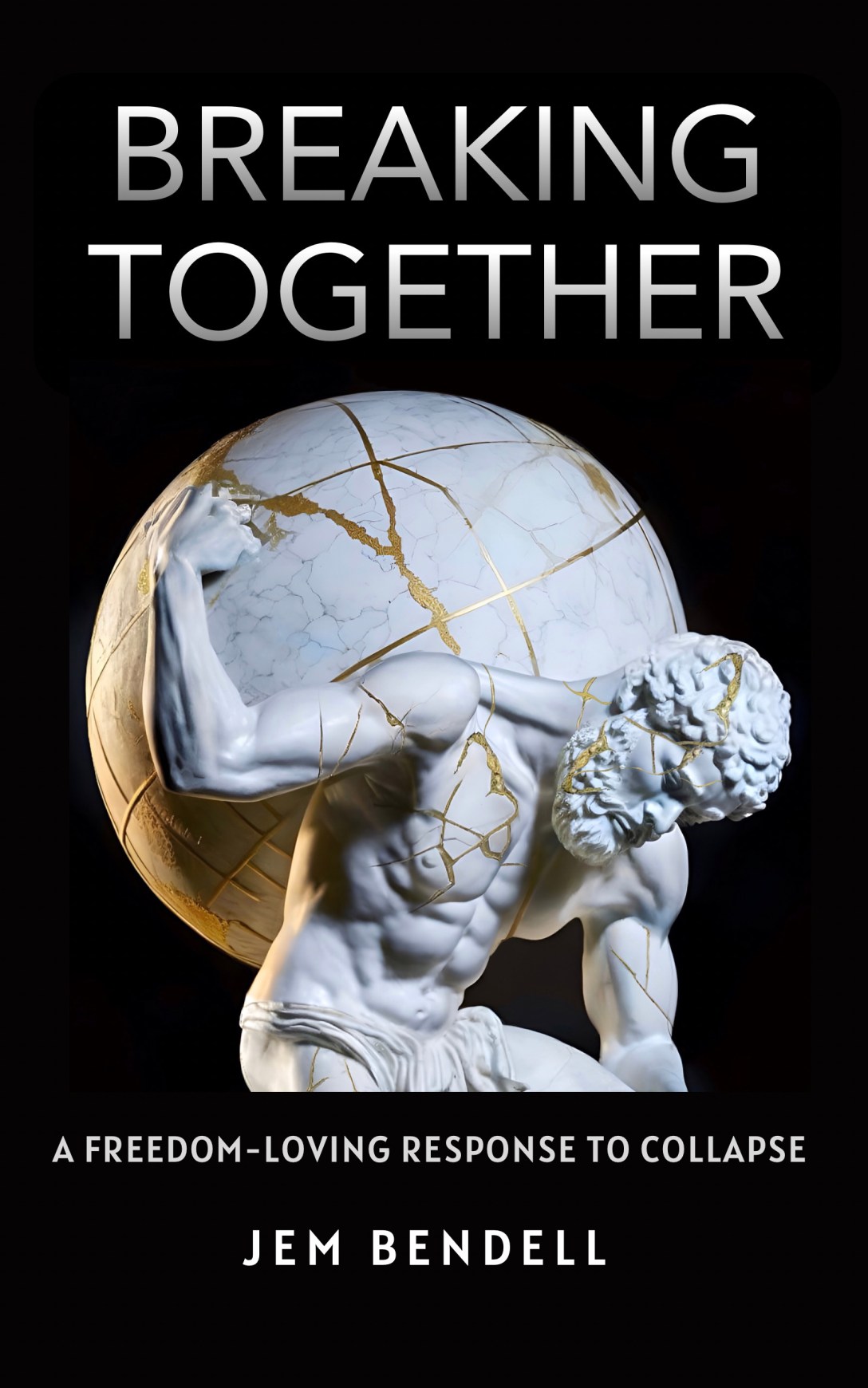

BREAKING TOGETHER – a freedom-loving response to collapse

Breaking Together – a freedom-loving response to collapse is out in hardback and e-book as well as paperback and audiobook. If you use a kindle, you can order in the USA or in the UK or worldwide (by typing ‘breaking together’ into your ‘national’ amazon site). The book is also available as a free epub.

From the back cover:

“This is a prophetic book.”  Satish Kumar, founder, Schumacher College

This book shows that instead of imposing elitist schemes and scams, regenerating nature and culture together is the only way forward.” Dr Stella Nyambura Mbau, Loabowa Kenya

This book is part of a healing movement that extends beyond what we normally think of as ecological.” Charles Eisenstein, author, Climate: A New Story

Continue reading “BREAKING TOGETHER – a freedom-loving response to collapse”

No wealth but life – pig style

Have you ever wondered where the term ‘piggy bank’ came from? Like me, some of you probably saved your spare coins in them when children. I didn’t give it a second thought until I stumbled across an actual living piggy bank in Bali. Midway through a cycling tour, we had stopped in a traditional village, and invited into a family compound. It was the kind where multiple generations all live in small houses next to each other, with a temple at the front, and some animals at the back. That is where I saw pig sty with a half dozen pigs. “The older women here don’t like putting money in a bank, so they buy a pig and feed it as their way to save,” my guide told me. A sensible store of value, I thought, especially with interest rates so low at the time. After the trip, I looked up the origin of the term piggy bank. Some historians guessed the name came from jars being made of a clay that was sometimes called ‘pygg’ in Germany and England, and that was the theory on Wikipedia at the time (it was 2015). But I had seen in the Indonesian national museum a piggy bank that was around 400 years older than when the word pygg was being used in Europe for a type of clay. Maybe I am a bit strange, but the piggy bank origin story had me. I dug deeper to discover that the earliest known pig-shaped money containers date to the 12th century in Indonesia.[i]

Continue reading “No wealth but life – pig style”

Beyond Climate War: Writings on Deep Adaptation to societal collapse

Updating this post in 2024, it is nearly 8 years since I first delivered a keynote lecture on the need to discuss what if it is too late to avert catastrophic damage to our societies from the direct and indirect impacts of climate and ecological damage. In that talk, I asked whether we don’t talk about it because of our fears. Because we can fear we will descend into despair and inaction. Or we might fear we will be attacked by our peers and dismissed by our friends. I suggested we needed to overcome such concerns, to explore what an anticipation of societal collapse might mean for our personal, professional and political lives. I offered a framework of questions to begin that conversation and called it Deep Adaptation. By taking time off from my job as a University Professor, I studied the climate science more closely in 2017 and 2018, and reached my personal conclusion that societal collapse in most countries in my lifetime is now inevitable. That meant I could not keep working on sustainable development and corporate sustainability any longer and released a paper in 2018 called Deep Adaptation. That was part of my process of moving on and transforming, not knowing what would come next.

The paper went viral and fuelled a new wave of activism, with Extinction Rebellion, and a new global network of people freely supporting each other, called the Deep Adaptation. Increasing numbers of people have been hearing about this paper, analysis, framework and community from its critics. My friends tell me that this negative reaction indicates that it has become a movement that matters. On the one hand, it is disappointing that people are hearing constant misinformation about what we are doing and why, and the implications for climate activism and policy. On the other hand, perhaps criticism of collapse anticipation is the safest way for some members of the general public to first hear about this possibility, as only those who are emotionally ready will explore further.

In 2023, I released a book, Breaking Together, which provided a lot more depth on the processes of societal collapse, and offered my ideas on how to respond to it. I recommend you read or listen to that, but if you want to locate commentary on specific issues related to DA, then the links to some of my blogs since 2018, below, may be of use.

Continue reading “Beyond Climate War: Writings on Deep Adaptation to societal collapse”