Do environmentalists secretly hate people?

“When people like you fly over Africa you want to see wild animals. When I fly over Africa, I don’t want to see dead Africans.” I still remember this statement from one of my former bosses at the UN, about 20 years ago. I was shocked at his idea that caring about the environment meant caring less about people. It seemed an attitude born of an urban life, forgetting the need to sustain the environmental basis of the livelihoods of billions. It showed me how hyper-modernist some leaders from Africa could be – perhaps from too much time flying over things to talk to people who fly over things. Since then, I always thought it a baseless form of rhetoric to claim that environmentalists prefer nature to people. Even if some might be like that, their lack of power on this planet means critiquing their psyche was  a distraction from serious policy discussion.

However, there is indeed another form of misanthropy, or people-hating, which can arise in environmentalism, as people become more anxious about the state of the planet. It is more subtle, involving a general denigration of humanity or the human condition, so people conclude we need to be controlled for our own good. This sentiment is not marginal to power and is facilitating the recent growth of authoritarian views within parts of the Western environmental movement. In my book Breaking Together, I explain how it is a fear-driven and illogical response which risks making matters worse as we go deeper into an era of societal disruption and collapse. The following is an excerpt where I explore this phenomenon. In it I mention various terms and chapters – if interested, the book is now free as a pdf from my University (clearly I haven’t got the hang of that ‘doomer grift’).

Subscribe / Support / Study / Essays

Continue reading “Do environmentalists secretly hate people?”
Be my twitter?

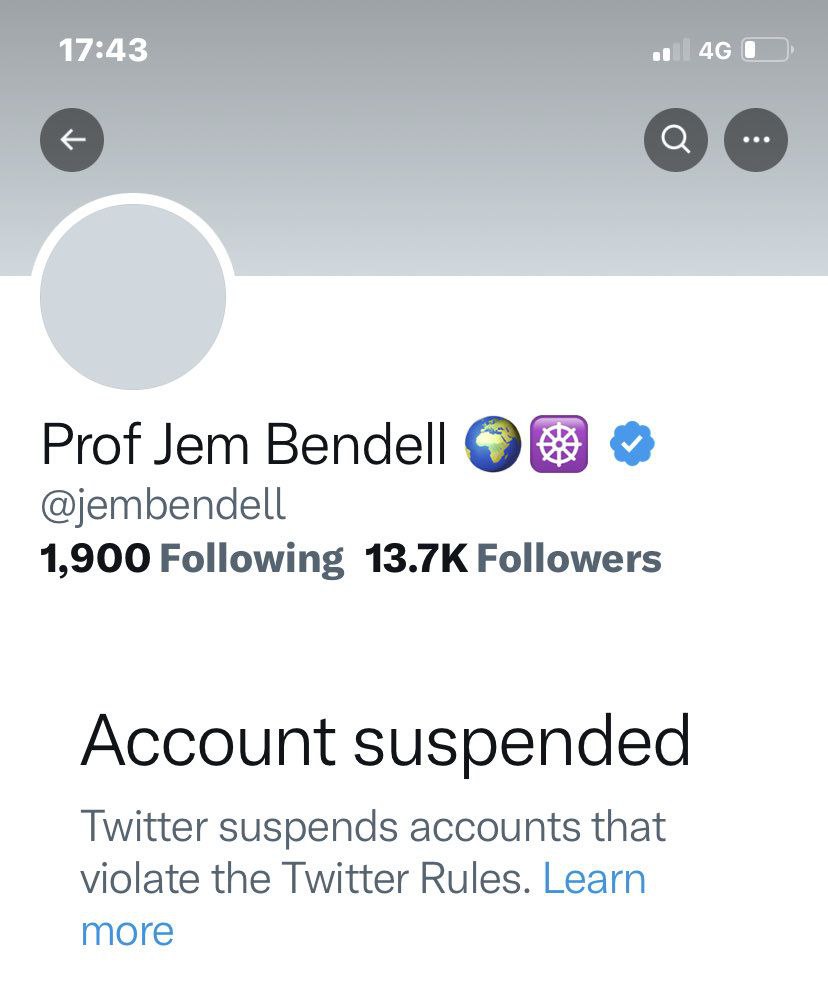
As I have been suspended from Twitter, I’d like to ask your help so that a Q&A on my book can be heard about. I was heartened that over 80 people joined me to discuss “Breaking Together: a freedom-loving response to collapse.” The event was hosted by Katie Carr of the Deep Adaptation Forum. The video follows below.

Why have I been booted from Twitter? Short answer: dunno. I received no warnings and no explanations. The text on my account says “After careful review, we determined your account broke the Twitter Rules.” Although I can be radical and forthright, at times responding to what I consider unfair criticism, I aim to be civil. Without further information, I’m curious as to the reason. Possibilities include some censorship code from old Twitter being triggered by a recent uptick in attention to my account. Or perhaps new Twitter doesn’t like my views on the unfortunate limits of renewables and electrification to transition humanity to sustainability. Another possibility is that the account was hacked in a sophisticated way so Twitter suspended it. I have submitted an appeal.

Subscribe / Support / Study / Essays

Continue reading “Be my twitter?”

Climate truth is a challenge to power – even that of senior experts

After another week of frightening temperature anomalies around the world, I gave a talk to supporters of the MEER project, which is trialling various means of locally-led climate adaptation that involve reflecting the sun’s rays. The video and transcript follow below. References for all the factual statements made in my presentation can be found within Chapters 1 and 5 of Breaking Together, which is available in all formats and regions, including a free epub download. Free audios of those chapters are also available. In the talk I am critical of mainstream climatology, as well as BigTech censorship of science-based analyses of the climate crisis that lie outside their preferred view of a manageable problem with technological solutions. From the talk:

“The so-called ‘fact checking’ group ‘Climate Feedback’ didn’t even consider two top climatologists worthy of a reply when they complained to them about helping Facebook to shadow ban an article that concluded we are inevitably heading for over 2 degrees global warming that will likely set off feedback loops. My understanding is that Professor Will Steffen died without even the courtesy of a reply from Climate Feedback. Dr Wolfgang Knorr still awaits one. So, we need to reclaim environmentalism from elites and officers of the establishment. We must stop pretending we are on the same side and instead build alternatives from below.”

Continue reading “Climate truth is a challenge to power – even that of senior experts”

Breaking Together for free – and my launch speech

So that cost is not a barrier to people accessing the analysis in my book Breaking Together, today the ebook becomes free to download. The book is also available as paperback, hardback, kindle and audiobook. My speech at the launch of the book is now online (see the video below, along with a rough transcript). We will be discussing the themes in the book in London on July 20th and Berlin on August 1st. Then I’ll disappear again to the organic farm school I am developing with fellow doomsters. If you, or someone you know, are feeling difficult emotions about this topic, or the recent climate news, then neither of you are alone. I recommend visiting deepadaptation.info and connecting with that community, or finding a relevant Deep Adaptation Guide. Please consider forwarding this information to anyone who might benefit from peer support on this topic. Thx, Jem 

Glastonbury Town Hall, June 18th 2023.
Continue reading “Breaking Together for free – and my launch speech”

I also hate this conclusion (on net zero)

I begin the final section of my chapter on Energy Collapse with the subtitle “I also hate this conclusion”. Because I did not want to discover that modern societies cannot continue their energy trajectories by simply displacing fossil fuels with new technologies. But that is what the sum of the relevant research shows us. In addition, the pursuit of the total electrification of economies will have hugely damaging effects on the biosphere, due to the mining involved. This is the awkward reality that most Western environmentalists are ignoring. The ‘green’ capitalists are extremely happy for us to keep ignoring that reality, as then any pressure for action translates into more money and pleasure for them. But if activism is about our personal commitment to higher goals, whether using moderate or radical tactics, then it must start with a fair assessment of reality and possibility. Otherwise, how is such activism not simply a mix of self-aggrandisement and emotional distraction by keeping busy?

The book Breaking Together is now available in audio, and Chapter 3 on Energy Collapse can be heard for free on soundcloud. To convey some of the arguments, below I share the first and last sections of the chapter. The image of the Kintsugi Tesla is from the Kintsugi World art project which accompanies the book.

Continue reading “I also hate this conclusion (on net zero)”

Audiobook and art for Breaking Together

The audiobook of Breaking Together is out. So you can learn about a freedom-loving response to collapse without taxing your eyes! It is narrated by my friend and longtime colleague Matthew Slater. To celebrate this, I am sharing a video of the Kintsugi World art project that accompanies the book (and from which the Kintsugi Atlas adorns the front cover). There have been a number of reviews already, and they follow the video below. The video includes the full introduction of Breaking Together.

Other ordering information is available here. The book will become free as an epub download from July 10th from www.jembendell.com.

Continue reading “Audiobook and art for Breaking Together”

Should scientists moonlight as ideologues?

This is an edited excerpt from Chapter 7 of ‘Breaking Together’ where I get a bit technical on the nature of the scientific method and how unscientific some natural scientists and other experts have become when they discuss our societal predicament. Listen to the whole of this chapter on “recognising collapse and cultural decay” for free on Soundcloud. The release coincides with the availability of the paperback from the Schumacher Institute. Further ordering info follows at the end of this excerpt.

Subscribe / Support / Study / Essays

Much of the discussion about risks and processes of societal collapse involves arguments about what people think is useful to believe, or how they wish to feel about the future. Such discussion is about people’s own identities and worldviews, involving lots of assumptions and logical fallacies. It can get quite nasty and resort to demonisation of individuals, condemned for being too negative. However, returning to the basics of scientific method can help to cut through this ‘noise’.

Continue reading “Should scientists moonlight as ideologues?”

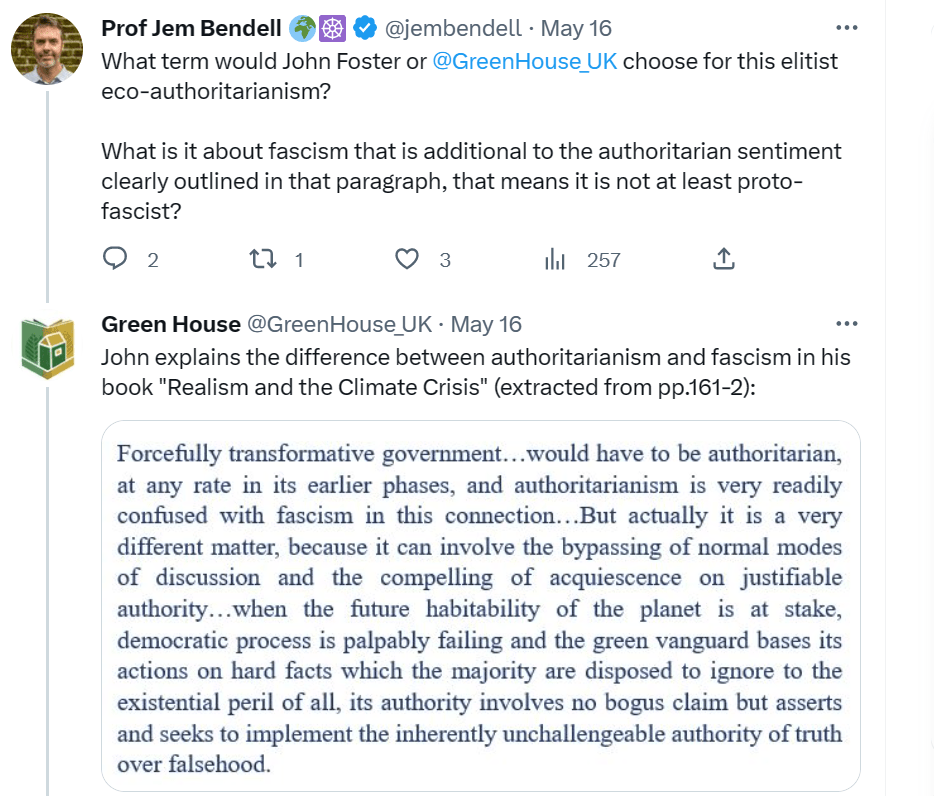
Why we must ALL challenge authoritarian views in green politics

Lancaster University academic, John Foster: “Forcefully transformative government… would have to be authoritarian…” “…if [Dr] Bendell wants to send GH [the Green House UK thinktank] an argued objection to what I said in my piece, GH will publish it along with a response from me. This is too important an issue not to encourage responsible debate on it.”

The following in an edited excerpt from the chapter “resisting the fake green globalists” in the book “Breaking Together: a freedom-loving response to collapse.” I am sharing it here in response to the Green House think tank supporting the views of the academic John Foster, which I quote further below. They invited a more substantive dialogue than possible on twitter. That seems appropriate as the thinktank claims to be “leading the development of green thinking in the UK” and has influential people on its board. The concepts I mention in this excerpt, and the evidence for them, are argued in detail elsewhere in the book, which is currently available as paperback/hardback/kindle, and will be available as a free epub download from The Schumacher Institute (TSI) from July 10th 2023 (as TSI always notes, these views are the author’s not the institute’s).

Subscribe / Support / Study / Essays

Continue reading “Why we must ALL challenge authoritarian views in green politics”

Getting more serious about food system breakdown

Combativeness and moral disdain pervades recent public discussion of environmental problems. It is not just one ‘side’ that resorts to such tactics. Take food and agriculture as an example. Some people speculate that eco-totalitarians will successfully force us to eat bugs and goo, whereas others oddly claim that anyone defending farmers is a far right extremist, obstructing the technological salvation of humanity and life on Earth. The AI generated image above is poking fun at the piety that’s in an unnecessarily binary discussion – as if we must all be steak lovers or steak haters, food tech fanatics or small farm purists. The famous climate activist Greta Thunberg has not descended into those silly binaries. Which is good, as they are unhelpful when we need a plurality of ideas on what to do about the unfolding breakdown of global food systems, as I chronicle in detail in Chapter 6 of my book “Breaking Together”. This blog coincides with the release of that chapter as a free audio (it is also available free from my University). 

Continue reading “Getting more serious about food system breakdown”

It’s time for a Great Reclamation in the face of collapse

A free audio recording of the Introduction to ‘Breaking Together: a freedom-loving response to collapse’ is now available. It is an extensive introduction in which I seek to encapsulate the full argument of the book, albeit without the detail in the following chapters. Below is an excerpt which introduces a few of the terms and ideas.

Subscribe / Support / Study / Essays

Excerpt from Breaking Together (Jem Bendell, 2023, Good Works).

“The people I am describing as ‘ecolibertarians’ have concluded that societies destroy their own eco-social foundations because the self-interests of the powerful are institutionalised to then coerce or manipulate people to experience life as unsafe and competitive, so that more people cope by becoming more unthoughtful, uncaring and acquisitive. Therefore, today, those same institutionalised patterns of establishment power are distorting public awareness of the breakdown of societies and the best means of responding to that (Chapter 13). In response, ecolibertarians believe less-oppressive ways of being and behaving need to be restored and applied to obtaining greater control of capital and state organisations, thereby funnelling resources into commonly-owned organisations, resources, platforms and currencies so that a gentler and fairer collapse of societies might be possible. The agenda is about reclaiming our power from the manipulations and appropriations of our lifeworld by the systems of Imperial Modernity. Around the world, various parts of this ‘Great Reclamation’ agenda are being pursued but, apparently, not yet with an overarching framework that enables integration and amplification of efforts.[i] Although the pace of collapse might be so fast that we do not have much time for updating our strategies for social change, I believe it is worth sharing such ideas while international communications still exist in their current form—so please read on!

Continue reading “It’s time for a Great Reclamation in the face of collapse”