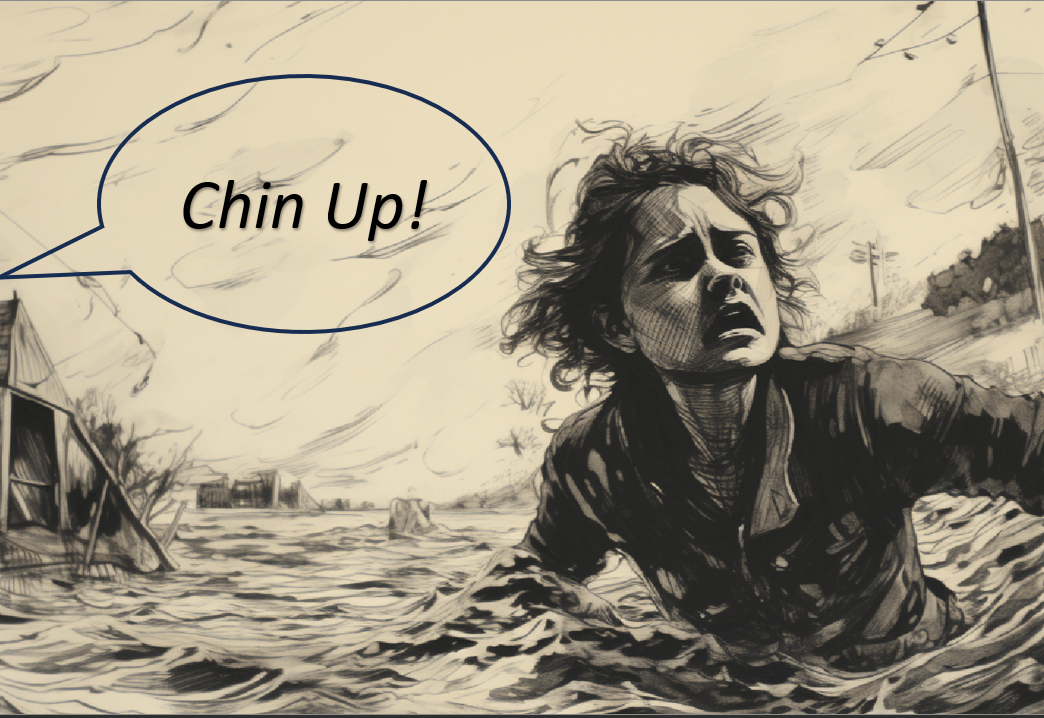
Accurate climate activists face prison, while their incorrect critics face… a pay rise?

What I have really valued, but also taken for granted over the years, is how my leadership courses have always been attended by a mix of people, brought together by a shared concern for being their best selves in an era of disruption and collapse. There have been climate activists, scientists, NGO officials and government officials in the room, or the zoom room, exploring sensitive issues together. It has been clear how much they are able to learn from each other. That contrasts with the way many top climatologists appear in the media, and on social media, to assume themselves to know everything that matters. That has led many over the years to casually disdain activists in various ways. The inconvenient truth they now need to face is that the activists are turning out to have been better at reading what was salient from the climate science than them, the salaried experts. Might some humility ensue? Or perhaps some curiosity about what creates such dangerous reticence amongst senior scientists and science bureaucrats? Maybe. But I’m not holding my breath.

Continue reading “Accurate climate activists face prison, while their incorrect critics face… a pay rise?”

Responding to the new wave of climate scepticism

When my book Breaking Together came out in May, some of my climate activist friends were surprised that I gave significant attention to rebutting scepticism on the existence of manmade climate change. I also surprised some of my colleagues at COP27 a year ago, when I gave a short talk on the rise of a new form of scepticism. That new form is couched in the important desire to resist oppression from greedy, hypocritical and unaccountable elites. I think the surprise of some that we still need to respond to climate scepticism reflects the bubble that many people working on environmental issues exist within. That’s a bubble of Western middle classes who believe they are well-informed, ethical and have some agency, despite relying on the Guardian, BBC or CNN for much of their news. Outside that bubble, there has been a rise in the belief that authorities and media misrepresent science to protect and profit themselves, while controlling the general public. That was primarily because of the experience of the pronouncements and policies during the early years of the pandemic. When people who are understandably resistant to that Covid orthodoxy have discovered the way elites have been using concern about climate change to enrich themselves, such as through the carbon credits scam, many have become suspicious of the whole agenda on climate change. Those of us who know some of the science on climate, and pay attention to recent temperatures and impacts, can feel incredulous at such scepticism. My green colleagues ask me: “How can someone deny what’s changing right before their very eyes?”

Continue reading “Responding to the new wave of climate scepticism”

#ConspiracyPorn hits Hawaii and the world

Look at those trees! Unburned! That proves weapons were used and it’s a conspiracy!

Oh, wait, that is a picture of a fire from a decade ago, before any ‘Directed Energy Weapons’ had been trialled. The unburnt trees are standing next to burned out houses in Valparaiso because that’s what happens with urban fires. Wooden houses catch fire easily from being hit by burning embers blown on the wind. But green leaves on living trees don’t catch fire so easily from those embers. Have you ever tried putting green leaves on a bonfire? It might get a bit smoky, but they don’t burn easily. In case you’re in any doubt, you could pick from a list of major fires in the 2010s, and search for images to discover how many of the trees ‘mysteriously escaped’ any of laser beams (which didn’t exist).

The reason a wildfire can burn many trees in a forest, not an urban area, is because the fire can pass through the canopy, so an actual flame passes from tree to tree. Crucial to such wildfires is the amount of dry matter on the forest floor, and the number of dead trees due to disease – as they can catch fire easily. Extremes of heat and cold, dry and wet, as well as the shrinking of forest area due to felling, are all known to increase the number of diseased trees, and therefore the likelihood of localised fires becoming massive wildfires. That is the best explanation for why, globally, forest fires have roughly doubled in the last 20 years. In case you didn’t know it yet, I am writing about these fire dynamics because of the tragic fires in Hawaii. In particular, there is strangely popular theory about the deadly fire in the town of Lahaina. The theory has meant that popular youtubers with massive audiences have chosen to ignore the reasons why forest fires became worse in recent years, and what we could be doing to try to reduce that in future. The conspiracy theory goes like this: the fires are started by Directed Energy Weapons (DEW), to create panic about climate change, and to force cities that resist adoption of ’15-minute smart city’ policies to curb private vehicle use. Some of the conspiracy theories also like to claim that the 15-minute smart cities agendas will curb personal movement rather than just cars (although there have been no such proposals or initiatives). The ‘evidence’ put forward for this view of the fires in Hawaii, includes: the fires only burned properties not trees, that the ashes look weird, boats were burned in the water, there are images of Direct Energy Weapons being used, and that Hawaii is hosting a 15-minute smart cities conference. Writing more than a week later, there are still many videos being widely shared on TikTok and other platforms that make some or all of these claims (see the ‘screen grab’ one of the most popular).

Continue reading “#ConspiracyPorn hits Hawaii and the world”

Let’s tell the moodsplainers they’re wrong and then get back to work

As we reel from the impacts of strange weather and the news of unprecedented ocean temperatures around the world, the moodsplainers are out in force. They tell us we are right to be anxious but wrong to not believe that our way of life can be saved. In our favourite news outlets, they tell us that it is both morally and practically important to stay positive, stem panic and bypass despair. They warn us not to abandon fairytales of change and salvation. It might be OK if they wanted to live in a self-protective bubble of delusion. But in their public advocacy, they’re dangerously suppressing necessary dialogue that might help us all to reduce harm in this era of societal disruption and collapse.

Continue reading “Let’s tell the moodsplainers they’re wrong and then get back to work”

Climate truth is a challenge to power – even that of senior experts

After another week of frightening temperature anomalies around the world, I gave a talk to supporters of the MEER project, which is trialling various means of locally-led climate adaptation that involve reflecting the sun’s rays. The video and transcript follow below. References for all the factual statements made in my presentation can be found within Chapters 1 and 5 of Breaking Together, which is available in all formats and regions, including a free epub download. Free audios of those chapters are also available. In the talk I am critical of mainstream climatology, as well as BigTech censorship of science-based analyses of the climate crisis that lie outside their preferred view of a manageable problem with technological solutions. From the talk:

“The so-called ‘fact checking’ group ‘Climate Feedback’ didn’t even consider two top climatologists worthy of a reply when they complained to them about helping Facebook to shadow ban an article that concluded we are inevitably heading for over 2 degrees global warming that will likely set off feedback loops. My understanding is that Professor Will Steffen died without even the courtesy of a reply from Climate Feedback. Dr Wolfgang Knorr still awaits one. So, we need to reclaim environmentalism from elites and officers of the establishment. We must stop pretending we are on the same side and instead build alternatives from below.”

Continue reading “Climate truth is a challenge to power – even that of senior experts”

From doom-scrolling the latest climate news to doom-sensemaking

As temperature records are broken around the world, some of the most senior ranking climate experts are quoted in mainstream media as expressing their grave concern. Because what is happening is worse than those climate experts predicted some years ago. They don’t say that though – misleading journalists to think that current temperature anomalies are not outside the projections from past IPCC reports. Many of them criticised and even vilified the more ‘alarmist’ readings of climate science over recent years. That includes my own Deep Adaptation paper, published 5 years ago this month. As I explain in Chapter 5 of my new book, now available as a free audio, the analysis in that paper aligns with observations of climate changes in 2023. In 2018 some NASA scientists privately agreed with me, before their bosses publicly dismissed my ‘alarmist’ conclusions after they had reached millions. Why is it that generalists like me were able to see what top climatologists would not express publicly? If we don’t inquire into the institutional and psychological reasons for their public reticence, then those same patterns will distort our future conversations on how to respond to the unfolding situation. That is not a minor concern, as psychological theories suggest that aversion to painful emotions and deference to incumbent power could become toxic to society.

Continue reading “From doom-scrolling the latest climate news to doom-sensemaking”

I also hate this conclusion (on net zero)

I begin the final section of my chapter on Energy Collapse with the subtitle “I also hate this conclusion”. Because I did not want to discover that modern societies cannot continue their energy trajectories by simply displacing fossil fuels with new technologies. But that is what the sum of the relevant research shows us. In addition, the pursuit of the total electrification of economies will have hugely damaging effects on the biosphere, due to the mining involved. This is the awkward reality that most Western environmentalists are ignoring. The ‘green’ capitalists are extremely happy for us to keep ignoring that reality, as then any pressure for action translates into more money and pleasure for them. But if activism is about our personal commitment to higher goals, whether using moderate or radical tactics, then it must start with a fair assessment of reality and possibility. Otherwise, how is such activism not simply a mix of self-aggrandisement and emotional distraction by keeping busy?

The book Breaking Together is now available in audio, and Chapter 3 on Energy Collapse can be heard for free on soundcloud. To convey some of the arguments, below I share the first and last sections of the chapter. The image of the Kintsugi Tesla is from the Kintsugi World art project which accompanies the book.

Continue reading “I also hate this conclusion (on net zero)”

Why we must ALL challenge authoritarian views in green politics

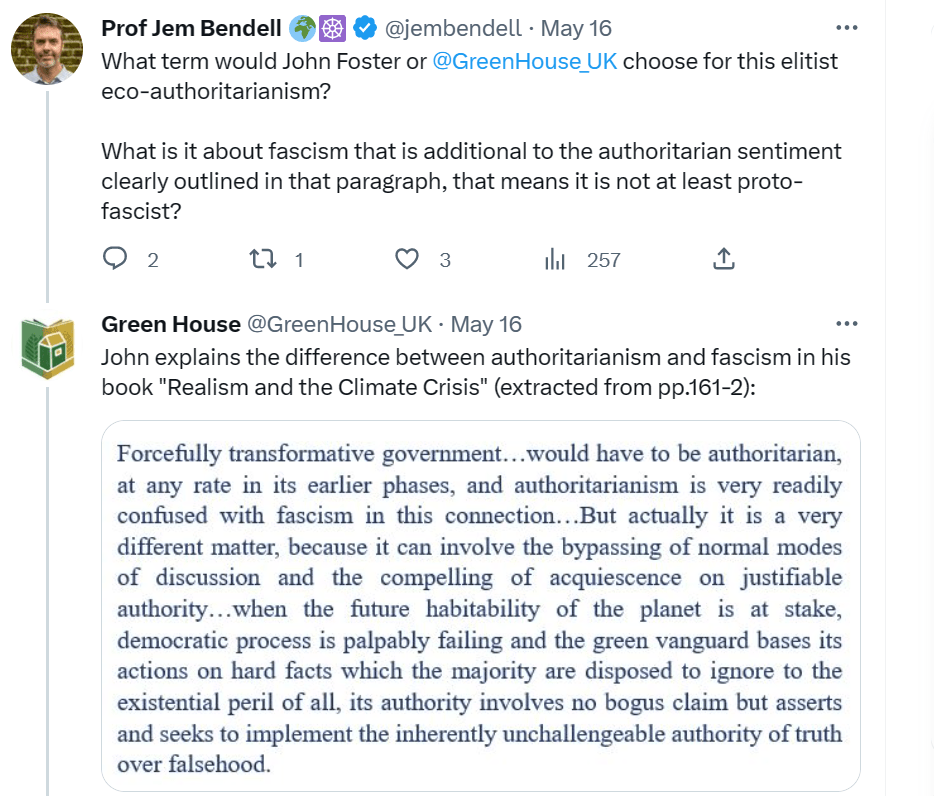
Lancaster University academic, John Foster: “Forcefully transformative government… would have to be authoritarian…” “…if [Dr] Bendell wants to send GH [the Green House UK thinktank] an argued objection to what I said in my piece, GH will publish it along with a response from me. This is too important an issue not to encourage responsible debate on it.”

The following in an edited excerpt from the chapter “resisting the fake green globalists” in the book “Breaking Together: a freedom-loving response to collapse.” I am sharing it here in response to the Green House think tank supporting the views of the academic John Foster, which I quote further below. They invited a more substantive dialogue than possible on twitter. That seems appropriate as the thinktank claims to be “leading the development of green thinking in the UK” and has influential people on its board. The concepts I mention in this excerpt, and the evidence for them, are argued in detail elsewhere in the book, which is currently available as paperback/hardback/kindle, and will be available as a free epub download from The Schumacher Institute (TSI) from July 10th 2023 (as TSI always notes, these views are the author’s not the institute’s).

Subscribe / Support / Study / Essays

Continue reading “Why we must ALL challenge authoritarian views in green politics”

BREAKING TOGETHER – a freedom-loving response to collapse

Breaking Together – a freedom-loving response to collapse is out in hardback and e-book as well as paperback and audiobook. If you use a kindle, you can order in the USA or in the UK or worldwide (by typing ‘breaking together’ into your ‘national’ amazon site). The book is also available as a free epub.

From the back cover:

“This is a prophetic book.”  Satish Kumar, founder, Schumacher College

This book shows that instead of imposing elitist schemes and scams, regenerating nature and culture together is the only way forward.” Dr Stella Nyambura Mbau, Loabowa Kenya

This book is part of a healing movement that extends beyond what we normally think of as ecological.” Charles Eisenstein, author, Climate: A New Story

Continue reading “BREAKING TOGETHER – a freedom-loving response to collapse”

No wealth but life – pig style

Have you ever wondered where the term ‘piggy bank’ came from? Like me, some of you probably saved your spare coins in them when children. I didn’t give it a second thought until I stumbled across an actual living piggy bank in Bali. Midway through a cycling tour, we had stopped in a traditional village, and invited into a family compound. It was the kind where multiple generations all live in small houses next to each other, with a temple at the front, and some animals at the back. That is where I saw pig sty with a half dozen pigs. “The older women here don’t like putting money in a bank, so they buy a pig and feed it as their way to save,” my guide told me. A sensible store of value, I thought, especially with interest rates so low at the time. After the trip, I looked up the origin of the term piggy bank. Some historians guessed the name came from jars being made of a clay that was sometimes called ‘pygg’ in Germany and England, and that was the theory on Wikipedia at the time (it was 2015). But I had seen in the Indonesian national museum a piggy bank that was around 400 years older than when the word pygg was being used in Europe for a type of clay. Maybe I am a bit strange, but the piggy bank origin story had me. I dug deeper to discover that the earliest known pig-shaped money containers date to the 12th century in Indonesia.[i]

Continue reading “No wealth but life – pig style”