Invitation to Sign an Oath to the Future

The following invitation is being sent to scholars around the world in the run up to COP27 in Egypt.

Dear Scholar,

Nearly two years ago over 500 of us from over 30 countries signed a public letter to coincide with the 5th anniversary of the Paris Climate Accord. We wrote:

“As scientists and scholars from around the world, we call on policymakers to engage openly with the risk of disruption and even collapse of our societies. After five years of failing to reduce carbon emissions in line with the Paris Climate Accord, we must now face the consequences. While bold and fair efforts to cut emissions and naturally drawdown carbon are essential, researchers in many areas now consider societal collapse to be a credible scenario this century… Only if policymakers begin to discuss this threat of societal collapse might communities and nations begin to prepare and so reduce its likelihood, speed, severity, harm to the most vulnerable, and to nature.”

Over the last two years we have seen climate impacts worsen, emissions climb again, methane levels jump, the science become more worrying, and the political mood darken in many countries. We have also seen the ongoing commercialisation of climate responses, the public sugar-coating of problematic science, and concerted denigration of people who focus on radical economic change to prepare for inevitable disruptions. The climate summits have morphed into career fests and trade shows at the end of the world as we know it. Although we are unlikely to change the huge systems that incentivise poor responses from professionals in this field, we can commit to learn and support each other in taking a different path.

Continue reading “Invitation to Sign an Oath to the Future”

Towards a 5th R in the Deep Adaptation Framework?

In the last few years a few people have suggested additional “Rs” for the 4 questions that comprise the Deep Adaptation framework for reflection and dialogue within an expectation or situation of societal disruption and collapse. As the idea of DA is used with groups around the world, various new ideas on what it means and what personal and group practices are relevant are emerging. One new R that I learned about recently is “Reverence.” That is what Reverend Lauren Van Ham adds to the framework as she uses it for the past couple of years with seminarians and faith-based communities. In my recent Q&A I asked her what a question might be that relates to Reverence, as I think DA involves inquiry, rather than simple answers. That is because societies and people are diverse, and an environmental breakdown affects all of it and, ultimately, everyone, thereby making generalised recommendations somewhat problematic!

Continue reading “Towards a 5th R in the Deep Adaptation Framework?”

Boring Averages and Climate Brightsiding – big mistakes in climate comms during #ClimateWeek

Do you know what the world’s average temperature was in preindustrial times? In absolute terms? If not, how does hearing of the subsequent 1.3C degrees of global warming make you feel? You have nothing to compare it with. We experience and talk about daily and seasonal highs and lows. Yet with climate we are asked to talk about incomparable averages of 1.5C or 2C degrees. People relate that to an existing cognitive frame of “warmth” which has dominated understandings of climate chaos. That is why people can say things like “I don’t believe in destroying the economy to stop just 1.5C of warming” and it make intuitive sense to others, despite being empirical nonsense. Even the people who work on these subjects can get completely confused and end up publishing extreme silliness such as a “best guess” that crops grown in Europe might cope with 15C of average global warming (making the average like the current Western Sahara – not known for its agriculture).

I write about this ‘average stupidity’ in a two-part essay on the biggest mistakes in climate communications. It is also where I provide the basic information on pre-industrial temperatures and suggest different ways to communicate about it.

Continue reading “Boring Averages and Climate Brightsiding – big mistakes in climate comms during #ClimateWeek”

Deep Adaptation in the Caribbean

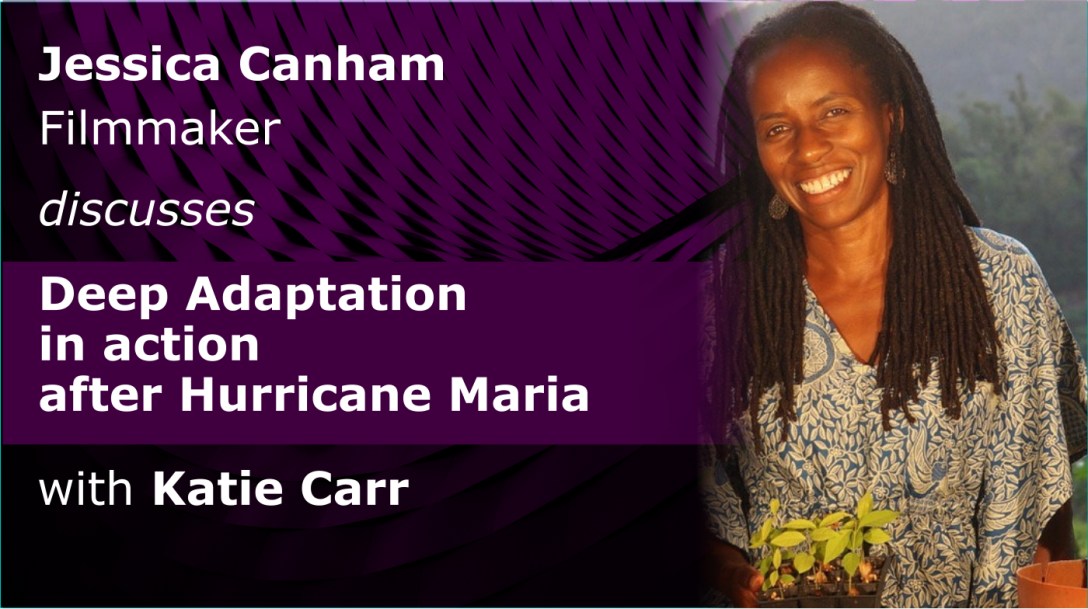
In this month’s Deep Adaptation Q&A, host Katie Carr speaks with Jessica Canham about Deep Adaptation in the Caribbean and possible implications for elsewhere.

Jessica is a member of the Deep Adaptation Forum, a film-maker. She is based in her ancestral island home of Dominica, in the Eastern Caribbean. She shares about her experience of ‘deep adaptation in action’ during and after Hurricane Maria hit the island of Dominica in 2017, when communities responded by sharing food, shelter, practical and emotional support – in ways that Jessica sees are virtually non-existent in modern western societies.

Along with her partner Tim, she has created documentaries from the Caribbean and South America, for international broadcasters with an emphasis on culture, environment and social justice stories. Her current documentary film project, “LOVE In Action”, focuses on the stories of revolutionaries working on the front lines of our climate and ecological crisis.

Having survived the devastation and collapse caused by Hurricane Maria hitting the island in 2017, Jessica continues to work to strengthen and maintain resilient, healthy local communities. On her mountain rainforest property, she has created and manages a transformational retreat centre Caapi Cottage Retreats where the focus is on nature connection.

Other recent videos from the Q&A series include the coordinator of the Deep Adaptation Forum (DAF) sharing her journey from sustainability to DA and also a socialist politician on his engagement with DA. The Forum is also hosting interviews with people either from or who identify with communities that have already experienced societal disruption and collapse – including indigenous peoples. More discussion of a less-or-non-Western approach to DA included Vanessa Andreotti in discussion with me – Jem Bendell. If interested in this theme I recommend reading about Deep Adaptation in India or listening to a talk I gave in Glasgow in 2019 as I engaged with local groups on climate justice ahead of COP26. You may also be interested in the growing arguments from activists and scholars that we need to ditch the ideology of sustainable development and become more realistic about the deteriorating situation – something I wrote about for the United Nations here.

To receive invites to future Q&As then subscribe to the Deep Adaptation Quarterly.

Don’t be a climate user – an essay on climate science communication

“A great deal of intelligence can be invested in ignorance when the need for illusion is deep.” – Saul Bellow

Jem Bendell, for the Deep Adaptation Quarterly, August 2022. 

As the heatwaves swept across Europe this summer, mainstream Western media gave some more attention to global heating. With 40+ degrees Celsius in the UK, for instance, many people were unnerved. They wanted to know more about what is happening and how bad it might become. This meant climate scientists were featured in the media. Then a curious thing happened. Some of those scientists began to ‘cherry pick’ the science to promote a particular narrative that the danger will cease to increase if specific policies are pursued. They presented their view as following science, and some experts then admonished people who pointed out the scientific limitations of that perspective. Does this mean there is now an ‘establishment story’ on climate change? If so, why, and what does it preclude?

Continue reading “Don’t be a climate user – an essay on climate science communication”

What has the UN Disaster Risk Reduction agency got to do with you?

I was interviewed this week by the Independent newspaper about why more than 100 scholars from around the world issued a public letter to delegates at the UN’s event on disaster risk reduction. This provides more depth than my opinion piece in the newspaper.

Q – What was the impetus behind this letter?

Jem – The impetus for this letter is a widespread experience that many of our fellow professionals working on social and environmental issues privately know that we have been using a failing approach, with all the indicators heading in the wrong direction, but that they are hesitant to say so in public. We perceive that is because they are not yet clear on how to make sense of that failure or what might come next. They also see professional risk in criticising both capitalism and the story that our world will improve with more technology and investment. Whereas more people in the general public now sense that our systems are broken, many experts in establishment institutions continue to think they must remain upbeat in public. But signatories to the letter clearly think that attitude could undermine the needed reckonings and radical changes.

Q – Who are the signatories?

Continue reading “What has the UN Disaster Risk Reduction agency got to do with you?”

Thoughts On Pandemic Response

Since April 2020 most media corporations have encouraged hostility towards open scientific dialogue and normal policy scrutiny. That has been accentuated by the way domestic partisan politics in North America has influenced media content globally and provoked censorship from Big Technology platforms. The sad result is that misinformed and emotionally activated people share misinformed and outrage-inviting commentary on the analysis of people who are demanding more open scientific dialogue and normal policy scrutiny. That creates a barrier to people discovering what is actually being said by people like me. Therefore I am listing my key writings on Covid in one place so it is easy to access them.  

It’s time for more of a citizen’s response to the pandemic – for a real #PlanB – where I explain how a different agenda to the current orthodoxy could be pursued that allies with our fellow citizens to remove barriers to us all making responsible decisions and how the Left has failed to articulate this agenda due to having lost close connection with the low paid workforce. 

Continue reading “Thoughts On Pandemic Response”

100s of scholars worldwide engage on collapse risk and readiness

In December 2020 over 600 academics signed an international Scholars’ Warning on societal disruption and collapse. It led to the formation of an initiative to help more scholars to engage publicly about their views on collapse risk, readiness and response. This is a quick summary of what has happened and what is in the pipeline.

The second public Scholars’ Warning letter appeared in the Independent Newspaper at the close of COP26 and was written about in a number of articles. It also appeared in French newspapers. Over 200 scholars responded within the 24 hours to sign and help the sense-making of journalists and others as the summit closed. If you agree with the sentiment of this latest letter, please share this video of some of the signatories reading it.

By registering their support for a more radical agenda on our climate predicament, including the need to discuss collapse risk, readiness and response, now journalists can find these scholars and bring these ideas to wider attention. One example is an ‘Inside Climate News’ article that interviewed a number of signatories.

Continue reading “100s of scholars worldwide engage on collapse risk and readiness”

Uniting in Love and Rage against Corporate Power

If you think things in society are going wrong, how does that make you feel? Sad? In some situations, might you feel some rage?

It is natural to feel angry about a bad situation. The issue is then what we do about it. Our culture tends to denigrate anger in ways that mean we do not have a healthy discussion or understanding of the difference between a positive anger and a destructive anger. Anger suppressed can lead to a destructive anger which manifests as aggressions towards people. However, there can also be a righteous anger which is a natural and important response to unnecessary harm and injustice. Such an anger can remain connected to our sense of love for creation and each other. But it needs to flow somewhere…

When you feel righteous anger about a situation, what do you do next? 

Continue reading “Uniting in Love and Rage against Corporate Power”

Tax Carbon Not Income and Reform Markets – part 2 of a #RealGreenRevolution

This is the 2nd in a 7-part essay on the type of policy innovations that would respond to the truth of the environmental predicament and, also, why most environmental professionals ignore such ideas to promote limited and limiting ideas instead. These ideas on a #RealGreenRevolution provide a contrast to current agendas, with the aim of encouraging a global environmental movement as a rights-based political force.  In this essay I focus on that sexy topic of taxation, and how to transform it to provide the price signals and funds to radically alter behaviours in fair ways.

To receive each part of the essay, subscribe to my blog, using the box on the right. To engage with other people who are responding to these ideas, either engage on the Deep Adaptation Leadership group on LinkedIn (where I will check in) or the Deep Adaptation group on Facebook, or by following the hashtag #RealGreenRevolution on twitter. The introductory Part 1 provides context.

Global Carbon Energy Tax Treaty

In 1997 one of the key ideas being discussed for how to help the whole planet reduce its carbon emissions was a taxation on carbon emissions. Using taxes to influence behaviours through market systems was something most governments had experience of and could be trialled quite easily. However, under the then US Vice President Al Gore, the delegation from the United States stopped that initiative and instead advanced the idea of creating markets for carbon permits. The resultant Kyoto Protocol started that process whereby we have witnessed polluters being given permits which they could then sell. Many environmental experts regurgitated the arguments of corporate public relations, that a cap-and-trade system would be better for the climate by identifying specific limits. Such carbon pie in our overheating sky was gobbled up by financial elites. The cap-and-trade systems have done little to nothing on carbon emissions, which have continued to rise ever faster around the world. I mention this history, as it is an example of how the mundane everyday influence of people working for corporations and governments focused on corporate interests can produce results that are ‘omnicidal’. That word means the killing of all life, and I use it because 1997 was the last chance humanity had to create a framework that could have slowed climate change sufficiently to avoid a manmade catastrophe for life on Earth. I don’t blame you Al, but the fact you are quoted with respect and excitement by environmentalists today suggests how ill informed, uncritical, timid and sycophantic to power the green movement and sector has become.

Continue reading “Tax Carbon Not Income and Reform Markets – part 2 of a #RealGreenRevolution”