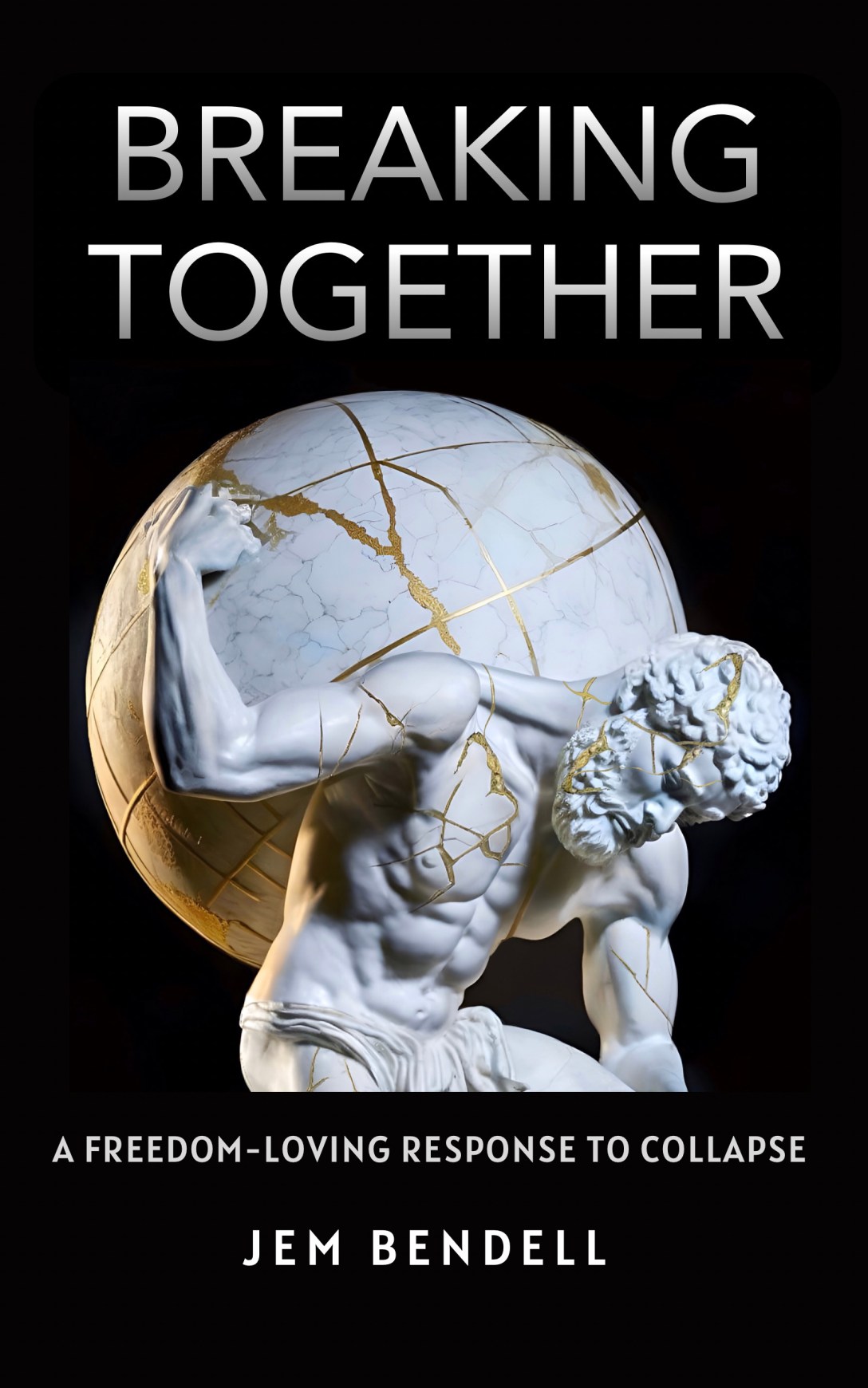
Audiobook and art for Breaking Together

The audiobook of Breaking Together is out. So you can learn about a freedom-loving response to collapse without taxing your eyes! It is narrated by my friend and longtime colleague Matthew Slater. To celebrate this, I am sharing a video of the Kintsugi World art project that accompanies the book (and from which the Kintsugi Atlas adorns the front cover). There have been a number of reviews already, and they follow the video below. The video includes the full introduction of Breaking Together.

Other ordering information is available here. The book will become free as an epub download from July 10th from www.jembendell.com.

Continue reading “Audiobook and art for Breaking Together”

Getting more serious about food system breakdown

Combativeness and moral disdain pervades recent public discussion of environmental problems. It is not just one ‘side’ that resorts to such tactics. Take food and agriculture as an example. Some people speculate that eco-totalitarians will successfully force us to eat bugs and goo, whereas others oddly claim that anyone defending farmers is a far right extremist, obstructing the technological salvation of humanity and life on Earth. The AI generated image above is poking fun at the piety that’s in an unnecessarily binary discussion – as if we must all be steak lovers or steak haters, food tech fanatics or small farm purists. The famous climate activist Greta Thunberg has not descended into those silly binaries. Which is good, as they are unhelpful when we need a plurality of ideas on what to do about the unfolding breakdown of global food systems, as I chronicle in detail in Chapter 6 of my book “Breaking Together”. This blog coincides with the release of that chapter as a free audio (it is also available free from my University). 

Continue reading “Getting more serious about food system breakdown”

It’s time for a Great Reclamation in the face of collapse

A free audio recording of the Introduction to ‘Breaking Together: a freedom-loving response to collapse’ is now available. It is an extensive introduction in which I seek to encapsulate the full argument of the book, albeit without the detail in the following chapters. Below is an excerpt which introduces a few of the terms and ideas.

Subscribe / Support / Study / Essays

Excerpt from Breaking Together (Jem Bendell, 2023, Good Works).

“The people I am describing as ‘ecolibertarians’ have concluded that societies destroy their own eco-social foundations because the self-interests of the powerful are institutionalised to then coerce or manipulate people to experience life as unsafe and competitive, so that more people cope by becoming more unthoughtful, uncaring and acquisitive. Therefore, today, those same institutionalised patterns of establishment power are distorting public awareness of the breakdown of societies and the best means of responding to that (Chapter 13). In response, ecolibertarians believe less-oppressive ways of being and behaving need to be restored and applied to obtaining greater control of capital and state organisations, thereby funnelling resources into commonly-owned organisations, resources, platforms and currencies so that a gentler and fairer collapse of societies might be possible. The agenda is about reclaiming our power from the manipulations and appropriations of our lifeworld by the systems of Imperial Modernity. Around the world, various parts of this ‘Great Reclamation’ agenda are being pursued but, apparently, not yet with an overarching framework that enables integration and amplification of efforts.[i] Although the pace of collapse might be so fast that we do not have much time for updating our strategies for social change, I believe it is worth sharing such ideas while international communications still exist in their current form—so please read on!

Continue reading “It’s time for a Great Reclamation in the face of collapse”

I was wrong to conclude collapse is inevitable…

I was wrong to conclude collapse is inevitable… because when I was concluding that, it had already begun.

When I concluded that societal collapse is inevitable, nearly 5 years ago, it may have been one of the reasons my Deep Adaptation paper attracted unusual attention. Many people agreed and thanked me for expressing that conclusion publicly. They said it helped validate what they already felt, and so enabled their emotional processing and to change their lives accordingly. Other people chose a variety of ways to disagree. Some claimed I was not being scientific to claim an inevitable outcome, and instead language like “near certain” or “very likely” would be more appropriate. Others preferred to regard societal collapse as a possibility, as they wanted to hope for a managed transition to a new form of society. Unfortunately, other people misrepresented what I wrote. To recap: in the paper I did not claim that we faced inevitable near-term human extinction and did not claim that the inevitable collapse would happen by 2028. Instead, in that paper in 2018 I wrote: “Recent research suggests that human societies will experience disruptions to their basic functioning within less than ten years due to climate stress. Such disruptions include increased levels of malnutrition, starvation, disease, civil conflict and war – and will not avoid affluent nations.” In 2023 many experts and UN officials are saying similar.

I summarised my position thus: “Currently, I have chosen to interpret the information as indicating inevitable collapse, probable catastrophe and possible extinction.” I then warned against the trap of concluding inevitable human extinction: “I have witnessed how people who doubt extinction is either inevitable or coming soon are disparaged by some participants for being weak and deluded. This could reflect how some of us may find it easier to believe in a certain than uncertain story, especially when the uncertain future would be so different to today that it is difficult to comprehend.”

Continue reading “I was wrong to conclude collapse is inevitable…”

BREAKING TOGETHER – a freedom-loving response to collapse

Breaking Together – a freedom-loving response to collapse is out in hardback and e-book as well as paperback and audiobook. If you use a kindle, you can order in the USA or in the UK or worldwide (by typing ‘breaking together’ into your ‘national’ amazon site). The book is also available as a free epub.

From the back cover:

“This is a prophetic book.”  Satish Kumar, founder, Schumacher College

This book shows that instead of imposing elitist schemes and scams, regenerating nature and culture together is the only way forward.” Dr Stella Nyambura Mbau, Loabowa Kenya

This book is part of a healing movement that extends beyond what we normally think of as ecological.” Charles Eisenstein, author, Climate: A New Story

Continue reading “BREAKING TOGETHER – a freedom-loving response to collapse”

Evidence and theory for how monetary collapse has been made inevitable

“At 8:30 p.m. on 23 March 2020, then British Prime Minister Boris Johnson announced a stay-at-home order effective immediately, backed up by the subsequent regulation three days later. The stated aim was to “flatten the curve” of the rate of infections. So, he launched the slogan “Stay Home, Protect the NHS, Save Lives” and said that the lockdown would be reviewed every three weeks. This was unprecedented and came as a surprise to the public. But a week earlier, on March 17th, the Governor of the Bank of England, Andrew Bailey wrote to the chancellor Rishi Sunak outlining a similarly unprecedented measure, which would direct tens of billions of pounds directly to large corporations:

“The new Covid-19 Corporate Financing Facility (CCFF) will provide funding to businesses by purchasing commercial paper of up to one-year maturity, issued by firms making a material contribution to the UK economy. It will help businesses across a wide range of sectors to bridge across the economic disruption that is likely to be associated with Covid-19, supporting them in paying salaries, rents and suppliers, even while experiencing severe disruption to cashflows. The Bank will implement the facility on behalf of the Treasury and will put it into place as soon as possible.”

Continue reading “Evidence and theory for how monetary collapse has been made inevitable”

Let’s chatGPT about gardening

After a two year research project, with an interdisciplinary team, the conclusions I came to on the state of the world, and our near future, are not that relaxing. They will be available in the book Breaking Together, out in May. One of the chapters is already available, preprint, as the matter of food security seems so urgent. [subscribe to this blog to get a link to the full book when it’s out]

That context means I am especially happy to have launched a demonstration organic farm, using an approach called syntropic agroforestry. It does not mean I will definitely escape the impacts of agricultural disruptions and the socio-political ramifications. But it means that at least I am doing something about it that will benefit both people and planet. 

As I’ve been writing so much for the forthcoming book, I’d rather garden than write about it, so I asked chatGPT to tell you all about the approach we are taking. The prompt was “Write a summary of many reasons (environmental and social) why syntropic agroforestry is a good idea. Explain why it is helpful to educate and support farmers in Indonesia to do syntropic agroforestry.” ChatGPT responded:

Continue reading “Let’s chatGPT about gardening”

Can you escape sustainable development?

This is the text of a newsletter sent to people who receive my irregular updates (that go out once or twice a year)

As you registered for my irregular update, a good guess is that you are interested in sustainable development – the concept for social and environmental progress that took off since the 1992 Earth Summit. So, in opening this update (my first since March last year), I’d like to clear up something: sustainable development is a lie. It has been a successful one because it helps middle class professionals earn salaries while pretending that’s for them caring about the world. Not only does all the recent data point to the failure to improve the world by spreading one economic model, but that failure was widely predicted decades ago. People like me ignored such critique because we wanted to believe something else. Why? Not because it was good for wildlife, landscapes and the poor. We wanted to believe because it was convenient with our careers to develop, consumer lifestyles to lead, houses to buy and kids to bring up. Ouch. But I’m tired of the mix of pseudo-concern and pseudo-professionalism that surrounds me in the sustainability field. Fortunately, many of us won’t pretend anymore.

Continue reading “Can you escape sustainable development?”

Would even an infinite fund on loss and damage be enough?

This is the Editorial of the final Deep Adaptation Quarterly of 2022.

The COP27 climate conference announcement of a new fund, of unknown quantity, for the loss and damage occurring due to climate chaos, means it might appear that politicians and bureaucrats are finally getting real about how bad the situation is. So could they be catching up with the ‘Deep Adapters’? Unfortunately, no fund will ever be able to recompense the loss and damage that is being suffered – and will be suffered – from the impacts of climate and ecological breakdown. No international currency, bank, or payment system will likely survive the extent of disruption when impacts of global heating really kick in. I am just back from my first and last climate conference, and not only experienced it as an exercise in denial but one that is made impenetrable by the numbers of people and resources maintaining it in myriad ways. Even critics of COP27, and climate policies more generally, have their budgets, wages, skills, and status tied to the story of ultimate salvation from climate chaos. A consequence of this denial is not looking at the root causes of our predicament. Which might also be a reason for the denial. So let’s go there…

Continue reading “Would even an infinite fund on loss and damage be enough?”

It’s not too late to stop being a tool of oppression

An audio version of this essay is available.

Death rates are still above normal in many countries of the world. The medical experts don’t know why. It could be from the long-term complications from past Covid infections, or it could be from the impacts of novel vaccines, or it could be from the delayed treatments due to lockdowns. Or perhaps it is from a mixture of these causes, or even from some other factor altogether. Even writing those two sentences induced in me a feeling of trepidation. I find myself readying for the annoyance or even aggression from some people. Which is odd: people did not behave so stridently on public health issues before 2020. I think the decay in normal scientific dialogue and policy scrutiny is a significant lasting damage from the last few years. It is why I am not going to let it lie. Instead, I hope we can all learn more about why people became so badly informed and aggressive towards others who reached conclusions different to their own. Only then might we avoid making matters worse when future public health crises occur. And if the excess mortality does not return to normal, then we are already within an ongoing health crisis right now.

It is why in this essay I am returning to the scientific facts which prove the medical authoritarian orthodoxy on Covid has been scientifically wrong. Not just wrong in hindsight, but now more widely recognised as wrong by experts and scientists who ignored some of the earlier concerns. This recent science can’t be ignored unless someone is no longer interested in the science on public health.

Continue reading “It’s not too late to stop being a tool of oppression”