The fact that so much of the world now speaks English has made it convenient for me, as a British man, to interact with people around the globe. Last week, for instance, I was with over 100 climate professionals and activists from across Asia, and the whole retreat (here in Bali) was in my native tongue. The prevalence of the English language means that I can learn about the experiences of people from different parts of the world. In addition, they can more easily learn from each other. But as we enter an era of societal disruption and collapse, the prevalence of English reflects a dominance of systems and cultures which is unhelpful. In Breaking Together, I describe this as Imperial Modernity: “the interlocking set of political, economic, and cultural systems that shape our everyday lives to favour the accumulation of power by elites.” It is why I am interested in learning more about responses to environmental change from outside English-speaking countries, and the ‘West’ more generally. Although living in Indonesia helps, my desire to engage beyond my usual circles is one reason why I am travelling on a book tour this year.
I lived the majority of my adult life outside the UK, where I was born. Over the years I have noticed that people from English-speaking countries are more likely than people from elsewhere to assume that their framings of philosophies, politics, problems, and suchlike, are both ‘common sense’ and universal. They are also more likely to express an opinion on what is right or wrong in other countries. However, my view is that just because the world speaks English does not mean the English-speaking world contains or defines everything that matters in the world.
I notice this issue when I speak or write about the political philosophy of ‘ecolibertarianism’. In Breaking Together I explain that ecolibertarianism involves the belief and praxis towards “an individual and collective state of being free and enabled to care for each other and the environment, rather than coerced or manipulated towards behaviours that damage it.” I make the case that this is a political philosophy suited for an era of societal breakdowns. I also explain my view that by ignoring the anti-democratic power of large corporations, especially global ones, ‘right-wing libertarianism’ is incoherent. Instead, ecolibertarianism aligns with many left libertarian traditions (which are remarkably well summarised on Wikipedia). That connection is why I cite political thinkers and leaders including Ocalan, Bookchin, Gandhi, and Bishop Romero in my book. Prior to WW2 the concept of libertarianism was associated with leftist politics. But since then, in the US, a form of libertarianism has been promoted by the right wing. Due to the influence of US media over the rest of the English-speaking world, I sometimes hear concerns from people in English-speaking countries that I am advocating a right-wing ideology. If you read the book and its chapters on how money systems and capitalism now drive collapse, you might conclude otherwise. The assumption I must be right-wing (openly or covertly) reflects how so many countries have been emptied of their social histories, to forget the freedom-loving basis of many strands of leftist politics, and the diversity of bottom-up approaches in leftist political history. In other words, the opposite of totalitarian systems.
The myopia of the English-speaking world is one reason I am reaching out beyond it in my attempts to invite a wider engagement with the unfolding collapse of modern societies. The French and Spanish versions of Breaking Together will be published in a few months. The book embodies an anti-imperialist philosophy, which is why I will promote the translations in Latin America and Francophone Africa. In Mexico, for instance, I will launch the book at events in Monterrey and Mexico City, in October. The Chinese and Brazilian Portuguese versions are in the pipeline (watch this space).
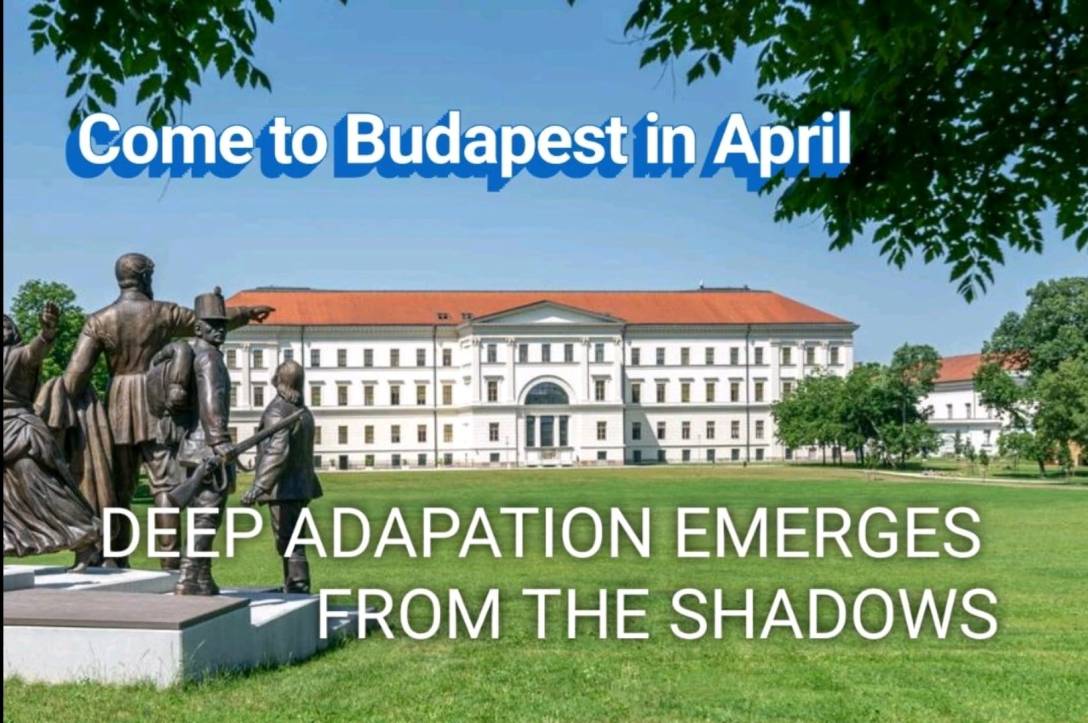
Even within the West there are countries that constitute the periphery in contemporary power structures. One such country is Hungary, a nation of less than 10 million people within the European Union. So I am pleased the book will soon be released in Hungarian, and I will be visiting Budapest next month to meet some members of its Deep Adaptation (DA) community. Gathered during two days of activities in Budapest, we will mark five years since the Deep Adaptation networks and forum were launched.
That seems appropriate, as Hungary hosts the largest DA community in the world, with as many participants in their national Deep Adaptation Facebook group as the international one (over 16,400 people at the time of writing). One of the administrators, Balazs Stumpf-Biro tells me that it is very active, with people sharing about “internal journeys, mutual aid and support.” The group has minimal rules, including that “in all circumstances, we have to be kind, attentive, and respectful with each other.” Balazs continues, “there are all kinds of people in the group when it comes to taste and views on life or politics. However, we firmly focus on what connects us instead of what separates.”
Unlike the experience in English-speaking countries, where mass media have ignored or misrepresented and vilified people who anticipate societal collapse, the media in Hungary have simply reported on this viewpoint and how people are acting upon it. Balazs believes that “people in Hungary seem to love DA because of its honesty and gentleness, which is our strength.” They have regular in-person meetings every second week in the countryside, and the following week in Budapest. After its online gestation, “it is magical that people now see and hug each other, discuss various topics of preparation, adaptation, arrange courses together, such as DIY and sewing.”
Subscribe / Support / Study / Essays
There was some discussion on the international DA Facebook group about why things are growing big in Hungary. My first guess is that the matter of societal collapse seems to many Hungarians as something more easily engaged with than it does to people in other countries. That is because Hungary has a relatively low population density, where an unusually high proportion of people own small farms, which account for a relatively large proportion of agricultural output (read about it here). On the awareness side, this situation means a larger proportion of people than in many other countries experience climate change as real and as an actual threat to their livelihoods. On the action side, more people have options to live differently, outside the rat race, with many already being less dependent on industrial consumer societies. In contrast, in many countries, normal life is too urban for their majorities to comprehend responding to collapse awareness at all, or in ways beyond workshops about their emotions. By pointing that out, I don’t mean to disparage such a focus, but to recognise that material circumstances affect culture and the likely responses to new situations. That many Hungarians have already been through a societal collapse during their lifetimes may also help to make this topic approachable for many. This despite the creeping collapse of modern societies presenting a wholly different situation, depending on how deranged our weather becomes in the years ahead.
Another explanation for the uptake of DA in Hungary is that it draws on the cultural openness of Hungarians to difficult situations, emotions, and expectations. The term used for this is HungaroPessimism and it is a widely accepted aspect of Hungarian culture. Perhaps that is why their mass media have given collapse-acceptors a fair hearing. It is this very same pessimism which, conversely, makes the collapse-readying community in Hungary so dynamic – and one to learn from. So I hope some people from neighbouring countries attend on the 19th-20th of April. And I hope their efforts to launch a nationwide Youth Adaptation Programme take off later this year.
Before Hungary I look forward to events in Belgium in a few weeks time with Satish Kumar and Pablo Servigne. Then, all being well, I will be speaking in San Francisco in October, then Geneva and Berlin in early November. Click on any of those previous links to be informed about the events as information becomes available.
I have been asked a couple of times why I am undertaking this travel. Some see it as a luxury and inconsistent with my views. But I don’t see it as a luxury, as I would be far happier staying put – to be writing, making music, helping out with the organic farm school, and meeting with friends. I am doing this tour because I believe it is time for more people around the world to be discussing our predicament in open and creative ways, but this topic is suppressed by managerial classes in all walks of life, especially mass media. So the coming 12 months will be my (somewhat sporadic) first and last international book tour. Therefore, I regard some travel, including flights, as consistent with my assessment of the situation and my wish to help before retreating to my new life. I am, however, very respectful of those who choose never to fly again, when that is part of a coherent effort to live lightly on the planet. Fortunately, there are many offerings and meetings online, through the Deep Adaptation Forum and other initiatives.
The DA Forum’s events calendar is a great resource to identify an event near you, or online, or to share what you are hosting: https://www.deepadaptation.info/events/
Jem in Budapest, Geneva and Berlin in 2024
Jem in California, October 2024
Donate to keep Jem writing / Read his book Breaking Together / Ask JemBot a question / Read Jem’s key ideas on collapse / Subscribe to this blog / Study with Jem / Browse his latest posts / Read the Scholars’ Warning / Visit the Deep Adaptation Forum / Receive Jem’s Biannual Bulletin / Receive the Deep Adaptation Review / Watch some of Jem’s talks / Find Emotional Support / Jem’s actual views on Covid
Discover more from Prof Jem Bendell
Subscribe to get the latest posts sent to your email.

[…] bejegyzés Jem Bendell oldalán közölt írása alapján […]