Mainstream media are ignoring a scientist who is whistleblowing the climate profession.
During the five years since new kinds of activism brought the climate issue into the headlines like never before, the topic has more clearly become one where people respond due to their preexisting worldviews. It’s not just believers and sceptics, but there are those who think technology can save us, those who think it’s too late; those who think the science is clear, others who think it is open; those who believe humans will muddle through and those predicting human extinction. Climate scientists themselves now range from those emphasizing ‘we can do this’ to those that express their grief and outrage by gluing themselves to buildings. Meanwhile, misleading narratives are amplified by a variety of vested interests, including fossil fuels, nuclear, and clean tech. Climatologist Dr Wolfgang Knorr is an unusual voice in this cacophony because he has been ‘blowing the whistle’ on the climate science itself and how it is being communicated. His perspective hasn’t found wealthy supporters or mainstream platforms, and so his voice hasn’t been much heard, which is why I want to bring it to your attention here.
Dr Knorr has impeccable credentials, with over 30 years working as a climate scientist, including management roles with top research institutions. He believes that the dangers of climate change are being understated, and that a false confidence has been conveyed by scientists. Unlike many scholars confined to their narrow fields, his insights are also imbued with political wisdom. I first met Wolfgang in 2019, when I was serendipitously visiting the Pelion peninsula where he lives. I encountered a man who was pained by the climate situation and the false confidence of his particular field – climate modelling – in restricting our understanding of that situation. I published our conversation that year and introduced him to the campaign group XR. Fortunately, since then Wolfgang has chosen to provide far more detail on the failings of institutional climatology and invite our attention on social and political implications. He has done that over the past year through a spate of articles which I’ll be referencing and linking to as I seek to convey some of his insight – and why it shouldn’t be ignored by people involved in the climate agenda.
Let’s start with the IPCC, an acronym for an international organization that is well known to followers of climate change. How to respond, respect, and utilize the IPCC, or not, has been a key issue for climate activists, and the environmental profession more generally. The majority have always referred to it as the authority. But over the years more and more experts have warned it is dangerously misleading. Dr Knorr goes further than most, to explain how the whole project has been protecting corporate power and the establishment by distracting us from the extent of the problem. He wrote that “The debates around the climate and ecological crisis that have been dominating the IPCC, the media and academia all have one common characteristic, which I would describe as a clinging on to the fantasy of knowledge, predictability and control.” As I continue to be admonished by some environmentalists for going beyond the IPCC interpretation, it is a relief to see more scientists identify deference to the IPCC as ideological allegiance that distorts our understanding and potential for action.
The reason the IPCC can behave in this way is because most career climatologists have been restricted by their skillsets and not been laser-focused on identifying and communicating salient truths. Dr Knorr explains that climate science is not a ‘hard science’ but involves subjective choice that perpetuates the prejudices of elites. That is partly why the profession focuses on the noise not the signal, the secondary not the salient. Knorr writes that “Hans Joachim Schellnhuber, founding director of the Potsdam Institute for Climate Impacts Research, warned of the dangers of professional blindness pointing out how most climate scientists focus on details and shy away from obvious but painful conclusions.” Elsewhere he goes on to note that the fact the implications of such a critique have been systematically ignored by the climate profession during the 7 years since its publication, demonstrates the depth of the problem. With this in mind, one can understand the doggedness of some climatologists in the public eye, when they stick to their story that we can avoid catastrophic weather destabilization with the right technology and political will. Their disdain for research analysts like me, can also be regarded as part of a process of occupational closure, whereby they seek to retain the status of their profession as its failings become more apparent.
Subscribe / Support / Study / Essays
Dr Knorr also covers some ground I have done since 2019 – that climate scientists appear to have misunderstood psychology and social change, in their belief it is important to preserve calm, positivity and hope. He notes that former IPCC chair Bob Watson admitting that the iron rule that bad news must be packaged in cheery optimism has now once and for all been thoroughly refuted. Therefore, Wolfgang also critiques the ‘moodsplainers’ who claim we should maintain hope. He notes the assumption of natural science, where a machine-like researcher is imagined as best only by denying the influence of their culture, values and emotions. He explains that myth has dissociated scientists from changes happening around them (and us), in ways that benefit the establishment and their own careers.
Dr Knorr does not restrict his critique to the science and its communication. Unusually for a climatologist, he is able to explore the political implications with some sophistication. He describes how the policy agenda has been limited to whatever will complement existing power structures even if they are involved in causing both the ecological predicament and the lack of meaningful response. He says we should not take at face value any call from a mainstream climatologist for radical change to save the planet, as they aren’t considering the systems of power which they benefit from. He concludes that the cause of climate change has evolved into a career and pastime for the wealthy to make them feel good, while those who can’t afford additional costs of change are further marginalised and morally humiliated. He recognizes it as an injustice so absurd, that it can only be characterised as the morality of the conqueror. He says the message from the climate elite is clear: “Worry about the climate crisis, but don’t worry too much because we have solutions if you just let us do the job.” In that context he explains that raising the pitch of the alarm simply creates more calls for corporate led, state funded action.
Knorr puts these dimensions of the climate movement and climate profession in the context of broader societal trends, to offer a stark warning as well as an invitation to more attention to political philosophy and strategy. First, he concludes that the climate movement and profession have been empowering the people and institutions least likely to make good decisions as societies experience more disruption due to environmental change. Second, because they are so siloed, middle class, and technocratic, both the climate movement and profession are not aligned with humanity’s other major concerns and social trends. Therefore, they risk becoming an agent of authoritarianism. He notes examples of the movement and profession attacking its more radical voices at the same time as those people are repressed by governments and maligned by corporate media.
How regressive and counterproductive might the climate movement and profession become? Dr Knorr gives specific examples of ecoauthoritarian attitudes spreading through politics. For instance, the German Green Party economics minister drew intense criticism for his authoritarian stance against the island of Ruegen that is threatened by his hasty decision to build several liquified natural gas terminals to make up for lost Russian gas imports. Once the climate crisis is a real emergency, policies will be characterised by the same kind of self-righteousness and authoritarianism witnessed in this case.
Having escaped the preoccupations of career climatologists, Wolfgang Knorr is able to share more clear-eyed analysis of the phases of the climate agenda. In a brutal departure from the fairytale thinking of climate scientists and activists, he argues that we have already seen peak climate intention, as the public’s attention is being gripped by more immediate and equally frightening threats. He therefore kills a sacred cow of climate activists, which is the assumption that climate change will become unignorable and therefore decisive politically. That assumption means that activists wrongly assume what they need to do is raise awareness of the climate issue.
Wolfgang’s warning couldn’t be more clear – in the name of a climate emergency, we are headed for a world of technological half-measures that will do too little to stop the further rise in greenhouse gas levels, while accelerating ecosystem destruction and inequalities between rich and poor. Climate scientists and activists have been helping that happen by colluding in the false belief that greater political and public awareness of the climate threat will drive change. Instead, systems of entrenched power and everyday concerns of exploited people mean that awareness raising has done nothing to curb or drawdown emissions. As climate chaos unfolds, attention to effective climate action will likely reduce, not increase. As the only way out he sees the strengthening of real democracy and calls on climate activists to align with social movements that struggle against the exploitation of power – such as the struggles of workers and the poor (nationally and globally).
For those readers acquainted with my book “Breaking Together: a freedom-loving response to collapse” you will notice there is significant resonance with my own analysis. But Dr Knorr is a climate scientist. As a body of work, his recent writing is whistleblowing on climatology itself and, by implication, much of the wider climate profession and movement. He is being ignored by mainstream media that cover climate change, such as the Guardian, and alternative media, such as popular YouTubers. Instead, the mainstream keep quoting the climate elite, who don’t challenge the status quo of global capitalism, despite being presented as radical and authoritative. The planet is being gaslit on the climate crisis by cowardly people with their hand on the mic. The backlash from the contrarian podcasters will not be countered by more-of-the-same from mainstream media and elite professionals. Instead, if scientists, activists, journalists and climate professionals actually give a shit, rather than wanting to feel superior to the general public, then they need to drag their colleagues and institutions towards agendas more informed by the truths that Dr Knorr speaks of. Because once you have seen the emperor has no lab coat, you can’t unsee that ugly belly of privilege and oppression.
DO YOU THINK CLIMATE JOURNOS SHOULD BE COVERING ANALYSIS LIKE DR KNORR’S? THEN WRITE TO THEM, OR TAG THEM ON SOCIAL MEDIA. OTHERWISE THERE IS LITTLE CHANCE.
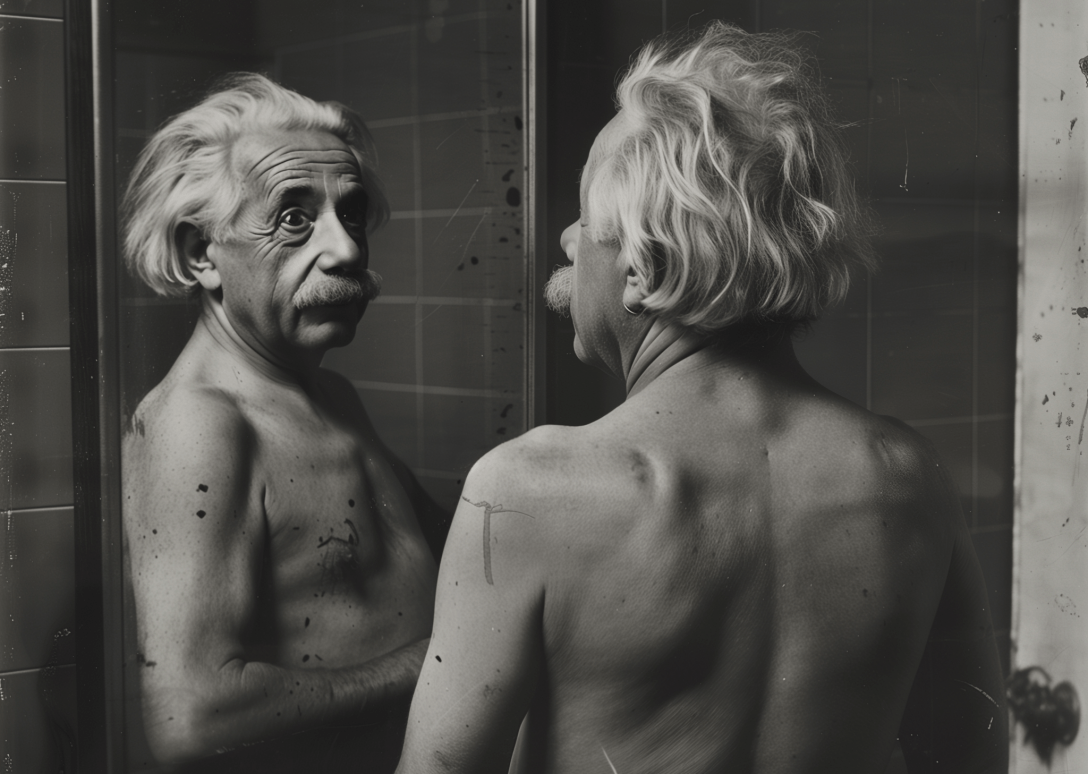
[I created the image with Midjourney. Einstein is the most easily recognizable scientist. His non-careerist approach to science doesn’t make him the most appropriate naked emperor, but his immediately recognizable image does.]
Donate to keep Jem writing / Read his book Breaking Together / Ask JemBot a question / Read Jem’s key ideas on collapse / Subscribe to this blog / Study with Jem / Browse his latest posts / Read the Scholars’ Warning / Visit the Deep Adaptation Forum / Receive Jem’s Biannual Bulletin / Receive the Deep Adaptation Review / Watch some of Jem’s talks / Find Emotional Support / Jem’s actual views on Covid
Discover more from Prof Jem Bendell
Subscribe to get the latest posts sent to your email.

[…] deepltraduction Josette – original paru sur jembendell.com […]
[…] for more climatologists to admit the failings of their profession, publicly, as top climatologist Dr Wolfgang Knorr has done. Otherwise, the environmental profession and movement is none-the-wiser and can criticise those […]