
On this day 6 years ago, I released through my university the ‘Deep Adaptation’ (DA) paper on climate chaos. Since then, I’ve been experiencing a range of emotions that arise from my view of the situation and the reactions of other people to that – and learning how to be OK with that. I’ve also been experimenting with ways of living differently as my old sense of self broke apart. These two themes were the focus of a new documentary about my life that was shown on Dutch TV a few weeks ago. The filmmakers made it beautiful and so I recommend watching below on YouTube or Odysee.
The emotional side of researching, communicating, and educating on collapse has been colourful and, at times, draining. I made and lost friends. I gained allies and enemies. I lost and gained a way of life. I wonder whether I could have learned anywhere near as much about psychology and spirituality without the emotional roller-coaster of becoming public about collapse risk and readiness. 6 years after the release of the DA paper, I want to share some reflections on the conflictual side of me coming out as a ‘doomster’.
Before deciding to release the paper in 2018, I went to a ‘courage and compassion’ gathering. At the time my dismay about being an environmental professional meant I was attending all kinds of events. What attracted me to that one was I knew if I decided to reject the requirements of academic reviewers to change my conclusions, and release the Deep Adaptation paper unchanged, then the implications could be significant for the rest of my life. For starters, it would be turning a private truth into a public one. Many of us allow ourselves to hold possible truths privately, where they can eat away at our sense of calm and purpose. However, if we turn that into a publicly communicated truth then we can’t as easily suppress its implications. In this case, the truth is that we are living amidst a climate tragedy, where the extent and momentum of environmental change will continue to damage societies around the world. The matter is so central to our life choices, that we each need to give it enough of our attention to arrive at conclusions and make them public in some way – to friends, family, colleagues, our profession or the wider public. That helps with moving into a new orientation towards life, which can’t be known before starting (as I discussed with Karen Perry in a DA conversation).
Back in 2018 I had also assessed that when the DA paper came out it would change my life by ending my career and alienating some professional friends. Because not only would I be criticizing my field of corporate sustainability, I would also be challenging widespread belief in human dominion and eternal progress. I sensed it might be even more disruptive to my life than that, if my analysis affected some people like it was already affecting me. That meant some people might see me as responsible for the emotional difficulties and life changes of others: for it is common knowledge that people can blame others when they feel uncomfortable. That has been made worse by social media enabling our negative projections to become a casual blood sport with other humans as the prey.
Perhaps my threat-scanning 6th sense was picking all of this up, and why the gathering on ‘courage and compassion’ seemed so important to attend. For two hours I heard people sharing about their personal histories of experiencing harm and how they had been integrating that into their approach to life. I heard stories of betrayal in business, and many shared their experiences of violence, including physical, sexual and psychological. I heard of the power of accepting that the harm had occurred, with a lasting effect, and yet it can be a fuel if we keep open to learning about it by sharing our experience. Hearing these testimonies helped me put my own worry in perspective and I went ahead with releasing the Deep Adaptation paper.
I’ve previously explained that my motivation for sharing my analysis of the climate situation was partly to burn bridges with my professional community so that I couldn’t return to denial. But it was also because I’d believed in the benefit of us humans knowing more about the world; so it seemed impossible for me not to share what I thought I had come to conclude about our predicament. The waves of change rippling around the world since then have been remarkable to behold and, sometimes, to be part of. But any action causes a reaction and after many hundreds of thousands engaged with the possibility of the collapse of industrial consumer societies, so came the backlash. Over the years I have responded to some of the many misrepresentations of the original paper, due to my belief in the importance of people knowing reality to the best of our ability. Now, 6 years on, the current observational data on the climate demonstrates that analyses like mine were closer to reality than the establishment climatology at the time. For instance, top scientists now admit the rate of sea-level rise is increasing worldwide, climate change is accelerating, and the damage from extremes is worse than forecast prior to 2018 (see Chapter 5 of Breaking Together for the details). But what has been surprising to me in 2024 is that past criticisms are still being recycled to silence attention to alarmist readings of climatology and to the matter of societal collapse. This indicates something different is occurring than a search for truth, and I’ve had to accept (painfully) that such behaviours will increase as anxieties grow. There will also continue to be vested interests distorting our understanding and dialogue, as they seek to maintain our deference to power.
One text that is still being used to dismiss the Deep Adaptation agenda is from Open Democracy, back in 2020. I identified 26 misrepresentations of my paper in their essay, which meant readers were being misled about my conclusions and recommendations. For instance, in the paper I explained that I did not support the thesis of ‘near term human extinction’, but the Open Democracy authors lifted a chunk of my text out of context to imply that I did believe in it. Many people, including Guardian journalists, could not have checked with the original paper before amplifying the false claims. They were too busy torching a straw man version of an analysis they found uncomfortable. The magazine presented the essay’s authors as young scientists in Extinction Rebellion (XR) and they were widely applauded by senior environmental professionals for their courage. However, according to a letter that the lead author Tom Nicholas signed to the newspaper City AM, the same month of publication, he was affiliated to the UK Atomic Energy Authority.
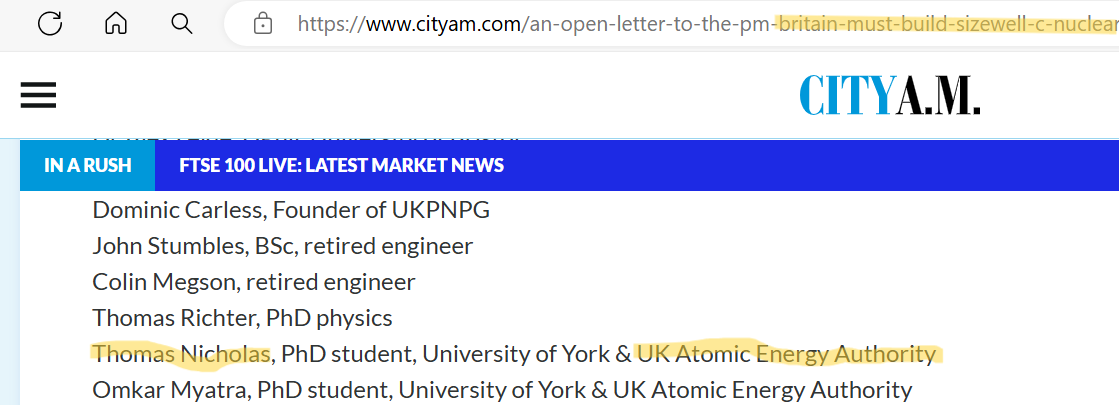
As XR co-founder Gail Bradbrook and I explained at the time, it is not only oil companies that have a vested interest in the way the climate agenda is understood. Without any clear climate adaptation strategies, the mainstream nuclear sector has a vested interest in marginalizing the more alarmist readings of climate science. Instead, both clean tech and nuclear professionals prefer our climate emergency to seem a manageable one – so long as governments back them with helpful policies and subsidies. To recognize professional and commercial affiliations does not mean to suggest people don’t have earnest beliefs and make useful contributions, but that factions of capital can influence all of us directly and indirectly – and sometimes through PR campaigns. Looking back, the clearest impact of XR campaigns before 2022 in the UK was on how the heightened climate concern helped to usher in government backing for new nuclear power stations. Other government policies did not change in any meaningful way. My own views on nuclear power are quite nuanced (eg. on molten salt), but this is a clear illustration of how the professional affiliations and alignments of influential voices in the climate arena must be disclosed and understood as potential conflicts of interest.
Three years later, the journalist Dougald Hine based his critique of my work upon the Open Democracy essay. It added insult to the initial injury, when he ignored the hundreds of scholars who agree with me and the extensive literature on the conservatism of the Intergovernmental Panel on Climate Change (IPCC – see footnotes 10 to 14), to lament my non-acceptance of its depiction of climate change. In a whole chapter dedicated to ‘yours truly’, he expressed regret that I had asked publicly about the potential industrial associations of any of the Open Democracy authors. The lead author had replied to me at the time without it being clear he had an affiliation with the nuclear sector. As I share Dougald’s interest in the relative roles of science and the arts in society, I regard it as both untenable and disabling to cast climate science and deliberation as a zone that’s free of vested interests and professional considerations. The idea we should accept an institutionalized view on a complex field of science prior to being more artistic in our discussion of its implications would require ignoring a century of scholarship on the history and philosophy of science, as well as the sociology of knowledge and discourse, which thankfully have already led to transdisciplinary approaches to inquiry (something I explain further in Chapter 7 of Breaking Together).
Subscribe / Support / Study / Essays / Covid
It is common knowledge that maligning the behaviour or character of one or more radicals is an age-old way of earning credibility with the establishment (or a poorly informed public), to then offer one’s own story of the situation. However, many of the criticisms over the last 6 years do not fall into that category. I even included some of them in a book I wrote in 2020 for French readers (where we featured a dialogue between myself and Jeremy Lent) and a book I co-edited in 2021 (where my co-editor had a different conclusion about the situation with societal collapse). My understanding has benefited from some valid critiques of my past work. For instance, I agree with the critique I had not been specific with what I meant about societal collapse. Therefore, I studied the relevant scholarship on past and predicted collapses, and refined my ideas in Breaking Together (Chapter 1). Not worrying about defending one’s existing views or reputation is key for being receptive to any robust data and well-evidenced analysis that is salient to a better understanding of either climate or societal collapse (whether that comes from within or outside the best-known institutions). Aspiring to be that way has helped me to revise my understanding of the climate crisis over the last 6 years, to include a greater role for aerosols, ocean health, and forest cover, than I had included before (Chapter 5).
When misrepresentations of my work and views are used to negatively speculate on my character as a means of marginalizing the agenda of Deep Adaptation, my initial reactions have included some anger. I have learned to notice the anger, let it subside, and return to the bigger picture and what it might be useful to do with my time. I have also learned to explore what lies beneath my anger. For instance, I notice two fears in me. First, I fear some career scientists could be delegitimising climate activists as being too alarmist or doomist, which then undermines their safety and freedom: safety, as the public and police become more aggressive, and freedom, as judges become more draconian (such as sentencing protesters to many years in prison). I worried that would become the collateral damage from groups like Scientists’ Warning uncritically promoting misleading anti-alarmist views such as those lead-authored by the nuclear scientist in Open Democracy. A second fear I feel is about the potential for people to be manipulated. Within that fear is my attachment to a belief in the need for progress in human understanding. I am still learning to drop that attachment and instead recognize that what is most important is for me to explore reality and communicate about it without expecting an outcome. In this process I have benefitted greatly from Buddhist philosophy and practice – so much so that I recently wrote about that in a magazine on the contemplative approach to life.
As there are hundreds of scientists publicly stating conclusions similar to mine, since 2020, I realize some of my critics are being wilfully blind and ‘shooting’ painful messengers to defend their own identity and worldview. That means pointing to more data won’t change their pattern. Only if people want to change will they do so. Recognizing that situation can ease the craving to explain – for there’s nothing to be gained. All of that means that whenever I am asked about being vindicated by the latest data and science, I try to return to what is important for a gently steadfast life of inquiry. If I may be so bold as to invite you into that:
- Let’s allow and express the difficult emotions we feel about the activists who have been undermined and the time that so many people have lost, because of the public being misled by many experts who were lying to themselves.
- Let’s invite people to explore why professionals with influence tend to marginalize critical voices and ignore potential lessons on why institutionalized experts can get things so wrong. We know further mistakes will be made, so we can invite learning to lessen that.
- Let’s forgive people for their attempts to undermine acceptance of the full extent of the environmental predicament, for it is an emotionally challenging situation and not everyone is sufficiently well-resourced to face it.
- Let’s be curious about whether we are continuing to learn about the situation (both knowledge and the emotions involved) and exploring how to live according to our own understanding of the truth.
- Let’s communicate in ways that nurture and express ourselves without attachment to the outcome of influencing people in an era when delusion and derangement are as likely to be the responses as enlightened ones. That can be through film (like the Dutch documentary), poetry, music, blogs, books, or whatever feels pleasant.
If interested in these ideas, then you can read further in a previous essay entitled ‘the doom vindication blues.’ If they resonate with you and you are professionally engaged in related fields then you would be very welcome on the leadership course I co-teach (online and in-person).
It is with the aim to communicate and celebrate without attachment to outcome that before ending this 6th anniversary essay I will share a video that compiles clips from some of the interviews and talks I’ve done that appear on YouTube elsewhere than my own channel. It provides links to what I’ve said and the fab people and organizations that have given a fair hearing to it. You can see 100+ videos on my own channel but this is a gateway to video content elsewhere on the web. Yes, we are many – let’s not forget that.
For there to be a public record of my perspective on mistaken claims by Dougald Hine about both the process and content of the original Deep Adaptation paper, I list them below. I provided that information to his publisher, Chelsea Green, in September 2023 and until now they chose not to reply with any suggestions for addressing the problems. As I like their other catalogue of books, I decided not to take the matter further. It might be as boring to read the corrections below as it was for me to list them, but if you concur, then there could be benefit from kindly asking Chelsea Green what their perspective is. Because this isn’t just about me – it is about the level of honesty, radicalism and solidarity within the Western environmental movement and profession. So while you are at it, you could check what the many ‘mainstream green’ supporters of the original Open Democracy article think today (as they were bold on twitter at the time). If we discuss from an ethos of gently steadfast inquiry (of the kind I’ve described above) then there is the opportunity to learn from any evolution in thinking and action since 2020.
Thx, Jem
Donate to keep Jem writing / Read his book Breaking Together / Ask JemBot a question / Read Jem’s key ideas on collapse / Subscribe to this blog / Study with Jem / Browse his latest posts / Read the Scholars’ Warning / Visit the Deep Adaptation Forum / Receive Jem’s Biannual Bulletin / Receive the Deep Adaptation Review / Watch some of Jem’s talks / Find Emotional Support / Jem’s actual views on Covid
Perceived misrepresentations in Dougald Hines’ “Asking too much of science” chapter.
ISSUE 1: The chapter misrepresents the Deep Adaptation paper to make it appear more catastrophic than it was.
Specifically, Dougald Hine quotes the Deep Adaptation paper in a way that implies I support the views of Guy MacPherson on methane and nuclear meltdowns, yet those arguments were cited in a section of the paper summarising the various ways people are framing our situation. Therefore, immediately after mentioning the way some people frame the situation as ‘inevitable near-term human extinction’, I wrote:
“With each of these framings – collapse, catastrophe, extinction – people describe different degrees of certainty. Different people speak of a scenario being possible, probable or inevitable. In my conversations with both professionals in sustainability or climate, and others not directly involved, I have found that people choose a scenario and a probability depending not on what the data and its analysis might suggest, but what they are choosing to live with as a story about this topic.”
Then, in the next paragraph I critiqued the people who frame the situation as inevitable near-term human extinction: “I have witnessed how people who doubt extinction is either inevitable or coming soon are disparaged by some participants for being weak and deluded. This could reflect how some of us may find it easier to believe in a certain than uncertain story, especially when the uncertain future would be so different to today that it is difficult to comprehend.”
The article in openDemocracy misled its readers of the content of the Deep Adaptation paper in the same way as Dougald does in his book. Drawing upon openDemocracy, the New Internationalist magazine made the same mistake. Both magazines issued an official retraction on this matter.[1] OpenDemocracy issued this correction: “Editor’s note, 7 October 2022: Some readers of this article have received the incorrect impression that in the original ‘Deep Adaptation’ paper Jem Bendell argued that nuclear meltdowns will lead to human extinction. We would like to clarify that ‘Deep Adaptation’ stated that such an opinion exists before explaining that its author had reached a different conclusion.”[2]
ISSUE 2: The chapter wrongly implies that YouTube videos were decisive for my conclusions on the climate science on the Arctic, which could create an impression of someone who isn’t professional in their research.
Dougald Hine makes an incorrect claim by writing: “If you want a sound scientific understanding of what might or might not be going on in with Arctic methane, you don’t put yourself in the hands of youtube.” Instead, the section of the Deep Adaptation paper on methane has multiple references to the original peer reviewed scientific literature. There are no YouTube videos cited in the paper. I collected relevant papers over the 3.5 years since that flu in March 2014, to then study them, and others during 2 months of research at the end of 2017.
By making this claim, Dougald is using an interview he did with me in January 2018, where I talked about a flu I had in 2014, which was over 4 years before the Deep Adaptation paper appeared, in a way that can be regarded as lampooning. I believe even professors can watch YouTube on substantive issues when they have the flu.
ISSUE 3: The chapter makes incorrect statements about the review process which could give the impression I was not abiding by normal academic process and therefore not professional in my research.
Dougald Hine wrote: “but when peer reviewers requested ‘major revisions’ = a common occurrence in the process of academic publishing – he felt he was being asked to suppress his conclusions.”
In fact, “major revisions” were not requested by the reviewers. Instead, their actual decisions were withheld from me by the journal editor, who asked me to resubmit the paper. However, reading the reviews it became obvious that I could not resubmit without changing my conclusions on the science, which formed the basis for the paper’s sections on denial and then the framework of deep adaptation i.e. if I changed the conclusions on the science, then the rest of the paper after the scientific summary would not have been possible.
ISSUE 4: The chapter incorrectly presents the credentials of the main critics that he cites, which adds to the wrong impression that climate scientists were all critical of my DA paper.
Dougald Hine incorrectly describes the authors of the openDemocracy article he relies on for his critique as “three young climate scientists.” However, the lead author was a nuclear physics student, who cited himself as working for the UK Atomic Energy Authority at the time.[3] The third author was acting as their editor (according to the NYT) and had just completed her biology undergraduate degree.[4] The other author was doing socio-political research on climate policy at the time – therefore is also not considered a “climate scientist”. The openDemocracy website itself clarified this at the time. “Thomas Nicholas is a PhD student in computational plasma physics at the University of York, and member of Extinction Rebellion Scientists.”[5] (note that XR scientists did not have a formal registration process at that time and was mainly a whatsapp group, and I was also part of it, as were many non-climatologists). “Galen Hall is a researcher at the Climate and Development Lab at Brown University.”[6] “Colleen Schmidt is a recent graduate of Columbia university, where her research focused on plant ecology.”[7]
ISSUE 5: The chapter misrepresents my citing of one of the world’s leading Arctic climate scientists as “one individual” in opposition to 100s of climate scientists, which could create the impression of me being someone who isn’t professional in their research.
The individual I reference is Professor Peter Wadhams. OpenDemocracy issued an apology for misrepresenting his claims and as not mentioning he is a significant climate scientist in the article that Dougald Hine references. That apology is found on the same webpage as the openDemocracy article itself (and was made just over a month after the article was published). They say: “Update, 31 August 2020: An earlier version of this article might have been misconstrued as implying that Peter Wadhams only gained prominence by making extreme claims about arctic ice sheet collapse. The text has since been clarified to make it clear that Wadhams’ claims to which the authors refer were made exclusively about the rate of arctic sea ice melt, not ice sheet collapse, and were made only once Wadhams had become a senior professor.”[8]
The paragraph about this issue in the 2018 Deep Adaptation paper said this:
“Given a reduction in the reflection of the Sun’s rays from the surface of white ice, an ice-free Arctic is predicted to increase warming globally by a substantial degree. Writing in 2014, scientists calculated this change is already equivalent to 25% of the direct forcing of temperature increase from CO2 during the past 30 years (Pistone et al, 2014). That means we could cut CO2 emissions by 25% and it is already outweighed by the loss of the reflective power of Arctic sea ice. One of the most eminent climate scientists in the world, Peter Wadhams, believes an ice-free Arctic will occur one summer in the next few years and that it will likely double the warming caused by the CO2 produced by human activity (Wadhams, 2016). In itself, that renders the calculations of the IPCC redundant, along with the targets and proposals of the UNFCCC.”
Note, therefore, that I also reference Pistone et al doing similar calculations to Peter Wadhams, but commenting on current, not projected, forcing. That paper includes 3 of the most eminent scientists on the topic, in one of the most respected journals.[9] Citing them and Britain’s leading Arctic scientist is not evidence of “cherry-picking” as Dougald Hine claims.
ISSUE 6: That chapter erroneously claims that it is unusual for scientists to criticise the IPCC and that I am alone in my critique of it.
At various times Dougald Hine implies I am unusual. For instance, I am a “one-man alternative to the IPCC.” He also includes a footnote stating that his scientist friend confirms the IPCC has been correct in its predictions.
First, this ignores the extensive critique of IPCC by climatologists, including those that have worked for it. Back in March 2010, senior climatologists (with a specialism in Oceanography) published in a top peer reviewed journal that the IPCC 2007 assessment report was very wrong in underestimating the situation and that over 2 degrees average warming was already inevitable, whatever happened to carbon emissions.[10] Since then there have been many peer-reviewed articles on the scientific reticence of institutional climatology, especially the IPCC processes. One synthesis study on the IPCC’s “understatement of existential risk” was supported by one of the most eminent climatologists in the world, Professor Schellnhuber.[11] Sometimes the communications are very clear, such as this in the journal Nature: “Climate change is hitting the planet faster than scientists originally thought.”[12] Even a paper with 25 top climatologists in the most establishment institutions (e.g. NASA) pointed to a potential climate sensitivity from existing doubled CO2 concentrations that is higher than what IPCC considered previously, and therefore wrote: “We remain unable to rule out that the sensitivity could be above 4.5°C per doubling of carbon dioxide levels, although this is not likely.”[13] Please note that such a level of warming is considered non-adaptable for human civilisation by various analysts. Although the individual scientists involved in that paper do not publicly condemn IPCC (unlike others), it shows how IPCC conclusions have never been a universal truth to be treated like an “object of belief” (to use Dougald Hine’s words), and reaching different conclusions is certainly not unprofessional.
Second, Hine’s argumentation ignores the scientists who came out in favour of the Deep Adaptation paper and critiqued the problem of scientific reticence. One of those top climatologists went into great depth about the reticence in establishment climatology, in a published interview with me in 2019.[14]
The academic field of the ‘History and Philosophy of Science’ pays attention to the way institutionalised science can get things wrong, and it is directly relevant to the topic of Dougald Hine’s book. Despite his claims, with the IPCC in this chapter, he appears to be treating climate science as an “object of belief” in order to adopt a tone lampooning my own research.
ISSUE 7: Dougald Hine writes “Bendell made things worse when he took to twitter to speculate about the authors vested interests” thereby implying I have a defensive and aggressive response to criticism and rendering the topic of funding and commercial interest irrelevant.
Hine doesn’t actually quote my tweet, where I asked the authors to clarify their roles and if they had been funded to do their article for openDemocracy. The lead author Thomas Nicholas was funded to do his nuclear science PhD at the time, and replied to that effect. He was also campaigning within and outside XR for new build nuclear power stations (although he did not disclose an affiliation with the UK Atomic Energy Authority at the time, but did so in a joint lobbying letter that month).[15] Such campaigning is widely seen as successful as the UK government subsequently committed to new build nuclear and cited climate concerns in their decision. The nuclear industry wants to be seen as an answer to climate change and scenarios which anticipate collapse dent their arguments. That is widely understood by climate activists, and I wrote about it with one leading activist.[16]
However, Dougald Hine is claiming it is wrong (“made things worse”) to ask what people’s funding, or commercial or professional interests are, when they critique someone or something. He also claims that to ask is to “speculate”. To claim that such questioning is poor behaviour risks rejecting basic understandings of how the interests of capital influence discourse. It is not a conspiracy theory or in bad taste to be curious about vested interests. Rather, it is a normal part of understanding any landscape of public debate. To ignore the role of power relations in shaping scientific process is to exhibit a misunderstanding of the relationship between science and society. There is a huge body of scholarship on this topic – it is a key aspect of the whole of Critical Society Theory and Critical Discourse Analysis.[17]
ISSUE 8: By claiming I was “picking an unnecessary fight with climate scientists” and repeating again in the conclusion that I was “picking a fight with climate scientists” he frames my responses as reflecting an aggressive character.
Not once does Hine mention my substantive response to the critique that he promotes. He ignores my detailed scholarly engagement with the criticisms from the openDemocracy authors in my reply in that same publication.[18] Therefore, he doesn’t mention my detailed engagement with, and rebuttal, of the dozens of misrepresentations in their article, some of which he repeats in his chapter. Even openDemocracy itself links to my rebuttal from the piece that Hine is relying upon in this chapter. When criticism is published, an in-depth answer to them in the same publication constitutes a form of scholarly engagement, not “picking a fight,” as Hine claims.
My past engagement with critics has even involved me including negative commentary on my Deep Adaptation paper (by Jeremy Lent) in a book published in my own name.[19] If someone chooses not to respond to one or two of their critics (as I have done at times), it is disingenuous to claim that is unprofessional or disagreeable behaviour.
It is unclear how else Hine might claim I was “picking a fight”. By stating my own views on the climate science in the Deep Adaptation paper? I do not criticise climatologists in that paper at all. This false claim that I was “picking a fight” appears to rely entirely on the mischaracterisation of my valid query about the funding and affiliations of some of my critics.
ISSUE 9: Hine uncritically uses a subjective framing from the openDemocracy piece to misrepresent what I wrote in the Deep Adaptation paper on non-linear changes, so as to claim I make elementary errors in logic.
On page 65 Dougald Hine says that I claim that an “unstopable exponential increase is underway” (Chelsea Green’s typo). I do not claim that in the Deep Adaptation paper. Instead, I claim that there are signs of “non-linear” changes, and that itself indicates probably “runaway” climate change. I do not define “runaway” change as “exponential”, but as non-linear:
“Non-linear changes are of central importance to understanding climate change, as they suggest both that impacts will be far more rapid and severe than predictions based on linear projections and that the changes no longer correlate with the rate of anthropogenic carbon emissions. In other words – ‘runaway climate change.’”
Four times I mention specific concerns about potential “exponential” change. I state there are concerns that insect born disease and agricultural impacts might be rising exponentially – and I provide references. I also state: “The rates of sea level rise suggest they may be soon become exponential (Malmquist, 2018)” and I state that for methane, “figures are consistent with a non-linear increase – potentially exponential – in atmospheric levels since 2007.” So at no time in the paper am I stating that non-linear means exponential and at no time I am stating that exponential change in the whole climate system is already underway.
To define “runaway” change as “exponential” is a subjective choice. For laypersons, runaway is widely understood as it is in any dictionary, such as Collins.[20] Those definitions include “out of control” and do not state “exponential” acceleration. In climate science there are differences of opinion about what “runaway” should be chosen to mean (i.e. it is a subjective choice). It is true that some (not all) climatologists choose it to mean exponential acceleration of change until a new equilibrium state is reached. I did not use that definition, and therefore Hine’s claim about my claim is wrong.
Hine makes a comparison between speed of changes in the climate system and the growth of a human body. That is purely a metaphor, to make the point that the speed of change could reach an equilibrium. Therefore, accepting his point, in climate science, we could ask what is the best and most recent paper on the climate equilibrium. That paper concludes that current human influence will lead to 10 degrees above pre-industrial levels.[21] That paper has led to a lot of debate, but the existence of debate on this is yet another example of the complexities and subjectivities in this field. If one doesn’t realise that subjective choices about the definition of terms within science is a typical aspect of the scientific process, then one risks treating science as an “object of belief” which is what Hine argues we should not do. I wrote about many of these issues in my detailed line-by-line critique and rebuttal of the openDemocracy article, which is linked to by my own response in openDemocracy. So it is not difficult for a curious writer to explore these issues. Sadly 2023 and 2024 temperature anomalies make these discussions additionally painful.
[1] View this retraction and apology. Is it too late to stop climate collapse? | New Internationalist https://newint.org/features/2022/04/04/it-too-late
[2] https://www.opendemocracy.net/en/oureconomy/faulty-science-doomism-and-flawed-conclusions-deep-adaptation/
[3] An open letter to the PM: Britain must build Sizewell C — nuclear sits at the heart of a green recovery – CityAM https://www.cityam.com/an-open-letter-to-the-pm-britain-must-build-sizewell-c-nuclear-sits-at-the-heart-of-a-green-recovery/
[4] https://www.nytimes.com/2020/12/26/style/climate-change-deep-adaptation.html.
[5] https://www.opendemocracy.net/en/author/thomas-nicholas/
[6] https://www.opendemocracy.net/en/author/galen-hall/
[7] https://www.opendemocracy.net/en/author/colleen-schmidt/
[8] See the end of https://www.opendemocracy.net/en/oureconomy/faulty-science-doomism-and-flawed-conclusions-deep-adaptation/
[9] Observational determination of albedo decrease caused by vanishing Arctic sea ice | PNAS
[10] A Very Inconvenient Truth | Oceanography (tos.org) https://tos.org/oceanography/article/a-very-inconvenient-truth
[11] International Climate Change Reports Are Dangerously Misleading, Says Eminent Scientist : ScienceAlert https://www.sciencealert.com/international-climate-change-reports-tend-toward-caution-and-are-dangerously-misleading-says-new-report
[12] Climate change is hitting the planet faster than scientists originally thought (nature.com) https://www.nature.com/articles/d41586-022-00585-7
[13] An Assessment of Earth’s Climate Sensitivity Using Multiple Lines of Evidence – Sherwood – 2020 – Reviews of Geophysics – Wiley Online Library https://agupubs.onlinelibrary.wiley.com/doi/full/10.1029/2019RG000678
[14] Climate scientist speaks about letting down humanity and what to do about it. Interview with Dr Wolfgang Knorr, July 2019 https://jembendell.com/2019/07/31/climate-scientist-speaks-about-letting-down-humanity-and-what-to-do-about-it/
[15] https://www.cityam.com/an-open-letter-to-the-pm-britain-must-build-sizewell-c-nuclear-sits-at-the-heart-of-a-green-recovery/
[16] https://www.resilience.org/stories/2020-07-30/our-power-comes-from-acting-without-escape-from-our-pain/
[17] Critical Discourse Analysis | The Critical Study of Language | Norman (taylorfrancis.com) https://www.taylorfrancis.com/books/edit/10.4324/9781315834368/critical-discourse-analysis-norman-fairclough
[18] To criticise Deep Adaptation, start here | openDemocracy https://www.opendemocracy.net/en/oureconomy/criticise-deep-adaptation-start-here/
[19] Adaptation radicale (editionslesliensquiliberent.fr) http://www.editionslesliensquiliberent.fr/livre-Adaptation_radicale-9791020908131-1-1-0-1.html
[20] Runaway definition and meaning | Collins English Dictionary (collinsdictionary.com) https://www.collinsdictionary.com/dictionary/english/runaway
[21] [2212.04474] Global warming in the pipeline (arxiv.org) https://arxiv.org/abs/2212.04474
Discover more from Prof Jem Bendell
Subscribe to get the latest posts sent to your email.

[…] intelligent British environmental writers criticise me for deviating from the IPCC – Dougald Hine in his book and Alistair McIntosh in his – as they sought to express a respect for science. Many […]