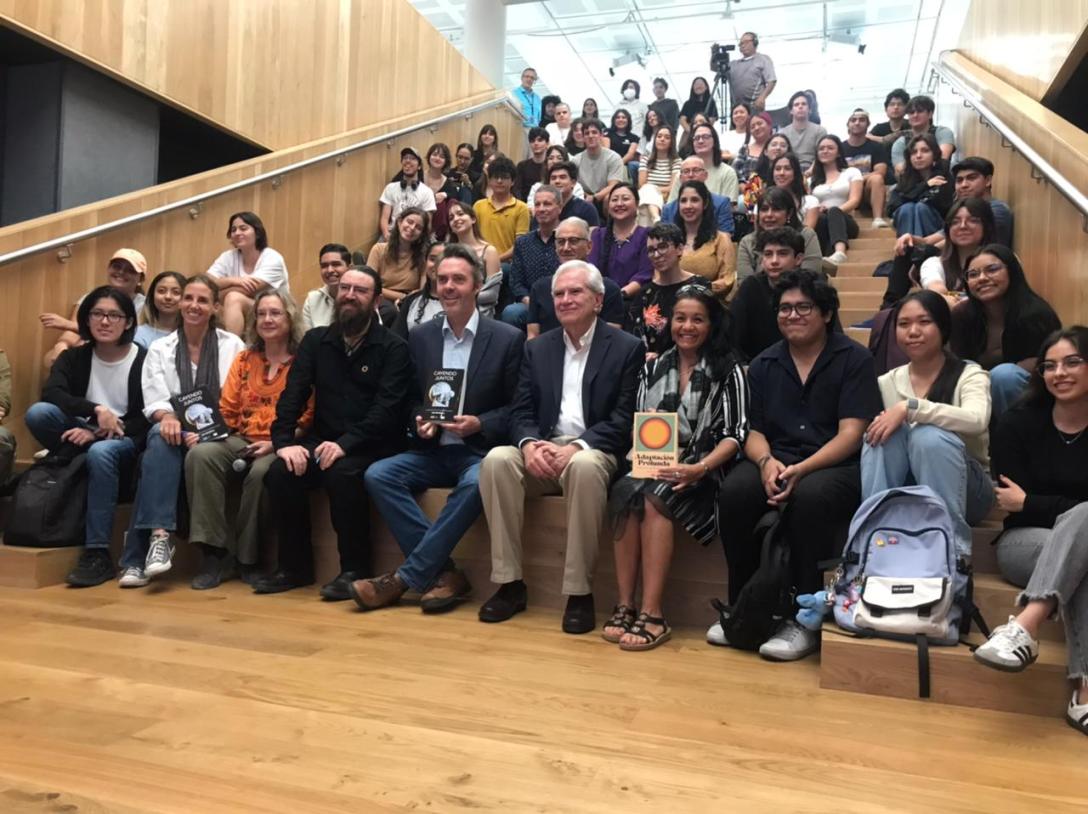
Transcript of speech given at the Monterrey Book Festival (Feria Internacional del Libro Monterrey), Mexico, 6th October 2024, to launch Cayendo Juntos, the Spanish edition of Breaking Together.
I am pleased to have reached you here in Monterrey just before the close of this remarkable event – one of the largest book fairs in the world. It is probably best that I was kept back until the final day, so that I wouldn’t spoil the mood of your previous days here. Because what I am going to talk about is not very fun. In fact, it is so heavy that I don’t talk about it much in public. But coming to Mexico felt important to me. That’s because I believe that Latin America, more generally, can play a significant role in softening the collapse of modern societies around the world. Three different areas of wisdom and struggle from this region offer signposts for how our human race might cope with the consequences of having overshot planetary limits and poisoned our living home. Those traditions are liberation theology, anti-imperialism, and indigenous cultures. So I’m honoured to be invited to offer my own ideas into your rich mix of intellectual traditions in Latin America.
For over 30 years this event has showcased a breadth of ideas in the Spanish language. Both fiction and non-fiction. I believe that is still a valid distinction, is it not? I know some people do wonder. I saw a sign in a bookshop that they had moved their apocalyptic fiction books into their current affairs section. Maybe one day they’ll move their current affairs books into the section for apocalyptic fiction.
Books themselves are a reminder of our love of storytelling. We are a storytelling species. Maybe the whales and the dolphins have wonderful myths that they tell each other under the waves. But we humans actually organise our built environments and our life purpose around our stories. Some of us might die for a story, or kill for a story. Buddhism has taught me more clearly than anything that we let our stories repackage experiential reality. It has also taught me that our desires to be safe, accepted, and comforted, plus our aversion to anything that doesn’t help that, influences much of our labelling of experiences. That can become problematic. It’s at the heart of the mess we are now in as a species.
When we refuse to see, hear or accept aspects of reality that we don’t enjoy, it is what psychologists call denial or disavowal. We do this all the time. Last year I noticed my cat was a bit exhausted one night, and then also the following morning. I knew he had recently recovered from blood parasites. But I was going away for the weekend and I didn’t want the drama, or to put him through the stress of a visit to the vet. Wait and see, I thought. But because of that, I didn’t see him again.
It’s not just Buddhists, but also psychologists who tell us that we deceive ourselves to avoid difficult emotions or distract ourselves from them. We also do it to fit in and get along… so self-deception can serve us by helping us to conform and succeed within our society. But it doesn’t serve us when things are going badly wrong. Such as when societies are breaking down. Which is what I believe is our situation today.
Since the mid-1990s I’ve worked on environmental issues, in various roles, at the UN, the private sector, NGOs, politics and finally as a full Professor of sustainability. I used to be proud of our successes in moving the corporate sustainability agenda forwards. But also during that time everything in our biosphere has got worse. For instance, populations of wild animals have declined an average of 68% in the last 50 years. So now wild mammals comprise only 4% of mammals on Earth, the rest being us, our pets and livestock. Now that’s a lot of wonderful humans and beautiful cats, but shows just how much damage has already occurred.
As a Book Festival audience, you like reading and thinking, so it’s likely that many of you paid attention to these environmental problems well before the billionaires did. So you probably of heard climate change before Al Gore or Bill Gates. Maybe you know therefore that after 40 years of warnings and efforts, we are now in the age of consequences. Or maybe you just learned of it recently, perhaps even from Claudia Sheinbaum. In any case, the changes you can see around you in recent years, as well as in the news, tell you somethings changing.
Sadly, globally, climate is changing faster than was predicted and with more immediate impacts on forests, soils, oceans, and agriculture. The past year has been 1.64 degrees Celsius above the global annual average temperature 130 years ago of about 13.8 Celsius. That’s an indicator of rapid changes to our own lives. Because farmers already experience more difficulty from weird weather and a major disruption to international grain markets is considered only a few years away by some top experts on food security.
Whatever the rhetoric on this issue being taken seriously now, atmospheric concentrations of carbon dioxide and methane are increasing, along with emissions from human activities.
But it’s more worrying than that. The rate of global sea level rise is an indicator of the rate of climate change in general. Water expands due to it warming up. And more ice on land melts into the sea. The two processes raise sea levels globally. So if that rise accelerates, it means that climate change is accelerating. Six years ago I noticed the data was indicating that. It has now been confirmed. So why is it accelerating? Well it might be due to self-amplifying feedbacks in the climate system. Forget the damage from the sea, what this means is that future warming might not be reduced that much by our actions today. Although we can and must do a lot more on climate and the environment, sadly we are already living in the age of consequences, and it is going to get worse.
The damage to the biosphere translates into economic and social problems. Part of that is direct, such as food price inflation. I read that is the highest category of inflation in Mexico over the last few years. Recently around 6 percent a year. That is the highest in OECD countries and the Mexican Institute of Finance Executives has pointed to extreme weather as partial cause.
Data on quality of life shows a global plateauing since 2016 and that 90% of countries now have a declining quality of life. Mexico is actually unusual in reducing poverty in recent years. The global phenomenon I’ve described means we can’t blame it on one particularly bad politician, or a war, or too many migrants, or the West losing confidence, or not being religious enough, or gender fluidity, or not having enough kids, or a deep state cabal. Instead, I believe it indicates something fundamental, biophysically. In my new book, now available in Spanish as ‘Cayendo Juntos’, I connect the cracks on the surface of modern societies to the crumbling foundations in our economic, energy, environmental, and food systems. I conclude we have reached a point where most modern societies, while continuing to function on the surface, are already in their early stages of collapse.
I might sound unusually gloomy. After all, I had a great lunch and am looking forward to some drinks and fun tonight. But opinion polls report that most people around the world aren’t very positive about the future. The data I detail in my book, shows that they rightly intuit something badly wrong.
Unfortunately, the mainstream media in nearly every country is against this view being taken seriously. For what’s the most dangerous idea to people who have wealth and status today? It is the idea that the society that they have been successful within is actually self-destructive. Because, if we realise that, then we don’t have an automatic reason to respect the systems that maintain their wealth and status. That is a revolutionary shift in perspective. It invites us to drop any compromise and speak freely.
Unfortunately, the mainstream environmental profession is not telling us the whole truth either. They have gone for the easy story that we can transition our societies off fossil fuels without a massive reduction in consumption of energy and resources and thereby without a major redistribution of wealth in society. I have just released an essay, in Spanish, on my website where I claim that the environmental profession is now telling a ‘fake green fairytale’ which is comprised of nine lies. The fairytale claims that humanity can maintain current levels of consumption (a lie) by being powered by renewables (a lie) which are already displacing fossil fuels (a lie) and therefore reach net zero (a lie) to bring temperatures down to safe levels within just a few years (a lie) to secure a sustainable future for all (a lie) and that the enemies of this outcome are the critics of the energy transition (a lie) who are all funded or influenced by the fossil fuel industry (a lie) so the proponents of green globalist aims are ethical in doing whatever it takes to achieve their aims (a lie).
Due to widely available evidence to the contrary, these are not just misunderstandings. To demonstrate that, I’ll explain a couple briefly in more detail.
First, the claim that humanity can maintain current levels of consumption is not true. Already, humanity is overshooting the carrying capacity of Planet Earth. This year the date that marked the beginning of the overshoot was August 1. We are degrading the capacity of seas, forests and soil to produce what we need, as well as using up key minerals. That’s even with around 800 million people malnourished last year. Meanwhile, our monetary system requires our economy to expand consumption of resources, and the theory of decoupling that from resource use has been debunked by hundreds of peer reviewed studies.
Second, the claim that modern societies can be powered by renewables while maintaining our current levels of energy use is not true. Over 80% of current primary energy generation is from fossil fuels. Even if we tried to switch everything to electric and generate the power from nuclear, hydro, wind, solar, geothermal, tidal and wave, then we wouldn’t have enough metals for either the wire or the batteries. For instance, we would need 250 years of annual production of copper for the wire and 4000 times the annual production of lithium. Mining is an ecologically damaging activity. And we would need to trash huge tracts of forest to produce the needed quantities of metal. There will be resistance, and rightly so.
You can read the rest of these green lies on my website, with links to sources of evidence, or read much more information on them in the first half of ‘Cayendo Juntos’.
I know these self-deceptions are powerful and have consequences, as they shaped my work for decades. Going forward, I wonder how much ecological destruction, in the form of new mining will be permitted and financed due to belief in the fake green fairytale? Permits for mining in primary forests have been issued because of the climate crisis. For instance, the Brazilian government explained that critical minerals for the net zero economy are a reason to issue permits for mining in the Amazon, including in areas inhabited by indigenous peoples.
That kind of mining is a major cause of deforestation. However, the narrowness of the fake green fairytale overlooks this. It ignores the science on the role of forests in cooling our climate through cloud seeding. It’s not just regional, with pollen and bacteria rising from the Amazon forest then seeding clouds and snow over Tibet. Because he is so fixated on the fairytale, billionaire non-scientist Bill Gates tells us trees don’t matter that much for climate. Laughing off tree protection or planting for climate concerns, he asked his audience last year: “Are we the science people or are we the idiots?”
Well, I’m happy your new President doesn’t listen to the pseudo-science of Bill Gates and has prioritised forest conservation in Mexico. I hear she has committed to no new deforestation from agriculture. It would be great if that is part of a broader commitment to forest conservation. If so, maybe she could tell Bill Gates in Davos next year that Mexicans are the science people, not his idiots.
Of course, some people say “we” environmentalists should not argue amongst ourselves. But they are mistaken about who “we” are. I’m not in the same movement as people who will campaign for policies that will trash the Amazon for the false promise of a more electric lifestyle. I’m not in the same profession or movement with people who want us to defer to the systems that have caused this destruction. I’m in a very different movement, and before concluding, I want to tell you about it.
Many people who don’t study the science already intuit that we are in a dire situation. Anxiety is rising. It means we can’t continue in cycles of self-deception. Over the past 6 years, I’ve seen evidence that “the truth will set you free”. Your response to acceptance of our predicament will be unique to you, but from what I’ve seen in people, it can be transformative. Because facing the reality of an unsustainable civilisation that is past its peak doesn’t mean giving up or becoming a hedonist or seeking retribution. Instead, it involves letting go of what we once assumed or hoped for. That means new ways can emerge. In my book Cayendo Juntos, I celebrate the changes in people’s lives once they accept our societies are in a slow process of collapse.
Many people quit to become full time activists or community leaders. That debunks the argument that having a catastrophic outlook undermines commitment to change. Many of the people I’ve met in the new collapse-aware community share what I describe as an eco-libertarian sentiment of resisting overbearing authority and the false saviour of technology, to work locally on environmental protection and adaptation.
Awakening to societal collapse brings with it a fear of our own death. Unfortunately, some people can suppress that with ego defence, becoming more stubborn about their existing views. But many are experiencing it as a process of opening. They realise they no longer crave to feel safe, coherent, valued, and impactful. Instead, they allow themselves to be fallibly open-minded, open-hearted and forgiving, and experience life with more gratitude than they did before. That way they, like me, like us, might soften the disruptions ahead, and or at least not make them worse. And accidentally, we might even start something new. Perhaps something both ancient and new. But that can only begin when we stop pretending and find new freedom through truth.
Please leave a positive review of the book on Amazon.
The image is of a follow up event at TEC Monterrey to discuss the ideas with their students.
Donate to keep Jem writing / Read his book Breaking Together / Ask JemBot a question / Read Jem’s key ideas on collapse / Subscribe to this blog / Study with Jem / Browse his latest posts / Read the Scholars’ Warning / Visit the Deep Adaptation Forum / Receive Jem’s Biannual Bulletin / Receive the Deep Adaptation Review / Watch some of Jem’s talks / Find Emotional Support / Jem’s actual views on Covid
Discover more from Prof Jem Bendell
Subscribe to get the latest posts sent to your email.
