4 years ago: “climate change is now a planetary emergency posing an existential threat to humanity”

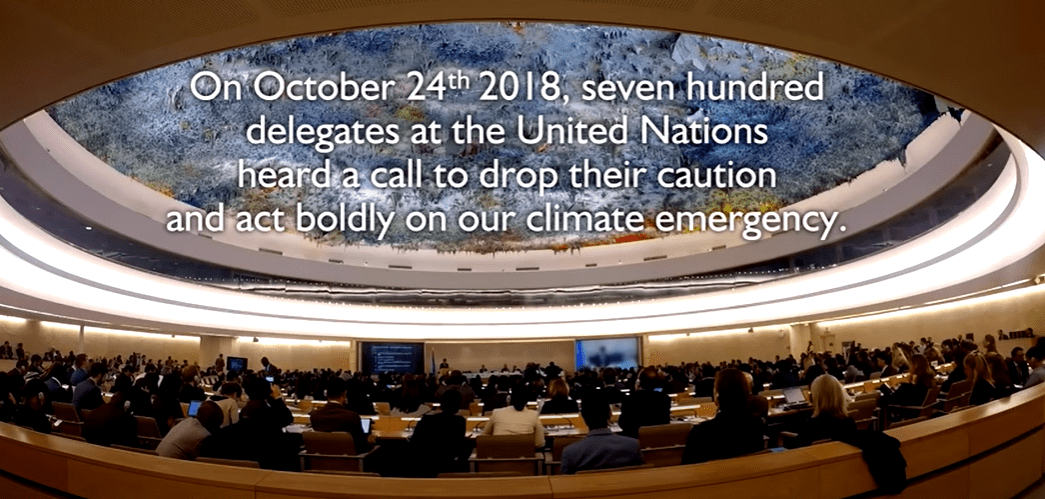
4 years ago today, I gave a keynote speech at the United Nations in Geneva, Switzerland. Soon after, a section of the talk was featured by the campaign group Extinction Rebellion (before they became famous).

Here is a transcript of a section of that speech:

“The Sustainable Development Goals offer one framework on public need. And we will hear of a range of efforts on different SDGs from our panellists. But I’d like to invite us to consider something bolder, more urgent. Although climate change is included in the SDGs, the latest report from the Intergovernmental Panel on Climate Change invites a reprioritisation. It implies that climate change is now a planetary emergency posing an existential threat to humanity. The artist who made this ceiling said he was inspired by a mirage in the Sahel where trees, donkeys and people all appeared to be melting up into the sky. We could take that a dramatic metaphor, in this human rights room, of the human face of climate change. So as our climate spirals away from one friendly to our civilisation, we need to face up to why we have been so incapable of changing our ways, collectively, at scale.

Continue reading “4 years ago: “climate change is now a planetary emergency posing an existential threat to humanity””

I’m not going to be joyful about collapse, but…

To me, ‘resilience’ in the face of climate chaos involves more than a garden, neighbours, and stories of guiltlessness. That means…

I’m not going to be joyful about collapse.

I’m not going to prioritise my survival.

I’m not going to give up on challenging abuses of power that harm people and nature.

Continue reading “I’m not going to be joyful about collapse, but…”

They’ve gone too far with the children – so what do we do?

Some countries recently stopped administering Covid vaccination to children. Sweden ceased recommending it for healthy children under the age of 18. Now Denmark won’t allow children to be jabbed for Covid, and they don’t recommend it either for anyone under 50, unless they are vulnerable.

These countries’ decisions make good sense, for several reasons. First, the disease is not dangerous to healthy children in the short term. For instance, the World Health Organisation (WHO) noted in August 2022 that only 0.5% of global deaths with a positive Covid test were under 25 years of age. Second, although long Covid is a significant and growing concern, a large study found that the vaccines were only about 15% effective at preventing that condition. It means we urgently need to explore other ways of combatting long Covid, whereas a simplistic focus on vaccines would undermine that.

A third reason for not vaccinating children for Covid is because that vaccination doesn’t significantly slow or stop infection and transmission. That matters if a vaccination programme is aimed at stopping children passing on a disease which does not harm themselves. A team from Imperial College London published their findings in The Lancet early in 2022, which showed that the impact of vaccination on community transmission of variants of SARS-CoV-2 appeared to be not significantly different from among unvaccinated people. Reviewing a range of studies, infectious disease specialist Dr. Franco-Paredes wrote in the same medical journal that because transmissibility is not reduced by vaccination a range of policy ideas should now be rethought.

A fourth reason for changing tack on child vaccination is the risk of significant side effects. That is why a team of top scientists recently wrote in the peer-reviewed journal European Society of Medicine that for “young healthy adults, some of the risks and disadvantages afforded by [Covid] vaccination prevail over the medical benefit..” They reached their conclusion even before new official data on adverse reactions. Alarmingly, a court case revealed in early October 2022 that the US government had kept private the data informing itself that about 800,000 citizens needed medical attention after their Covid jabs.

Continue reading “They’ve gone too far with the children – so what do we do?”

Join some events with compassionate realists

Having founded the Deep Adaptation Forum in 2019 to help collapse-aware people to support each other and develop helpful practices and responses, this day two years ago I left, so that it would be an initiative shaped by its participants. It was heartening, therefore, to receive an update from them today, highlighting some of the participant-led activities that are coming up. In case you don’t know about what they do, here is that update. I recommend joining something, or even proposing something. As climate anxiety grows, yet experts denigrate us for compassionate realism, it is important we give ourselves opportunities to experience how brilliant human beings can be.

Continue reading “Join some events with compassionate realists”

Invitation to Sign an Oath to the Future

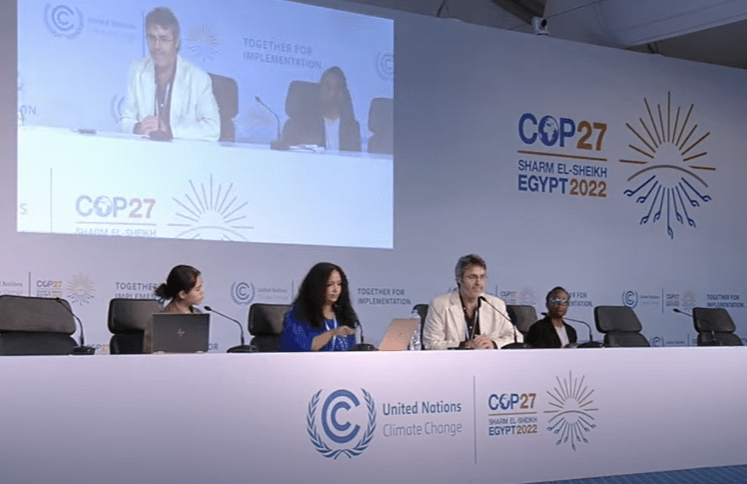
The following invitation is being sent to scholars around the world in the run up to COP27 in Egypt.

Dear Scholar,

Nearly two years ago over 500 of us from over 30 countries signed a public letter to coincide with the 5th anniversary of the Paris Climate Accord. We wrote:

“As scientists and scholars from around the world, we call on policymakers to engage openly with the risk of disruption and even collapse of our societies. After five years of failing to reduce carbon emissions in line with the Paris Climate Accord, we must now face the consequences. While bold and fair efforts to cut emissions and naturally drawdown carbon are essential, researchers in many areas now consider societal collapse to be a credible scenario this century… Only if policymakers begin to discuss this threat of societal collapse might communities and nations begin to prepare and so reduce its likelihood, speed, severity, harm to the most vulnerable, and to nature.”

Over the last two years we have seen climate impacts worsen, emissions climb again, methane levels jump, the science become more worrying, and the political mood darken in many countries. We have also seen the ongoing commercialisation of climate responses, the public sugar-coating of problematic science, and concerted denigration of people who focus on radical economic change to prepare for inevitable disruptions. The climate summits have morphed into career fests and trade shows at the end of the world as we know it. Although we are unlikely to change the huge systems that incentivise poor responses from professionals in this field, we can commit to learn and support each other in taking a different path.

Continue reading “Invitation to Sign an Oath to the Future”

Towards a 5th R in the Deep Adaptation Framework?

In the last few years a few people have suggested additional “Rs” for the 4 questions that comprise the Deep Adaptation framework for reflection and dialogue within an expectation or situation of societal disruption and collapse. As the idea of DA is used with groups around the world, various new ideas on what it means and what personal and group practices are relevant are emerging. One new R that I learned about recently is “Reverence.” That is what Reverend Lauren Van Ham adds to the framework as she uses it for the past couple of years with seminarians and faith-based communities. In my recent Q&A I asked her what a question might be that relates to Reverence, as I think DA involves inquiry, rather than simple answers. That is because societies and people are diverse, and an environmental breakdown affects all of it and, ultimately, everyone, thereby making generalised recommendations somewhat problematic!

Continue reading “Towards a 5th R in the Deep Adaptation Framework?”

Boring Averages and Climate Brightsiding – big mistakes in climate comms during #ClimateWeek

Do you know what the world’s average temperature was in preindustrial times? In absolute terms? If not, how does hearing of the subsequent 1.3C degrees of global warming make you feel? You have nothing to compare it with. We experience and talk about daily and seasonal highs and lows. Yet with climate we are asked to talk about incomparable averages of 1.5C or 2C degrees. People relate that to an existing cognitive frame of “warmth” which has dominated understandings of climate chaos. That is why people can say things like “I don’t believe in destroying the economy to stop just 1.5C of warming” and it make intuitive sense to others, despite being empirical nonsense. Even the people who work on these subjects can get completely confused and end up publishing extreme silliness such as a “best guess” that crops grown in Europe might cope with 15C of average global warming (making the average like the current Western Sahara – not known for its agriculture).

I write about this ‘average stupidity’ in a two-part essay on the biggest mistakes in climate communications. It is also where I provide the basic information on pre-industrial temperatures and suggest different ways to communicate about it.

Continue reading “Boring Averages and Climate Brightsiding – big mistakes in climate comms during #ClimateWeek”

Faith-based responses to disruption and distress from global heating

Many people describe their awakening to the extent of the environmental predicament that faces humanity as a ‘dark night of the soul’ or even a ‘near death experience’ because of how it both troubles and changes them deeply. As a result, many people have reported a new sense of freedom from past concerns and compromises, with a shift towards living more truthfully, compassionately and courageously from now on. Something like that happened to me, so I even made a short film about it.

As the cause of this awakening is a collective one – the state of the planet – some have wondered whether it might trigger a mass awakening with huge potential for societal change. Conversely, some have wondered whether more people will try to suppress this awareness and their feelings about it, and instead double down on their worldview and identity. Others have just assumed it will all end in apathy and depression. My own work on this topic with psychologists and spiritual teachers led me to conclude the rather obvious answer – it depends! The way we support each other with ideas, techniques and community in the face of difficult emotions, or what some call ‘bigger-than-self anxiety’, is key. Being able to talk openly about our fears of death and wider mortality seemed to be important, and why I included a 4th R in the Deep Adaptation framework – reconciliation.  

Continue reading Faith-based responses to disruption and distress from global heating

Coaching in a time of polycrisis: enabling post-heroic leadership of adaptive communities

As more people experience anxiety from a polycrisis of intersecting societal disruptions, some even anticipate societal collapse, while the unfortunate have already been experiencing breakdowns in their own societies. In such circumstances it can be normal to look to people in senior positions to solve the problems. Conversely, if we currently hold a senior position, it can be normal to look to ourselves to have the answers and offer reassurance. But just because it is ‘normal’ does not mean it is logical. Research on leadership has identified our human propensity to over emphasize the importance of senior role holders when we think times are tough (or when things are fantastic, but never when things seem just ordinary). Aggrandizing the importance of supposedly good or bad people at the top of a hierarchy is itself a reason for such widespread bad leadership – something that Richard Little and I discussed in a chapter in a book that asked why there are so many bad leaders. Instead, we can all take more time to understand systems of social organizing and help people to collaborate for positive outcomes. With the right support, senior leaders can help, not hinder, that process. Where might such support come from? Most senior executives are coached. Indeed, coaching is not only a large business sector, but potentially highly influential in how senior leaders better grapple with the developing polycrisis and spreading breakdowns of systems in societies. In a recent seminar I gave on the opportunity for coaches to make a difference, hosted by the Climate Coaching Alliance, I was joined by coaches Katie Carr and Matthew Painton. They specialize in supporting people who are seeking to integrate their awareness of likely or unfolding societal collapse. I am delighted Matthew will be discussing these topics in a Deep Adaptation Q&A later this month. Ahead of that, below he shares his thoughts on how coaches can respond to the current situation. Over to Matthew…

[Search for more or Subscribe]

Let’s face it, coaching and (non-clinical) therapy are privileged modalities – it requires disposable time and income to undergo elective processes of self-improvement. Generally, it is people who are already doing relatively well, or who have high expectations of themselves and of life who tend to engage expert, non-clinical, support and attention. But we could also say that every human being on earth, without exception, deserves to be seen, to be encouraged, to have wise and dedicated allies, to be ‘brought-on’, and to have close attention from someone with faith in their wholeness and potential, who will help them cope and develop into maturity in this complex and challenging world. In an ideal world, sustained and skillful attention from someone who is competent and dedicated to our well-being, as coach, mentor, counsellor, therapist, elder or tutor would be freely available on demand. But in this market-driven world such attention has become an artificially scarce commodity. 

Continue reading “Coaching in a time of polycrisis: enabling post-heroic leadership of adaptive communities”

Deep Adaptation in the Caribbean

In this month’s Deep Adaptation Q&A, host Katie Carr speaks with Jessica Canham about Deep Adaptation in the Caribbean and possible implications for elsewhere.

Jessica is a member of the Deep Adaptation Forum, a film-maker. She is based in her ancestral island home of Dominica, in the Eastern Caribbean. She shares about her experience of ‘deep adaptation in action’ during and after Hurricane Maria hit the island of Dominica in 2017, when communities responded by sharing food, shelter, practical and emotional support – in ways that Jessica sees are virtually non-existent in modern western societies.

Along with her partner Tim, she has created documentaries from the Caribbean and South America, for international broadcasters with an emphasis on culture, environment and social justice stories. Her current documentary film project, “LOVE In Action”, focuses on the stories of revolutionaries working on the front lines of our climate and ecological crisis.

Having survived the devastation and collapse caused by Hurricane Maria hitting the island in 2017, Jessica continues to work to strengthen and maintain resilient, healthy local communities. On her mountain rainforest property, she has created and manages a transformational retreat centre Caapi Cottage Retreats where the focus is on nature connection.

Other recent videos from the Q&A series include the coordinator of the Deep Adaptation Forum (DAF) sharing her journey from sustainability to DA and also a socialist politician on his engagement with DA. The Forum is also hosting interviews with people either from or who identify with communities that have already experienced societal disruption and collapse – including indigenous peoples. More discussion of a less-or-non-Western approach to DA included Vanessa Andreotti in discussion with me – Jem Bendell. If interested in this theme I recommend reading about Deep Adaptation in India or listening to a talk I gave in Glasgow in 2019 as I engaged with local groups on climate justice ahead of COP26. You may also be interested in the growing arguments from activists and scholars that we need to ditch the ideology of sustainable development and become more realistic about the deteriorating situation – something I wrote about for the United Nations here.

To receive invites to future Q&As then subscribe to the Deep Adaptation Quarterly.