What kind of music is related to deep adaptation? I wondered this recently. I don’t think it’s music about doom and gloom. Instead, it is anything which invites us to connect with our hearts, remember ancient wisdom, feel gratitude for what has been and still is, accept loss and death as natural, and recommit to conscious living no matter what lies ahead.
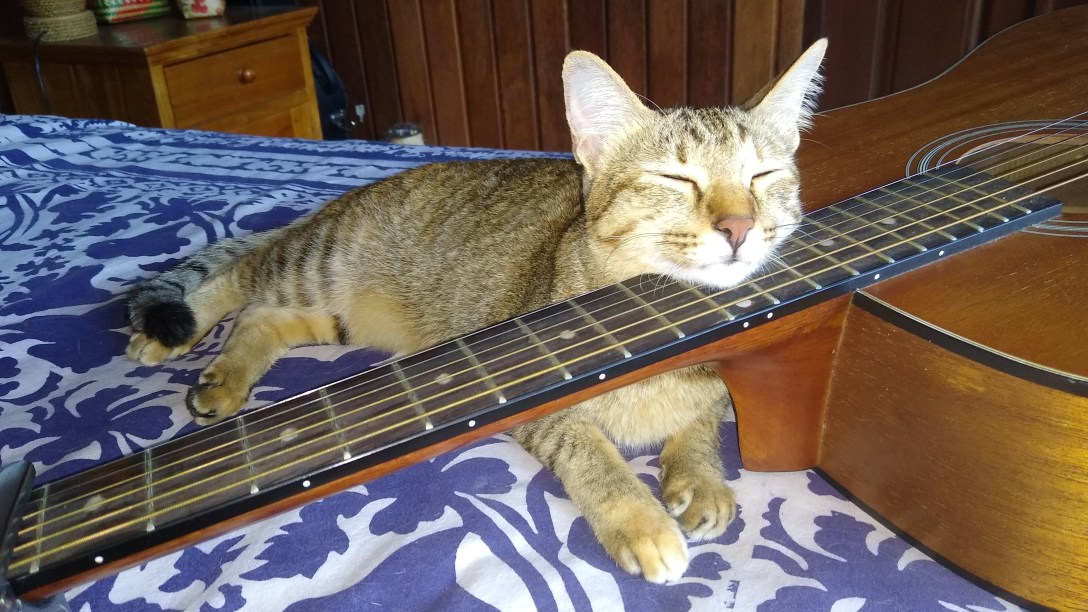
With my new band, Barefoot Stars, I’m releasing songs that I wrote from such emotions. ‘Healing Hearts‘ is about allowing endings with the knowledge something new will emerge. My latest release, ‘Mystical Cat‘ is not only about a deeper appreciation of nature, as reflected in our pets, but also about the significance of life not depending on its duration (you need to wait for the 3rd verse to hear that though). I wrote the song the night Amy died. She was a rescue kitten, adopted from Villa Kitty in Bali. She was the first non-human creature I met who had a sense of humour, not just play. Getting to know her opened my mind and heart to the depth of thought and emotion that’s possible in life other than human. That paved the wave for me to rescue a black kitten from the Brahma Vihara Temple, and he accompanied me during a reclusive 21 months when I wrote and released Breaking Together.
Thank you for following my blog. In the spirit of “if you don’t ask you can’t get…”
If you would like to see wider communication of the analysis and ideas of deep adaptation and ecofreedom, then I want to ask for the following help. Here are some things that I believe would have significant impact and I can implement efficiently:
Audio Book of Breaking Together in French – that will help reach French, Canadian and African audiences. The French book is out next month, and will be available as a free epub early next year. Funding required: 3k usd.
Audio Book of Breaking Together in Spanish – will help reach Latin American audiences. The Spanish book is out in October, and will be available as a free epub early next year. Funding required: 3k usd.
Translation of Breaking Together into Russian. For sale and also free epub release in 2025. Funding required: 8k usd.
Scholarships for activists from all corners of the world to attend the “Leading Through Collapse” courses with me for free. Funding required: 400 usd per person.
Design and delivery of an online course on collapse readiness from a collaborative and non-defensive perspective. In English with a ‘freemium’ model of participation. Funding required: 10k usd.
On this day 6 years ago, I released through my university the ‘Deep Adaptation’ (DA) paper on climate chaos. Since then, I’ve been experiencing a range of emotions that arise from my view of the situation and the reactions of other people to that – and learning how to be OK with that. I’ve also been experimenting with ways of living differently as my old sense of self broke apart. These two themes were the focus of a new documentary about my life that was shown on Dutch TV a few weeks ago. The filmmakers made it beautiful and so I recommend watching below on YouTube or Odysee.
The emotional side of researching, communicating, and educating on collapse has been colourful and, at times, draining. I made and lost friends. I gained allies and enemies. I lost and gained a way of life. I wonder whether I could have learned anywhere near as much about psychology and spirituality without the emotional roller-coaster of becoming public about collapse risk and readiness. 6 years after the release of the DA paper, I want to share some reflections on the conflictual side of me coming out as a ‘doomster’.
There are many ways of living with ‘collapse acceptance’. My own approach doesn’t represent the best one. To acknowledge the diversity, and help us all learn from that, once in a while I ask a colleague or friend to share some thoughts on how they are responding. Katie Carr was a founding member of the Deep Adaptation Forum and teaches the ‘Leading Through Collapse’ course with me (online twice a year and for one time only in the States this October). I asked her to share why a dance camp is one of her most restorative activities of the year. I hope it inspires. Thx, Jem
By Katie Carr
I recently returned from rural Oxfordshire in the UK, where I joined around 300 people from across the country to dance in a circle while chanting songs and mantras from many different spiritual traditions. Sacred Arts Camp is an annual week-long community event, where we camp in small circles, sharing cooking, care, and connection. Every time I attend, I am reminded of the importance of this kind of embodied and joyful ritual, especially as the world and our day-to-day lives seem to become more precarious. I also remember how much my heart longs for the experience of community and belonging that are so difficult to imagine, let alone co-create, in the midst of industrialised consumer societies.
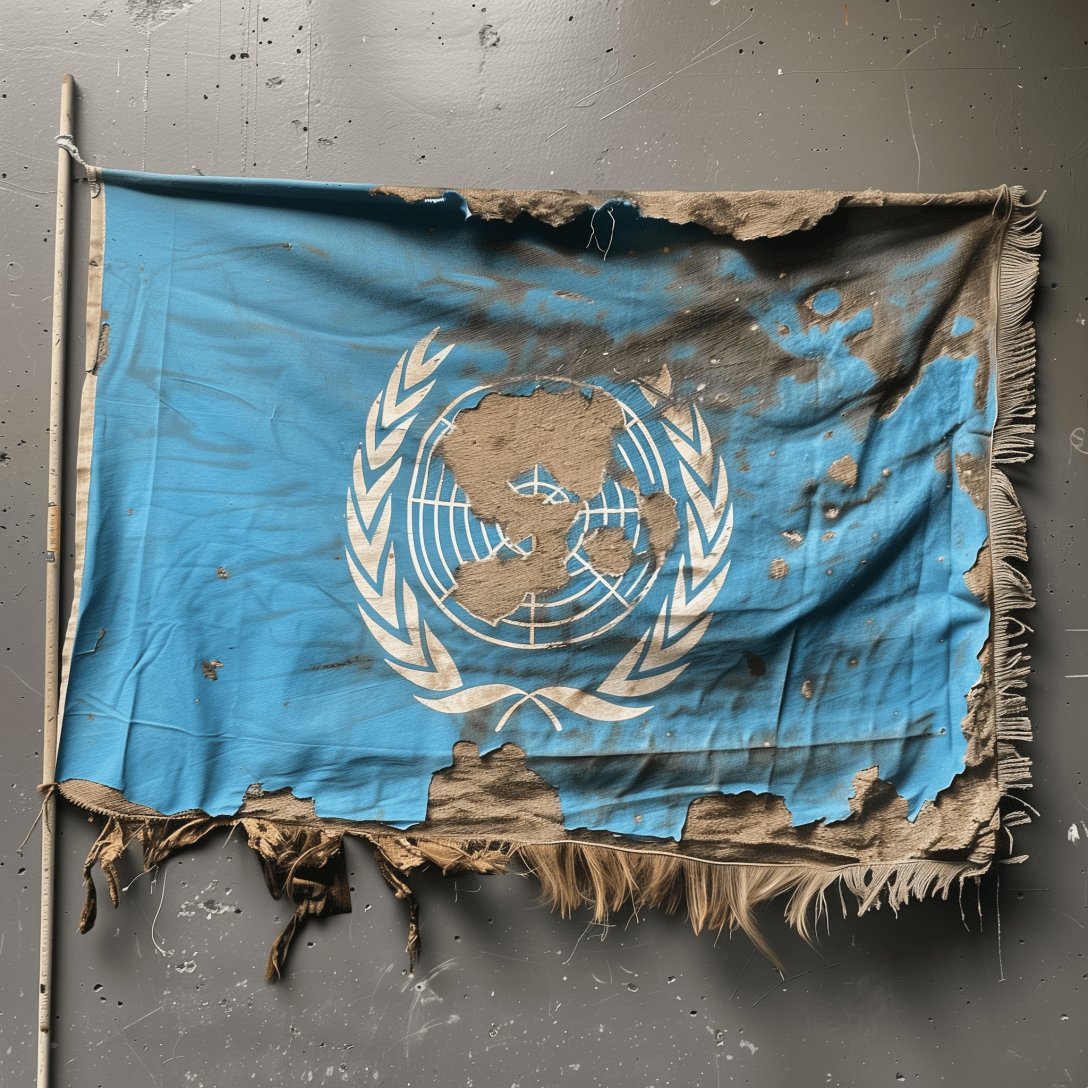
If we conclude that current difficulties are aspects of an unfolding collapse of societies around the world, what might we want to see from officials in the United Nations system?
That was a question posed to me recently by an initiative which recognizes something of the scale of the challenges faced and wants to communicate that to professionals involved in international affairs. They include not only international civil servants, but also governmental officials in foreign relations, international development and environmental issues.
Having worked in the UN system in various research roles, as well as with international NGOs, I recognize the conclusion that because we have global problems, we need globally coordinated action. Since the 1990s, I wrote a lot of published papers with that in mind, including some reports for the United Nations. But years later, I now see the hope people have in the UN system in contrast to the reality of its ineffectiveness and the growing suspicion that parts of it, such as the WHO, have been hijacked by a global managerial elite (who have bad ideas on most things). I have come to see that although many international civil servants do important work on the ground in some countries, many of them in the headquarters are involved in a deadly charade, where their status, income, and emotional stability lead them to lie to themselves and to the public about our planetary predicament, its causes and what to do about it. This is exemplified by their continued lie that ‘sustainable development’ is possible, despite years of data now proving the critiques from decades ago that it was capitalist-friendly ideological tosh. For one year I discussed and corresponded with various professionals in the field of sustainable development about why they continue the charade and heard what I described as their ‘deadly sins of denial’ in an article for Brave New Europe.
Six hundred and seventy-four scholars from 53 countries, believe that “Only if policymakers begin to discuss this threat of societal collapse might communities and nations begin to prepare and so reduce its likelihood, speed, severity, harm to the most vulnerable, and to nature.” Each signatory, with doctoral degree, endorsed a public warning on societal disruption and collapse due to environmental change. They cover more than 20 major academic disciplines, including ecology and climatology, thereby conclusively demonstrating that preparations for societal collapse are being taken seriously by experts from around the world. The announcement of the final list of signatories concludes a 3-year initiative to promote awareness of the scientific basis for exploring how to reduce the damage from societal disruption, breakdown, and collapse, due to environmental change.
Beyond Mattering Do I matter? Is that my driver? If I matter, then I matter, With no question, no trying. To accept I matter, without condition, Is something I could feel from within, But can I? Perhaps with the help of a mantra, On losing my need to matter. So, let’s make it now: I shall not need to matter But it’s welcome when I do And I won’t need to have mattered But it’s welcome if that’s true Neither will I need to be heard to know Or known for who I am For that would be joining a very pointless queue. But there go those bells from the temple Durga doesn’t quite agree She’s sending me some edits To this mantra on feeling free. So, let’s try again: I really won’t matter much But it’s welcome when I do And I haven’t mattered much But it’s welcome if that’s true I won’t be heard that much Or much known for who I am For that’s an endless queue. I write these words to clarify And remind my future self But will I share these words somewhere? Or leave them on the shelf? Oh, this need runs deep To matter To matter To ‘share’ to matter But Durga’s bells remind me that sharing can be okay Because, after all It just won’t matter. Not much, anyway. (June 2020, edited June 2023, by me)
It’s crazy how fast things grow in the tropics! When we founded Bekandze Farm in early 2023 we thought we could make a small but meaningful contribution to local food security and environmental care, by promoting and supporting the development of regenerative agriculture in our small patch of Bali. Sixteen months later the infrastructure is in, the garden is thriving, and the training is in full swing. But it hasn’t just been the plants that have been growing – our vision for the project has been growing too!
When we started Bekandze Farm – Regenerative Training Center we knew there was a need, but we had little idea how great that need was. Nor did we realise how vast is the opportunity to have a positive impact on how food is grown here, not just in Bali but throughout Indonesia. When we advertised for staff we attracted applicants from all over Indonesia hungry for an opportunity to develop their professional skills in regenerative agriculture. When we promoted our first free farmer training program we fielded enquiries from isolated farmers on far flung islands throughout Indonesia eager to take up the opportunity to connect learn from regenerative farmers in other parts of the country. And when we were approached by one of only two vocational high schools still teaching agriculture in Bali to help them stop the hemorrhaging of students out of agricultural studies into tourism, we knew for certain that we were on the cusp of something far greater and more impactful than we had envisaged.
Many people ask me about how to insulate themselves from a financial collapse of some kind or another. I am not a financial advisor, and my focus has always been on collaborative resilience, whereby collectives of people might cope better. But when pressed by friends on what they could do to protect themselves a bit, what I typically recommend is to lessen one’s dependence on goods and services traded within a corporate market place, participate more in an economy of locally-produced goods, try to own some of the basic necessities like a bicycle, and if having some savings then put some of that into crypto (like Ethereum, which does not require massive amounts of energy), gold or silver (in physical possession), or other items that are likely to maintain their value and utility over time. I also recommend not postponing things like elective surgery or house repairs. Further than that, I suggest people no longer assume that their financial savings will give them spending power in the future and instead that they look to nurture other kinds of ongoing productivity with that money. In my own life, these considerations combined with my wish to promote collaborative resilience, so that I funded the launch of an organic farm and farm school in a country where I could afford to do that without debt. But financial resilience is not my field. Therefore, I asked my colleague Matthew Slater to explore this issue with me. In the following guest essay, Matthew writes as one who has been devouring financial collapse narratives since 2008 and studying the phenomenon of money, as well as building alternative means of exchange. He explains that the quick fixes for financial security through gold and crypto that are often promoted by both the financial press and popular YouTubers are a distraction from substantial efforts towards collaborative resilience. In addition, he reminds us of the oppressiveness of the global monetary system, which invites our resistance. His writing is philosophical and colourful but he also does more concrete work based on his analysis, which you can learn about at matslats.net Thx, Jem
The failure of our system of money and debt is inevitable and possibly imminent, according to numerous unofficial narratives likely to be labelled ‘disinformation’. Some financial collapse narratives focus on the danger of leverage, or on possible triggers of the next crisis; others on how neoliberal policies are constructing a system that exacerbates social tensions and will explode in revolution; others on the inherent unsustainability of exponential growth on a finite planet. Are such stories just fake-news-clickbait, agitprop, or even psyops? What can we learn from them?
This essay is not to warn or convince you about the risks to participants in that system: chapters 1 & 2 of Jem’s recent book, Breaking Together, do that well enough. This essay attempts to digest the diverse narratives out there, to share an analysis that is guiding my own decisions, and hint at the direction of possible useful action for others. I am not a financial advisor, and I do not advise you to look to finance to save you.
Most leaders of the Green movement and profession in the West who I talk with, or read from, don’t want to recognize either the validity or significance of a public backlash against senior experts and authorities on matters of public concern. Nor do they want to admit their own role in contributing to that distrust and backlash. Perhaps they don’t want to recognise how they helped to amplify the damaging pharma-defined authoritarian and pseudo-moralizing narratives and policies promoted to us during the early years of the pandemic.
They prefer to regard any concerns about eco-authoritarianism as being fanciful conspiracy theories dreamt up by opportunistic YouTubers. While it is true that some influencers appear to be so out-of-touch and attention-seeking that they ignore the suffering of millions of poor people from climatic change to instead warn, without evidence, that the WHO will initiate ‘climate lockdowns’ [1], that does not mean there are not valid concerns about creeping censorship, propaganda, and authoritarianism. It does not mean some of that anti-democratic creep has been supported by environmental leaders, including those in power in Germany and elsewhere.





You must be logged in to post a comment.