Although there are many potential benefits from accepting societal collapse, there is nothing inherently beneficial about being right about one’s expectations of catastrophic change. Having held more accurate assessments than the majority doesn’t reduce the pain about what’s happening or what’s to come. It doesn’t compensate for the alienation experienced with those who would not see, or even condemned our clarity. It doesn’t compensate for the pain of witnessing the lost opportunities for people to process this reality for themselves. If there is any benefit in being right, it comes from how we acted with our awareness until now. Has it influenced us to do more of what we consider wholesome, and less of what we consider unwholesome? Has it meant we have tried to develop our capabilities for coping better as life becomes more difficult? Perhaps, also, to help others develop their own capabilities? You know the basics – mindfulness, letting go of old habits and expectations, and having a way to make sense of life in an era of collapse. For some of us, we can experience a liberation from past compromises and the permission to ‘go wild’. Without evolving ourselves in such ways, then feeling we were right could generate a further alienation, through a pointless sense of superiority. And what we definitely don’t want is to be isolated in our pain as things unfold, in the same way many of us have been isolated in our anticipation. So, when our outlook is confirmed by current observation, it is a time to assess whether we have made good use of our knowledge. Then, if not sure, to commit to try again.
Continue reading “The Doom Vindication Blues”Category: essay
The Professional Implications of Collapse: Deep Adaptation in Organizations
As modern societies experience further disruption and decline, how can our work in organizations help more of us ‘break together’ not apart?
Once people reach the conclusion that societies are not just being continually disrupted but that we are in a situation of actual breakdown, not everyone can quit their job and do something new. After doubt transitions into shock, grief, and anger, not everyone can ‘go wild’ like many ‘doomsters’ do. Nor would we want everyone to! How to integrate an acceptance of societal collapse into one’s professional job in a large organisation is therefore a huge issue. However, until now I did not find anyone in the field of organisational development who could try that. This intransigence even existed amongst experts on ‘sustainability’ and so moved me to write an article last year that summarised the ways they were maintaining their denial. However, five years after the Deep Adaptation (DA) movement took off, it appears that the situation is opening up a bit, as I noted in the latest DA Review. The recent engagement with both DA and my new book ‘Breaking Together’ by world-leading sustainability advisors and trainers R3-0.org, is another indicator of change. Some management consultants may prefer to speak of a polycrisis of ongoing disruption, rather than the unfolding collapse of industrial consumer societies – but an opening has appeared, nevertheless. Therefore, in this essay I will offer some initial ideas for how to work on societal collapse risk, readiness, and response, within organisations.
Continue reading “The Professional Implications of Collapse: Deep Adaptation in Organizations”Major life changes become the least risky option
Last month, I spoke with the participants in a course hosted by the American cultural commentator Daniel Pinchbeck. The course was all about regenerative attitudes and initiatives. Before a Q&A, I was asked to share four key ideas that would be relevant to the lives of the participants. As I’ve talked about it so much already, I decided to skip the evidence basis for taking societal collapse seriously, and spoke about the changes I am seeing in myself and others, and how that might inspire them. The four things can be summarised as:
- You don’t escape this
- You have permission to go wild
- You can’t avoid losing things
- You can gain what’s most important.
Stubborn optimism in an era of collapse
The weak but well-funded arguments for techno-optimism in the face of climate chaos have kept on coming. The latest were a series of articles in mainstream press about a book that claims renewable energy will sustain societies while stabilising the global climate. Brazilian researcher Claudia Gasparovic, offered a rapid debunking of the book’s arguments, in a post on LinkedIn. Similar arguments were put to the book’s author by journalist Rachel Donald for Mongabay. The weakness of techno-optimism on climate change was something I explored in my book Breaking Together. If you read Chapter 3, you will know that the idea modern societies can maintain current consumption patterns by switching to entirely renewable energy is one founded upon blindness to material dimensions of energy generation and storage. If you read Chapter 4, you will know that energy and carbon dioxide are two issues within a far broader problem of the ecological overshoot by modern societies. If you read Chapter 5, you will know that the momentum of change in our oceans and atmosphere, coupled with the dramatic loss of cooling aerosols and cloud-seeding forest cover, means we are already within a scary situation with climate.
Continue reading “Stubborn optimism in an era of collapse”Laughing off the apocalypse?
There was an interesting interview with Gavin Schmidt recently. He is one of the most senior climatologists in the world, heading up NASA’s department on climate science. Refreshingly, unlike the other senior climatologists, he didn’t sidestep how recent weather was not predicted by mainstream climatology. He told the American science celebrity Neil deGrasse Tyson that climatology significantly underpredicted current warming. He said there was “total failure” to predict what happened in 2023. See for yourself, for 3 minutes from 4 minutes in.
Gavin is one of the more approachable of the senior climatologists. He provided specific written criticisms of my 2018 Deep Adaptation paper. That was in stark contrast to others who misrepresented it, and me, so as to discourage people from considering that the party is over for modern societies.
Continue reading “Laughing off the apocalypse?”Bali Weather Breaks Records – Why Farmers Know but Instagrammers Don’t
As I type these words on January 25th 2024, we are breaking another all-time temperature record here in Bali. It is 32C degrees in the Ubud area, above the previous record of 31C for this day in history. The average maximum was once below 30C (see the image above). So when does such unusual weather indicate a new climate regime, rather than just a few unusually hot days? That should be a matter of scientific analysis, not ideological posturing. If we are analytical, the answer depends on the data on long-term trends and the possible reasons for such trends. As I have recently become an organic farmer, this information is even more important to ascertain, because it influences what and when to plant, as well as how much protection from water and temperature stress we should invest in. So I am going to share with you what I found out about Bali’s weather, and what this means for those of us who live in this region. I also think it has implications for people everywhere, so wherever you are, please read on…
Continue reading “Bali Weather Breaks Records – Why Farmers Know but Instagrammers Don’t”Why I am not on the Epstein list
On the 11th September 2012, Melanie Walker of the Gates Foundation introduced me, on email, to Jeffrey Epstein. Previously I’d been discussing whether to apply to the Gates Foundation for funding to work on alternative currencies. Bitcoin was just 3 years old and stimulating some interest in a field that had hitherto been marginal. It didn’t seem that their Foundation would fund work on it, and so I received an introduction to a billionaire philanthropist who was prepared to host and fund gatherings of experts, including a group of ‘Young Global Leaders’. That’s the network the World Economic Forum (WEF) established to connect emerging leaders of the world’s largest corporations with emerging leaders in politics and other walks of life. I had engaged with that network for a few years until 2017, as I had been seeking to continue to influence action on environmental problems at scale.
I don’t recall much from the one Skype call I had with Epstein, apart from that he was in the tropics, and at some point, when I was making my best effort to sound intelligent, he interjected to say: “Well Jem, you know, I just want to have fun.” I remember being flummoxed, not knowing how to help billionaires have fun.
After that video call, I Googled him. I vaguely remember reading that he had been found guilty of using underage prostitutes. Now, ten years on, I know that prostitution is the wrong word for what was happening. Instead, paedophilia and, most probably, blackmail, are better descriptions. But back then, when reading about that, did I simply cut off? Unfortunately, not. I decided to send him the proposal that he had requested. But I explained (in a phone call) that due to his notoriety, none of the events he might fund could occur on any of his properties and that he could not be a host, only a guest.
After those exchanges, we never spoke again.* Maybe he was insulted by my stipulations. Or maybe he was having too much ‘fun’. Or maybe his aim had been to get compromising images of leading experts and ‘Young Global Leaders’ for future blackmail. If the latter, then that would indicate a very sophisticated approach, as cryptocurrencies were years away from becoming a major issue in global finance.
Looking back, I wonder what I was doing. I had been prepared for him to fund work I believed in, just so long as I managed the reputational risk. I had rationalised that promoting a different approach to monetary systems was paramount. I thought I was driven by principle, but I wasn’t even thinking about how there might be victims of his actions. And I was also too easily influenced by others, such as the people who introduced us, or the many recipients of his donations in the world’s top Universities.
I mention this now as an example of how people who believe in themselves and what they are doing can make really bad choices when they are so convinced of their need to make the world a better place. Those people who associated with Jeffrey Epstein, despite his known crimes, provide an extreme example of how the desire to succeed through working with elites is what helps to maintain destructive systems. Many people today seek the attention, favour or finance of people who have been involved in even worse crimes than Epstein. For instance, people who lied to the public to start illegal wars that killed a million people. It is this deference to power, even admiration of it, no matter how destructive or disgusting, that enables it to continue.
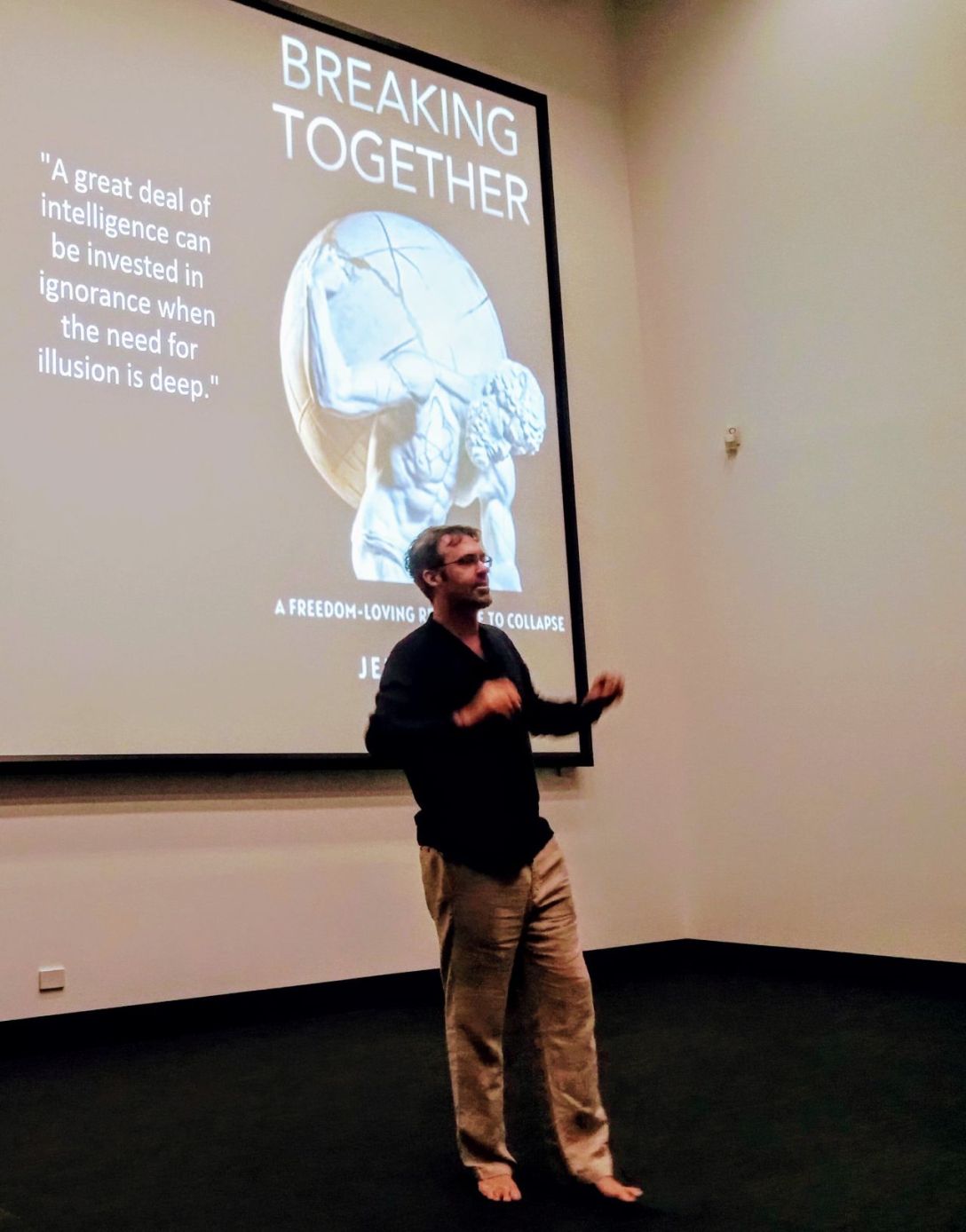
If you read my book, Breaking Together, you will know that I don’t believe there is an evil cabal that coordinates everything in the world. Instead, there are powerful systems that maintain ways of living that are destructive to each other and wider nature. We could all do more to resist and replace those systems. So, we can start with ourselves and our own forms of compliance. It means I have far greater respect for the people who have refused to collaborate with elites or officers of the establishment and instead focus entirely on grassroots organising. It’s why I mentioned this strange episode in my life, and criticised my past self, in my speech to launch my new book.
I had this in mind when, last year, I was approached to appear in a documentary series for Netflix about major world crises. During a call with the producer and editor, it became apparent to me that the series would present the ideas of Bill Gates as the answer to every issue they looked at, from combatting diseases to addressing climate change. I explained I didn’t want to be just the guy explaining the threat of doom before ‘SuperGates’ comes to the rescue. Somewhat annoyed, I mentioned when Gates Foundation staff introduced me to Jeffrey Epstein. Immediately the video of the producer’s screen went black. The director kept chatting for a while about some limits on how pro-Gates their show would be. Neither a goodbye nor a follow up email came from the producer.
Once again, that experience reminded me that the power of money to distort humanity’s view of our situation only works because human beings prostitute themselves to corporations, billionaires and foundations. Whether it’s Epstein, Gates, Musk, Theil or any of the rich American men who like playing with machines and doing maths, it’s the rest of us who are giving them far too much airtime on issues they shouldn’t have any influence on. Unfortunately, they also own platforms like LinkedIn, Facebook and suchlike, so can manipulate what we do or don’t see from our peers. But they can only do that because staff in their companies choose to implement policies and procedures that are dangerous to our human rights and democracies. So, if you know anyone who works for the biggest companies of the world in media, finance, and technology, then ask them why aren’t they rebelling inside those companies, to make it less easy for rich white men to fuck up people or planet? That’d be far more powerful than going on a protest or tweeting about someone on Epstein’s list.
—
Mainstream media hasn’t been digging into the evidence in the released documents that suggests Jeffrey Epstein was generating material to blackmail world leaders. For a look at that evidence, see: https://public.substack.com/p/jeffrey-epstein-ran-sex-blackmail
*Update Feb 12th 2026. I have looked at correspondence more closely, including with the people who introduced us to confirm the timeline. One time when we spoke in 2012, I explained he couldn’t host a project due to his reputation, and then included that in the written proposal (Sept 17th): after that we didn’t communicate again about funding (he didn’t reply to my reminder of Sept 22nd). I also wrote to him once when travelling to New York in March 2014 but we didn’t meet then or since. My lessons from that, including my self-criticism for continuing any dialogue, are in my article from 2024, and my speech in June 2023. I subsequently discovered he was subscribed to my free email newsletter and so received those from me, with automated salutation, every 3 to 6 months (it went to over 3000 people).
Donate to keep Jem writing / Read his book Breaking Together / Ask JemBot a question / Read Jem’s key ideas on collapse / Subscribe to this blog / Study with Jem / Browse his latest posts / Read the Scholars’ Warning / Visit the Deep Adaptation Forum / Receive Jem’s Biannual Bulletin / Receive the Deep Adaptation Review / Watch some of Jem’s talks / Find Emotional Support / Jem’s actual views on Covid
Visions of a post-doom world
Was Jesus Christ a Buddhist monk? That is the subject of a few books and films which focus on the many years between childhood and the time of his preaching that are recorded in the Bible. The BBC documentary featured evidence from a Buddhist Temple that mentioned a famous teacher from afar, with the local name for Jesus. Learning from different wisdom traditions makes a lot of sense. So perhaps ‘the son of God’ might have explored that as well. I mention this speculative history because both Christianity and Buddhism have been important to my own experience and understanding of the world. In more recent times, I have focused more on learning from Buddhist insight, partly because it has been new to me. This is reflected in the name of our farm school, which is the Sanskrit word for healing through transcending separations: Bekandze Farm. The word features prominently in the Medicine Buddha Mantra, which is one of the oldest and most popular. This was the background to why I was delighted to appear in the podcast series “Buddha at the Gas Pump”. I wrote some reflections about that discussion with Rick Archer, and posted them as an article on LinkedIn. In the pod we discussed the question of whether or not we need, or benefit, from a vision of a better future, in the material realm, including humans or wider life on Earth. Below I cross-post the article. For it I used the JemBot to summarise a few of the ideas in my book Breaking Together. If you want to go deeper into any of these ideas, then studying with me is possible, twice online and twice in person, during 2024.
Subscribe / Support / Study / Essays
My other past writings on LinkedIn are here.
Continue reading “Visions of a post-doom world”Talking Collapse at Christmas
[a version of this post went to 5k subs of my biannual bulletin]
What are you going to talk about over the coming holiday period? There is a lot of sad stuff going on in the world, which seems impossible to either influence or ignore. There is the temptation to utter platitudes about peace on Earth, or hoping it will be better next year. But you are reading these words. So we both know you are made of sterner stuff than that. How about trying a different tack entirely? Something like: “It appears to me that all this terrible news is part of a pattern. Modern societies are crumbing and the elites are causing more damage as they try to hold on to their power. These are aspects of societal collapse, and we need to start accepting it, so we can discuss what to do about it. It looks like we need to change our hopes and plans for the future.” Yes, the time has come for you to be a ‘party pooper’ …but at least one with purpose.
For a few years I didn’t want to poop any parties. I felt apprehensive about promoting my views on collapse, as I knew how emotionally unsettling it can be to realise the tragic and dangerous situation we are all facing. Instead, I thought people who were already aware of the situation would benefit by hearing from people who were responding to their collapse anticipation, or acceptance, in positive ways – and so I hosted 30+ guests in the Deep Adaptation Q&As. Over the years, my reticence to speak out has changed. That is because, although societal collapse is still taboo in mainstream media and politics, a huge proportion of the general public already experience how normal life is unravelling and that the ecological situation is unavoidably frightening. I want to help more people make sense of this situation and consider their options. As the initiative ‘Just Collapse’ often repeats, it is time to talk about societal collapse. That is why this year I released the book Breaking Together and began to #TalkCollapse in a variety of podcasts and some interviews in mainstream media. In this post, I’ll sum up some of that audio and video from the past year. It will give you a number of options of what to share with people you talk about collapse with in the coming weeks, months, and beyond.
Continue reading “Talking Collapse at Christmas”Deep Spirituality in an Era of Collapse
Reverend Stephen G Wright
[This essay is available as an audio, narrated by Jem Bendell]
As a follower of the contemplative-mystic Way for many decades, and written about it, guided others in it, even set up a School to ‘teach’ it, in recent years I’ve taken the idea and community of Deep Adaptation into deep discernment – to consider its impact upon my spiritual life and that of others. The unfolding ecological disaster, and its implications for our societies, is something I observe and experience from that contemplative-mystic approach to life. I have come to believe that deep adaptation will be spiritual or there will be no deep adaptation at all. By which, I mean that there will be no softening of the collapse of societies, for people or wider nature, unless more of us discover and prioritise our own spiritual response to this predicament. That is not a summons to fluffy feel-good spiritual experiences to keep the horrors at bay. It is a summons to fierce and profound inquiry, a deep plunge into the joypain of existence, and a wholly (holy!) different perspective on reality and what it is to be human in that reality. Such a Way lifts (or sinks) us into an utterly different relationship and perception of life; of self and that which is beyond the self. Without that we shall persist in limited perceptions of what it is to be human and part of all of life. Without it we would continue deploying our good intentions and rearranging bits and pieces of ordinary reality without fundamentally changing our relationship to that reality.
Continue reading “Deep Spirituality in an Era of Collapse”


You must be logged in to post a comment.