There are many ways of living with ‘collapse acceptance’. My own approach doesn’t represent the best one. To acknowledge the diversity, and help us all learn from that, once in a while I ask a colleague or friend to share some thoughts on how they are responding. Katie Carr was a founding member of the Deep Adaptation Forum and teaches the ‘Leading Through Collapse’ course with me (online twice a year and for one time only in the States this October). I asked her to share why a dance camp is one of her most restorative activities of the year. I hope it inspires. Thx, Jem
By Katie Carr
I recently returned from rural Oxfordshire in the UK, where I joined around 300 people from across the country to dance in a circle while chanting songs and mantras from many different spiritual traditions. Sacred Arts Camp is an annual week-long community event, where we camp in small circles, sharing cooking, care, and connection. Every time I attend, I am reminded of the importance of this kind of embodied and joyful ritual, especially as the world and our day-to-day lives seem to become more precarious. I also remember how much my heart longs for the experience of community and belonging that are so difficult to imagine, let alone co-create, in the midst of industrialised consumer societies.
If we conclude that current difficulties are aspects of an unfolding collapse of societies around the world, what might we want to see from officials in the United Nations system?
That was a question posed to me recently by an initiative which recognizes something of the scale of the challenges faced and wants to communicate that to professionals involved in international affairs. They include not only international civil servants, but also governmental officials in foreign relations, international development and environmental issues.
Having worked in the UN system in various research roles, as well as with international NGOs, I recognize the conclusion that because we have global problems, we need globally coordinated action. Since the 1990s, I wrote a lot of published papers with that in mind, including some reports for the United Nations. But years later, I now see the hope people have in the UN system in contrast to the reality of its ineffectiveness and the growing suspicion that parts of it, such as the WHO, have been hijacked by a global managerial elite (who have bad ideas on most things). I have come to see that although many international civil servants do important work on the ground in some countries, many of them in the headquarters are involved in a deadly charade, where their status, income, and emotional stability lead them to lie to themselves and to the public about our planetary predicament, its causes and what to do about it. This is exemplified by their continued lie that ‘sustainable development’ is possible, despite years of data now proving the critiques from decades ago that it was capitalist-friendly ideological tosh. For one year I discussed and corresponded with various professionals in the field of sustainable development about why they continue the charade and heard what I described as their ‘deadly sins of denial’ in an article for Brave New Europe.
Six hundred and seventy-four scholars from 53 countries, believe that “Only if policymakers begin to discuss this threat of societal collapse might communities and nations begin to prepare and so reduce its likelihood, speed, severity, harm to the most vulnerable, and to nature.” Each signatory, with doctoral degree, endorsed a public warning on societal disruption and collapse due to environmental change. They cover more than 20 major academic disciplines, including ecology and climatology, thereby conclusively demonstrating that preparations for societal collapse are being taken seriously by experts from around the world. The announcement of the final list of signatories concludes a 3-year initiative to promote awareness of the scientific basis for exploring how to reduce the damage from societal disruption, breakdown, and collapse, due to environmental change.
Mainstream media are ignoring a scientist who is whistleblowing the climate profession.
During the five years since new kinds of activism brought the climate issue into the headlines like never before, the topic has more clearly become one where people respond due to their preexisting worldviews. It’s not just believers and sceptics, but there are those who think technology can save us, those who think it’s too late; those who think the science is clear, others who think it is open; those who believe humans will muddle through and those predicting human extinction. Climate scientists themselves now range from those emphasizing ‘we can do this’ to those that express their grief and outrage by gluing themselves to buildings. Meanwhile, misleading narratives are amplified by a variety of vested interests, including fossil fuels, nuclear, and clean tech. Climatologist Dr Wolfgang Knorr is an unusual voice in this cacophony because he has been ‘blowing the whistle’ on the climate science itself and how it is being communicated. His perspective hasn’t found wealthy supporters or mainstream platforms, and so his voice hasn’t been much heard, which is why I want to bring it to your attention here.
Beyond Mattering Do I matter? Is that my driver? If I matter, then I matter, With no question, no trying. To accept I matter, without condition, Is something I could feel from within, But can I? Perhaps with the help of a mantra, On losing my need to matter. So, let’s make it now: I shall not need to matter But it’s welcome when I do And I won’t need to have mattered But it’s welcome if that’s true Neither will I need to be heard to know Or known for who I am For that would be joining a very pointless queue. But there go those bells from the temple Durga doesn’t quite agree She’s sending me some edits To this mantra on feeling free. So, let’s try again: I really won’t matter much But it’s welcome when I do And I haven’t mattered much But it’s welcome if that’s true I won’t be heard that much Or much known for who I am For that’s an endless queue. I write these words to clarify And remind my future self But will I share these words somewhere? Or leave them on the shelf? Oh, this need runs deep To matter To matter To ‘share’ to matter But Durga’s bells remind me that sharing can be okay Because, after all It just won’t matter. Not much, anyway. (June 2020, edited June 2023, by me)
Many people ask me about how to insulate themselves from a financial collapse of some kind or another. I am not a financial advisor, and my focus has always been on collaborative resilience, whereby collectives of people might cope better. But when pressed by friends on what they could do to protect themselves a bit, what I typically recommend is to lessen one’s dependence on goods and services traded within a corporate market place, participate more in an economy of locally-produced goods, try to own some of the basic necessities like a bicycle, and if having some savings then put some of that into crypto (like Ethereum, which does not require massive amounts of energy), gold or silver (in physical possession), or other items that are likely to maintain their value and utility over time. I also recommend not postponing things like elective surgery or house repairs. Further than that, I suggest people no longer assume that their financial savings will give them spending power in the future and instead that they look to nurture other kinds of ongoing productivity with that money. In my own life, these considerations combined with my wish to promote collaborative resilience, so that I funded the launch of an organic farm and farm school in a country where I could afford to do that without debt. But financial resilience is not my field. Therefore, I asked my colleague Matthew Slater to explore this issue with me. In the following guest essay, Matthew writes as one who has been devouring financial collapse narratives since 2008 and studying the phenomenon of money, as well as building alternative means of exchange. He explains that the quick fixes for financial security through gold and crypto that are often promoted by both the financial press and popular YouTubers are a distraction from substantial efforts towards collaborative resilience. In addition, he reminds us of the oppressiveness of the global monetary system, which invites our resistance. His writing is philosophical and colourful but he also does more concrete work based on his analysis, which you can learn about at matslats.net Thx, Jem
The failure of our system of money and debt is inevitable and possibly imminent, according to numerous unofficial narratives likely to be labelled ‘disinformation’. Some financial collapse narratives focus on the danger of leverage, or on possible triggers of the next crisis; others on how neoliberal policies are constructing a system that exacerbates social tensions and will explode in revolution; others on the inherent unsustainability of exponential growth on a finite planet. Are such stories just fake-news-clickbait, agitprop, or even psyops? What can we learn from them?
This essay is not to warn or convince you about the risks to participants in that system: chapters 1 & 2 of Jem’s recent book, Breaking Together, do that well enough. This essay attempts to digest the diverse narratives out there, to share an analysis that is guiding my own decisions, and hint at the direction of possible useful action for others. I am not a financial advisor, and I do not advise you to look to finance to save you.
Most leaders of the Green movement and profession in the West who I talk with, or read from, don’t want to recognize either the validity or significance of a public backlash against senior experts and authorities on matters of public concern. Nor do they want to admit their own role in contributing to that distrust and backlash. Perhaps they don’t want to recognise how they helped to amplify the damaging pharma-defined authoritarian and pseudo-moralizing narratives and policies promoted to us during the early years of the pandemic.
They prefer to regard any concerns about eco-authoritarianism as being fanciful conspiracy theories dreamt up by opportunistic YouTubers. While it is true that some influencers appear to be so out-of-touch and attention-seeking that they ignore the suffering of millions of poor people from climatic change to instead warn, without evidence, that the WHO will initiate ‘climate lockdowns’ [1], that does not mean there are not valid concerns about creeping censorship, propaganda, and authoritarianism. It does not mean some of that anti-democratic creep has been supported by environmental leaders, including those in power in Germany and elsewhere.
In recent Q&As, I have been asked how I sustain myself in these times. To understand my reply, you would need to understand my outlook on the future. I think a process of the collapse of modern societies has begun, and that catastrophic loss of life will occur on all populated continents in the years to come. If I live another twenty years, I would be witnessing that disaster unfolding. That is the context for my choices over the past five years.
I think I can’t plan to realistically avoid societal collapse myself but can try to avoid some of the early pain. That involves choices about where and how to live (moving to Indonesia). I also want to help soften the crash in the area I intend to live (through an organic farm school and other projects). I no longer believe I can contribute much to systemic changes that would reduce harm at scale (which was the motivation of my previous career). But I don’t want to give up on that entirely, due both to my sense of responsibility, as well as my relevant skills, experience, professional status, and network (so I wrote a book, and still blog and teach). Aside from these matters of personal security and contribution to society, I have felt a strong desire to live more lovingly and creatively than I did in the past, which has led to me becoming a musician and meditation retreat leader.
In an era of constant disruption and even collapse, are there any ways back to feeling at peace, or even happy, about one’s current employment? Many people I meet express unease, because their job feels like a distraction from an environment and society that is beginning to break around us. For some, their employer is even making matters worse. Although it is painful to pay attention to a world in crisis and collapse, the pain is clearly made worse by living out-of-step with that awareness. For many people, conforming to the preoccupations and performances of their profession now means living a lie. But feeling out of integrity with who we are and what we know to be unfolding would not be our fault – it’s the result of being trapped in a system and culture that is dying. Stuck in such a way, people are losing crucial time to discover how they might live in greater integrity with their values in this new era. Meanwhile, others are quitting their old work to ‘go wild’ with entirely new ways of using their time on this glorious Earth (as I’ve described before). But many people, perhaps like you, will have responsibilities they want to maintain, at least for now, which requires keeping their current income.
Do you think it reasonable to find a way of earning a living without lying to yourself and others? I do. Because it should not be too much to ask that we can meet each other with greater honesty in our professional lives. In this essay I want to tell you about the variety of ways I have learned that people are integrating their collapse-awareness into their lives while continuing with their existing employment. I hope it might help you to make, or affirm, your own decisions.
I’ve met enough people discussing ‘deep adaptation’ over the last five years to know that the truth can set us free from the pain of pretending. There are options if we need to keep working in the same job or sector for now. In a previous post, I described the new openness in some organisations to begin discussing how to better prepare staff, stakeholders, and the organisation for a new era of polycrisis due to a process of collapse. To support such discussions, I offered an eight-step approach to deep adaptation in organisations. But most people don’t have roles in organisational development, and won’t be working in an organisation that has an enlightened leadership or possibilities for significant change. With that in mind, I reflected on the other ways I know collapse-aware people have been responding when not quitting their job or career altogether. What follows is a summary of what I’ve learned.
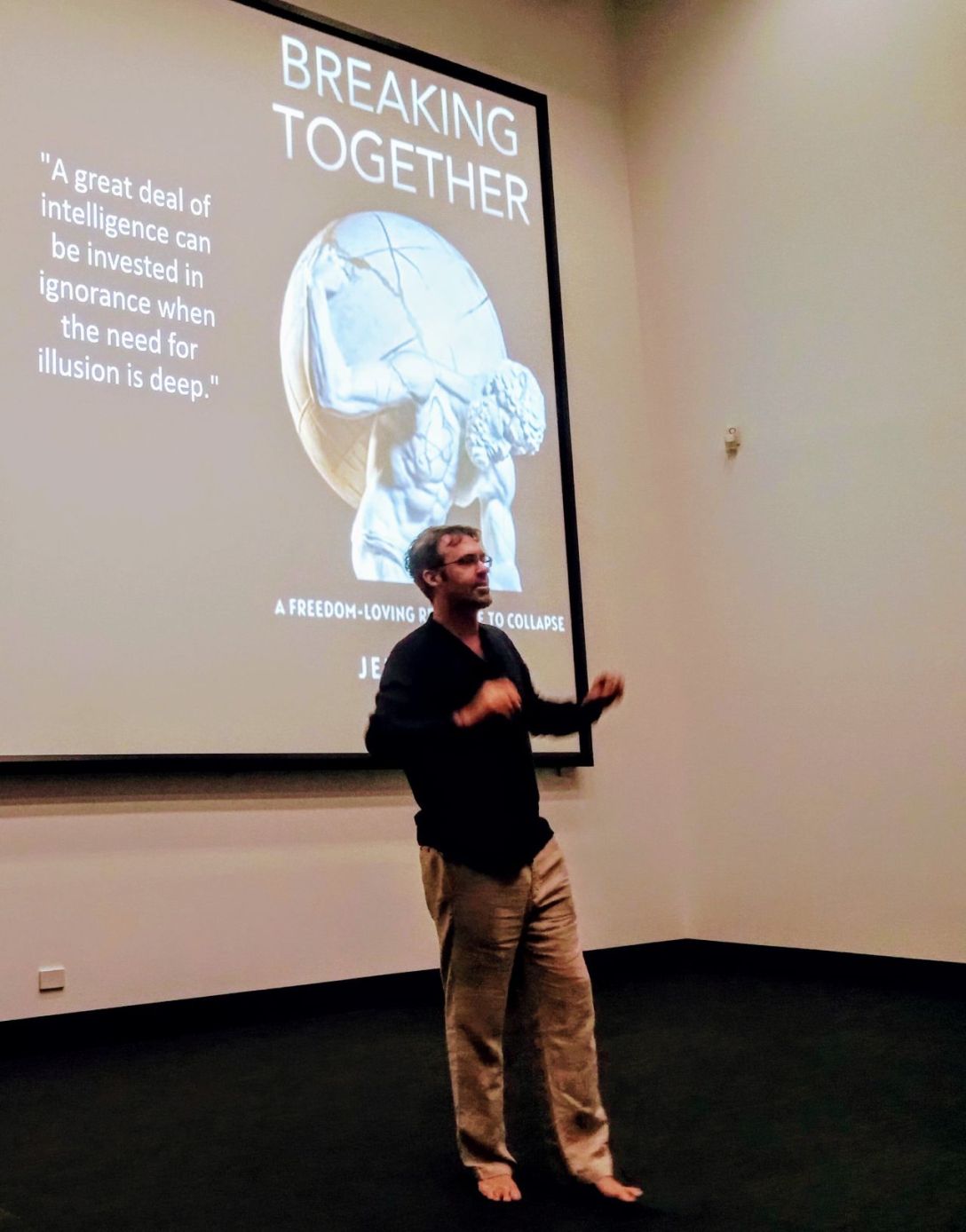
Although I’ve been immersed for years in the news and scholarship on the unsustainability of modern societies, it is difficult to keep all of that information at the forefront of my mind. Not only is it a ‘heavy’ topic, it uses a specific part of my mind, and perhaps my body and soul, to critique, synthesise and communicate on such issues. So after doing a dozen podcasts and talks since my book came out, I paused to make more time to develop my organic farm school and play music. I’ve also been enjoying teaching again, both online (join me?!) and in person (including the Bay Area in October). Looking back at the various interviews, I think the first one I did to mark the launch of Breaking Together is the one to watch. Dave Derby of Lowimpact invited a focus on what is most at fault for driving the collapse, as a starting point for discussing what we can do to soften the crash – for ourselves and others. That meant we explored the role of an expansionist monetary system, and alternatives to ‘green’ authoritarian panic as the science darkens and societies are disrupted. You can watch us discuss that here. But as many people prefer to read, I’ve checked the transcripts and compiled them into one document in this blog post.







You must be logged in to post a comment.