The Future of Corporate Responsibility Research

Many people around the world are working on the social and environmental performance of business and financial institutions. A lot is being researched and written about it. Where is it all headed? What and where do we need to focus on in future, and what are the emerging knowledge needs?

I prepared at short paper on this topic for the UN Principles for Responsible Management Education working group on research. It incorporated findings from a survey of subscribers to my company’s CSR Jobs mailing list (www.lifeworth.com).

That paper, entitled “Broader and Deeper – the future of CSR Research” is downloadable from Lifeworth’s homepage, along with the survey results. (Visit http://www.lifeworth.com and click Future CSR Research Paper, or survey).

The paper concludes that the future of research on the social and environmental dimensions of business and finance will be both broader and deeper:
a) It will be geographically broader as the global shift in economic, political and eventually cultural power means that large emerging nations become important not only in terms of their domestic practices but their impacts around the world.
b) It will be intellectually broader, as practitioners demand greater relevance to complex decision making on societal dimensions of business and interorganisational relations from research by universities.
c) It will be organisationally deeper as integration of societal issues into all business functions, from marketing to accounting, becomes essential for risk management,  innovation and competitiveness.
d) It will be personally deeper, as more professionals will need to exist on the “bleeding edge” of innovation to drive forward organisational change, and to deal with ever greater complexity as business takes on more societal responsibilities.

I welcome comments and ideas.

These are Financial Times for Sustainable Luxury

I just participated in a panel with Marco Bevolo from Philips Design and Timothy Han from the company that bares his name. We discussed whether luxury can be sustainable at the Net Impact conference in Europe. Marco and Timothy captivated the audience with their enthusiasm for how high end design can inspire new levels of product and service sustainability and responsibility. Marco’s book will be interesting (www.futurehighend.com). If you havent seen Timothy Hans products yet, then have a look at http://www.timothyhan.com

The day after the Financial Times quoted us both on the question of sustainable luxury. It links to the professional network I launched on this issue, www.authenticluxury.net

So, we are getting there. Next stop is a talk the International Luxury Business Association next week, and a keynote at the IHT luxury conference in India.

Targets now vogue, for responsible enterprise

I just launched the Lifeworth Annual Review at the League of Corporate Foundations in Manila. An interested and interesting group, who are beginning to explore the environmental dimension of their work, although basic issues of poverty and governance remain. Photo below.. looking a bit worse for wear having been up at 2am overseeing the upload of the website at http://www.lifeworth.com/2007review/default.htm

imgp0656.jpgimgp0653.jpg

This year the reviews are also available in print (see http://stores.lulu.com/lifeworth). Story follows below.
“Continuous Improvement not Enough, Targets now in Vogue for Corporate Responsibility, says Lifeworth review.”

14th February, 2008, Lifeworth, Geneva, Switzerland.

A wave of corporate announcements of environmental targets swept the world during 2007, says a review of the year published by a corporate responsibility consultancy.

Awareness of climate change drove this agenda, with many companies announcing specific targets as part of their membership of initiatives like The Climate Group, the Carbon Disclosure Project, or the WWF Climate Savers initiative. Reckitt Benckister, Cisco and Proctor and Gamble are praised in the review for adopting broader targets.

“Continuous improvement is no longer enough, with time-bound targets now in vogue for corporate responsibility” says report co-author Jem Bendell, a Director of Lifeworth, which publishes the annual reviews. “Targets express an awareness of the scale and urgency of an issue and a willingness to engage it. Although investing in new management processes are key, making a commitment to a performance target helps add the substance,” he added.

This, the seventh annual review, reports on a survey of corporate responsibility professionals which suggests progress is occuring, but not fast enough to meet the international community’s goals on either climate change or world poverty. The poll of Lifeworth’s 4000 newsletter subscribers found they thought that by about 2028 approximately 57% of global economic activity would be environmentally sustainable. If that rate continues then overall performance would be 78% by 2050. This means the corporate responsibility community, as represented by Lifeworth’s subscribers, think current rates of progress would create a sustainable economy by around 2070. The Intergovernmental Panel on Climate Change (IPCC) has stated the world needs to see over 50% reductions by 2050, and the latest science suggests an 80% cut by then to remain under a critical threshold of 2 degrees warming. That would mean at least a 20% reduction in the next 10 years, and given growing emissions from industrialization in the global South, possibly even double that reduction in industrialized countries to offset it. The review argues that a slower rate of change appears to be futile, and so achieving a sustainable economy by 2070 will not actually be possible.

The world community has also made a commitment to eliminate world poverty by 2025. To do so would require economic activity to be socially responsible. Professionals estimate that on current trends only about 50% of economic activity will be socially responsible by then. It will only be about 75% by 2050.

“The message from the Lifeworth Annual Review is that although CSR efforts are delivering some progress, it may not deliver the sustainable global economy in time and we need to explore ways of enabling faster and deeper change,” explained Professor Michael Powell, Dean of Griffith Business School, which supports the publication. “A global step change in progress towards a sustainable world economy is required, and this will involve more targets from companies on their social and environmental performance, as well as more collaboration on how to shift entire sectors and market systems so they reward firms in meeting those targets” explained Dr. Bendell.

The implication is“we need to speed up the dissemination of new ideas, make them more readily available and easily accessible” says Professor David Grayson, of Cranfield School of Management. “The Lifeworth Annual Review is one practical way of doing this. I am delighted that the new Doughty Centre for Corporate Responsibility has helped make this happen this year.”

The concept of a ‘global step change’ is proposed by the review, to both describe the leap in progress required and the importance of promoting sustainable consumption. The Review suggests that if everyone lived like Europeans, ecological footprint calculations suggest we would need three planets to support us, and that if everyone lived like the average Asian we would also need more than one planet. Indian middle classes now have a higher per capita consumption of carbon than the average Briton. The review, titled “The Global Step Change,” concludes it would be physically impossible for all the world’s poor to achieve higher wellbeing in ways as resource-intensive as the new middle classes in Asia and elsewhere. “Humanity’s challenge is to find ways to improve human wellbeing within the limits of the Earth’s resources; to stop living as if we have another planet to go to” explains Jem Bendell. For this, Professor Grayson adds, “we need a new mindset for Corporate Sustainability to stimulate innovation and create radically new business models.”

Professor Powell, said “The review shows that more and more executives are realizing the need to gear up their efforts on sustainable business, and governments also increasingly recognize the need for hard targets. Beating climate change requires a step change in commitment and action. As the first Australian business school to adopt the United Nations Principles for Responsible Management Education, Griffith Business School is committed to educating business professionals to understand the critical nature of this challenge.”

The review warns that the adoption of specific targets by companies is only the beginning. “We should remember that targets themselves are not the mechanisms of change. It appears that many countries will miss their Kyoto targets, and the first Millennium Development Goals on primary school education have already been missed” explains Dr Bendell. “The solution may be for wider coalitions of groups to apply themselves to the factors that shape our economy. To explore ways of collaborating to shift whole markets.”

To coincide with the publication of the review, Lifeworth is launching an online directory of corporate targets for social and environmental performance: http://www.responsibleenterprise.com

Lifeworth’s predictions for 2008 and beyond:
* Many more companies will announce time-bound environmental performance targets
* Some companies will announce time-bound social performance targets
* Some Asian-based multinationals will announce targets
* More Private Financial Institutions and NGOs will encourage time-bound targets from companies
* More networks and partnerships between companies and their stakeholders will focus on how to shape the market drivers that reward meeting such targets, including public policy, financial systems and consumer awareness.

The review is launched by Jem Bendell, at the League of Corporate Foundations in Manila, Philippines, on February 14th 2008, and by the co-sponsor Professor David Grayson, in a series of lectures and speeches from February 13th to 15th in Brussels and in Copenhagen, at the Belgium Business and Society Conference and the Copenhagen Business School.

This seventh annual review from Lifeworth incorporates quarterly reviews from the Journal of Corporate Citizenship, published by Greenleaf, and is sponsored by Doughty Centre for Corporate Responsibility, Cranfield School of Management, UK and Griffith Business School, Australia. All the annual reviews are available for ordering in hardcopy from Lifeworth (http://stores.lulu.com/lifeworth), as well as being free to download or browse online at http://www.lifeworth.com

For press enquiries, contact lead author Jem Bendell at +44(0)2071936102, or jb at lifeworth.com


No (Luxury) Logo

When I saw a video of designer Tom Ford saying last week that he doesn’t have a logo in his menswear collection, it reminded me of Naomi Klein’s book No Logo. That might seem like a weird connection to make between an ex Gucci luxury designer and a famed anti-capitalist. In that book Klein wasn’t criticising the power of marketing and brands so much as the exploitative economic system they so effectively hide. Marketing is communication, and involves finding out what peoples needs are. And brands? We have used symbols since we walked upright. If brand marketing can promote awareness of the realities of production and trade then thats a good thing, because it’s our consumption habits that are chewing up people and planet and have to change. Its just got to be done authentically. That was one of the ideas behind the luxury industry project I worked on during 07 for WWF-UK. They spend the most on advertising and are the most aspirational brands… so if they could be the most sustainably and responsibly produced, traded, distributed, advertised and used, conscious consumption might spread further and faster. What follows is the press release put out by my company today on the reaction to the report so far…

Media Response to WWF-UK Report on Luxury Brands Could Be Tipping Point for the Industry.

(Media Update, Thursday 6th December 2007, Lifeworth, Geneva, Switzerland)
Last week over fifty newspapers and magazines from Britain, Brazil, Australia, New Zealand, Italy and Switzerland reported on the corporate responsibility of the world’s largest holding companies of luxury brands. For the first time they had been ranked on their ethical performance in the report Deeper Luxury: Quality and Style When the World Matters, which was published by environmental group WWF-UK. The news went ‘viral’ through trade journals and blogs on fashion, jewelry, and celebrities.
The report “could herald a huge change in the way global luxury brands operate,” states Fashion UK.(1) “The luxury goods industry looks like it’s having its own Nike moment,” suggests UN corporate reporting expert Dr Anthony Miller, referring to the mid-90’s criticism of labour practices in Nike’s supply chain that made the company invest heavily in its corporate responsibility programme. Within days, Just-Style.com reported that “PPR Group commits to improving sustainability” as a result of the publication.(2)
Leading industry executives speaking at the International Herald Tribune (IHT) conference on luxury, in Moscow, on the day of the report’s launch, portrayed a growing awareness of the importance of ethical performance. Laurence Graff, chairman of Graff Diamonds, and Yves Carcelle, chairman and chief executive of Louis Vuitton, spoke positively of their company’s responsibilities. However, in Conde Nast Porfolio.com, Lauren Goldstein Crowe contrasted “the words v. the reality,” citing the WWF-UK report as an opportunity for needed leadership on this agenda (3). Not surprising then that IHT had earlier refused an offer to launch the report at their conference. The newspaper did not feature the report, with the international business coverage being scooped by Vanessa Friedman at the Financial Times.(4)
“Press coverage has focused on the ranking, and on what these companies are failing to do right for the environment,” noted WWF-UK’s Anthony Kleanthous in The Guardian. “However, the main thrust of the report looks to a future in which the very definition of luxury deepens to include not only technical and aesthetic quality, but also environmental and social responsibility,” says the co-author of the report.(5) The longest chapter in the report focuses on the business reasons why that new approach to luxury is commercially viable. “We examined key commercial challenges facing the industry and found that greater depth and authenticity is a strategic response to many of them,” explains Dr. Jem Bendell of Lifeworth Consulting, the responsible enterprise consultancy contracted by WWF-UK to manage the research project and co-write the report.

“Modern technology means that what’s on the catwalk today can be copied and in the shops tomorrow, so brands need to offer something deeper than purely appearance. The same goes for counterfeiting.” says Bendell. “Sales growth in societies with high social inequality means that luxury brands face a crisis of legitimacy and a regulatory backlash, so their products will need to benefit the local economy with good jobs. The increasingly youthful profile of luxury consumers means luxury brands need to find ways to build in value to casual fashion items, without making them non-casual, with sustainability and ethics an obvious approach,” he explains. “The increasing availability of luxury items means that brands must find new ways of maintaining their cachet, rather than relying on the memory they were once scarce and exclusive. Deeper luxury is the strategic answer to all these challenges.”
Also an Associate Professor of at Griffith Business School in Australia, Dr. Bendell stresses the need for a paradigm shift in corporate strategy: “Consumer awareness should no longer be assumed as the only commercial driver for ethical excellence. Though counter-intuitive to traditional corporate strategists, this shift in thinking is fundamental to the contemporary business environment of global communications, where successful brands are behaving more like social movements.”

Tom Ford, the former Gucci top designer said on the eve of the report’s publication that “we need to replace hollow with deep.”(3) Ford’s business instinct rather than telepathy is key, according to Bendell. “There’s no one better than Tom Ford for spotting trends in consumer mood. The report details a variety of strategic commercial imperatives for deeper luxury. If executives don’t get it, that could be because they’ve had it so good for so long and have become complacent.”

At the IHT conference Tom Ford explained his emphasis on depth means that his own clothing label does not carry – a label. “In the report we explain that ‘no logo luxury’ is a growing trend that responds to consumers’ desire for authenticity as well as responding to the availability of counterfeits,” says Dr Bendell. If luxury is having its ‘Nike moment’, then “executives could do well to hire expert advice on the stages of corporate response to social challenges over the past 10 years, to learn from the experience of others,” says Sao-Paulo based sustainable enterprise advisor Roland Widmer. “Lifeworth is working with research and consulting partners to offer solutions to those executives in the luxury industry who really believe in achieving social and environmental excellence as part of the identity of luxury brands” says Dr Bendell.

And what of the reaction? “Some executives might be stung by the coverage, and some environmentalists confused,” notes Lala Rimando of the Authentic Luxury Network. “But WWF-UK should be applauded for sticking its neck out by publishing this report” says the Manila-based business journalist and consultant. “The scale of the environmental challenge is so great and pressing, and the reach of NGOs into Asian societies currently so limited, that if the brands that affluent Asians love can excel in sustainability, then awareness of sustainable living may grow in emerging economies fast enough to offer a chance of curbing global consumption and pollution within environmental limits.”
Lifeworth has launched the Authentic Luxury Network to bring together executives, designers, analysts and entrepreneurs who want to lead the creation of more sustainable and ethical luxury (http://www.authenticluxury.net). The company has also launched a site for people to keep up to date with celebrity reaction to the report and its proposal of a Star Charter for responsible brand endorsement (http://www.starcharter.net).

Dr Jem Bendell will be presenting his analysis on the future of luxury at seminars in Singapore (in January 08), Manila (February 08), Brisbane Gold Coast (April 08), Dubai and Geneva (May 08). To be invited email luxury(at)lifeworth.com. In addition, a few places are available at a CSR Geneva dinner on sustainable luxury on December 10th 2007 (email tiago.pintopereira(at)gmail.com).
To download the report: http://www.wwf.org.uk/deeperluxury

To contact Lifeworth Consulting: http://www.lifeworth.com

1) http://www.ft.com/cms/s/0/dbe49fbc-9dda-11dc-9f68-0000779fd2ac.html

2) http://www.just-style.com/article.aspx?id=99314

3) http://www.portfolio.com/views/blogs/fashion-inc/2007/11/29/luxury-and-ethics-the-words-v-the-reality

4) http://www.ft.com/cms/s/0/dbe49fbc-9dda-11dc-9f68-0000779fd2ac.html

5) http://commentisfree.guardian.co.uk/anthony_kleanthous/2007/12/brand_awareness.html
Press coverage of the report includes:
FT Online

http://www.ft.com/cms/s/0/dbe49fbc-9dda-11dc-9f68-0000779fd2ac.html

Tribune de Geneve

http://www.tdg.ch/pages/home/tribune_de_geneve/english_corner/news/news_detail/(contenu)/165120

Reuters

http://uk.reuters.com/article/domesticNews/idUKL2864063820071129

The Telegraph

http://www.telegraph.co.uk/earth/main.jhtml?xml=/earth/2007/11/29/eabrands129.xml

BBC Airbus-ting

moz-screenshot-71.jpg

Most days I look at the BBC website. This week I found theyve started carrying advertising. But not any old advertising… no less than adverts saying that flying Airbus is the greener thing to do. See the screen shot below at the foot of this posting. The inaugural flight was from Singapore to Sydney. I didnt know you could drive. Perhaps Toyota brought out an amphibious Lexus while I wasnt looking, complete with storage tanks for weeks at sea.

So I sent their Global advertising person the following email:

Dear Phu,

I would welcome your advice, as the contact on the BBC website for global advertising.

Do you check the scientific credibility and clarity of the claims made by advertisers on your website?

If so, what is your evidence for the claims from Airbus, regarding comparison of flying a full aircraft with driving a car (perhaps single occupancy car)? This is disingenuous because people do not drive from Singapore to Sydney, for example, and flying makes such travel much more possible, and thus increases people’s potential carbon emissions. A comparison with a ship or train would be the only useful comparison for such long distances. The science of these claims was previously challenged in a refereed academic journal in 2002 (Journal of Corporate Citizenship: see http://www.jembendell.com/lw2002/spring4.html)

I would also welcome information on how promoting flying through advertising on your website as viewed by people outside the UK is compatible with:
a) the specific text and general spirit of the BBC Charter.
b) the role of the BBC world service in promoting British international interests, which the Foreign and Commonwealth Office is clear now includes global action on carbon emissions
c) a coherence between editorial and advertising, given the current climate change programming on BBC World.

I copy this to colleagues who are interested, as well as Simon Derry at BBC Trust and Kevin Marsh of the BBC college, who presented this summer at a UN event on media responsibilities.

Although I realise you must be getting many questions on this matter at this time I would welcome an answer that is specific to the issues I raise. Please note I will be posting this email and your reply on my personal and company blogs, and including it in my column in the academic journal I mention above.

Regards,
Dr Jem Bendell
Director, Lifeworth
Associate Professor, Griffith Business School
Visiting Fellow, UN Research Institute for Social Development
www.lifeworth.com / www.jembendell.com
jem@lifeworth.com / +44 (0)2078707594
moz-screenshot-71.jpg

On Bumble Bees and Brahmins

You may have heard that the bumble bee is in trouble. That the buzz from these servants of life is growing quieter in many parts of Europe and the US. I read that the populations are collapsing. In November last year, the New York Times helped bring attention to what researchers are calling “colony collapse disorder,” in which honeybees are disappearing, flying off in search of pollen and nectar and not returning to their colonies. Populations have been reported as declining across Europe. (1)


As they buzz from flower to flower, bees are intimately involved in plant reproduction, and thus in all fruits and the broader food chain. “As bees pollinate 90 crops worldwide, the threat to food supplies is grave.”(1). Less bees, less food, less us. This reminds us of our dependence on the rest of life.


The demise of the bumble bee is a reminder of a reality we often forget. We too easily assume we are separate from and better than the rest of life. Yet if we combine findings from different natural sciences we have glimpse of a different view, one that suggests the humble bumble might be closer to spirit than our most esteemed human beings.


The dance of the honeybee is one of the most intricate communications in nature, telling other bees of the location and supply of pollen. But how can a tiny insect with only a few million neurons possess all the information needed to carry it out? Mathematician Barbara Shipman has found that the dance can be predicted by a mathematical object called a flag manifold. One day, while Shipman was projecting the 6 dimensions of a flag manifold onto a two dimensional piece of paper, she was amazed to see that the form she was creating is the same as the bees’ dance. She had found a mathematical structure that contains all the different forms of the dance. Shipman speculates that since the flag manifold expresses movement in extremely tiny particles known as quarks, that the bees themselves may be quark-sensitive, and connected to the quantum level of matter and energy.(2) If so, then their mind may be far more capable than we realise (continued below…)

990800063_67f62096b9.jpg


What does being conscious of the quantum level of reality imply? There is a lot of debate, but a one idea this gives me is that at the quantum level space and time do not operate in the way we normally understand and experience them. They might not even exist at all. Two experiments could indicate this. First, if you fire a photon of light through one of two slits one at a time, with even a long period of time between each, in the end you create an interference pattern on a photographic plate on the other side as if a whole beam had been fired at the same time at both slits.


Some, such as famed physicist Bohm, consider this means there is a wave form that accompanies the photon, and so it interferes with itself. Perhaps another view could be that the individual photons interfered with photons from the future or past. That would seem as plausible as the idea of a parallel universe of photons, or that the photons pass through different slits at the same time, or exist in all possible positions until detected – which are some other theories advanced. I would conclude that at the quantum level either time or space is not what we assume it to be, or something that transcends time and space interacts with those photons (3). Second, at the quantum level particles are spinning. If you separate a particular into two, and then move them far apart, if you change the spin of one piece, the spin of the other piece will also change. This ‘causal non-locality’ suggests that at the quantum level particles and energy are connected by a universal space-transcending field, or that space doesn’t exist in the way we understand and experience it. The idea that a photon might leave a trace in this field which then interferes with other photons is another way of explaining the previous conundrum. Ervin Lazlo offers a name to this underlying unifying field that transcends space and time – the Akashic Field (4). The use of a term with a history in eastern spiritual philosophy is deliberate, as a unifying dimension that transcends space and time is expressed in all the great spiritual traditions, with Abrahamic religions like Christianity calling it the Holy Spirit.


If bees are quantum dancers, are they more conscious of this Akashic field than us? Or, in western traditional terms, are they more conscious of the Holy Spirit? That sounds strange, doesn’t it? It’s heretical not only in religious terms but also in the secular view of humans being the best. It challenges the assumptions of Abrahamic religions head on, as they view humans and the spiritual realm as separate from and better than ‘nature’. Even in Eastern spiritual traditions that don’t maintain such a distinction between the spiritual and the natural world, there is a very clear hierarchy, with humans at the top of the spiritual tree, and with those humans less connected to the Earth being more on top than others. The Hindu assertion that one group of people are one step away from nirvana by virtue of their genes always seemed a bit self-serving, especially when I met young Indians getting pissed at a party, showing off their latest mobile phones, and saying they’ve got nothing to worry about on the spiritual front because they’re Brahmin. By tradition, Brahmins are meant to do more intellectual pursuits than lower castes. But why is conceptual thought more ‘spiritual’ than the mental experiences during farming for your food? A lot of conceptual thought can be malign.


I find the assertion that people with disabilities are somehow dealing with a karmic debt, and probably have further to go in the cycles of reincarnation, a malign interpretation of eastern spiritual philosophies. The strength and beauty of our bodies or minds is more of a barrier to spiritual awakening than it is a tool. Our spiritual selves are not our bodies or minds. People dealing with more challenges to their bodies and minds are more likely to understand their essential nature as not solely bodily or mental. They are more likely to have a chance of being one step away from nirvana. Stephen Fry once said he wouldn’t swap his bipolarity for the world. I also recognize how my eczema through childhood has made me who I am today. I don’t want more suffering, but when it happens I accept its power to throw light on my assumptions that I am my body and mind. The implication is we should listen and learn from those who live with affliction, and listen to the aspects of ourselves, the moments of ourselves when we are physically afflicted. It doesn’t mean seeking suffering, as that’s an egoistic response to knowledge of the challenge to transcend body and mind, but just recognize it has some value when it occurs, as it inevitably will throughout and at the end of life.


If transcending separative consciousness is key to awakening to our spiritual selves, to that part of ourselves that is part of the akashic field or holy spirit, then we need to transcend those two things which create our experience of separation: body and mind. More complex thought is as much a barrier as a pathway to that awakening. With this in mind, and evidence of the possible closeness of bees to the quantum realm, what does this suggest about our assumptions that people are the top of the spiritual tree, either through reincarnation or a belief that human’s are made in God’s image? Might bees, and other life forms that act in a collective, and serve wider life, have a consciousness that transcends separation? Could bees be more spiritual than us? Sounds weird. But do the maths. If all souls have to move to nirvana how can we have trillions of ants and bees and far less humans? For humans to exist millions more insects must exist. The mathematics of assuming the gateway to heaven or nirvana through reincarnation goes through humans, and then higher status humans like Brahmins, just doesn’t add up.


In light of this, some questions bother me a bit. Are humans of higher worth than the rest of life? If so why? What is our role in relation to the rest of life? The old answers from East and West don’t really work. I think humans are a bit ‘special’. We are the latest, highest, expression of life’s potential for complex thought, that we know of, on this planet. Life always had the potential for us to think as we do and there seems to be a purpose within that. I will develop this in another blog posting (www.jembendell.com). For now, I should point out it means that, on the downside, humans have a unique capacity amongst life forms for suffering. We can suffer on a level of thought that other animals can’t. This needs to be reduced. On the upside, we have a unique capacity to inquire into and know Life itself. To bring together the separate with the universal.


But the plight of the humble bumble throws these questions of the importance of humans into relief… because it reminds us we are one ecosystem, and how questions about rank and hierarchy are preoccupations of the human mind that should not distract us from essential oneness. Their crucial role in serving Life’s creative process makes bees more important than us in respect of ecosystem maintenance. How can we return the favour? Scientists aren’t sure what’s responsible for the crash in bee population. Some are suggesting it is a virus, a parasite, or a fungus, while others are pointing to problems arising from genetically modified plants, agricultural chemicals or climate changes that could be weakening bees immune systems and making them more susceptible to diseases and disturbances. (1, 5)


One possible disturbance is wireless internet networks and mobile phone signals, which some are suggesting interfere with the way bees communicate. Anecdotal evidence where people with bee infestation in their lofts have found them all gone after installing wireless mean we quickly need to see some more geographical studies of wireless networks, phone masts, and bee populations past and present.(2) And as major commercial interests are at stake we need that research to be funded independently of companies and governments with vested interests. Given the risks, we should be open to the possibility of a variety of potential causes, and take precautions. When the data’s in it might turn out that we have to reduce some forms of electromagnetic pollution. It would be time for all of us, Brahmins included, to put down our mobiles and quiet our chattering minds, for the sake of all Life, including our own.

 For those of you inspired to start some beekeeping, this e-book is a good start. Or you could go the whole hog and live the good life… “Self Sufficient Life” tells us all about “Keeping And Raising Chickens And Poultry. Build A Chicken Coop. Growing Your Own Fruit And Vegetables. Beekeeping. Herbal Remedies, Hydroponic Gardening, and Your Own Greenhouse.” What am I doing with my office life. 😦


(1) http://www.guardian.co.uk/environment/2007/jun/27/society.conservation1

(2) http://findarticles.com/p/articles/mi_m1511/is_n11_v18/ai_19847180/print

(3) http://en.wikipedia.org/wiki/Bohm_interpretation

(4) Science and the Akashic Field, Ervin Lazlo, http://www.amazon.com/Science-Akashic-Field-Integral-Everything/dp/customer-reviews/1594770425

(5) http://www.spiegel.de/international/world/0,1518,473166,00.html


Image from: http://www.flickr.com/photos/azrainman/990800063/

Ps: Comedian and social commentator Bill Mather did a story on this, available at the following link. But he mentioned a quote from Einstein that seems to be “urban myth” as no one on the web quoting it, that I found, has got an original source. Still, he delivers the message: http://www.youtube.com/watch?v=_KGIKBVd8no


What’s an NGO to do?

Around the world entrepreneurs are saying they can end poverty and save us from climate change, while turning a profit. Meanwhile politicians are often saying more radical things about wellbeing, quality of life, and a new direction for humanity than most mainstream NGOs. And recently the mass media and entertainment worlds aren’t ignoring the seriousness of key social and environmental challenges. In such circumstances what is an NGO to do? Over the last 20 years we have seen more advocacy from NGOs who recognised you couldn’t end child labour or tropical deforestation project by project, one factory or forest concession at a time, and so sought to influence government, intergovernmental and private sector policies. Perhaps the current responses, at least at the rhetorical level, indicate some success with advocacy by ‘global civil society’. Yet some suggest it means charities should step aside, because they aren’t competent to work at technical levels of implementation on issues like financing, auditing, and good governance. Many NGO people have agreed, perhaps, with their feet, by joining businesses, consulting firms and financial institutions.

It’s time for NGOs to work out their new niche. Some are nervously moving back towards a charity mentality of saying to people “give us some cash and we will feed those people or protect this animal”, or asset stripping their own brand through big bucks partnerships with companies that don’t address how the corporations internal practices worsen the problem the NGO is meant to be solving. This isn’t the way. Instead, its time to be more ambitious and more systemic. To see how the new interest from business and government can be leveraged for broader and deeper change. To try out new ways of solving problems and propose fundamentally different ways of organising things. Unfortunately lots of senior managers in NGOs don’t see that, or are scared of it. Some seem almost scared of their members, worrying that being more ambitious might upset them, lose them. Others just don’t have time for any creative ideas, as they are busy with time sapping form-filling to demonstrate to big donors how they’ve been good at following proper procedures. All this promotes a culture that doesn’t want to risk failure, and settles for projects that can help tick the boxes for funders. “The revolution will not be funded”, as Incite aptly put it in their book published in April. http://www.incite-national.org/

This was the basic thinking about the need for new NGO approaches which I brought to my work with WWF-UK, as a senior strategic advisor to their work on business, trade, finance and international development. At the start the crucial thing for me was to work out ways for WWF to leverage other sectors, which have a lot more power than even the world’s largest environmental NGO, to transform markets so they function in ways that create more just and sustainable outcomes. Going back to the old model of merely moaning about stuff wasn’t an option. Engaging other organisations to reduce barriers and create incentives for systemic change was my main aim. Yet seeking to engage organisations poses its own set of conundrums. It’s key for an NGO not to fall into the trap of being a cheap consultant to industry or government, or get access by selling out the brand to a ‘partner’. And it’s key to have a strategy rather than just get hooked on a particular method or tactic. We shouldn’t think that partnership with a company or a company attending our meeting is a sign of success. It ain’t. Change is. Too many NGOs think you chose just one club to play a round of golf. Nasty reports and column inches – thats the 7 iron. Stakeholder dialogue and happy reports – thats the putter. But the clubs aren’t the game. You have to respond to the terrain. And so what is that terrain? Its society, stupid. So, NGOs have to get more savvy with their understanding of what society is and how it changes. I have a simplified model in my head based on integrating some insights from extremely boring social and political texts about things with pompous names like structuration theory and neo institutional theory. I see society as about people interacting with things and each other in ways that can be helpfully describe in 4 categories: assumptions, beliefs or norms, rules and resources. It’s a bit farcical that often people in the social change profession don’t have a sense of the terrain or a strategy for changing it. It leads to people becoming addicts of a particular approach, thinking that working only on values, or only on new ideas, or only on regulatory reform, or only through dialogue and networks, or only through protest, is the way. Dumb…. which wouldn’t be any of my business except when they take up scarce resources in organisations that should be innovating change.

Is this all easier said than done? Yep. But one way to illustrate what I’m saying is to give examples of the projects I helped set up at WWF, before I returned to Lifeworth Consulting.

  1. Stopping stupid lobbying: I worked with SustainAbility and Blueprint to shape up a project that would look at whether investors are asking companies to be coherent and progressive with their public affairs and lobbying activities. The aim being to encourage this in the investment world and thus in the corporate world and hence reduce the short termist and ideological crap we hear from some companies and trade associations on needed regulatory innovations to promote more long term real value creation (not just a derivatives bubble). And promote good lobbying too, like some are doing on climate change. The report has come out this week “Coming In from the Cold” and a range of follow up activity is being planned with investors who get the idea we need to see companies supporting value creation across an economy, not externalising costs onto other companies in their same portfolio. See sustainability.com for more info and talk to Seb Beloe there. Great clarity and style.. just like the head honcho.
  2. Getting money where it’s needed: I created a partnership with UNEP Finance Initiative to explore how to reduce the risks of investing in SMEs in the global South, and make it easier to do so. If we come up with ways of using philanthropic and government schemes to then leverage billions of dollars of private funds into clean tech in Africa which also creates lots of jobs and cash into the local economy then Ill be happy. So Im pleased to still be working as a consultant on this project. We even generated 40K funding from the Geneva government and then got nominated for a prize… already (www.obsfin.ch). See www.unepfi.org for more info on our event on September 26th 07 and talk to Inderpreet Chawla there. A real spiritual warrior bridging the consciousness of his “rustic” Indian upbringing with global IT, finance and UN life. Love also to Jen Morgan, Andrew Gaines and Oliver Karius for helping bring this project to life.
  3. Getting corporate lobbying on the agenda in India: With the deputy director of UNRISD, Peter Utting, we devised a project researching how Indian firms are lobbying state and federal government and the implications for sustainable development. This will end up as a programme paper sent free to academics around the world, and hopefully some decent media coverage in India in order to put this issue on the agenda. Then, perhaps, once everyone has the info, we can help Indians to stop stupid lobbying in their own country, and promote more transparent and accountable lobbying. After all, what happens in a country with about 17% of the worlds population is more important than what happens in a country with about 1% (India vs UK). UNRISD are hosting a conference on these issues in November 07 in Geneva. See www.unrisd.org for more info. Your contact there is Peter Utting, a rare species in the UN system… which one? Perhaps an elephant… big brain, long memory, higher view, and always returning to the same ground of basic truths about power and democracy… so needed amongst a flock of sheep.
  4. Getting iconic brands and celebs to promote sustainability in emerging markets: The world needs sustainable consumption to become sexy in Asia, and fast. Otherwise we will all be stuffed by an inflationary resource crunch and climate chaos. What to do when NGOs really aren’t very sexy or known in much of Asia? Encourage iconic brands, celebrities and the mass media to do the job. So, one sector that is powerful in shaping aspirations, and using a lot of celebrities and advertising, is the luxury industry. Fortunately it’s also a sector known by decision making elites in very hierarchical societies. So, we have been looking at commercial reasons why the luxury industry might want to become champions of sustainability, and then how to engage celebrities with that. I’m pleased to be leading this project now with Lifeworth. We will launch our report on the future of luxury in November 07, along with an industry initiative bringing together those in the sector who want to lead change. More information will be coming soon at www.brandfutures.net. The chap championing this now at WWF is sustainable brands guru Anthony Kleanthous. Got even more style than Seb. Whatever do they teach them on that environmental course at Imperial? But if you think you can help with this project, please contact the much less stylish me.
  5. Enabling more transformative partnerships: Sometimes partnerships between business and NGOs are piecemeal and hinder not help broader change. Its time for a greater focus on partnering to achieve change not just within the partners but within wider society including market frameworks. So I created a project with the UN System Staff College who teach UN and NGOs and business people around the world about partnering, which is looking at the last ten years of learning on partnering and will provide strategic planning tools to help people plan more transformative partnerships. I’m glad to be putting in some pro bono work to co write the final report, which should be out by November 07. Hmm… that month is beginning to look a bit hectic. Your contact at www.unssc.org is Dr Partnership himself, David Murphy, a man who taught me how to write and helped launch my crazy portfolio career.
  6. Enabling more big picture planning by NGOs: All those projects are external, but there is also an internal need in WWF to help the staff be strategic in their planning… and to work towards deeper and broader change. I thought systems science would be useful for this so brought in systems illustrator Rupesh Shah to help people with this approach and come up with some tools. Ajay Barai at WWF-UK is your contact for that project. A man who puts the echo into eco tourism if the photos of his bar nights at his own resort in Tioman are anything to go by: http://www.bagusplace.com/en/html/rest_bar2.html. Was there in April…. wow…


jem in tioman april 07

For me all these projects are about promoting sustainable international development. But you won’t read anything about this kind of work in the development journals at the UN where I work as a Visiting Fellow. It’s as if the development profession prefer to think non westerners have only livelihoods not lifestyles, and that to promote a just and sustainable form of world development you’ve got to fly somewhere hot and poor like a modern day missionary… or perhaps tourist with ‘refined’ tastes.

I was only working with WWF part time and had to do lots of form filling and internal blah, as well as deal with the helicopter tragedy and then restructuring (see blog posting in September 06), so didn’t get to work more with them on public policy issues, responsible mass media, emerging markets, or business education reform. On the latter issue I’m pleased to be working with the Globally Responsible Leaders Initiative in my role as Associate Professor of Griffith Business School. The aim is to promote a transformation in business education offered by business schools. i.e. the institutions that too often turn out hardnosed hard hearted management robots. Lots of work to be done there then. See www.efmd.org

If you are interested in this issue of how NGOs can carve out a new niche in their advocacy and bring a new level of professionalism to their social change work, let me know. The project I’m doing with UNRISD is looking at how NGOs work through networks to influence policy. Im planning on integrating the findings from this, the UNSSC Partnerships work, and my internal strategy advisory work at WWF, into an NGO strategic planning 1 day workshop. I will offer this in Australia in March 08 and London and/or Geneva in May 08. Ill be presenting some of the initial ideas to the strategy group of Global Action Networks Net in Geneva in November 07. See www.gan-net.net and your contact there is the effervescent Steve Waddell. He’s the Pope of new international community organising. Or perhaps the Madonna.

Weeing with the Foreign Secretary

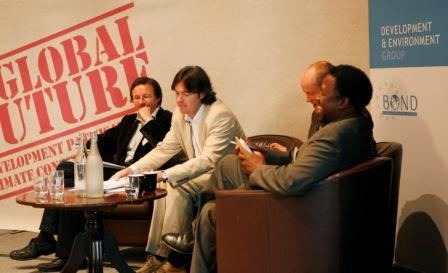
hands upLast week, during a nervy pre-speech wee break, then UK Environment Secretary, David Miliband walked in to use the adjacent urinal. “Ah, Dave, I’ve been meaning to talk to you about water privatisation…” I didn’t say. Introductions in toilets aren’t my thing. We were sharing another platform that day, giving plenary talks at the Development and Environment Group of BOND on the topic of development in a resource constrained world. Mr Miliband has been key in promoting sustainable consumption in the UK; often talking of the need for us to live within the means of our One Planet. Now that he has been promoted to Foreign Secretary we will hopefully hear of the need for One Planet Politics, that recognises the limits of and the unity within our one planet and the timeline within which we need to secure progress. No longer “foreign” secretary, but a leader of global relations.

In my talk I asked the audience the following simple questions.

  • Hands up if you work in international development (all hands went up)
  • Keep them up if you work on that in part due to a commitment to the principle that everyone everywhere should have the opportunity to thrive in harmony with others, to self determine their lives without harming others. (all hands stayed up)
  • Now keep them up if you think that everyone everywhere, all 6 billion, could live like we do? (all hands came down).

I argued that the only way to ignore this paradox is if one works on international development due to a charity mentality, focused only on helping out some unfortunate people a bit. But if we are committed to universal principles about the dignity of everyone then we have to address this resource consumption issue, and find ways for people to develop in resource light ways, and reduce our own consumption to create resource space for others. Thus the environmental challenge is central to a rights-based approach to development.

panel

My paper “The Consuming Issue for Development” follows below.

Information on DEG and the event, with links to follow up activities is at:

If, after reading the paper, you have any comments on the consumption challenge, please share them below. Oh, and yes, he washed his hands.Clean hands, cleaner world?


Miliband: Clean hands, cleaner world?


The Consuming Issue for Development


The climate challenge is a consumption challenge. Most of our emissions result from the products and services we consume. To tackle the humanitarian and economic crisis of climate change we must promote cleaner energy generation but also reduce the consumption of resources as a whole, both at home and abroad. Yet today humanity consumes fives times as much as fifty years ago. If everyone lived like the British, ecological footprint calculations suggest we would need three planets to support us. Indian middle classes have a higher per capita consumption of carbon than the average Brit. So it’s likely that if everyone lived like the new Asian middle-classes, the success stories of development, we would need at least three planets.

Does international development assistance arise from a commitment to the principle that everyone should have their basic needs met, live in freedom with dignity and pursue their aspirations? In that case it would appear that international development assistance has been based on a lie. Because it would be physically impossible for all the world’s poor to achieve higher wellbeing in ways as resource-intensive as the new Middle Classes in Asia and elsewhere. Resource-heavy development is, by objective measures, only a possibility for a minority or for the short-term. Therefore it is an elitist and undemocratic view of social progress. So how can all of humanity live well in a way that will endure? Our challenge is to find ways to improve human wellbeing within the limits of the Earth’s resources; to stop living as if we have another Planet to go to. That is the only authentic approach to a universal principle of social development.

As the United Nations Environment Programme (UNEP) policy framework for sustainable consumption recognises, we can no longer focus only on managing the specific impacts of consumption, such as avoiding certain areas or controlling types of pollution.[1] Instead, we must reduce overall demand for resources. That does not mean more efficiency, but demand management. For instance, more efficient fridges can mean fridges that are cheaper to run, and thus multiple fridge households and no reduction in overall resource demand.

This should not mean reducing wellbeing. Instead, it means a reduction in the actual resource through-flow of economies. This will require the ‘dematerialization’ of systems of production-consumption (i.e. physical efficiency of those systems), and the ‘optimization’ of systems of production-consumption (i.e. better management, planning, and changed attitudes and behaviour in those systems). This requires a shift in economic paradigm from the linear ‘take, make and waste’ approach to resources to a circular ‘make and remake’ approach.

Such a shift will need strong leadership from government and business. It is a common misconception that sustainable consumption is about shopping by individuals. In fact personal shopping is the least important factor in sustainable consumption. Business is the biggest consumer of resources, and can provide alternative products and services, and government is the biggest guide of this. The UK’s Sustainable Development Commission’s Sustainable Consumption Expert Roundtable report ‘I Will If You Will’, demonstrates not just that the individual consumer is not to blame, but that governments and business must themselves initiate and facilitate broad change.

Poor people want jobs not hand outs. Thankfully the sustainable consumption challenge could create mass employment opportunities. The European Trade Union Confederation has found that “less dependence on natural resources can be coupled with more intensive use of labour.”[2] To achieve a low-carbon high-employment economy, governments will need to shift taxes from employment to resources and help people gain skills for a sustainable economy.

In many cases, the poor may need to increase their consumption of resources to improve their quality of life. This means rich consumers must reduce their consumption rapidly towards a more fair allocation of resources, both within and between states. For any increases in poor people’s quality of life to endure they must be based on more resource-efficient solutions. It makes little sense to help people today by ruining their, and our, tomorrow. Thus redirecting resource consumption into more sustainable infrastructures and products is key. For example, the same amount of energy might be required to build a train system as a system of airports and roads but the former will create a level of mobility with less ongoing energy demands.

In summary, we need a ‘Global Step Change’ in consumption. We must step:

  • more lightly, by reducing the total level of resource consumption involved in meeting our needs and aspirations;
  • more carefully, by reducing our demands on sensitive ecosystems and exploited people;
  • in the right direction, by increasing the proportion of resources that go into creating enduring means of meeting human needs in resource-light ways;
  • together, by increasing our support for others to meet their needs and aspirations through stepping forward more lightly, carefully and in the right direction.

Hilary Benn’s ‘Preface’ to the 2006 White Paper acknowledged the interconnected and interdependent nature of our global society and the scale of global challenges faced. The full implications of this are now beginning to be realised. They include achieving sustainable consumption in the UK, to reduce Britain’s pressure on the atmosphere and other countries’ resources, as well as to create incentive for sustainable innovations in factories and farms around the world. They also include achieving sustainable investing and banking, so that finance flows to sustainable enterprise around the world. As the Development and Environment Group (DEG) of BOND commented on the White Paper, it is time for DFID to play “a stronger leadership role at home in representing the interests of the world’s poor.”

Assuming we can agree that changes in the development model are required:

  • What are the most appropriate roles of civil society and government in bringing these changes about?
  • How should government spending (as defined in comprehensive spending review and public service agreements) be adjusted to reflect the challenges identified?
  • Could DFID call for a rapid intellectual and practical retooling of the worldwide international development community to integrate the climate challenge into all their work? Could it require organisational strategies for that retooling as a prerequisite for any future grants?
  • How might DFID draw from its experiences with British companies through groups like the Ethical Trading Initiative (ETI) to encourage sustainable innovation in the supply of products and materials from the Emerging World to British companies? How might it engage private financial institutions in this regard?
  • Could DFID actively support efforts to achieve more robust global environmental governance, such as a World Environment Organisation to replace UNEP?
  • What other processes are there that we should be aiming to influence to reflect our positions?


[1] UNEP (2001), Consumption Opportunities: Strategies for change, a report for decision-makers. Geneva: UNEP.

[2] http://www.etuc.org/a/3356 and http://www.etuc.org/r/753

Opinion about Business will reach a ‘Tipping Point’ Worldwide

Hi Blog subscribers, Im sending you a sneak preview of what Lifeworth are publishing on wednesday…

LW Logo B&W

Interest in ‘Moral Markets’ Significant, says Review of Global Business Trends.

People’s deepest assumptions about both business and work could be changing in cities around the world, with major implications for future competitiveness. A more subtle shift than the widely reported growth in entrepreneurialism across Asia, it is nonetheless significant. It is a shift towards moral markets. This is the suggestion from Lifeworth’s 6th Annual Review of Corporate Responsibility, published today.

In the foreword, Professor Michael Powell explains how “the dominant paradigm for business success is changing to recognize the absolute necessity of social and environmental sustainability in tandem with financial viability.” Dean and Pro Vice Chancellor of Griffith Business School, Professor Powell is leading the Australian university’s effort to play a leading role in this new approach to business in the Asia Pacific region.

The Review argues this shift is partly the result of changes in technology and industry that are leading to greater ‘work-life blending’ which erode barriers between what we aspire to in our lives, who we work for and what we work towards. It is also the result of growing awareness of the scale, urgency and depth of the challenge posed by climate change. “Last year views on Climate Change ‘tipped’ in much of the Western world,” explains lead author of the review, Dr Jem Bendell. “It used to be a nerdy issue of scientific interest and environmental concern. Now it is a personal issue, of political interest and humanitarian concern.”

The Review, entitled ‘Tipping Frames’, introduces a strategic model for people working on social change, which combines the concept of a ‘Tipping Point’, involving the rapid dissemination of ideas, with that of ‘Cognitive Frames’, involving the assumptions and ideas triggered by key words and terms. Other frames identified as on the verge of tipping concern finance and international development.

A plethora of initiatives such as The Marathon Club, Enhanced Analytics Initiative (EAI) and UN Principles for Responsible Investment (UNPRI) are reshaping what finance professionals understand as material and relevant to their fiduciary duty. Also important is the emergence of a positive connotation to the environmental challenge of consumption. As the social and environmental impacts of economic growth intensify, new visions of sustainable development may be emerging in China and India. As Rajesh Sehgal, Senior Law & Policy Officer at WWF-India explains in the Review, “Indian companies can become leading exporters of and investors in sustainable goods and services, whilst emerging as key actors in promoting a proactive international sustainable development agenda.” Whether this will lead to a tipping point in the way Asian nations generally view and pursue ‘development’ is currently unknown. A counter process of reframing has been underway for sometime, with the shift to individualism and materialism most clearly illustrated in 2006 by the economic boom in Vietnam, which is chronicled in the Review.

Therefore Dr Bendell argues that “although important, the trend towards moral markets is not the dominant one in many parts of the world, such as the rapidly emerging countries. If we want to end poverty and protect the planet we must make it the decisive trend. Although we can’t legislate for personal morals, we can legislate to create market frameworks, enabling conditions and incentives that support moral behaviour.”

Bendell suggests business leaders should both track and become involved in progressive changes in cognitive frames, for strategic reasons. “Changes in basic assumptions about the nature and purpose of business and work will have major knock on effects for the behaviour of consumers, staff, investors and regulators.” Consequently he calls for more research and analysis of these assumptions in societies around the world.

The Lifeworth Review “illustrates well how many assumptions and values in society are shifting as the scale and urgency of the challenges we face finally sinks in,” concludes Professor Powell.

Publisher information:

Incorporating trends analysis from the leading academic journal in its field, ‘The Journal of Corporate Citizenship’ the Review is sponsored by Griffith Business School and the International Centre for Corporate Social Responsibility at the University of Nottingham. It is published by the professional services firm Lifeworth, in association with Greenleaf Publishing, both of whom specialise in organisational responsibility, accountability and sustainability.

‘Tipping Frames: The Lifeworth Review of 2006’ can be downloaded for free at www.lifeworth.net from March 28th 2007.
The ideas in the introduction are in development… what do you think of the model?

If I can Make it There (by video), I’ll make it Anywhere…

I’ve never been to New York. I even lived in America, but never made it to the 2nd largest financial centre in the world (London rules). So an invitation to launch my new UN report at the UN HQ was great. Kinda. I had just been in the pub with a colleague from WWF talking about climate change and his concerns about flying. It’s the fastest growing form of carbon pollution, and by making it far easier to whiz around great distances it means we maintain personal and work relations over greater distances… and so lock ourselves into a new pattern of pollution. Argh! I couldn’t go and launch my book on ‘NGO accountability’ and in the process add more crap into the atmosphere… I’m working with WWF, for God’s sake.

UN Launch

Already at +0.6 degrees, human-caused Climate Change is causing water and food shortages, increased storm damage, and river bank erosion, leading to millions more refugees. Hundreds of thousands of plants and animals are now under threat of extinction. Scientists say we have to keep climate change below 2 degrees otherwise it will go beyond our control. That will require a halving of global carbon emissions in the next 2 decades, which means that people like us (presuming you are in the consumer class) have to cut our emissions by over 2 thirds right now.

Yes, that’s unlikely. Especially when much of our emissions come from products from companies whose actions we don’t directly control. Which means our current form of civilisation is unlikely to see out this century. So why bother? Two reasons. First, we have to try, and if we slow the pace of damage the suffering will be less. Second, because I want us to be worth saving. There are various sides to the human character, we are all saints and sinners in different ways at different times. I have a hope that the loving, caring, thoughtful side of human character is our defining one. Climate change is a symptom of us losing touch with who we are, as part of nature, and results from the desire to consume stuff, as if more stuff makes us who we are. With this view, the means for combating climate change also become the ends.

This is not to say there are difficult balances to be struck. Some blithely say “my work to save the world offsets my emissions”. In some cases they may be right…. but whether someone’s policy or advocacy work stops tonnes of carbon being tipped into the air is impossible to judge, by them or anyone else. And the time and effort to work it out would be a wasteful exercise. To make the right decisions about this people need to understand the challenge, and be working on this for the right reasons. No flight is essential. But there are also other ways to reduce your own carbon emissions such as not running a car or keeping your heating down. Ultimately, personal lifestyle change is not the whole solution. I could fall under a bus and reduce my emissions to zero, but that wouldn’t change climate change one bit. We need major changes from industry and government to meet the challenge. But living more lightly and consciously on this planet is consistent with a demand for systemic change from business and government, not a replacement for it.

It’s for this interest in the way to live that I worked on NGO accountability. I think debates about accountability could help NGO staff to connect with a common purpose in promoting collective benefit. It’s time for NGOs to begin describing themselves not in terms of what they are not (such as non-governmental and not-for-profit), but in terms of what they are commonly for. There’s many ways to describe this common ethic, which is about expressing oneself in ways that help rather than hinder others’ expression, and the basis for all of Life’s expression – our planet. I also hope that by engaging in questions of accountability, NGOs will become clearer about issues of power, given how unaccountable power in society underlies many social and environmental problems that NGOs address.

To get a grip of accountability, we need to be clear on the type and means. There is bad type of accountability. “I was just following orders” they say in war crimes trials. But there is a good form of accountability to the intended beneficiaries of our work, and others we affect in helping them, if they have less power than those beneficiaries. In my dossier I call this ‘democratic accountability’, which is a situation where people affected by decisions or indecisions can affect them. An organisation can either promote or hinder democratic accountability by i) helping hold powerful organisations to account to those they affect ii) so long as when doing this they are accountable to affected 3rd parties with less power iii) so long as those 3rd parties are accountable in the same way. Once that bigger picture is established of the type of accountability needed, then we have to focus on the means. Too much has been done in this field that is about binding us up with paper and reports, or creating new hierarchies of reporting to people who don’t know how to be agents of downwards accountability. Instead, effective accountability processes need to encourage people to connect with their sense of purpose, be reminded of it, encouraged to explore it and what it means, to be clear on the WHY not just what and how. So I’m pleased at WWF a colleague of mine has launched a project on what the organisations beliefs are. That’s more important than additional form filling.

Last week I had lunch with someone from an international environmental organisation comprised of NGOs and governments, and she said they only just had video conferencing installed – and she didn’t even know where it was. As I walked out through their car park full of 4x4s, I thought if organisational accountability is seen in terms of paper, not people, and doesn’t encourage us to be more authentic and reflective in our work, then it will hinder us in meeting the challenges we face.

Thanks Elisa and NGLS for making it possible for me to walk the talk. As ol blue eyes almost sang… New York, New York, If I can make it there (by video), I’ll make it anywhere…

The UN webcast of the launch is at: http://webcast.un.org/ramgen/specialevents/se070119.rm

The report is at: http://www.un-ngls.org/site/article.php3?id_article=202

The UN did their own press release, edited version follows:

As NGOs Multiply, Study Urges More Public Scrutiny, by Thalif Deen

UNITED NATIONS, Jan 22 (IPS) – Just after the coastal regions of South and Southeast Asia were devastated by a disastrous tsunami in December 2004, hundreds of non-governmental organisations (NGOs) descended on Thailand, Indonesia, Sri Lanka and the Maldives armed with relief supplies — and good intentions.

The massive humanitarian effort, according to a new study, was “testimony to the skills and power of many NGOs.”

“But it also heightened concerns about opportunities for the misuse and abuse of humanitarian funds,” says the 102-page report, titled “Debating NGO Accountability”, released here.

Within months, says the study, there were complaints in Sri Lanka about corruption in aid distribution, and the lack of strong political will on the part of the government to address the challenge. A series of about 30 articles in U.S. newspapers also raised the issue of ethical failures — including “sky-high salaries of top executives and expenses for offices, travel and perks” — while disputing the motives of some of the so-called humanitarian missions. “They highlighted conflicts of interest, failures to adhere to an organisation’s mission, questionable fundraising practices, and a lack of transparency,” says Dr. Jem Bendell, author of the study, which was commissioned by the U.N. NGO Liaison Service (NGLS).

Tony Hill, coordinator of NGLS, points out that the heads of 11 leading human rights, environmental and social development international organisations publicly endorsed the first global accountability charter in June last year — perhaps as a result of the increasing number of scandals involving charitable organisations. The organisations that signed the Charter included ActionAid International, Oxfam International, Amnesty International, CIVICUS World Alliance for Citizen Participation, Transparency International and Save the Children Alliance….

However, Bendell, an associate professor at Griffith University Business School in Australia and director of the consulting firm Lifeworth, argues that “accountability” in itself is not simply a good thing, as it so often assumed. Rather, he says, it must be clear that groups must be accountable specifically to those that are affected by their decisions and actions. It is this concept of “democratic accountability” that lies at the heart of the study, and will allow NGOs to continue to develop as effective and important actors in the international arena, notes Bendell, who is currently advising the World Wildlife Fund (WWF), the world’s largest environmental organisation, on strategic development…

Asked if all international NGOs should sign the charter, Bendell told IPS: “Yes, it would be great for every major international NGO to sign the Accountability Charter.” He said the charter provides a basis for NGOs to come to a greater awareness of their common purpose in promoting public benefit, not private profit. “We need innovative approaches to be shared amongst charter signers, to find out the least bureaucratic and most meaningful mechanisms for promoting coherence with the human rights and democratic principles it states,” he added.

Yet these NGOs can only be as effective as their donors allow, he pointed out. So the study “emphasises the importance of the accountability of donors to those they identify as their intended beneficiaries.” He also said that too much money is spent on pet causes and political meddling, and not at all responsive to the needs of people affected by the giving. “And too much of these funds are generated from investments in companies and financial products with damaging impacts on society.”…

Asked about government regulation of NGOs, Bendell said that charity law and tax law are key mechanisms that governments use to regulate NGOs. “We would benefit from more sharing between governments on the best practices in these regulations to promote vibrant civil societies, with NGOs that are accountable to their intended beneficiaries and broad principles of human rights,” he added. (END/2007)