Latest

Leadership beyond leaders

I recently had lunch with someone who worked with a global network of young leaders and also a group of elder statesmen and women. With such an intergenerational exposure to leaders and leadership I had to ask what she thought leadership is. After some discussion I was surprised at how many people working in fields that convene or praise “leaders” don’t think through what leadership means, let alone responsible leadership. Instead, more obvious and visceral things seem to identify leaders: fame, role, impact, novelty and personal connections being key. Maybe I seemed a bit disappointed, so my lunch companion asked me what I thought a leader is. Id read books about leadership but none of the theories were fresh in my mind, so with the benefit of a poor memory, I made something up that describes the characteristics of people I admire and thus the qualities I seek to express myself (in my better moments). After lunch I decided to type up the ideas here…

There is a whole bunch of other things that are important and help comprise a great character (born leaders?), or a skilled professional (trained leaders?), but here are the 5 key attributes I identified. Leadership involves:

* Inspiring people to believe in their greater selves,
* Showing them a pathway for enacting that,
* Encouraging them to participate in a community in the process,
* Practically helping them along the way, and then,
* Reminding them of their commitment.

Leadership is expressed, not held. With these attributes in mind, no one is a leader per se, but anyone can exhibit leadership. That is because leadership exists in relation to others and contexts.

I’ll expand a bit… Inspiring people to believe in their greater selves is key because its the most incredible thing you can do for someone, to unleash their hopes and dreams and sense of dignity and ability. Usually the result of encouraging someone to think of their greater or higher self is for them to connect to a purpose beyond their immediate worries or insecurities, and be an agent for something useful in the world. It is deep and lasting impact, and important at an existential level.

Showing them a pathway for enacting that is important, as unless people can relate their aspirations to their immediate predicament, this can lead to frustration and disillusionment. By providing a practical example of how to take a first step, this makes an abstract idea seem tangible.

Encouraging them to participate in a community is important, as it is through engaging others that we can achieve results, learning what we bring, and how we are valued, when acting from our higher aims and sense of purpose.

Practically helping them along the way is important, as true leadership needs to involve some substantive contribution rather than simply exhortation and advice. Introducing people to people, providing them with new responsibilities or opportunities for experiences and training, and defending them when they stumble while advising them on what to do as a result, are all important if the initial inspiration is to stabilise into a new way of being.

Reminding them of their commitment is key. I almost said “holding people accountable” but that sounds too much like a positional role. Instead, what’s important is that if someone is impacted positively by your actions and advice, and you see them act differently as a result, then you have a bond. They will remember. In my own experience I have often belittled the impact I’ve had on others, not wanting to take things too seriously or create an impression of hierarchy. This means I’ve not accepted this aspect of leadership and perhaps this means that Ive missed the opportunity to play that useful role for people… to help them reflect on whether they are living their commitments or not today. Perhaps it takes a maturity that I’ve not had, to take on all this final aspect of leadership, which assumes an “elder” role… To do it in a way that is also humble, and still playful, could be my personal holy grail.

After lunch I looked back at some of the literature on leadership and it appears much discussion on leadership does not emphasise these attributes. Could it be our somewhat individualist, egotistical and patriarchal culture means we focus on powerful or charismatic individuals? Or that our organisation-centric and hierarchical forms of work mean we focus on those people who best get people to serve organisations, rather than their own higher callings?

Perhaps. And these limitations also then play out in discussions of what “responsible” leadership might be. Many speak of responsible leadership in terms of an individual being a fearless do-gooder confident in their own moral frameworks or, more introspectively, seeking fulfilment beyond accomplishment or, more simply, looking after their immediate subordinates.

I’ll venture that ‘responsible leadership’ is the expression of the five relational qualities I identified above in ways where the intention and effect is to help people who will be influenced as a result. i.e. if leadership concerns ones immediate relations with others, responsible leadership concerns one’s wider relations with communities influenced by those being “led”.

Sometimes a focus on responsible leadership can distract us from systemic issues. As if individual leaders acting in the public interest could change the world despite ingrained racism and sexism, structured inequality, corporate-owned mass media, consumerism, compound interest and financial speculation (to list some of my pet peeves). So its important when thinking about responsible leadership to think in movements and systems. Therefore our key interest, research, education, advice and advocacy should be about how we can cultivate such leadership in everyone, and what aspects of our culture, politics, economics and organisations undermine these qualities of leadership that anyone could naturally express!

In outlining these attributes of leadership I’ve probably been inadvertently rehearsing a leadership theory found in a 1950s management text or 4th century BC spiritual text. If so, please advise, as I could then cite the ideas of a known “leader” who defined leadership this way. As Im involved in the Globally Responsible Leadership Initiative (GRLI.org) I could then also feed this stuff into their work in a way that could be valued academically (as you dont get points for a bad memory freeing up mental space for a new schema!).

Or if these are new ideas and we need a new management fad name for them, tweet me a suggestion (@jembendell http://twitter.com/jembendell). Perhaps Relational Leadership? Connective Leadership?

Thanks,
Jem Bendell

Flattery before a fall? How top biz schools must step up

Ive been on the road for the last few years, but wherever I go Ive foind people love name dropping Harvard Business School, INSEAD, Said Business School etc. Although about 10 years ago I decided my academic connection would be with biz schools not other parts of the Uni sector, I never really acknowledged this obsession with biz school brands. When I was at Uni, being snooty about business schools seemed peculiar to me, as most academics and students of top universities looked down their noses at the business schools and departments for not teaching “proper” subjects. I recall my contemporaries at Cambridge scoffing at one of our cohort switching to business studies at the University’s new business school, then called Judge Management Institute. Back then it wasn’t considered something a smart person would do. Well maybe he could scoff at us now.

In recent months I’ve been looking into what business schools have been doing to play a useful role in society. I discovered that business schools originally had a very progressive role, in democratising access to senior roles in business. However today it appears that some of the elite schools are the laggards in real enquiry and social change. Perhaps they’re too self absorbed. It seems there’s nothing worse for your performance than being widely admired.

I discovered some great innovations in progressive business education in France, India and South Africa. And to summarise, I outlined 16 steps that responsible business schools should take. These I developed from a variety of experiences, conversations and experiments, including some work with the Pro Vice Chancellor of an innovative Uni in Australia that I’ve worked with for some years now. Im hoping they will feed into a number of initiatives Im involved inm and still others Im not, to help shift more schools towards being enablers of truly responsible and transformative leadership. Read more at http://www.lifeworth.com/consult/2011/05/sixteensteps/

Democracy is for lovers

As a vibrant election campaign comes to a close, it looks like I wont be able to use my favourite jokes when giving talks in Singapore in future…

Whenever asked about politics, as a visitor I had said…

“I’m sorry i dont know much about Singaporean politics…

….apart from that there isn’t much.”

or…

“One thing i quite like about your system is that, unlike where Im from, your politicians can’t blame the previous administration!”

Democracy is becoming more complicated in Singapore, and so at least in future foreign experts wont find it as convenient to say uninformed sycophantic nonsense about being culturally open when speaking about different political systems. (if you are reading, yes, you know who you are – you called it professional, I call it cowardly).

So while Brits vote against greater democracy, Singaporeans embrace it more. The world revolves and I know where my hopes now lie.

No, it’s not for haters: democracy is for lovers.

A course in sustainable luxury

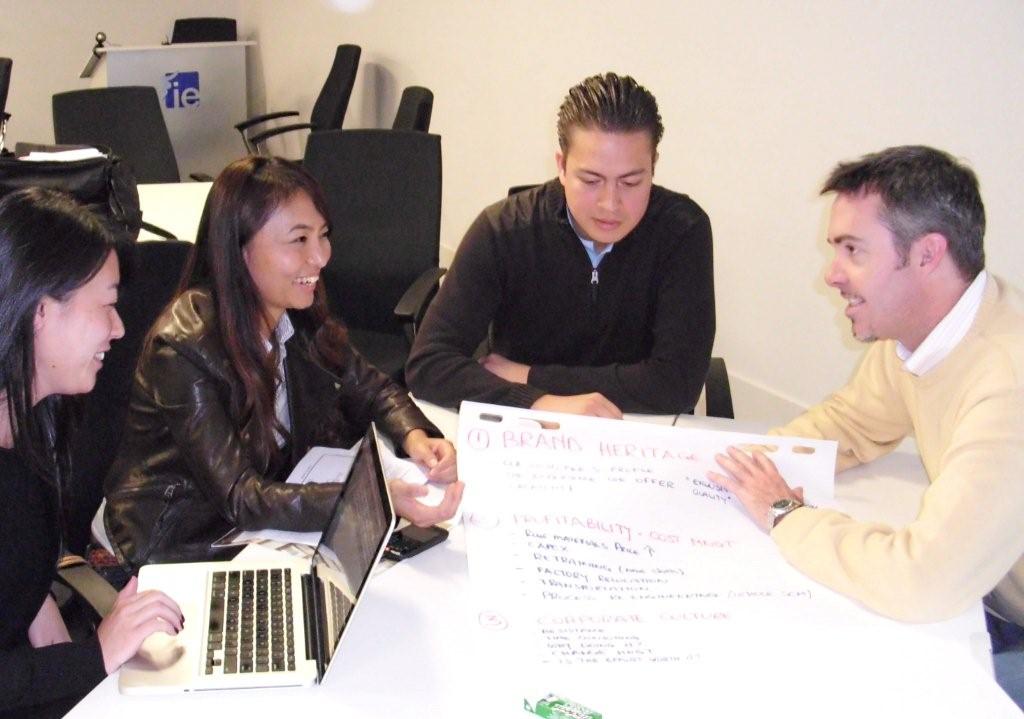
The evolution of sustainable luxury, as an idea and a practice, continues, as Ive just finished teaching the first 2 days of the “sustainable luxury and design” MBA module at IE Business School in Madrid.

It was a diverse class from all corners of the world.. and of course a fun place to teach it.

Thanks to Nicky Black (Corporate Citizenship Manager of De Beers), for sharing insight into her work at a busy time of year (she is working on their next report to society, and got some feedback from the students on that).

I dressed up for the occasion…

Sean Ansett, the Corporate Responsibility Director of Burberry, also travelled to Madrid to discuss what his team of 17 are doing on these issues. It was fun to see how Sean has developed his long experience in CSR to relate it to the needs of a premium brand.

Here he is in motion in class…

These sessions were somewhat introductory, and in the next sessions in April I’ll be able to work with the students more…

More info what next is on The Authentic Luxury Network.

Follow this via http://twitter.com/jembendell

Nestle shares value by 0.0146%

Nestle ‘shared value’ prize, 500,000CHF. Nestle profits in last year, 3,420,000,000CHF. A value sharing of 0.0146 of a percent of profit. Tax deductable of course.

So the question really should be the extent to which Nestle is changing the way it does its normal business. As I noted in the Journal of Corporate Citizenship in 2008, despite the rhetoric about “shared value” being a new strategy for core business, the numbers do not add up.

“Given that many of the examples offered by companies of how they can address social challenges through business are in practice making less of a rate of return than that expected from the business as a whole, are not scalable, and are dependent on government or NGO subsidy through partnership, we may question whether they really embody a new strategy. Perhaps they could be more appropriately understood as an advanced form of an established strategy: effective public relations through corporate philanthropy.”

In the two years since I haven’t seen much indication of a systematic attempt to change strategy.

As time goes buy, will more people have to conclude it isnt possible for a giant to be anything but greedy?

Or do you think there is real change within, real opportunity from, our largest multinationals?

Debate it at justmeans.com or below. And if you deserve support, then apply for the prize! (Think of Robin Hood).

Tweet @jembendell

How not to be a crap professor of business ethics, CSR or sustainability

I sometimes show my students the Daily Show’s John Oliver interviewing a Columbia University professor of business ethics. In it he asks the professor what he is doing about the ethical character of business students in the light of the financial crisis. The professor outlines courses that teach cases about corruption and the choices people have to make. Oliver says “that’s great, when are you going to start teaching this?” The professor replies “Um, we’ve been teaching it for thirty years”. After a confused pause, Oliver asks “Would you say you are very good at your job?”

By treating business ethics as something one learns how to debate in the abstract, and the various different explanations people give for their actions, has done very little to build the moral character of graduates from business schools, at least according to the studies that show student values pre and post graduation. It also does little to equip them with the insights, evidence and approaches to lead ethical business, rather than simply respond to ethical dilemmas. So can sustainability, social responsibility and the like be taught? As there’s a debate on a Linked In group, and I’m in the midst of designing an MBA module for IE Business School on sustainability, I took the opportunity to clarify my insights on the matter. So, here goes…

Teaching social and environmental responsibility in business needs to focus on:
– both standalone courses and integration into existing subjects
– both critical as well as practical perspectives
– both firm-centred and issue-centred perspectives
– both “content” and “consciousness” i.e. where the latter is about how we perceive ourselves, our careers, our organisations, our societies, etc.
– both class-based and work/action-integrated approaches
– both lecture and facilitated group learning with reflective exercises, role play, etc.
– both insight from publications and the tutor’s personal professional experience (and/or those of guest lecturers)
– both case studies and cross-cutting analyses

I make these distinctions as much present teaching in this field is only standalone, practical, firm-centred, content focused, class-based, lectured, text-based and with case studies for light relief. Such teaching, on its own, without the other stuff I mention above, is largely useless at educating people. Worse, it can encourage people to think that this field is something one is proficient in by simply recounting various arguments and a few models – a superficial confidence that impairs real insight and change.

Therefore I recommend the “whole person learning” track of GRLI which has a free book to download, written by the late Bryce Taylor.

Towards Rio 2012

In May 2012 Rio De Janeiro hosts a major UN conference, that marks the 20th anniversary of the first Earth Summit. In 1992 the Rio Earth Summit was the largest ever held, and helped spread around the globe the idea of ‘sustainable development’ as a common goal integrating environmental protection and poverty reduction. It also saw the UN and its member states calling on business and civil society to join in meeting the challenge, thereby encouraging more corporate responsibility and integrated approaches from nongovernmental organisations. Having discovered “sustainable development” in 1988 on the back of the Brundtland report, and just about to start a Geography degree at Cambridge Uni, I followed the Rio Earth Summit and was hopeful that it marked the beginning of a major change. I responded to the call, by working on and developing partnerships between businesses and NGOs in the following years. By 1995 I was helping develop market demand for wood certified under the Forest Stewardship Council system, and by 1996 developed an organisational concept for the Marine Stewardship Council, for WWF. In 1997 I then co-wrote a book about these novel ways of implementing the call from Rio.

Since then the field of innovation on responsible enteprise and finance for sustainable developed has grown and grown, and with that my workload, as an activist, analyst, and advisor. The FSC and MSC are now both massive organisations influencing the sustainability of forests and fisheries worldwide.

However, twenty years on, the statistics on environment and development are not particularly encouraging; consider the rising rates of deforestation, carbon emission, malnutrition and forced migration. Why? Partly because the focus on sustainable development was sidelined by a primary focus on trade liberalisation in the 1990s, on geopolitics and security in the 2000s, and because of an over-riding focus on increasing economic growth rates throughout. One reason for the lack of focus in 1992 on economic root causes of social and environmental problems was the exuberance and hopes after the end of the Cold War: discussing flaws of capitalism was seen as unhelpful and not hopeful. One reason for the focus on what non state actors can do, and thus not government, was the dominant influence of Western nations, who were embracing a laissez faire approach to state governance at that time.

Twenty years later the lack of major global progress towards sustainable development, towards true integration of environmental and developmental priorities, should make us question this lack of attention to economic systems and government roles.

In the last twenty years we have seen non state actors experiment in many new ways to advance the sustainable development agenda, with partnerships and voluntary standards emerging to promote responsible enterprise and finance. Its been exciting and exhausting. However, despite our enthusiasm, these experiments have also reached some limits of what they can achieve in promoting wider change. Leaders in business and civil society are therefore calling for government to become involved to help mainstream the innovations in sustainable development governance. If Rio 1992 was about governments calling non state actors to act, Rio 2012 may be about non state actors calling on governments to act in support of their innovations.

It is a call that may be heard, because today there are non Western nations with more recent experience of strong government leadership that have greater influence in the intergovernmental arena. In addition, twenty years on we should be able to show more maturity in exploring how systemic flaws in a our economic systems could be changed to reduce pressures for poor social or environmental outcomes.

A debate is beginning to be had in both business and civil society circles about the type of economic system we need for a more fair and sustainable world. Although often rudimentary, and often misunderstanding what capitalism is, these debates show there is growing willingness to tackle issues at the depth and scale that matches their signficance to our planet and our humanity. If it was practical not to discuss capitalism in 1992, given the shortcomings of our progress towards global sustainable development since then, it would not be practical to avoid discussing it today. Consequently we will see an agenda for innovating collaborative economic governance for sustainable development emerge over the coming years. Rio 2012 could be a useful moment in helping to globalise that conversation. However, if it becomes a huge draw on our time and attention without getting to the root causes of our enduring social and environmental problems, it could be worse than useless.

For those of us who have worked hard heeding the original call of Rio, we would do well now to organise to influence people’s awareness of what we have learned through success and failure over the twenty years.

With that in mind, I have begun reflecting on those lessons, and on how they could be communicated and learned in ways that could influence the agendas of organisations that can implement change. Because, we must not lose sight of how such summits are not in themselves implementing mechanisms.. connections have to be made from the insights and hopes of such summits to the real institutions of national and international governance.

Therefore, here are some initial ideas on what we could do:

– clarify the lessons from the last 20 years and the accuracy of the narrative I have just described above

– communicate these insights and narrative to global civil society through networks such as the stakeholder forum for the Rio 2012 summit, and get buy in

-communicate these insights and narrative to business networks active on sustainable development, such as the WBCSD, which was born by the last Earth Summit, and the World Economic Forum, which subsequently saw the light and embraced the goal.. and get their buy in

– begin deliberations and research and a devise a plan of technical assistance for a collaborative economic goverance agenda that would seek to mainstream the last 20 years of innovations in sustainable development practice and sustainable development governance

-communicate these insights, narrative and the technical advice about how to implement a collaborative economic governance agenda to mainstream sustainable development innovations, to the various parts of the UN system that are involved in Rio 2012

– engage the Brazilian government, NGO and business communities on this agenda, as given Brazil’s emergence they will play a far greater role in shaping the agenda, messaging and outcomes of the summit than in 1992

– create powerful communications products, such as TV documentaries, popular books, and celebrity campaigns and concerts that sing from this hymn sheet, rather than a dumbed down and expedient narrative, as we have seen at past summits

– remind everyone that the impact of this summit will be in the way it influences other institutions such as WTO, IMF, WB, UNCTAD, UNDP, ECOSOC and so on, and that unless the connections are made to these agents of economic governance, the summit will be a global mirage of hope in a desert of statis and despair

If you agree, and can actually do something about them, please get in touch. Given my existing commitments to other work, my only plans for engaging in this process are some work Im doing for UNCTAD. However, I will find time to discuss other ideas if you have plans to act.

If someone calls someone a cynic what does that make them? (hint, look it up)

Only cynics call people cynics. Why? By definition, cynicism is to assume negative intentions in others. Therefore to think someone is a cynic is to assume they have a negative view of others. It is to assume that they are being negative.

To dimiss either skepticism or critique as cynicism is to ignore the perspective and characterise the individual as negative, and thus to exhibit cynicism oneself.

We need skepticism and deep critique for inquiry and so it is mistaken to believe it to be either professional or moral to characterise these as purely emanating from a person’s negativity. Rather, the opposite is true – skepticism and critique are the beginnings of freedom, truth and effective action. Moreover, we even need some cynical thinking when evaluating the opinions, actions and inactions of those with power to affect others. That cynicism of never simply trusting in the moral character of the powerful is at the heart of modern notions of democratic rights, accountability and the separation of powers in a nation. Cynicism of those in power is an agent of progress, whereas cynicism from those with much power, or in search or praise of power, is an agent of tyranny.

Reflections on a year promoting responsible enterprise

Lifeworth Consulting is a social enterprise that promotes sustainable development through influencing enterprise and investment. We also run Lifeworth.com, the jobs portal for responsible enterprise. Reflecting on our year, in each of our specialist areas during 2010 we sensed people realising the need for far greater change than they currently seek in their own organisations, and some confusion about how to deal with that gap between awareness and action. We’ve been seeking to help.

We analyse, educate and advise on global changes in business-society relations and how to influence and respond to these changes in helpful ways (Enterprise Trends). Our activities and outputs in 2010 responded to this growing desire for transformation, working with the UN, GTZ as well as CSR networks in Asia to contextualise the key challenges for CSR and responsible investment in the coming years. We also analyse, educate, and advise on the specific practice of cross-sector relations, including partnerships between business and public interest organisations like the UN and NGOs (Engaging Change). We find that the desire to attempt transformational change counters some of the negative effects of growing demands for numerical scores on project effectiveness in challenging funding environment. Social change can be tough, and requires new ways to assess progress, although not ones that see a partnership’s existence itself as the goal. We brought that perspective to our work with UN agencies and NGOs during the year, as well as through the teaching of courses and publishing of papers.

Our third work programme is the focus of our corporate strategy advisory work, where we help high-end brands to develop their approach to achieving social and environmental excellence (Authentic Luxury). It is topic we were busy with in 2010, but mostly with research, lectures and media. The companies in this sector are not moving as rapidly as we had imagined they might, given the strong business case for prestige brands to out perform on social and environmental issues. We worked with a couple of companies on their CSR strategies, but are yet to see wider demand for support to develop and execute ambitious and creative approaches.

Below we summarise some of the activities, and more importantly, the resources we have produced as a result, most of which are freely downloadable via the links. In addition we highlight what’s coming next, and how it relates to the key responsible enterprise and responsible finance challenges of 2011.

Enterprise Trends

The contemporary incarnations of CSR and Responsible Investment have been around for some time. So what is its extent, worldwide? And what does it mean for the actual social, environmental and governance performance of companies and investors? It is time for some global analysis on these questions. So we worked with the UN Conference on Trade and Development (UNCTAD) to co-edit their first global overview of the state of CSR and RI communications. The main conclusion was that as commitments to CSR and RI are now so widespread yet communications on impacts so diverse and unclear, it is time to see more standardisation, with public interests in mind. I shared some insights from that at a session on the future of CSR communications at the CSR Singapore conference. During the year we conducted a study on the performance of environmental, social and governance (ESG) analysts and raters, speaking to leaders and stakeholders in this sector from around the world. My interview with UNPRI Executive Director, Dr James Gifford was recorded. In February we will publish the study, which identifies 9 flaws in current mainstream ESG practice, and makes recommendations for how to fix them, including the development of a multi-stakeholder code of conduct for ESG analysts and raters. The study will be serialised and open for discussion on the ESG Investing discussion group. In 2011 we will also continue our work with UNCTAD to map the progress of private standards for CSR and RI, and what the public policy implications may be.

2010 saw growing interest in the role of business in development. Our interest in development does not arise from companies and investors beginning to engage in this issue, but from a long standing interest in in cultural exchange, how societies progress or not, and shared global challenges. From that perspective we see potential, but also some gross assumptions from people coming at development from the business world. We released our study on this area, outlining the need for a new management system for pro-development business. That followed up a keynote at the launch of the first MDG Scan report by National Committee for International Cooperation and Sustainable Development (NCDO). We also published a major study on a key issue for social progress that has been almost entirely overlooked by CSR and RI until now – economic inequality. Given government spending cuts in many parts of the world, rising prices for basic needs, while banker salaries and bonuses remain high, matters of economic inequality are likely to gain more attention in 2011, and demand more attention from the private sector. In addition to this research work, we were pleased to help the UN, GTZ and ArcelorMittal in Liberia. My colleague Emma Irwin designed and facilitated a workshop to help executives to understand the financial and moral imperatives of integrating Human Rights into their management systems, as well as how to begin that process.

Aside from the rising interest in development, the six CSR trends I identified in my last book, The Corporate Responsibility Movement, appeared to strengthen during 2010. I presented these trends of standardising, mainstreaming, integrating, levelling, enterprising and yoyoing to special events hosted by CSR Singapore and CSR Geneva. The growing desire for transformational change inspired more people to explore ‘design thinking’ as a mechanism for developing products and business models that can help create fair and sustainable societies. My colleague Ian Doyle led an exploration of what ‘design thinking’ can offer CSR and sustainability professions, which we published in the Journal of Corporate Citizenship. I shared some of these ideas in a keynote at a workshop for youth on design thinking for social change, run by Syinc in Singapore. I reflected on how there is no magic bullet for social change, and that an ability to struggle with forces of inertia is key to our effectiveness.

If we seek transformation then we seek to understand the root causes of the problems we experience, and a vision of the kind of system we wish to bring into being. In looking back at 2009 we sensed that more people in the CSR and RI fields were having such discussions: and therefore capitalism was being debated. Our annual review of CSR was called “Capitalism in Question” and in it we offered a concept of economic system that integrates principles of capital and democracy. In 2011 we will share this further by an article in Singapore Management University’s Social Space, and in the book Healing Capitalism, to be published by Greenleaf in September, co-edited by my colleague Ian Doyle.

Engaging Change

Sensing what is needed is different from knowing how to bring it into being. A core theme of our work for decades has been the potential and pitfalls of cross-sectoral collaboration as one method for generating social change. Given the growth in cross-sectoral partnerships over the last decade since my last book on the topic, Terms for Endearment, I had decided to research the latest thinking and practice and share analysis on how to take partnering to the next level. Some outputs from this included a special issue of the leading journal ‘Business Strategy and the Environment’. Contributors to the special issue look at experiences of partnership from across the Asia-Pacific, and bring new insights into what really drives partnerships and what the future holds. With my co-editors Eva Collins and Juliet Roper, we identified a new ideology that partnership is always useful in creating change, and that struggle and conflict are unhelpful – something we termed ‘partnerism’. 2010 was also the 10th anniversary of the UN Global Compact, a cross-sectoral collaboration between business and the UN, and something I have followed since discussions with Georg Kell in 1998 about the initial idea of it. To coincide with the anniversary, the Journal of Corporate Citizenship published my reflections on how it must now address economic governance issues, which I then developed further into a series of proposals, after attending their Global Leaders Summit in New York.

How should public interest organisations attempt to have more systemic impact through their partnering with private sector? That is the subject of my next book, Evolving Partnerships, which is published by Greenleaf in April 2011. It provides tools for strategic review and planning so that UN agencies, NGOs and others can upgrade their partnering for greater social change. It should be available for ordering next month. I will continue to integrate these insights and approaches into my teaching and training on stakeholder relations and partnerships, including at the University of Geneva and Griffith University.

We are also applying our approaches to our training and strategic advisory for UN agencies. My colleague Ian Doyle led a seminar on private sector engagement for staff of the United Nations International Strategy for Disaster Reduction (UNISDR). As global value chains have become longer and more complex while natural disasters are increasing, so business continuity is becoming more important, and we believe there can be a convergence with reducing community exposure to natural hazards and increasing their resilience. We have also begun advising the International Labour Organisation (ILO) on its strategy for engaging the private sector in innovative ways. In particular we are looked at what can be done to encourage and support voluntary action against forced labour, a form of enslavement for over 12 million people today. Hopefully we will see some outcomes from this work during 2011.

The network Lifeworth Consulting co-founded, CSR Geneva, continued to bring together people from different sectors to discuss the role of business in addressing global challenges, with over 700 participants. Last year my colleague Janna Greve produced its first directory of members. In the coming year we will organise some events to help the international community better understand how to engage business, so sign up now to be informed.

Another collaborative network initiative that I helped to conceive, while at WWF-UK, gained momentum during 2010. The Finance Innovation Lab is promising because it provides a multi-stakeholder space to explore the systemic flaws and fixes of our financial system. In my advisory capacity to both the Lab the community currency charity CommunityForge, I helped CommunityForge engage the Lab, and create a new working group on the need for innovation in community currencies to promote a sustainability transition. The head of CommunityForge, Matthew Slater also happens to also be my web developer, and co-leader our innovation centre in Auroville (India) during the first part of 2010. In the coming year we will be publishing our study on why and how larger corporations can support and start using community currencies. I also hope to advise the Finance Innovation Lab on an effective approach to internationalising, given the global nature of the financial system.

Clearly we still believe in the power of partnerships, but in 2010 we were reminded of the pitfalls of attachment, where people’s sense of esteem becomes attached to the existence of a project, and the manner of its organising, rather than seeing it merely as a tool, and one that needs testing for the job at hand. No matter what tools, topics and resources are deployed, personal character is key to transformative action.

Authentic Luxury

High-end brands play a major role in the world, signalling what constitutes success and respectability, for many, across cultures. Asia continued to be the boom market for luxury brands during 2010, and thus grew their potential to shape awareness of sustainability challenges in a key part of the world. We have worked on CSR in the luxury sector since conceiving a project on this topic for WWF-UK in 2007 that led to the publication of Deeper Luxury, which stimulated a lot of media interest, including a TV documentary. In 2010 we saw the interest in this area grow steadily. Having introduced colleagues at Eco Chic Fashions and the UN with the idea for the UN’s first professional fashion show at its European headquarters, it was great the idea come together at the beginning of the year, profiling many ethical designers from around the world. I then joined the UN’s Biodiversity Platform, which is encouraging companies in the luxury sector to promote biodiversity conservation.

I was pleased to judge the Walpole British luxury association’s CSR awards, which were won by Six Senses Resorts, and give a keynote on sustainable wellness at the Wellness Summit in Singapore, which reflects how sustainability considerations are growing in the spa and wellness industries. A video of that talk is embedded below. The interest in these topics is global, as reflected by the world’s first Centre for Studies on Sustainable Luxury, in Buenos Aires, which I helped to launch. We will be working with them next year to offer courses on sustainable luxury in Latin America, launching the world’s first sustainable luxury awards, and co-developing the online professional Authentic Luxury Network.

I spoke about the future of fashion in Brisbane, at the Asia Pacific Centre for Sustainable Enterprise (APCSE), which I helped to found the year before, and they recorded it. As part of the research for a book due out in October, that I have been writing with APCSE on sustainable luxury, I worked with a fashion designer and sustainable materials producer in Southern India, to create a prototype of a form of high-end global sustainable luxury. The organic, hand woven, natural dyed denim sherwani we created appeared in Vogue and Marie Claire, by way of some great photos by award winning photographer Paulo Pellegrin, modelled by yours truly (no, not a career move). I wore the sherwani to the centenary fashion show of men’s luxury fashion house Ermengildo Zegna, and after Anna Zegna introduced me to the work of artist Michaelangelo Pistoletto, then ran a workshop on sustainable fashion for textile companies and designers in at his foundation in the northern Italian town of Biella. The sheer fun of working in Italy means I really hope their efforts to encourage CSR in high-end fashion take off in 2011 and that we are able to help further.

One of our strategy clients in 2010 was a high jewellery brand based in London. That helped us to deepen our understanding of the challenges and opportunities facing the jewellery sector, which I discussed on the radio. My colleague Ian Doyle presented his insights from our research on jewellery at the Paris 1.618 sustainable luxury fair, the Atelier for Sustainable Luxury (now the Sustainable Luxury Forum), and at De Beers’ stakeholder consultation. After interviewing dozens of experts about key issues, benchmarking 10 high jewellery brands on their CSR, and identifying leading innovations, we will publish a report responsible jewellery in March.

Also in March we begin teaching the world’s first MBA module on sustainable luxury, at the leading IE Business School, in Madrid. I hope the large luxury brands will be ready to hire the students to transform their companies. However, the luxury industry is not the most innovative and efficient sector that I’ve experienced, and the current commitment from large incumbent brands has been inconsistent. Perhaps the students would do well to establish or join the kind of niche luxury brands that are in the Authentic Luxury Network – the one’s that emerge from the Zeitgeist, rather than repackage the old.

In addition to our consulting business we maintain a CSR jobs and events portal. We’ve designed it in a way that means its full of jobs and events, a useful free one stop shop. But we haven’t designed it in a way where it makes money. So in 2011 we will need to reflect on where next for the portal, after 10 years of providing CSR jobs info to the emerging CSR movement and profession. In 2011 we will open a Geneva office again, based at the new Geneva Hub. We will remain a boutique consulting outfit, only seeking a few clients in the year, working where we can plant seeds that may have a lasting positive impact. We will likely continue to do pro bono work where we get excited about the change potential. We have been doing that by staying small and limiting both overheads and financial expectations. In such a company, what is key is the creative dedication of people who believe their work should be about more than money, status or fun. Therefore I’m grateful to my colleagues who see life that way. Thanks to Ian Doyle for his consistent focus and adaptability, to Janna Greve for her positivity, Hanniah Tariq for her insights, Emma Irwin for her professionalism, Nicky Black (now with De Beers) for her voluntary support, Anne Ellersiek for her phenomenal brain and Matthew Slater for his reliability and moral inspiration.

Each year for the past nine, we have published an annual review of CSR. Not any more – the developments with web2.0 mean that we will provide commentary on an ongoing basis with our RSS feed. In addition, our next book, Healing Capitalism, will review the last few years in CSR and RI.

I believe that this year we will see many more questions raised about economic fairness, about the ethics of the use of power, and we will see increasing cynicism about how business behaves, and a growing spirit of critique. Consequently, there will be more calls for corporate accountability, and a clearer understanding that a responsible business is one that seeks more systematic transparency and accountability from business as a whole. We will also see ISO26000 becoming referenced as the definition of CSR, for good or ill. The implications of Web2.0 for business-society relations will unfold further, with particular implications for fashion brands. We will begin to realise that these new communications tools mean that everything in commerce has an alternative. Even the currencies we use.

Thanks for your interest in our work, and I hope you have success in making waves with your own. You can follow me during 2011 on twitter @jembendell.

Jem Bendell, Director, Lifeworth Consulting.

Here is that keynote on sustainable wellness:

http://www.vimeo.com/16553604