The 5Rs of Deep Adaptation

The 5Rs of Deep Adaptation is a framework that I developed to guide the reflections and conversations of individuals, organisations and communities when they aim to reduce suffering as they face, or experience, societal collapse. I developed it after I concluded that we were not talking about our personal concerns and conclusions about collapse because we did not know how to talk about it. That meant conversations were often abruptly ended with phrases like “we can’t conclude that or we will have nothing to work towards.” I thought that when our conversations stopped like that, we were losing the time and opportunity to reduce suffering and save more of society and the natural world. 

Over the years, the framework has helped many of us to talk collapse. Some or all of the 5R framework has been used in many communities around the world, from environmental initiatives to psychotherapy groups, from faith-based groups to activist movements, and from educational institutions to those analysing business futures. There are even academic papers that reflect on the use of the framework in different settings [1]. So in this article I will summarise the framework and then invite the creatives amongst you to share your depictions of the framework graphically. 

Continue reading “The 5Rs of Deep Adaptation”

Science has not proven there is no free will – almost the contrary

This essay is the first in a series on aspects of free will and consciousness, and the implications for how we live in a metacrisis that, understandably, challenges our assumptions, beliefs and emotions. In this essay, I show how the increasingly popularised view that science has disproved relative free will is actually neither true nor scientific. I then explore other forms of knowledge on the matter. Thanks, Jem (PS: this is not written by AI ;-).

Science has not proven there is no free will – almost the contrary. 

In the last few years, you might have casually seen a few science magazines, or heard the commentary of a YouTuber or Tiktoker, and assumed that many people now think that science has proven there is no free will. If you have more than a passing interest, you might have noticed new books, from major publishers, which claim the matter is concluded – there is no free will and we can be grateful for it. A widely-quoted author on the topic, Robert Sapolsky states, “we are nothing more or less than cumulative biological and environmental luck, over which we had no control.”[1] Possible reasons and implications of an increase in the volume of arguments against free will is something I’ll explore in the second essay in this series on free will, consciousness and philosophy in an era of ‘metacrisis’ and societal collapse. In my book Breaking Together, I advance a freedom-based response to the predicament of humanity as an alternative to the various strands of either panicked authoritarianism or numbed disengagement. Therefore, the matter of whether freedom exists at all is rather important. In the book I included a brief discussion of the nature and existence of free will [2]. That was before the uptick in content claiming that our thoughts, feelings and actions were predetermined since the moment of the big bang (which is not a flippant summary of ‘determinism’). In response, with a series of essays, I will go deeper into the sciences, philosophy and social sciences on the matter. That is because this is not a mere intellectual and unending discussion; rather, it has very real ramifications for whether powerful people will accelerate the damage to humanity and the environment – and how we might organise ourselves for better outcomes.

Continue reading “Science has not proven there is no free will – almost the contrary”

How People Get Ready – building the commons in working-class communities is key to collapse preparation.

The one talk that I’m scheduled to give in the UK this year is at the Festival of Commoning in Stroud. My reason for that is my support of what Michel Bauwens describes as cosmolocalism [0] in the face of collapse, and what I term the ‘Great Reclamation’ of our power. It is best explained and illustrated by one of the organisers of the Festival, Dave Darby, in a guest article…

“All civilisations collapse in the end. The Roman Empire is long gone, along with the ancient Greeks, Egyptians and Sumerians. Will the global civilisation of corporate capitalism buck the trend? Of course not, but how long does it have left? In such a complex system, it is impossible to predict when there will be a sudden shift, but there is good evidence that the process of breakdown has already begun. Damage to soils, water tables, forests, the oceans and climate is occurring alongside economic and political upheaval. No longer is this a theoretical matter about the distant future, but something we should be preparing for today. But how? 

Continue reading “How People Get Ready – building the commons in working-class communities is key to collapse preparation.”

It’s The Empire, Stupid: Trump, Tariffs, the Dollar, Big Tech, EU Regs and CBDCs

Behind the headlines that are naively pro- or anti- Trump, there is a not-so-hidden agenda from the US government to remove any threat to continued US hegemony via its dominance of monetary systems. This is occurring in a context where the oil-backed dollar will not have the same power in decades to come. That means attempts are underway to secure future financial control in our digital era, where a handful of large companies have immense power. With this imperial agenda in mind, it is possible to predict future policy moves and consider how we wish to respond in our own lives and work.

To begin with, it is important to recognise the economic context we live within. The world is experiencing a new variant of capitalism, where a handful of international corporations control digital territory. In this internet age, it means they increasingly control our means of communication, trade and financial transaction. Some people think this is better described as ‘techno-feudalism’, rather than a more virulent form of monopolistic international capitalism. That term encourages us to recognise our subtle enslavement to corporations, and their executives, who increasingly influence our perceptions and behaviours.

Continue reading “It’s The Empire, Stupid: Trump, Tariffs, the Dollar, Big Tech, EU Regs and CBDCs”

Global Justice Starts at Home

I invited Malika Virah-Sawmy to share her reflections on the changes in approaches to international solidarity at a time of rising poverty and political disquiet in Western nations, as well as the degradation of the global environment. I met Malika through working on Deep Adaptation, and she served for a time as a holding group member of the DA Forum. I hope you find her perspective important for your own efforts.

Witnessing the political saga in many Western countries over the past year gives the impression of deep political upheaval. As inflation persists and family budgets become increasingly strained, frustration is manifesting in various ways. Elites are promoting narratives that shift attention away from exploitative economic systems. That means migrants like myself, refugees, and even bureaucrats are blamed – but never the rich. It leaves me wondering what politics will rise after people wake up to this false dawn promised by the xenophobes and anti-bureaucrats. Because it can’t take that long for people to realise their pay hasn’t increased and their bills haven’t decreased as a result of backing the opportunist politicians. At that point, the path might be open for more meaningful engagement with the difficulties in this era of ‘permacrisis’. If you are not satisfied with the ideas from your political leaders and pundits, then I’d like to offer an outside perspective. It is a view that might not only help citizens in the West, but also help people in less wealthy regions of the world.

Continue reading “Global Justice Starts at Home”

Indigenous Wisdom for an Era of Collapse

[NB: two places have become available on the last online course Leading Through Collapse that I’ll teach, starting Mar 17th – apply before 3rd Mar]

I’m noticing increasing Western engagement with Indigenous teachings and elders. One reason might be that as people wake up to societal collapse, they reconsider deep assumptions in their culture, and are open to learn more from the wisdoms of Indigenous cultures. That seems like a great thing, but, like anything, there are both benefits and pitfalls. It’s something I’ve mused on for a while, so I’d like to share a few thoughts with you.  

For decades, some strands of the Western environmental movement cited the wisdom of Indigenous cultures, from Aboriginal Australians to Native Americans, and many places in between. Then, like me, they largely failed to integrate such wisdom into life choices and professional or political activity. Even the environmentalists who work in solidarity with Indigenous peoples have tended to bring their own assumptions and interests which then distort the teachings, insights and ways of being in the world. That is not only due to modernist ideologies of progress, hope, and happy endings, but also from the distortions that can come from privilege. Let’s face it, the middle classes and elites tend to be the ones in the West who make time to learn from Indigenous cultures. The theories of social change favoured by the privileged anywhere tend to be that education, awareness and reform are what matters. That makes organising to resist and reclaim power to meet basic needs and aspirations in more independent and self-reliant ways a secondary concern, if at all. I know of that strategic preference because my past career was shaped by it. Without these filters, I wonder what more we could learn from listening to, and experiencing with, those people who live with a different cosmology, and who experience life differently to our urban commercial norms.

Continue reading “Indigenous Wisdom for an Era of Collapse”

Should Deep Adaptation spaces be discussing contentious social issues that are (arguably) not directly related to collapse? 

Sometimes people object to any discussions of politics, pandemics, wars, racism, or gender, in Deep Adaptation fora. The ‘little’ matters of ecological destruction and the collapse of societies are stressful enough, even before airing any of our disagreements about politics or current affairs. Consequently, some people wish for a place where such topics are avoided, so the discussion is limited to how to help each other emotionally and practically. Some groups in the Deep Adaptation movement even make it explicit that politics should not be discussed. However, I’ve said for a few years that I think that such a position is no longer tenable, with the issue now being how such conversations can be well held, so they advance understanding rather than discord. That is simply because collapse has been shaped by politics and will be made better or worse by politics in future. Additionally, contentious social issues involving inequality, gender, race, neurodivergence, health and human rights, amongst others, don’t become irrelevant just because societies are fracturing. In fact, for many people such matters can become more important, as they wish to maintain their values and reduce suffering as situations become more difficult. I’ve wondered over the years if we don’t try to apply the ethos of Deep Adaptation to matters of policy and power then how robust is our commitment to that ethos

Continue reading “Should Deep Adaptation spaces be discussing contentious social issues that are (arguably) not directly related to collapse? “

Some reasonable essays on collapse

In my annual personal update (not the Deep Adaptation Review), I included a summary of the essays I wrote in 2024. I thought it useful also to post these to my blog. I group the essays by topics of: integrating collapse awareness into your working life, the broad trends in Deep Adaptation, the political implications of collapse awareness, making sense of the latest climate data and science, plus personal reflections on motivations in this age of consequences. Next year I will be writing less, as I focus more on the organic farm school (please help!) and music (new single: Aspirations). I hope that both my book and these essays will support your own life choices. For more support, consider joining our online short course. Thx, Jem

Integrating collapse awareness into your working life

The essay Keeping your job at the end of the world (as we know it) addresses the conundrum facing many people who are questioning everything due to collapse anticipation, but can’t quit their job, for financial or other reasons. Written to coincide with a speech at Griffith Business School, where he was an Adjunct Professor, Jem Bendell discusses ideas rarely, if ever, heard in professional contexts. That is because he not only mentions people who have chosen to “keep serving (reveal and recommit in post)” or “repurpose your job (refocus in post)” but also those who de-prioritise their employer’s interests. This includes “quit quietly (retire in post)” and even to “sabotage non-violently (rebel in post).”

Continue reading “Some reasonable essays on collapse”

Holding Space for Strong Emotions

“I wanted to punch the guy, but when I realised I couldn’t do that, I just switched off.”

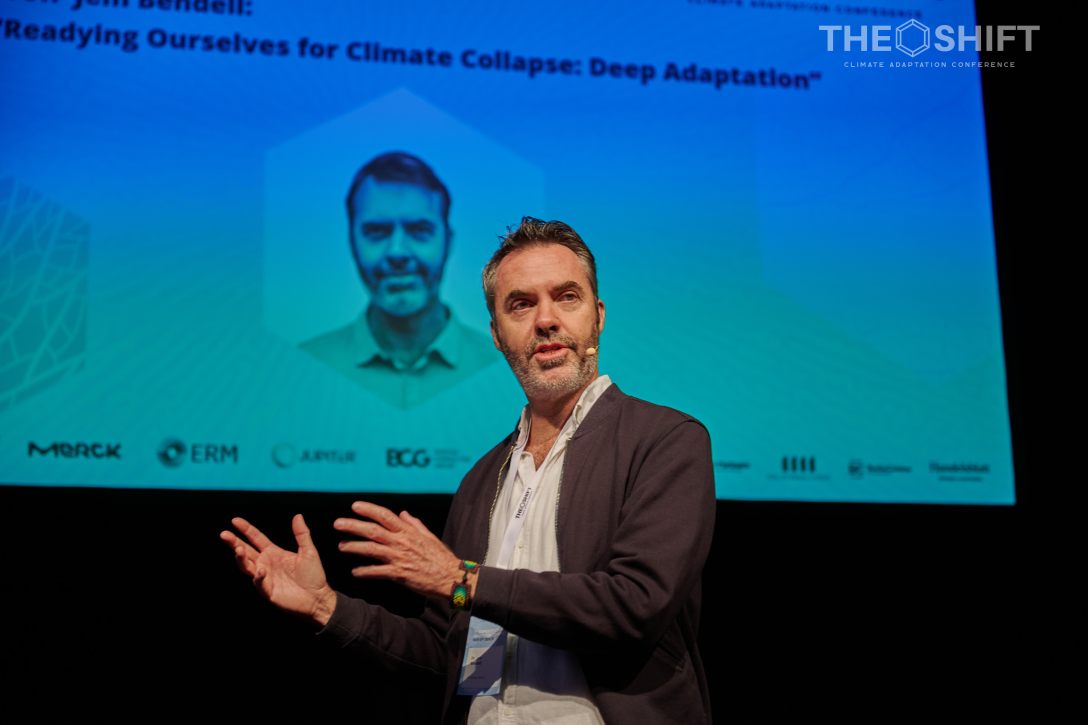
This was certainly a new kind of response to giving a speech. I’d just left the stage at a conference on adaptation to climate change, and was surrounded by people wanting to exchange a few words and contact details. “You really stimulated the audience, as we hoped you would,” one of the organisers said, smiling as he told me of the guy who liked my views so much that he wanted me to connect with his knuckles.

I’d already heard enthusiastic praise from another organiser, so I reacted to the negative feedback in dismissive fashion. “Anger is a way of responding to difficult information, situations and emotions. It gets us out of fear,” is more or less what I said. I continued with my mini lecture by saying “Fight or freeze are two normal responses to fear. It’s why I talked about the benefit of getting better with allowing, witnessing and working through difficult emotions. It’s also why we must recognise so much of our conversation in professional circles is to avoid conflict and emotional difficulty, using convenient narratives, that stop us from facing reality.” This all tripped off my tongue because being intellectual and slightly combative is my go-to response when under threat. However, I’m writing this essay because I was on the cusp of noticing that go-to response, and chose a different way to engage when experiencing conflict. If you also navigate strong emotions about the state of our world, I hope the following thoughts may be of use.

Continue reading “Holding Space for Strong Emotions”

A life changed by collapse (mine)

For much of my adult life I’ve lived outside the UK, my country of birth. Therefore, I’ve been curious about the dynamics of social change occurring in different contexts, including the environmental movement and profession. That is why I wrote my book with an eye on how it might be useful to the environmental movement in parts of the Majority World, and therefore I look forward to learning from the responses after recently launching the Spanish and French editions, with a focus on how they may be received in Latin America and Francophone Africa. It also meant I was pleased to read recently that one of Indonesia’s leading environmental commentators, Jalal, is reading my latest work, and contextualising it with my previous decades working in corporate sustainability. I gave it attention, as Indonesia is the country I have chosen as home for the last few years, and where I’ve invested into a social enterprise for collaborative resilience in the face of collapse – Bekandze Farm School. His essay reviewing my intellectual journey was one of the best I’ve read, and so I had it translated into English, to share with you here. I don’t expect or ask you, or anyone, to change direction in the way I have done, but to allow an awareness of collapse to transform your own priorities, as and when you ready – as there is not one right response. But there are some benefits! If you are interested in exploring your own path with peers, then please consider our online course (next one starts late January).

Continue reading “A life changed by collapse (mine)”