
“But the world’s climate was as hot as this in the past.”
Do you hear this a lot? I do. The obvious answer is “sure, it was especially hot when our planet was just a chunk of molten rock spun out from the Sun. But back in terra logica, the main issue for ecosystems and agriculture is the SPEED of climate change.”
The problem with this issue of the speed of change is that consensus in climate science moves very slowly. The more funding that went into climate science, the greater was the amount of research and people to find consensus amongst. That meant the key signals, like the 2017 paper predicting 1.5C by 2025, went largely unnoticed by institutional climatology – and was certainly not acted upon.[1]
In a 2021 chapter with Dr. Rupert Read and a top German climatologist, who chose to remain anonymous, we explained the limitations of mainstream climatology for telling us the real situation. We pointed to how, in fast moving crises with high hazards, there needs to be an ability to identify salient information rapidly. This even has a name: post-normal science.[2]
The slowness of institutionalised climatology means that top scientists recently celebrated the commitment at the IPCC to publish a report in 2027 about the possibility that multiple neglected factors are increasing the pace of climate change. Maybe they will still be able to feel good about their report in 2027.
I’d not bet on it.
In that context, despite it being a digital trigger-alley where reasonable people are demeaned by those who need to vent, twitter is actually proving a useful tool for sharing the latest in salient climate data and analysis. In particular, Leon Simons and retired Professor Eliot Jacobson have been doing great work over the past 18 months. Of course, it is ridiculous that a planet of 8 billion people with 10s of thousands of professional journalists has not been producing more than a handful of people doing cutting edge real time analysis on the issue that matters most to the future of humanity.
But here we are.
Turning to climate twitter, we discover that there’s something up with our global climate that the top scientists and journos aren’t shouting about yet. Maybe because it’s too frightening…
Global temperatures have just averaged 1.7C above pre-industrial levels for a 6-month period.[3] Does that not sound so big? Well, that’s in comparison to 13.8C average temps back in 1890.[4]
If we take half a year as a reasonable indicator of current averages, rather than a momentary anomaly, then that is about a 0.5C increase since an average of 1.2C warming for the whole year of 2022. [5]
That indicates around a 0.5C leap in a year.
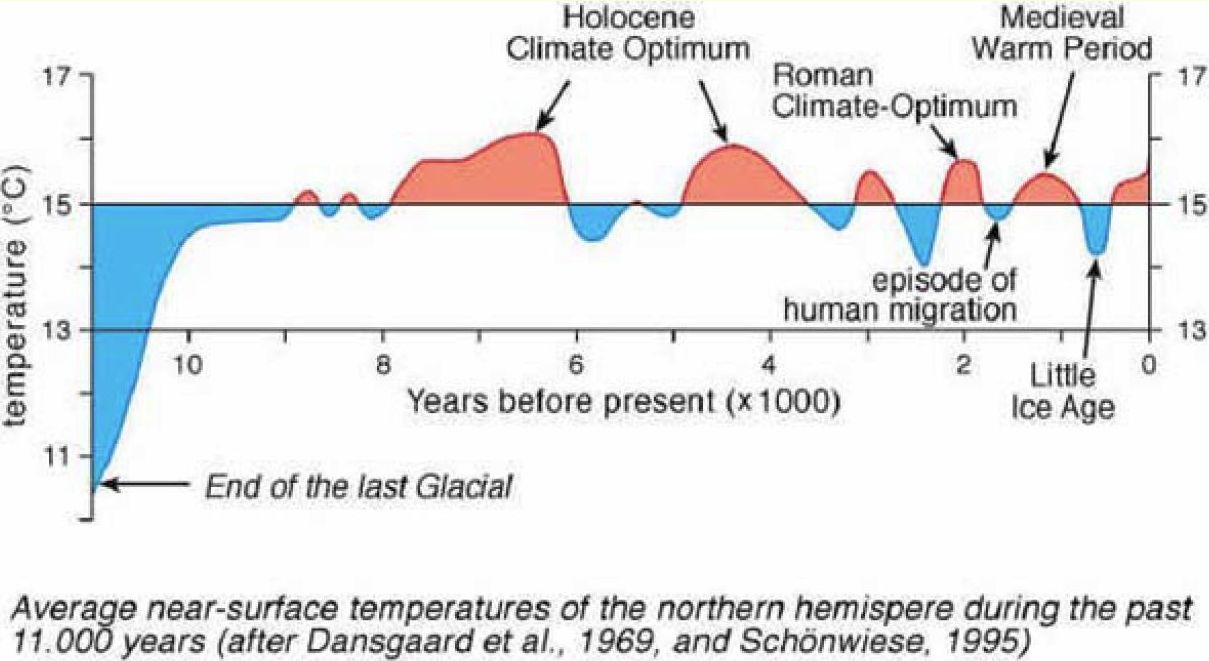
Studies of Antarctic ice cores suggest that previous global rises of 0.5C took about 500 years or more [6]. That’s even shown in those graphs used by sceptics of climate change.
1 year versus 500 years. Can we agree something’s happening here? I’d say it’s exactly clear: these measurements demonstrate that we are in the midst of abrupt climate change. Once we understand how such additional heat will lead to less CO2 being absorbed by the oceans, amongst various other amplifying feedbacks, as I describe in the climate chapter of ‘Breaking Together’, we realise how this situation is going to damage our own lives.[7] That’s what I tried to get across with my Deep Adaptation paper back in 2018.[8] That shift in awareness helped to ignite a new kind of activism, before the backlash came. Much of that pushback came from people aligned to the nuclear industry, or who desired the ear of elites, and it helped to gut the movement of a truly radical agenda.[9]
I should emphasise that the figures I give here are rough estimates, and I’d welcome more precise calculations from people to crunch different data sets to compare current changes with past warming periods in the Holocene. But we shouldn’t let that distract us from the key insight here: current abrupt climate change means that humanity needs emergency responses that are fair and accountable.
Let me ask you a question. What do you think is worse?
a) People who don’t pay attention, or dismiss this topic, as they haven’t got the time or skills to investigate, and find it reassuring to listen to people who claim it’s not a problem, or that it is fixable, or that another problem is more urgent.
b) People who work on this matter, and are using rising concern to embellish their careers, income, status, identity, worldview, or even votes, so they deny it is anything other than a predicted and manageable situation, using the latest tech.
c) People who work on this matter and realise tech won’t fix it, so are desperately imagining eco-authoritarianism as the way to do something significant about it (or shift their anxiety and despair a bit by becoming aggressive).
I ask that, because I think with knowledge comes responsibility. Therefore, it is a tragedy that both climate science and environmentalism over recent decades became dominated by professional self-interest, ‘green’ capitalist agendas, and a counter-revolutionary admiration of power and status.[10] I’m sorry for the part I played in that.
Instead, an #ecolibertarian agenda that seeks to free individuals and communities from the harmful pressures and manipulations of global capitalism is needed to help soften the crash and plant some seeds of what might be possible in a new era.[11]
Subscribe / Support / Study / Essays
There are some signs that my previous professional field of climate sustainability is waking up to smell how their organic coffee won’t save the world. However, as I explained in the editorial of the Deep Adaptation Review, the professionals most closely wedded to the industries that benefit from stories of techno salvation from ecological disaster – the renewables, electric vehicles, nuclear and bigtech sectors – are doggedly hanging on, and either ignoring or continuing to demean those of us who were more accurate in our assessments.[12] Will it become easier for them to imagine an end to their connection with reality than the end of their past identities, worldviews and income? Perhaps only if they could blame us ‘doomsters’ for being something bad – even though we were closer to the truth of the matter and had to tolerate their abuse. I guess some might say we are gloating over the apocalypse. But no, we just want to shift the conversation and action agenda onto how to cope kindly with unfolding societal disruption and collapse.[13] Please check out the Deep Adaptation Forum if you want to engage others on that agenda: www.deepadaptation.info
REQUEST! If you think this article is important, and containing analysis that you aren’t reading enough of, then please DON’T post it on social media. Yep, don’t bother. Why? Because such content is ‘visibility filtered’ due to the ‘fact checking’ organisations and their staff being aligned with ‘green’ capitalist agendas and considering anything they label as ‘doomism’ as misinformation. If you are in doubt, read here and note that top climatologist Prof Steffen didn’t even get the courtesy of a reply before he died. As I explained in ‘Breaking Together’, I think those who vilified or hid more alarmist readings of the science have blood on their hands for suppressing important contributions to humanity understanding our situation and responding. As this is so scary, I completely forgive them for that emotionally avoidant response. It seems many won’t forgive me for puncturing their story of being good professionals doing their best – but I suppose I must learn to forgive that as well. Recognising this ongoing suppression of analyses which challenge incumbent power I’d like to ask you to use email or a messenger app to send this post to a few people who you think are on the edge of accepting that we are in a crisis situation that is not accurately being described by institutionalised climatology.
Sources:
[1] “If we consider (b), the year in which the global mean first reaches 1.5°C, the distributions are shifted a little earlier, with a mean of 2025 for IPO positive and 2029 for IPO negative.” https://agupubs.onlinelibrary.wiley.com/doi/full/10.1002/2017GL073480
[2] See chapter 1 of “Deep Adaptation” book.
[3] Prof Jacobsen crunching the ERA5 data. https://twitter.com/EliotJacobson/status/1756750662371770583
[6] Paleo records:
One useful source is the ice cores of Antarctica:
Even graphs used by climate sceptics since 1995 show the same slow pace of past warming (but exclude the last 20 years):
[7] Stream episode Climate Collapse – chapter 5 of Breaking Together by Jem Bendell podcast | Listen online for free on SoundCloud https://soundcloud.com/jem-bendell/climate-collapse-chapter-5-of
[8] Versions of the Deep Adaptation paper – Prof Jem Bendell https://jembendell.com/2019/05/15/deep-adaptation-versions/
[9] Our power comes from acting without escape from our pain – resilience, https://www.resilience.org/stories/2020-07-30/our-power-comes-from-acting-without-escape-from-our-pain/
[10] Professional incentives distorting climate science and its communication: https://jembendell.com/2022/08/03/dont-be-a-climate-user-an-essay-on-climate-science-communication%ef%bf%bc/
[11] The ecolibertarian agenda for an era of disruption and collapse: https://braveneweurope.com/jem-bendell-what-is-ecolibertarianism-its-the-freedom-loving-environmentalism-we-need
[12] Professionals Inch Towards Talking Collapse – DA Review (campaign-archive.com) https://us9.campaign-archive.com/?u=c58fbb0d721b1e5f3e4787bdf&id=421f0c2449
[13] Initiative for Leadership and Sustainability: Over 500 sign #ScholarsWarning on collapse risk (iflas.blogspot.com) https://iflas.blogspot.com/2021/02/over-500-sign-scholarswarning-on.html
Donate to keep Jem writing / Read his book Breaking Together / Ask JemBot a question / Read Jem’s key ideas on collapse / Subscribe to this blog / Study with Jem / Browse his latest posts / Read the Scholars’ Warning / Visit the Deep Adaptation Forum / Receive Jem’s Biannual Bulletin / Receive the Deep Adaptation Review / Watch some of Jem’s talks / Find Emotional Support / Jem’s actual views on Covid
Discover more from Prof Jem Bendell
Subscribe to get the latest posts sent to your email.
