A year ago I took (very) early retirement from academia, and was given the title Emeritus Professor upon leaving. Looking back, I am grateful for the academic freedom I enjoyed at the University of Cumbria. Although there were exacting demands for generating income through MA and MBA courses, the University had a tradition of critical inquiry, interdisciplinarity and experiential learning. Without that freedom I could not have developed my understanding in a range of fields to be able to write the book Breaking Together – and to teach leadership the way I do today. I had always been a polymath and read philosophy about ways of knowing. I was fascinated by the pros and cons of the ways that different academic disciplines constructed their focus, forms of evidence and criteria for conclusions. Therefore, I developed a form of ‘critical interdisciplinary research analysis’, where one interrogates research from different disciplines with a prime focus on real world salience and an awareness of there being limiting assumptions within any field of inquiry. Unfortunately, academia militates against this approach by incentivising career researchers to specialise. Meanwhile, many non-scientists defer to the claims from institutionalised specialists and their peak bodies. That is an understandable reaction, although pretty lazy when coming from scholars and public commentators on our environmental predicament. As the reality with climate change appears to be far worse than what was predicted, some of that deference will reduce, along with the hostility towards better analyses. If you are interested in this matter, please see (or listen to) Chapter 7 of Breaking Together.
As I close the academic chapter of my life, I want to recognize the contributions of those of us who took inspiration from the Lake District to engage in world affairs with a more fresh and ‘wild’ perspective than is typical from the urban and elite universities of the world. I also want to share some thoughts on ‘where next’ for those who are considering staying in academia.
For ten years the Initiative for Leadership and Sustainability (IFLAS) at the University of Cumbria helped promote more critical perspectives while also teaching the basics expected of professional managers in its field of expertise. Even our launch event at the Royal Geographical Society in London and my Inaugural Professorial lecture in Keswick included stark warnings about the counter-productiveness of an agenda of incremental reform in the face of devastating environmental change. Our monthly speaker series sought to highlight bold ideas that we felt were at the leading edge of the topic of sustainable development. One of our highlights was the ‘Leading Wellbeing’ festival with Brathay Trust. We welcomed speakers as diverse as Charles Eisenstein, Jennifer Robinson, Lynne Franks, Jo Confino, Nandita Das and Anna Zegna, to explore the breadth of the topic of corporate responsibility, and beyond.
Key to my own development as an intellectual and educator on leadership and its development, was Richard Little, now a Visiting Professor with the University. He was working at the leadership trainers Impact International at the time, and his critical take on the brainwashing which constitutes most leadership courses helped shape the courses I launched. I also helped him write one of the most amusing scholarly papers that I ever co-authored, about why there are so many bad leaders. I am pleased to know that many of the people who attended our leadership courses have stayed in touch and consider their studies with us to be life changing (in a good way). I am also pleased that we reached hundreds of people with heterodox economics, through our free online course on currency innovation well before bitcoin had become the phenomenon it is today.
As part of our efforts to question orthodoxy in our field, IFLAS launched an ‘Occasional Paper’ series, and one of them went viral, being downloaded over a million times. It was titled “Deep Adaptation: a map for navigating the climate tragedy.” Authoring the paper was part of a process that led me to quit academia last year, as I decided to commit to my new life in Indonesia. Now I co-run an organic farm school, play and produce music, and write essays on collapse readiness and response (e.g. this one). I will also keep teaching the ‘Leading Through Collapse’ course a few times a year, with my longtime collaborator Katie Carr, as it remains a unique support for people who want to be socially engaged in this age of consequences.
Although I had a lot of intellectual freedom at the University of Cumbria, I wonder what our overall contribution was. We operated within a neoliberal context that had effectively reconstituted Universities. With very limited public funding, we were a business needing to attract students to courses that they thought would help their career progression, most often in large corporations. Within that context my colleagues David, Philippa, Caroline, Sarah, Martin, Tony and I, all did our best to create a dynamic part of the University. Yet much of the teaching by IFLAS was in the paradigm of training executives to be better at delivering on commercial aims, above all else. As educators we may have been more interested in the individuals developing their own ‘critical wisdom’ (described in Chapter 8), but that was not the main aim of the programmes we taught on. This is not a criticism specific to Cumbria, as so many Universities in the West have been selling the status of a Western degree to promote ideas and approaches around the world which hasten its destruction (even when claiming otherwise).
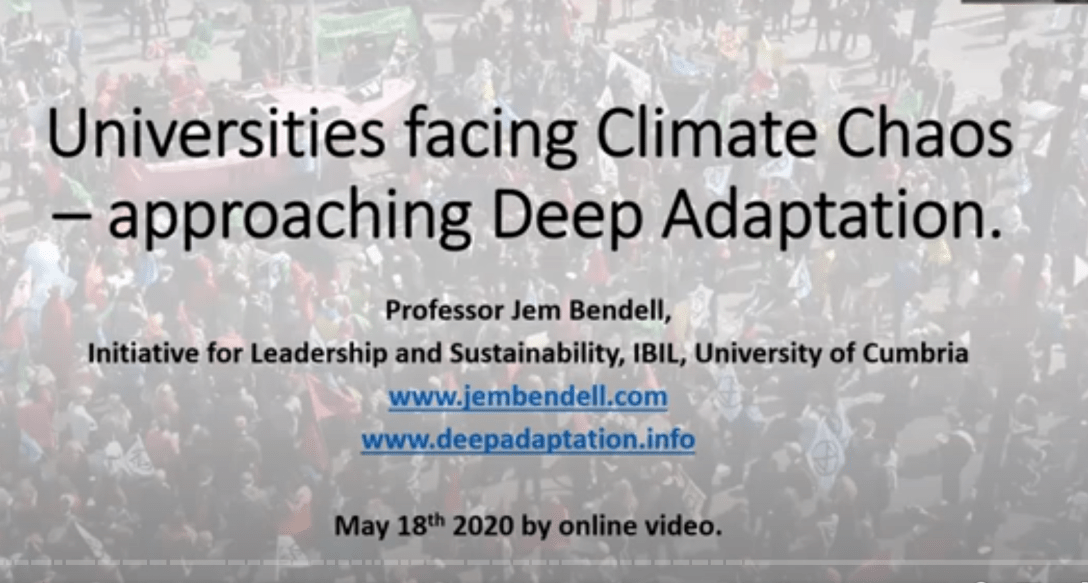
After I had woken up to the truth of our environmental predicament, in 2020 I gave a public lecture about what Universities could do to promote adaptation to climate change. It seemed fair that I started with ideas about my own sector. I covered matters of curriculum, research, and operations. But I argued that recognising imminent or unfolding societal breakdown means a more fundamental shift in the philosophy and direction of Universities. No longer would aiming for growth in student numbers and income be a smart strategy. Instead, that might justify investments that would increase risks and mean further to fall. My brief glance of what is happening amongst Universities in the UK on climate adaptation ahead of writing these reflections indicated that nothing like the ideas I presented 4 years ago have been taken up. Nevertheless, there are some scholars who continue to make the case for systemic change, illustrated by a recent paper from James Dyke and George Monbiot. Although I respect their views on the matter, I have concluded that the structure of higher education is such that radical change won’t occur in the countries I know about.
If you are an academic reading this, then you might be asking yourself what to do. You might be asking yourself questions about whether and how to integrate collapse readiness and response into your teaching, research and administrative responsibilities. Or you might be considering reducing hours, or quitting altogether, like myself, Rupert Read, Alison Green, Larch Maxey, and others have done in the last few years due to their climate awareness. Your degree of freedom will depend on your financial and family obligations, what subject area you are in, and what risks you are prepared to take. I recommend reading my essays on the professional implications of collapse and keeping your job at the end of the world, as many of the issues apply.
Staying within academia and finding a way to work on collapse doesn’t necessarily mean one would be doing anything useful. Instead, there is the possibility that intellectuals embedded within universities will distort attention due to the need to seek funding and not alienate senior managers. That is already happening in two ways.
- First, there is a reframing of collapse so it appears less critical of incumbent power. Terms like polycrisis and multi-crisis (perhaps even permacrisis) imply that various problems can be managed and resolved. Elite organisations are even telling the funders who provide grants on societal collapse that they can’t use such terminology.
- Second, there is the promotion of the idea that the breakdown of our ecologies, economics and societies is an intellectual topic for pontification and deliberation, based on how much we think we know about past civilizations. That is the kind of semi-autistic emptying of this topic’s significance and the emotions associated with it, which academia seems very adept at.
In Breaking Together, I briefly warn of these processes of incorporation of ‘collapse attention’ by the establishment. With that in mind, I have mixed feelings when reading reports coming out from new initiatives like the Accelerator for Systemic Risk Assessment (ASRA) when they avoid mentioning common drivers associated with capitalism and expansionist monetary systems. It remains an open question whether the professionalisation of this field will move anything forward rather than create new ways for elites and their officers to keep talking while avoiding – and thereby marginalising – challenges to power.
I am pleased that my last contribution as an academic was a paper in a journal of art and therapy, resulting from a collaboration with a Balinese artist who wanted to invite attention to the idea that farming can be an honourable and reverential activity. Made Jodog thought of that during the collapse of the local economy due to the Covid policies, when many people returned to farming. The Art of Planting Rice as a Meditative Practice: Sensemaking and Equanimity about Societal Disruption through Performance Art was published in August 2024. Dr Jodog’s performance art also appeared in the Dutch TV documentary on my own journey.
Below, by listing a varied selection of some outputs on the IFLAS blog, I hope to provide a gateway to some of the contributions that came from the foothills of the fells during the 10 years I worked there.
Thanks for reading, Jem
Subscribe / Support / Study / Essays
Selected items from the IFLAS blog 2013 to 2023
(There is a lot more content on the IFLAS blog, so I recommend you visit it and use the search box).
October 2023: Is it time for climatologists to apologise to activists? An open letter from international scholars.
The letter argues that many activists’ warnings about climate change were more accurate than mainstream scientific predictions and therefore criticises the undermining of activists by some climatologists. It highlights the need for greater collaboration between scientists and activists to address the climate crisis effectively. The post emphasises the urgency of acknowledging activists’ contributions and apologising for the harm caused by previous criticisms.
July 2023: Creativity Beyond Hope – Prof Bendell talk at Paradiso Amsterdam
In his talk “Creativity Beyond Hope,” Professor Jem Bendell discusses the onset of societal collapse and critiques the reliance on ‘hope’ for positive change. He argues that rather than hope, creativity and faith in ourselves are crucial. Bendell connects the decline in the Human Development Index and quality of life to broader systemic failures and emphasises the role of the arts in fostering new perspectives.
November 2022: The Influence of the Concept of Deep Adaptation in Academic Literature – by October 2022
By mid 2022, the Deep Adaptation paper had been referenced in at least 295 publications, including 138 journal articles, 49 book chapters, 44 books, 42 theses (incl. BA, MA and PhD), and 22 other documents. In this post, Dorian Cave explores how the idea of Deep Adaptation has affected individuals and organisations in addressing the climate crisis. He reflects on the growing acceptance of inevitable societal disruptions due to climate change and the importance of preparing emotionally and practically for these changes.
November 2022: Cumbria University Professor hosts discussion of localised heat reduction at COP27 UN climate conference
At COP27 Professor Bendell hosted a presentation by the founder of the MEER Framework. Dr Ye Tao. He presented the crucial need for more options for cheap, local, ground-level and safe solar reflection systems. “These are not the grand schemes of venture capitalists or billionaires, but simple tools that might help the poor to cope with extremes of temperatures”. Bendell concluded that “More radical and less-corporate approaches are needed to generate the kind of creative ideas that humanity urgently needs.”
November 2022: Scholars’ Oath to the Future
The Scholars’ Oath to the Future, launched at COP27, is a commitment by scholars to meaningfully acknowledge their past failures in addressing climate issues. It involves apologising to younger generations and pledging to be more proactive in sharing unsettling analyses, naming injustices, and challenging distortions by powerful interests. The oath, supported by 165 scholars from 34 countries, emphasises a renewed commitment to reducing harm and promoting universal values for future generations.
May 2022: Sad but Necessary Lessons at Rio+30 and Stockholm+50
The Rio+30 report reflects on the lack of progress made since the 1992 Earth Summit, discussing the mixed outcomes of global environmental and social policies. In this post, the reality of ‘sustainable development’ being a failed ideology is explored, along with the implications for international policy.
November 2021: Hot Air from Glasgow Means it’s Time for Radical Leadership – say over 200 scholars.
This post criticizes the outcomes of COP26, stating that the summit failed to deliver meaningful economic transformations necessary to address climate change effectively. Over 200 academics signed a letter urging for community-led emergency responses and radical policy advocacy to combat climate chaos, emphasising that reliance on corporate commitments is insufficient. They call for honest leadership that recognizes the urgency of climate justice and the need for systemic economic changes to reduce emissions and foster resilience.
October 2021: Adaptation Delayism – preventing urgently needed dialogue and initiative.
Discusses the concept of “adaptation delayism,” where criticism of alarmist readings of the science means delaying necessary actions to try to reduce harm from already-inevitable levels of climate change. The post argues that this mindset undermines urgent mitigation efforts by promoting a false sense of security. It emphasises the need for immediate and radical actions to reduce emissions rather than relying on adaptation as a primary strategy.
March 2021: Monetary adaptation to planetary emergency: new paper addresses the monetary growth imperative.
An occasional paper shows that some economists who have argued that capitalism without growth is theoretically possible were mistaken. Neither more GDP growth nor more borrowing is the solution to unprecedented levels of debt. Instead, the role of government treasuries, central banks and banks must now change. The paper also notes that academics often have a bias towards questions, conclusions and narratives which will be acceptable to power.
February 2021: Over 500 sign #ScholarsWarning on collapse risk
Responsible communication of research and its implications for policy dialogue is a fundamentally important topic as people experience more disruption, confusion and a sense of vulnerability, due to the direct and indirect impacts of environmental change. Therefore, the principles with which people coordinating future activities of the international Scholars Warning will approach their work include: transdisciplinarity, diversity and rights.
December 2020: Facts on Deep Adaptation in response to a New York Times style article.
Addresses misconceptions and misinformation about the Deep Adaptation framework. It clarifies the intent and scope of Deep Adaptation, which emphasises preparing for societal disruptions due to environmental crises. The post highlights key principles such as resilience, relinquishment, restoration, and reconciliation, and argues against misrepresentations that suggest it promotes fatalism or defeatism.
December 2020: International Scholars Warning on Societal Disruption and Collapse
A declaration by over 250 scholars who warn about the imminent risks of severe societal disruption and collapse due to climate change, biodiversity loss, and other environmental crises. The scholars emphasize the urgent need for transformative change, holistic thinking, and international cooperation to mitigate these risks. They advocate for deep adaptation strategies, which include building resilience at community levels, reassessing economic and political priorities, and fostering ethical and compassionate responses to the unfolding crises.
September 2020: Adaptation Radicale and Collapsology discussed in France.
Explores the concepts of radical adaptation and collapsology in the context of climate change. It discusses how these ideas address the inevitability of significant societal disruptions due to environmental degradation. Radical adaptation focuses on transformative changes to social, economic, and political systems to enhance resilience, while collapsology studies the potential for societal collapse and the necessary preparations. The post emphasises the importance of community, ethical considerations, and proactive measures to navigate the challenges ahead.
June 2020: Does anticipating societal collapse motivate pro-social behaviours?
Explores the psychological impacts of anticipating societal collapse due to environmental crises. The post highlights how awareness of potential collapse can lead to anxiety, depression, and other mental health issues. It discusses the importance of mental health support and resilience-building strategies for individuals grappling with these concerns. It emphasizes the need for community support, therapy, and proactive mental health care to help people cope with the psychological burdens of such awareness.
February 2020: Fact Checking the Climate Crisis: Franzen vs. Facebook on False News
A guest blog from leading climatologists, who criticise Facebook for censoring an article in New York Times by author Jonathan Franzen. The ‘fact checking’ organisation involved never responded to this critique and the censorship of opinion on climate change remains.
November 2019: Financing Local Government Climate Emergency Responses With Currency Innovation
Across the UK and Europe, Local Governments have been declaring a climate emergency. IFLAS Occasional Paper #4 seeks to start a conversation with people who have knowledge of either local government finances or the implementation of local policies on the climate emergency. After mentioning green bonds, utilising climate emergency levies, creating climate resilience funds, and leveraging public-private partnerships, a new proposal called Local Future Tax Credits is described.
November 2019: Will There be Academic Rebellion on Climate Change?
Is there potential for a significant academic movement in response to the climate crisis? This post suggests that academics could leverage their positions to advocate for more radical and urgent measures. It stresses the need for “more compassionate and curious ways of responding, rather than just grabbing a gun and saying ‘We have to be ruthless now and not care about the poor or the refugees’”.
October 2019: Executive Rebellion – when should we take to the streets on climate?
Climate change faces business leaders with moral and practical dilemmas. There is a growing pressure on executives to act decisively against environmental degradation and the potential consequences of their actions. The post highlights the need for a strategic approach to balance short-term business interests with long-term sustainability goals, emphasising that decisive action may require substantial personal and professional risks. Andrew Medhurst, quit his job in the City of London and ended up finance director for Extinction Rebellion.
September 2019: Climate scientists should admit failure and move on
The IPCC’s various assessment reports have repeatedly relied on highly idealised so-called integrated models that can be easily bent to produce results that fly in the face of common logic. Dr Wolfgang Knorr suggests that scientists need to acknowledge the failure to significantly mitigate climate change despite decades of warnings and research and should shift their focus from attempting to prevent climate change to preparing for its impacts.
July 2019: Compendium of Research Reports on Climate Chaos and Impacts.
An overview of various academic and research reports addressing the possibility and implications of societal collapse due to climate change and other global crises. The Compendium is divided into four sections. The first is on our changing climate, the second is on related environmental changes, and the third is on societal impacts and the fourth is on the significance of our response.
October 2018: Leadership Beyond Denial of Our Climate Tragedy
In this transcript of a talk by Prof Bendell, he calls for a new kind of leadership that acknowledges the severe implications of climate change and societal collapse. He argues that traditional leadership is often in denial about the severity of the climate crisis and emphasises the importance of honesty, courage, and emotional intelligence in navigating the challenges ahead. He asks ““What if it is too late to avert a catastrophe in our own societies within our lifetimes, due to the impacts of climate change, particularly on agriculture?” How would you FEEL?”
July 2018: New Paper on Deep Adaptation to Climate Chaos
Jem Bendell introduces his influential paper on deep adaptation, which emphasizes the necessity of preparing for inevitable climate-induced societal disruptions. Bendell argues that mainstream environmental strategies focusing on mitigation are insufficient and calls for a paradigm shift towards adaptation and resilience. He outlines the core components of deep adaptation: resilience, relinquishment, and restoration, advocating for a proactive approach to societal and individual transformation in response to climate realities.
April 2018: Integral Technology in Blockchain, Cryptocurrency and Beyond – a concept note for discussion
This concept note by Jem Bendall and Matthew Slater shares insights on how the new technologies of blockchain and cryptocurrency could be guided towards pro-social outcomes rather than speculative and hoarding behaviours with heavy energy footprints.
January 2016: Occasional Paper 1: Searching for Sustainability Leadership
Limited progress towards the sustainability of either business or society despite decades of voluntary initiative is one reason why more managers and academics are calling for letter leadership for sustainability. This Occasional Paper drew upon Critical Leadership Theory to argue that the existing paradigms in leadership and leadership education are counter to sustainability and should not be incorporated into sustainability efforts unchallenged. Instead, a new approach to leadership and its development is required, which begins to be introduced in this paper.
December 2016: Building the Credit Commons – 1st Money and Society Summit
This event gathered experts, activists, and scholars to explore the concept of the “Credit Commons.” The idea centres on creating a shared, cooperative financial system that enables communities to manage their own credit without relying on traditional banks. The discussions emphasized the potential for such a system to promote economic justice, resilience, and sustainability by decentralizing financial power and fostering local economic networks.
February 2014: IFLAS hosts Lancaster Ethical Small Traders Association economic summit
IFLAS hosted an event for the Lancaster Ethical Small Traders Association (ESTA). The meeting focused on fostering collaboration among local ethical businesses and discussing sustainable trading practices. The event featured discussions on ethical trading, local economies, and the role of small businesses in promoting sustainability.
January 2014: IFLAS at the University of Cumbria becomes first public university to accept Bitcoin for tuition fees
The University of Cumbria announced it will accept payment for courses via Bitcoin. The tradition of the university in action research and applied research means our academics naturally seek to learn by analysing practice. This is a trial move by the university, approaching it as a learning exercise and welcoming feedback.
Donate to keep Jem writing / Read his book Breaking Together / Ask JemBot a question / Read Jem’s key ideas on collapse / Subscribe to this blog / Study with Jem / Browse his latest posts / Read the Scholars’ Warning / Visit the Deep Adaptation Forum / Receive Jem’s Biannual Bulletin / Receive the Deep Adaptation Review / Watch some of Jem’s talks / Find Emotional Support / Jem’s actual views on Covid
Discover more from Prof Jem Bendell
Subscribe to get the latest posts sent to your email.

Yes Academia… in my country, turned out to be a propaganda machine of a global kleptocracy. I did not even want to finish a degree here, but started publishing peer reviewed papers that are sufficiently reasonable in my view… for what it’s worth…
Ending the Global Kleptocracy: Financial Innovation for the 21st Century | Journal of Critical Realism in Socio-Economics (JOCRISE) (gontor.ac.id)
Jem – This is my favorite recent essay of yours! Hearing your own history and internal thoughts while in the academic context reminds me how grateful I am for the value of academic work (I was a popular science writer in the pre-doom days of the 90s) but equally for my always having been outside of academia. So when my fascination with science turned to bold advocacy of climate adaptation for trees (“assisted migration,” or as the Indigenous speak of it, “helping forests walk”), there were no barriers to what I could say. Very important that you made allowance for those whose “family obligations” require them to just stay in the game and hold their tongues. Indeed, collapsitarians two or more decades younger than me are sometimes responsible for family members with whom they can’t even be authentic about their worldview shift. One more thing: a bit of synchronicity: You posted this essay as a first-year retrospective of your having jumped off the cliff from academia. This morning, a video I created last week was uploaded to the Post-doom youtube channel, as the October feature of the Postdoom community that my husband, Michael Dowd, founded back in 2019. On this first anniversary of his sudden death, I excerpted sermons he had presented on “death as natural and necessary and no less sacred than life” (from 2015 to 2023). And I added commentary on the timing of his own worldview shifts and a bit about what prompted those.
Always lovely to hear from you Connie and to know that a vibrant community is growing around Michael’s post-doom message and work.