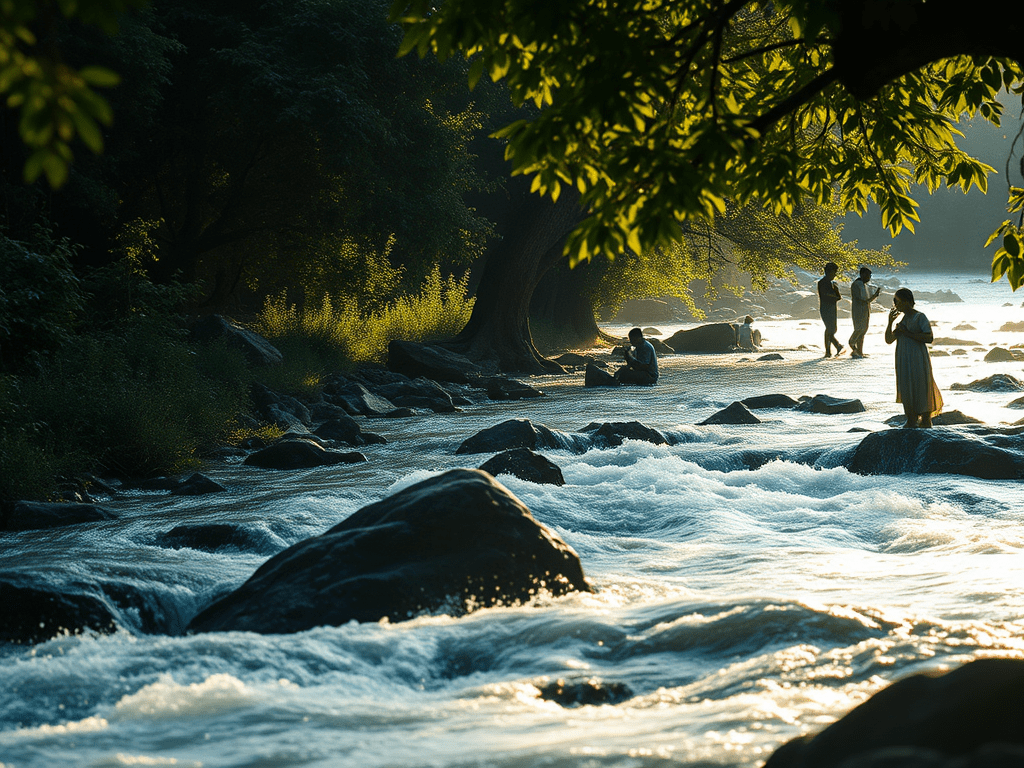
Skeena Rathor was a founder-member of the campaign group Extinction Rebellion, which changed the conversation on climate change in 2019. The group called for carbon neutrality in Britain by 2025. So the growing global emissions and worsening climate has been generating some reflection amongst activists. I invited Skeena to share her experiences and why she is now focusing on the importance of water. In the following essay, she shows how we can experience nature and climate as part of us, and vice versa, so we meet the challenges of social and ecological breakdown in a more holistic way. We publish on World Water Day to encourage attention to a wonderful new documentary on this theme: Water Is Love. Over to Skeena…
Water is more than just H2O. For times immemorial, many Indigenous and other wisdom traditions have regarded water as a living, spiritual entity, as a medium connecting the physical world with the spiritual, and as an essential force that sustains all life. For example, the Akan people of West Africa see it as a divine energy, the Māori view rivers and lakes as living entities with spiritual significance and the Lakota tradition reveres water as “the first consciousness bestowed upon Mother Earth” (Tiokasin Ghosthorse).
For me personally, these aren’t abstract philosophical concepts. Through the Rishi Sufi tradition of my family and ancestors, I’ve been blessed to grow up experiencing water as the sacred initiator and vessel for our prayers and the element that brings all of life together. We are asked to enter a prayerful state only after a water blessing – our water puja or Wuzzu. We are also raised with the instruction that the greatest honour we can have bestowed upon us is to receive water from another and in turn it is the greatest gift we can give someone else. We are asked to pray with waters as our keeper as we pray on mother earth, under grandfather sun and grandmother moon and our star parents as the way of entry into our connection beyond the human.
How would we remember ourselves as water; how would we move water, or even drink and wash if we regarded it in such a sacred way? What can water teach us as we try to repair ourselves and our broken world? How could restoring a heartful and soulful relationship with water transform our ecological movements and the ways we respond to climate breakdown?
A stunning new documentary, created by Tamera Media, offers us some powerful starting points. “Water is Love: Ripples of Regeneration” follows a group of young people shaken by the climate crisis that come in touch with elders and ecological practitioners from around the world. Through an original animation and vivid portrayals of ecosystem restoration projects in India, Kenya and Portugal, the film highlights the huge potential that local communities have in coming together to regenerate landscapes and water cycles, localize water supply and our economies and, on that basis, build a post-capitalist infrastructure. The film demonstrates a transformative act of ‘Co Liberation’.
But “Water is Love” is more than just another informative ecological documentary that gives you facts and solutions. Maybe more importantly, “Water is Love” will enchant your heart with the sheer beauty and mystery of water. It will give you a felt sense of what our world could be if we learned to align with the wisdom of water’s meandering flow.
For those involved in the Deep Adaptation movement — focused on embracing the inevitable societal collapse caused by climate breakdown while adapting to a new, respectful and regenerative way of life — this documentary holds great relevance. I believe that water is — or needs to be — at the heart of Deep Adaptation.
Here are three essential takeaways:
#1: “Water shapes climate”
Water cycles are fundamental in regulating temperatures and ensuring balanced precipitation, as is also demonstrated by the work of Michal Kravcik, Walter Jehne, Antonio Nobre, Zachary Weiss, Millan Millan and others. Summarizing their research, “Water is Love” shows through a beautiful original animation how ecosystems, particularly forests and wetlands, play a crucial role in maintaining a stable water cycle by facilitating the evaporation and transpiration of water, which helps cool the atmosphere and moderate temperatures. This process, known as “evapotranspiration,” not only creates a natural cooling effect, reducing the extremes of heat, especially in tropical and temperate regions. In a phenomenon now referred to as the “biotic pump”, vegetation also creates small water cycles over land which draw in clouds formed over the sea. For example, much of the water that supplies the Amazon rainforest gets sucked in by the forest itself—the evapotranspiration of billions of trees creates small water cycles and an air current that draw in “flying rivers” in the sky, from the Atlantic Ocean.
In addition, forests give off bacteria and pollen, which are transported high into the atmosphere through evapotranspiration, where they act at condensation nuclei so that clouds can form. As Jem Bendell explains in Breaking Together, this cloud seeding was considered a local process and wrongly downplayed in discussions of global climate. Now we know that pollen from the Amazon is found in the snows of Tibet, proving what a global phenomenon this is by increasing the albedo or reflectivity of our planet. The drop in Earth’s cloud cover as the solar cycle blocked more cosmic rays from aiding the formation of clouds was predicted two years ago in Professor Bendell’s book. Such analyses don’t reduce concern for CO2 and CH4 but widen the agenda to encapsulate the important of water cycles, clouds and, therefore, the forests.
One can summarise this ecologically-minded understanding of climate change in the language of Gaia Theory, where healthy, diverse ecosystems function as self-regulating systems that create the very conditions they need to sustain themselves, including apparently “environmental factors” such as appropriate rainfall and balanced temperatures. Water cycles and ecosystems are Earth’s natural climate regulating and cooling systems. And they allow for considerable resilience and adaptability in the face of stress and crisis. Within intact ecosystems and water cycles, there will hardly be drought or flood as they can balance heavy rain events or extended dry spells. Yet, when ecosystems get degraded—be it through deforestation, overgrazing, monoculture, pollution or urbanization—those balancing and regulating functions are lost. It is quite ridiculous that ‘carbon tunnel vision’ has led to influential people dismissing any concern for the role of deforestation as unscientific and irrelevant.
“Water is Love” shows that the extreme weather events now hitting the planet at ever greater frequency and intensity—whether Los Angeles’ beyond-devastating recent fires, drought in 40% of the world or catastrophic flood—aren’t just the result of the greenhouse effect. They happen when vegetation gets stripped away and water cycles collapse. We can reattune our climate narrative to recognise we are experiencing water cycles collapse.
Subscribe / Support / Study / Essays
#2: We can cool our planet through decentralized community-driven water management
Climate justice movements have focused on carbon, climate and collapse. The new film “Water is Love” asks: What could become possible if we focussed on water cycles, ecosystems and local communities instead?
It is true that we need to acknowledge how carbon emissions drive climate breakdown which is contributing to the creeping collapse of modern societies— and prepare sensibly for what that might entail. But that train of thought can also become a limiting narrative if it’s the only lens through which we make sense of reality.
It has been a deliberate learning for me as someone from an “outsided” culture to relate to how our dominant culture tells stories and to notice how I have struggled to feel an affinity with the chosen headlines describing the science of our collapse chosen by the IPCC and Western environmental movements and institutions. In our story of climate breakdown that drives societal collapse we have focused on what we have taken, done and destroyed rather than what we haven’t taken care of – ourselves as water and our waters from where we come. We have spoken to the science of CO2, a story hard to access and feel for most human beings. We have mostly spoken outside the sense of our relationality. We have reduced our predicament just as Western epistemological styles do.
By continuing with the climate story as it is, which is now owned and manipulated by the war and domination system, we run the risk of being co-opted by capitalism’s ontology (“Earth as an inanimate rock,” “an intelligent machine,” “resource” or “passive stage for humanity”) and trapped in its alleged “solutions,” coming to believe that at this level of urgency only the kinds of large-scale centralized programs and tech fixes are possible, which big capital alone can administer: Solar panels and electric cars at best, careless geoengineering at worst.
But as many have pointed out, climate breakdown is not only carbon-made, it’s above all capital-made: Even if we stopped all carbon emissions today but continued operating within an economic system bound to perpetual GDP growth, we’d still face ever more catastrophic climate disruptions, because we would continue to tear up Earth’s ecosystems in capitalism’s insatiable hunger for ever more consumption.
“Water is Love” reminds us that a genuine, effective response to the climate crisis must offer a way-out of capitalism (and its fathership of mass colonialism) and concentrate on regenerating Earth’s climate regulating and balancing systems.
Restoring water cycles, ecosystems and communities isn’t only the best way to sequester carbon, cool our atmosphere and localize our economies. It may also enable us to create togetherness and resilience, build ecological or pluriversal “naturi” or “matri” – cultures and heal the disconnect from life that I believe is at the root of the climate crisis.
One of the projects that “Water is Love” portrays is Tarun Bharat Sangh in Rajasthan, India: Reviving Indigenous practices of rainwater conservation, medical doctor-turned-ecologist Rajendra Singh sparked a massive grassroots movement for restoring India’s driest and most desertified area. Within one generation, they created a dozen thousand decentralized rainwater harvesting structures that allow the rainwater to filter into the ground and replenish aquifers. As water recharges the ground, vegetation and springs return. That way, decentralized rainwater retention revives broken water cycles. In Rajasthan, the results have been stunning: Tarun Bharat Sangh greened thousands of square kilometres of desert, made dried-up rivers flow again all year and lowered regional average temperatures by 2-3 degrees, while hundreds of thousands of people can live off their lands as they enjoy regenerative water and food sovereignty.
With accelerating climate breakdown and catastrophically insufficient government action, I feel it’s urgent we realize: If such regenerative water and land management practices were applied at relevant scales, we could help to cool far wider areas and ultimately the global climate – perhaps even in one generation, as they did in Rajasthan. Tarun Bharat Sangh’s founder Rajendra Singh says: “Decentralized community-driven water management is the solution for the 21st century crisis of water.”
#3: Restoring of waters is healing broken relationship
This crisis of water is not just an external crisis or crisis outside who we are now. Our water crisis is perhaps the heart of the heart of the polycrisis and the global health crisis. It is at the heart of our collapse of aggregate intergenerational trauma and at the very centre of our crisis of and in relationships.
Nearly two years ago I entered into a personal breakdown precipitated by the novel coronavirus and before that a grief breakdown that included experiencing the loss of Extinction Rebellion to both systemic oppression and infiltration, six weeks before losing both my parents within 90 days of each other. This collapse showed itself in many ways, a heartbreak that played out as myocarditis and a rupturing of my endothelial linings in the gut, brain and central nervous system causing dyings, failings and misfirings within my neurotransmission systems affecting my serotonin and dopamine pathways. My autonomic nervous system collapsed and I was unable to regulate my breathing, temperature, heart rate, blood pressure and lost fluent coordination of movement and balance with nerve and sensory loss throughout my body.
As an enculturated member of western belief and thought patterns – as a trauma therapist and body and brain development teacher with decades of experience in self-regulating practices I believed I could heal myself in this “thoughtful and intelligent” way. I “thought” it was merely a test of “healer heal thyself”. But there was a baseline of regulation that I couldn’t get past. I was too dysregulated to get a handle on regulation practice, even human co-regulation wasn’t working. Insight came to me through water and in how I was relating to water. No matter how much water I drank I was unbearably thirsty.
My heart felt magnetised towards water because my body wanted water and I was dreaming day and night about being in water with Daddi Umma (my grandmother). I started noticing that I could contain my thirst and I would start to regulate when I prayed and drank straight from a natural spring water source near our home. I also noticed that when I prayed as my ancestors had taught me to – after a water puja/blessing on the land, I would enter a window of regulation in which I could find some focus on healing.
I slowly gained strength knowing that water was my healer and knowing it was my own water body that was my healing vessel. As I grew stronger, I started to research and connect back into my trauma training connections and found that what is most alive in current trauma research and therapy is healing practices focused on regulating, moving and clearing our inner water flow. Our water bodies also respond rapidly to sound resonance and coherence work and as they do so they create the conditions for repair and recovery.
The World Health Organisation asserts that neurological disease is now the leading cause of ill health worldwide – stroke, migraines, depression, anxiety, Alzheimers and Parkinsons are all linked to neurological disturbances. All of these conditions affect our memory, fluency and coordinated being. We are becoming a highly dysregulated, discoordinated species that is literally forgetting who we are. I’m suggesting that what we are seeing is the physical manifestation of a toxic traumatic load in our own water bodies that has become overwhelming and is propelling us into a dying process. From the deepest parts of ourselves we are both drying out and poisoned waters. I believe that water holds all memory and creates all possibilities for life to flow. Truly and deeply water IS LIFE. At the molecular level we are more than 99% water but as we dry out and lose the flow and clarity of our water we are losing the vitality and memory of who we are.
What has this to do with relationships? After losing XR, Gail Bradbrook and I have been writing a root cause story about our times of breakdown and polycrisis. In this story we examine the homo sapiens journey through the lens of the mothering principle (non-gendered). The story we tell is of a species that is destroying its evolutionary biology and neurobiology through the story of lost mothering/fathering and masculine and feminine harmony and merging. The story of a species that is in constant postures of attack and defence because it has lost what Darcia Narvaez elucidates as nine principles of the homo sapiens evolved nest that has held true for 96% of our her/history and that allow us to deeply trust life and our place in a greater web of life. Where we realise our essential and beautiful place in the “hoop of life,” as indigenous elder Pat McCabe calls it.
As we collected this story I was reminded of a vision I had after teachings from an aboriginal brother who we had invited to be with our Regenerative and Visionary Cultures team in XR. He described trauma as debris in our water bodies both within us and in our earth and planetary waters. Water holds the memory of all life so it makes sense that collective age-old trauma is being held in our water bodies. I had a vision of water bodies that were dammed and stagnating, waters that had lost their flow, their rhythms, their energy and cycles and waters that were freezing toxicity because it was the only way not to poison the rest of life.
In vascular/circulatory and metabolic disease which is where neurological and nervous systems can go into dysfunction and degeneration, the flow of our water body is lost. Interestingly in my work as a trauma therapist, especially in relation to the collective systemic trauma of modernity, what I encounter most is the complexity of a collective “freeze response” and its related numbness, vacancy, unfeeling, dissociation and desensitisation responses and patterns. It’s similar to what Carol Gilligan and Naomi Snider in their work “Why Does Patriarchy Persist” name as unhealthy resistance. Where our sensing and feeling and therefore connecting is in collapse. When we can’t FEEL each other, our relationships fall apart.
This is perhaps why Audre Lorde said, “The white fathers told us: I think therefore I am. The black mother within each of us – the poet – whispers in our dreams: I feel therefore I can be free.” Here Audre, is bringing to our attention what happens when we lose capacity for feeling – we become servants of the machine mind. If we agree with Audre that we feel in order to be free, then restoring the freedom of our internal water communication and circulatory pathways will be key to restoring our capacity to “feel” and therefore to be free. Previously that wasn’t a claim one could easily back up with science. But there is exciting new research on how our water bodies hold various memories and states of feeling. There are important new insights on the fascia, which is the connective tissue just under our skin which holds all the cells and matter of our body together. It contains a watery gel, and is now understood by relevant specialists as one of our primary sensory and internal communication mechanisms. With this in mind, restoring our waters both locally and globally, is not only where we find inner health and relational health but also our liberation and freedom of emergence – the new life that wants to be born. Such an understanding resonates with many ancient traditions which regard water as the womb of life, where it matters how well our water is and also how well its rhythmic cycles and free natural flow states are.
An internal lack of flow and desertification is also how and why the joy, sensuality and ecstasy of resonance and coherence too often allude us, making relational life a superficial and bland affair. And as the uncontained joy of relating and relationships fall apart we become untethered, uninterested and disorientated to life. Perpetual feelings and experiences of un-belonging, separateness and powerlessness can persist. This all creates spirals of relational breakdown and loss. It might be fair to say that homo sapiens have become too highly non-relational and that our internal and external water states reveal the condition of our relational capacity.
This is how water truly is LOVE. It is the source of life and a vessel of our feeling.
When we speak of “ecology” in Western civilization, we often use a technical language that conceals its most basic principle: Ecosystems are communities of living beings and webs of relationships whose health and resilience relies on the strength of these precise relationships. The ecological emergency isn’t just a technical, economic or “environmental” issue; it’s a crisis of broken relationship.
What would a climate movement look like that embodies this understanding?
I am pleased to see a growing engagement with the issue of water quality within the environmental movement in the UK. This is primarily a reaction to the cavalier, sometimes criminal, actions of privatised water companies as they pollute the rivers and seas of Britain. It has led to action in Parliament, by MP Clive Lewis, and on the streets, with Extinction Rebellion activists in support. Whatever the response from government, this can be an important first step in bringing ‘the environment’ back home to our communities, our bodies and our spirit. Without acknowledging the dis-ease of broken relationship and committing to healing, we will likely end up perpetuating destructive patterns of modernity, patriarchy and ingrained racial prejudice. That can happen even with the best of our intentions, or driven by the conviction that given the urgency of the crisis, we have no other choice than the path we’re taking. Even regenerative solutions such as permaculture and the likes presented in “Water is Love” can fall into this category, when the underlying mindset is one that assumes that humans alone can know what’s to be done and what if waters knew what needs to be done?
But being in relationship with the living animate world is a different way of being altogether. One that invites us to abandon ideas of human centrality, in which Earth is reduced to being merely the “environment.”
The stories of regeneration which “Water is Love” shares are all processes of reconnection that leave people awe-struck by the intelligence of Earth’s design and re-enchanted by her wisdom and beauty. Such work isn’t motivated by improving carbon figures and temperature ranges. It’s rooted in something the rational Western mind can neither calculate nor predict.
I guess that’s why the filmmakers decided to call their work “Water is Love.“ When we recognize that we actually have a partner in the living web of the beyond-human world, the healing we so much long for can begin.
Whether that will be “enough” to turn around the tide of ecological and climate breakdown is hard to say. But restoring relationships is relevant either way, whether we will survive or not. What else would we do? And while there’s no certainty, I believe that restoring relationships is also our best shot at enabling a human future. As Joanna Macy reminds us, “We will probably not know in our lifetimes whether we are serving as deathbed attendants to a dying world or as midwives to the next stage of human evolution. We simply don’t know. So, what is it going to be? With nothing to lose, what could hold us back from being the most courageous, the most innovative, the most warm-hearted version of ourselves that we can possibly be?”
I sincerely hope it helps more of our friends in and around the legacy of Extinction Rebellion evolve our understanding towards an ecological approach to climate change, rather than the narrowly ecomodernist one which threatens to mine pristine wilderness to chase ‘fake green fairytales’.
Watch and share the film around World Water Day
The documentary “Water is Love” is such an important work that I wish all friends and participants in the Deep Adaptation movement, and anyone who cares about the climate crisis and our Earth, to watch and appreciate. This work speaks to such important aspects of the paradigm shift which our movements now need.
The film is now available to be streamed on its website. Please share it with your friends and consider organizing a local screening where you live, since this is a great first step towards building a local watershed community. Between now and April 22, the filmmakers will also conduct live conversations with thought leaders, activists, scientists and others. If you want to watch them, make sure to follow them on Instagram (@waterislove.film).
Skeena Rathor Kashmiri
(with grateful support from Martin Winiecki)
Previous reflections from Skeena Rathor on jembendell.com:
Hoarding Green Righteousness Will Not Get Us Far – dialogue will – on embracing curiosity and collaboration rather than smearing people who have more radical assessments of the environmental situation.
Act Now BECAUSE It’s Too Late – XR founder member invites us men to join – on inviting men to ally with women during the various protests where repressive tactics were being used.
An environmentalism from and for the majority – insights from women in #deepadaptation – a review of Skeena’s thoughts on a deeper and more radical environmentalism, written by Simona.
Donate to keep Jem writing / Read his book Breaking Together / Ask JemBot a question / Read Jem’s key ideas on collapse / Subscribe to this blog / Study with Jem / Browse his latest posts / Read the Scholars’ Warning / Visit the Deep Adaptation Forum / Receive Jem’s Biannual Bulletin / Receive the Deep Adaptation Review / Watch some of Jem’s talks / Find Emotional Support / Jem’s actual views on Covid
Discover more from Prof Jem Bendell
Subscribe to get the latest posts sent to your email.

[…] this blog in recent weeks (e.g. Dave Derby on building the commons, Malika Virah-Sawmy on local solidarity economies with a decolonial sentiment, and Skeena Rathor on new-yet-ancient identities of self and wider […]