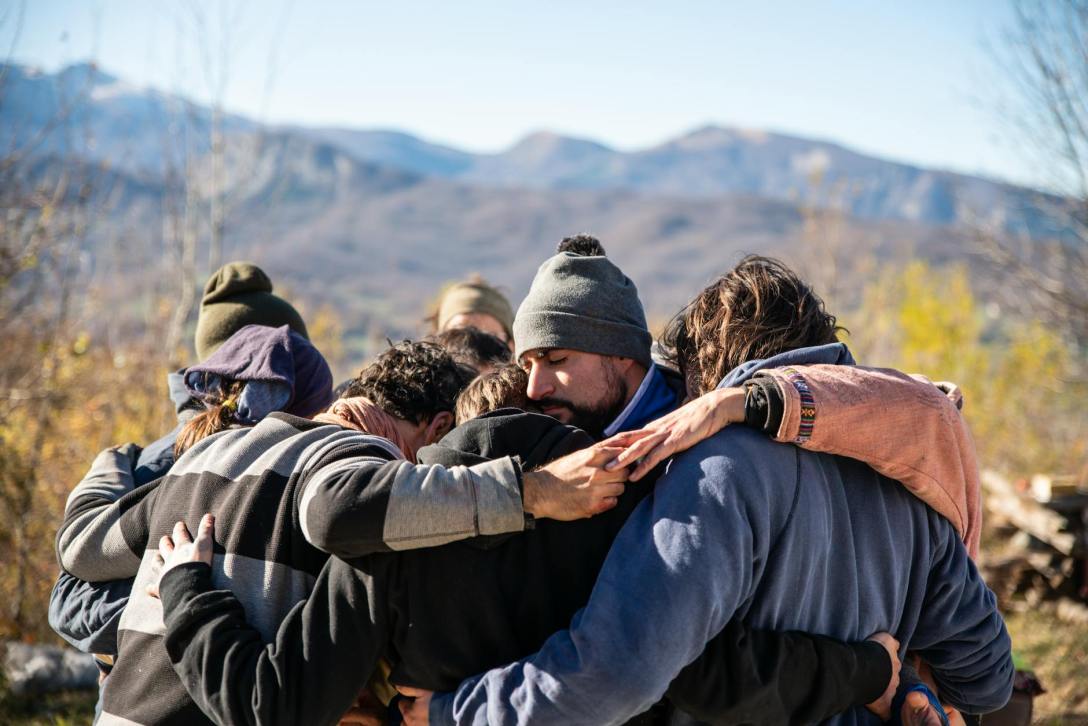
If it’s a “man’s world”, and that world is falling apart, what are men supposed to do? Be less like the men of our parent’s generation? Be more in touch with our feminine side? Give more space to women in our organisations and communities? Or could there be something more, perhaps of greater potential, for men to explore and to become? Are there healthy forms of masculinity that humanity needs in a fracturing world? I think so. And that’s the subject I want to share some thoughts on. To share publicly on this topic is new for me, and so I’d welcome your feedback (this blog is open for comments).
The ‘metacrisis’ – or early-stage societal collapse – is experienced by most of us as more difficulties and disruptions in politics, economics, culture, health and the environment. However, the utility of the ‘metacrisis’ term is in pointing to the interrelatedness of the troubles, and an underlying crisis in the common assumptions, values, beliefs, norms and habits of our societies. Unfortunately, some social commentators avoid that deeper critique when they use the term ‘metacrisis’ to speak of a degradation of the traditional values and economic structures which privilege people like themselves. Contrary to that view, many of us have concluded that the dominant cultural order where men and qualities associated with men are privileged in society (AKA patriarchy) is part of the problem. I covered some implications of that previously, including the importance of listening and learning more from women leaders and Indigenous elders. But that is not the sum total of the implications for men. Instead, a “healthy masculine” could emerge from the crucible of this metacrisis, and I am already seeing dimensions of it. In this essay I will share thoughts on that, arising from personal reflections and participation in both men’s groups and other support groups.
I’ve written this essay partly as a response to having met men over the last few years who seemed to lose their ‘footing’ when introduced to deep critiques of their identity as white Western males. In some cases they substituted their past certainties by following agendas set by individual women — often usefully, but sometimes involving their uncritical deference to authority. In other cases, I witnessed men rejecting critiques and embracing ‘anti-woke’ calls to reassert their cultural privileges without guilt or moderation. Sometimes that has arrived with vaguely moral assertions that privileging masculinity as we do in patriarchal societies is good for everyone, or the only cultural option available to us. I believe that if there were more ideas about the healthy masculine, and ways to be supported in expressing that, then there could be more positive outcomes from the unsettled feelings that some men experience within the metacrisis. That was one reason for creating a set of Oracle Cards with a friend, Dean Powell, who trains men on how to host men’s groups. It is also some of the thinking underneath the design of the peer mentoring in the Metacrisis Initiative. But now I wish to share some more of that thinking for discussion and development.
Before considering masculinities, we could usefully consider what qualities become more important for all of us as, whatever our gender, as societies become more unstable. Therefore, in my next essay I will explore how any of us might ‘show’ up better in a context increasingly typified by limits, loss, and instability. In this essay, I will focus on what can be regarded as qualities and transformations particularly relevant to men in a metacrisis. At 4000 words, it’s a bit of an ask for you to get through it — but I think the subject is crucial to how we might soften disruptions and collapse, whether locally or wider than that.
Shifts in our understanding of masculinity
Over the years I have experienced some of the ways that male friends of mine have been exploring what it is to be an emotionally healthy man, without accepting the patterns of the past or becoming paralysed by the critiques of those. They easily express their care, receptivity, and intuition, along with other attributes often associated with the feminine. Nor do they express any sense of competition with leadership by women. They have been focusing on how to live their lives in meaningful ways with integrity. The themes that emerge from their experiments in reclaiming a masculine identity for themselves can be regarded as transformations of qualities that patriarchal cultures have associated with men. I will share them here before reflecting on the extent to which they are qualities that could help us within metacrisis and collapse. In doing so, I am not claiming that such qualities are inherently male, nor only male, but are regarded as particularly masculine in the cultures I’m aware of:
- From control to stewardship: shifting from needing order and managing outcomes to tending processes – for community and collective wellbeing – without assuming mastery.
- From suppression to containment: not the absence of emotion, but the ability to hold intensity (fear, anger, grief) without exporting it as harm. This is a disciplined, grounded presence rather than withdrawal.
- From individualism to solidarity: using strength (physical, social, economic, mental) in service of nurturing and protection of the less powerful: children, friends, communities, ecosystems.
- From certainty to humility: relinquishing the need to “know” or lead through answers, and instead cultivating an ethical orientation amid ambiguity.
Most of the male friends, within whom I have seen these four shifts, have not been particularly interested in either metacrisis or collapse. But I am a subjective observer with that metacrisis in mind as I identify those shifts. Perhaps, therefore, I am only seeing the shifts that are relevant to easing that bigger situation. Nevertheless, separately from any conversation about societal disruption and collapse, some men are undergoing transformations, and helping each other in that, which could also be useful for the difficulties unfolding around us.
The four shifts I’ve described are ones I like to think I’ve embodied in my professional efforts since the Deep Adaptation paper went viral in 2018. At first, a few people with money to fund projects wanted me to work on research papers on how collapse would unfold and to even establish a think tank. Others wanted me to be a spokesperson for advocacy movements on climate and collapse. Neither approach felt right to me and instead I focused on how to convene groups of people to help each other work out how to live positively with our difficult outlook on the future. Sometimes I ‘hit back’ at misleading criticism, as I mentioned in Grist Magazine. But that was because I thought I had a specific capacity for defending the legitimacy of the new networks and communities, and wanted to do my part. My defence was claimed by some as me being ‘patriarchal’, with the implication my arguments should be dismissed.
In my personal life, I don’t see these four shifts within me quite as clearly. I believe I am increasingly aware of my emotions, and open about them, without acting impulsively from them. I regard my collapse-awareness being key to pushing me in that direction. But if I compare my personal life to others, I am still individualistic, while striving for control and certainty in many areas. I don’t even want to shift such aspects of my character at this time. Reflecting on why, I notice my limited trust in how the world is, and how people are — something which might come from childhood (and I shared about previously). That’s a reminder to me that some patriarchal habits in men can arise from feelings of insecurity. It is something I’ll explore more on my own in future.
Reclaiming masculine qualities from patriarchy
Over the years, the lack of confidence I have felt in how to ‘be a good man’ rather than just ‘be a good person’ has not been helped by a lack of discussion about healthy masculine qualities. I have read books on positive versions of manhood, such as the book of that title by Steve Biddulph, but have not come across a structured assessment of the qualities associated with masculinity that can be reclaimed from the toxic patterns within patriarchy. That seems like it could be a useful exercise – so I will try it here.
Some of the qualities associated with masculinity in many cultures today include strength, protection, courage, rationality, productivity, merit and authority. I am interested in how we could disentangle those qualities from the habits of dominance, extraction, and status performance that typify the culture I’ve termed ‘imperial modernity’ (previously in my book Breaking Together). For each quality, I will explain the potential evolution for the current context of societal metacrisis, and give an illustration from some men I know personally.
True strength: Not force or invulnerability, but load-bearing integrity. This is the capacity to stay present to difficulty (material, emotional, moral) without denial, displacement or depression. It involves the capacity to remain open-hearted in conditions that could invite shutdown, cynicism, or aggression. It includes endurance, but also permeability: allowing grief, uncertainty, and feedback, to inform action rather than harden into rigidity. This kind of strength shows as reliability under strain, not spectacle. I recall a time when a friend’s business failed. He did not rage or retreat into silence. One morning, after tennis, he told me that he had chatted with his teenage son the day before about how he was feeling sad, scared and ashamed. He wanted his son to know that feeling like that, and expressing it is not weakness. He told his son he would try again.
True protection: Not control or paternalism, but attempts at safeguarding the conditions for life. This is anticipatory and relational: reducing harm, buffering shocks, and prioritising the vulnerable (people, species, places) without seeking obedience or loyalty in return. This kind of protection operates through stewardship, boundary-setting, and solidarity, not ownership. Over the years, I have had the benefit of seeing some men facilitate gatherings with this quality. They establish agreements on how to interact and then, without fanfare, swiftly and firmly remind anyone who deviates from those agreements, thereby enabling fair and fluid participation.
True courage: Not conquest or risk-seeking, but bold truth-aligned action under uncertainty. This is the willingness to face social, material, or reputational cost in order to act with integrity, such as speaking honestly, withdrawing from harmful systems, or stepping forward to serve, without guarantees of success. I thought of this when hearing from a friend who had previously worked in construction. Back then, racist jokes were routine, but at one point he couldn’t let it slide. He told them that although he’d laughed along for ten years it had to stop. He lost a couple of friends on the crew, but knew it was the start of a better way of working.
True rationality: Not narrow instrumentalism, but context-sensitive discernment. The ability to reason with multiple ways of knowing: empirical evidence, lived experience, ethical reflection, and intuitive knowing. This kind of rationality recognises uncertainty, avoids false precision, and resists optimising one variable (e.g., profit, efficiency) at the expense of system viability. It might be upsetting for some people to read me write about this, but most of the guys in my men’s group disputed the claims and policies from medical authorities during the early years of the Covid-19 pandemic. They took the time to assess the questionable logic behind some policies, find the relevant data, and learn about existing pandemic response plans. Rather than suspend their judgement to avoid being shamed, they chose personal responsibility and sought to help their neighbours with advice and health support (both physical and mental).
True productivity: Not maximising production or ignoring its consequences, but bringing intentions into reality while leaving relationships intact or strengthened. One’s desire to act and provide is applied to meaningful ends within real ecological, social, and personal limits. This kind of productivity includes ongoing awareness of context rather than clinging to outmoded plans. In my time as a newbie organic farmer, I have met many men who adjust their commercial expectations to the realities of partnering with nature rather than dominating it. There are more risks, and less quick financial rewards, but the outcomes are multiple and important.
True merit: Not credentialism or competitive accumulation, but contribution to collective understanding, healing, and betterment. Worth is evidenced by what one helps defend or regenerate (such as soil, trust, friendships, skills, mutual aid, cultural coherence), especially under stress. It privileges usefulness, humility, and teachability over status signals. This kind of merit can involve commitment to something larger (truth, community, or the sacred) without the need for recognition or legacy. As I considered this quality, I immediately thought of one of my close friends in the UK, who drove a taxi for 20 years. He didn’t have a University degree, and when he chose to study one of my courses, was interested in the learning and the relationships, not the certificate. Driving a cab meant he could discuss all kinds of ideas with people from around the world, and share his wisdom with those who wanted to hear — a kind of guru taxi driver.
True authority: Not dominance or positional power, but earned trust and accountable guidance. Authority arises from demonstrated care, competence, and coherence over time. It invites scrutiny, distributes decision-making where possible, and remains accountable. Its legitimacy is continuously tested by outcomes for the whole, not by titles. When I was a tutor at the University of Bristol, a friend of mine was studying to be a teacher. I still remember a story she told me which seemed ‘far fetched’ but captures this notion of earning one’s authority. She said a head teacher had been asked to consider suspending a student who was often sleeping in class. Instead, he worked out that the boy was homeless and was often sleeping in his car. Identifying that the child was at risk, he worked with relevant services and friendship networks to find the youth accommodation as well as after school activities.
Across all seven of these enacted qualities, a common thread is finding power-within and power-with, rather than power-over. They each require receptivity as much as projection. They involve exercising capacities in ways that ground oneself, maintain relationships, respect limits, and enable others to stand, adapt, and participate. They are qualities that correspond to the biological attributes of men relative to women, upon which male archetypes have emerged across cultures. That does not mean they are only accessible to, or admirable in, men but they are usefully witnessed in men without limiting us to the patriarchal expressions of them.
Why useful, you might ask? I think a benefit of naming some shifts in behaviours, and reclaimed qualities of masculinity, in the way I have done in this essay, is that they help us to recognise ourselves and each other, to then gain support, or provide it. The drawback of listing them is they can come to be regarded as the way we should behave, and thus enable new kinds of oppression and performativity. That risk is greater for attributes associated with the ‘healthy masculine’ or the ‘healthy feminine’, as some of us will want to appear attractive and admired within gendered stereotypes. However, I’ve concluded there is little we can do to avoid people with (perhaps momentary) craving egos from relating to lists of attributes in that way — so that shouldn’t hold us back from discussing them.
Deeper benefits of masculine archetypes for our challenging times
Recently I have been reflecting on the idea that there could be a far deeper benefit from discussing the healthy masculine, as we reclaim the sacred or divine aspect of the male form from religions that are deeply intertwined with patriarchal control. For instance, it is obvious to anyone who looks into it without the blinkers of dogma, that Abrahamic religions of Judaism, Christianity and Islam have each downplayed, deleted, or pigeon-holed, the feminine dimension of the divine. One example is how the early formation of the Christian Church excluded a text about Mary Magdalene that was guiding groups of Jesus-followers in Egypt and elsewhere, along with the associated emphasis on a direct experiential connection with the divine rather than one mediated by a clergy who we should obey. Throughout the centuries, counter movements to patriarchal religious imposition have often equated a reverence for nature as involving the worship of female and/or feminine qualities. However, that is an incomplete response. Our environment, and the whole of Planet Earth, involve both male and female forms in the processes of creation. Thus, we live as much within Father Earth as we do within Mother Earth. Any hangovers in our culture of the ‘sacred masculine’ being assumed to be separate, remote, and single-minded, actually restrict men today from celebrating the fullness of the male form, and our embodiment of it as male human beings (something noted by other writers on contemporary masculinity). Some cultures have a history of iconography related to this, including images of the ‘Green Man’ across Europe and Asia, and a variety of demigods in animist and Indigenous religions across Latin America and Africa.
Christianity offers us a more ‘upclose’ divine masculine in the form of Jesus, although not explicitly connecting him to processes of the natural world. When the Roman Empire institutionalised the views of St Paul about the identity of Jesus as a demi-God, or even fully-God, for followers to worship, Christianity implied Jesus was (and is) somewhat separate to us humans. Instead, if we regard him as a masculine expression of enlightened humanity, we can more easily celebrate that as a potential for manhood in our own societies.
Outside of an Abrahamic religious context, men can look towards a variety of earthly-yet-divine masculines, in the figures of Lao Tsu, Siddarttha Gotama, and more. Their teachings don’t require a separation between material or natural, on the one hand, and spiritual on the other (despite subsequent distortions). Therefore, I have begun to wonder whether men who cling to unreconstructed notions of the divine masculine are denying themselves a huge part of their own potential spiritual experience of being alive. Instead, we can come ‘home’ to the aspect of divine consciousness within ourselves. Personally, I feel like I am entering a process of liberation by recognising that.
Transforming societies around gender roles during metacrisis
I have avoided talking about it thus far, but I know the field of scholarship and activism on gender is huge, involving strongly-held theories and heated debates. Some readers might regard my exploration of a healthy masculine as a pointless task within patriarchy, while others might see it as essential for dismantling patriarchy. Some readers might see the focus on masculinity as yet another form of male-centrered attention, while other readers might see that it is about time I shared publicly on this topic, after my previous essay on women’s leadership, and more than two decades after I began working on women’s rights and feminist-informed methodology. Some may regard the ideas in this essay as wrongly seeking to stabilise either “masculine” or “feminine” as meaningful polarities of identity, whereas others may see me as not sufficiently exploring how the biological differences between the sexes mean we need greater differentiation in our understandings of healthy identities. I regard some of the aggression in such discussions as reflecting trauma, on all sides, and unhelpful for our attention to positive change. Mentioning that trauma might deepen the annoyance of some readers, but, as I mentioned in my last essay on women’s leadership, sometimes us men need to not shy away from receiving unfair criticism, and not react aggressively to it — as we haven’t been on the sharpest ends of patriarchy.
With all of those lively discussions about gender in mind, I want to reiterate that, for all of us, whether men or women, a useful deconditioning from our upbringing and contexts, must include a steady relinquishment of either the orientation towards, or admiration of, dominance, denial, and disconnection, in favour of grounded, relational, and quietly courageous participation in a world that is no longer coherent in the old terms. Such deconditioning doesn’t need us to drop recognition of biological differences and how to positively work with those.
When I have discussed these ideas with friends, the conversation has often turned to how society might change. Spreading the ‘healthy masculine’ across a fracturing society cannot rely on simple generational replacement, as younger men are also susceptible to retrenchment into patriarchal backlash when anxious. Top down messaging about a healthy masculine is also unlikely to happen in current societies. Perhaps, then, we need to turn to prefigurative politics — enabling and embodying the desired norms within micro-communities first, rather than waiting for macro-shifts. On the one hand, men’s groups can be where the reframed masculine qualities and personal shifts can be supported. On the other hand, community groups, eco-villages, religious associations, activist groups, and peer mentoring circles can seek to embody the kinds of qualities that will help in a metacrisis, whatever our sex or gender. That is something I will return to in my next essay.
Collapse-aware communities are ripe for this work, yet my experience is that some of them default to either male stoicism (practical survivalism) or feminine-coded emotional expression (grief circles). We should not ignore how the groups that focus on emotional processes are mostly populated by women and the groups focused on practical prepping, or on calculations of the risk and processes of collapse, are mostly populated by men. To address that, I recommend that those of us working with the Deep Adaptation framework include the reclamation of masculinity from patriarchy within discussions and projects related to the 5th R of the framework. This can also be something we talk about in our podcasts, blogs, and social media. Conceptual discussions like this essay can be useful foundations, but sharing our examples will be more impactful, along with our participation in relevant initiatives. Crucially, spread will happen not through shaming old masculinities but through making the ‘healthy masculine’ visible, attractive, and useful.
As I covered a lot of conceptual ground in this essay, I did not include much discussion of my own experience. When discussing a draft of the essay with a friend who is a coach with some experience of men’s work, he encouraged me not to leave more personal reflections to a future essay. That got me thinking: is living within and from a healthy masculine identity a priority for me? Rather than it being a joy of my own evolution, I sense it might involve new risks of pain, restriction, and boredom. That feels awkward for me as I learned to be who I am with many privileges. Conversely, such a focus could seem an indulgence when there are other things to do. To prioritise this agenda, I would also need to be more confident about the shifts and qualities I’ve described in this essay, via receiving critique or validation by some experts and elders whom I respect. Perhaps, then, putting this essay out into the world will help that process of building my own confidence in the importance of what I’ve described, and help my own journey into healthy masculinity. Let’s see.
If you are interested in this topic, there are some interesting podcasters exploring such matters. I recently appeared on two of them: reskillience and wisernow.org. In addition, for men, I recommend seeking out a Men’s Group that explicitly seeks to support its participants to express a healthy masculine and doesn’t regard that as being in opposition to feminist concerns. You could share this essay with the organisers to get their reaction. If you want to find a ‘collapse aware’ Men’s Group, you will probably need to start one. Perhaps that could be done under the umbrella of Deep Adaptation. And if you are a woman and have found these ideas to have merit, then I encourage you to share them with the men in your life. Additionally, whatever your gender identity, you would be welcome to join a future cohort of the peer mentoring in the Metacrisis Initiative. I’m looking forward to us discussing these ideas in our next monthly online salon.
—
You can listen to my journey via Reskillience, with Catie Payne, or, more extensively, with Carlotta at WiserNow.
Discuss these issues with us by registering for the Metacrisis Salon on May 4th and 5th.
Comments on an earlier draft of this essay were gratefully received from Kaliya Hamlin, Chris Taylor, Ilena Young, and Matthew Slater.
Discover more from Prof Jem Bendell
Subscribe to get the latest posts sent to your email.

My comment doesn’t really respond to what you’ve written, Jem, but I think it’s an important consideration. It’s tempting for me to write, “I don’t think that you can discuss the concept of ‘metacrises’ without discussing capitalism”. But of course that’s patently incorrect, nearly everyone who uses the term does – and therein lies the problem. I’m not diminishing the issue of masculinity/what it means/toxic masculinity etc. but for me the principal explanation for the occurrence of multiple crises at the same time over much of the globe is our current economic system.