4 better or 4 worse? As XR nears its ‘big one’

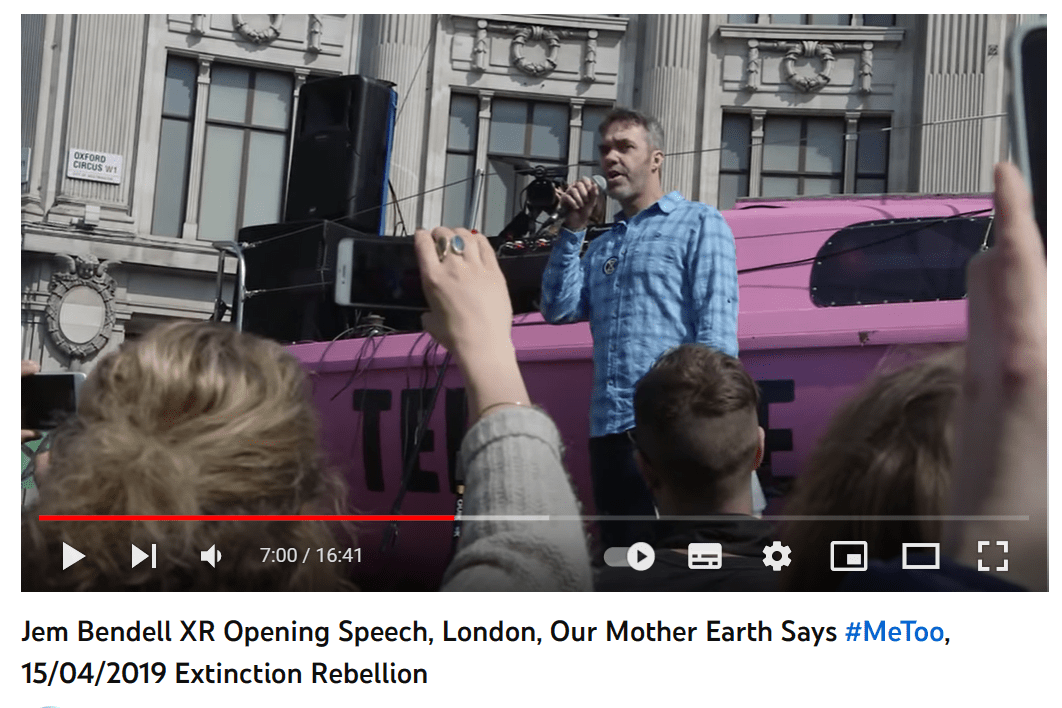
Four years ago I stood by the pink boat of truth in Oxford Circus to give the opening speech at the international rebellion against governmental crimes against humanity for inaction on the ecological and climate crises. The video of the full speech:

Four years on, many of the activists who have been involved in XR since that time have been reassessing how they will engage in future. The former finance lead of XR UK, Andrew Medhurst has written up his reflections, where he also summarises some of the new strands of work – showing how movements evolve due to successes and failures. I share my own journey in a book that is now on sale (ahead of free release as an epub in July). It is called Breaking Together: a freedom-loving response to collapse” – a title that I hope conveys some of the ideas. It has entered the Amazon bestseller charts at #1 in its category ‘political freedom.’ That category fits, as I map out a very different agenda to the one that has hijacked Western environmentalism in the last decade. That is the now-dominant agenda telling us that technology, enterprise, surveillance, restrictions and the schemes of billionaires, are the way ahead, and so we must force each other to stay hopeful and compliant. As co-founder of Extinction Rebellion, Clare Farrell, has explained “if you want to save some of the world, but hate being told what to do, this book is for you.” She is encouraging everyone out for the ‘big one’ in a couple of days. I am pleased to see a range of environmental groups supporting their effort to remind leaders of the level of public concern about the climate and ecological crises.

I remained convinced, however, that unless the green movement escapes its deference to the establishment and stops looking down on whomever corporate media tells us to, then there is no chance of a truly society-wide mass mobilisation for radical social change.

Continue reading “4 better or 4 worse? As XR nears its ‘big one’”

I was wrong to conclude collapse is inevitable…

I was wrong to conclude collapse is inevitable… because when I was concluding that, it had already begun.

When I concluded that societal collapse is inevitable, nearly 5 years ago, it may have been one of the reasons my Deep Adaptation paper attracted unusual attention. Many people agreed and thanked me for expressing that conclusion publicly. They said it helped validate what they already felt, and so enabled their emotional processing and to change their lives accordingly. Other people chose a variety of ways to disagree. Some claimed I was not being scientific to claim an inevitable outcome, and instead language like “near certain” or “very likely” would be more appropriate. Others preferred to regard societal collapse as a possibility, as they wanted to hope for a managed transition to a new form of society. Unfortunately, other people misrepresented what I wrote. To recap: in the paper I did not claim that we faced inevitable near-term human extinction and did not claim that the inevitable collapse would happen by 2028. Instead, in that paper in 2018 I wrote: “Recent research suggests that human societies will experience disruptions to their basic functioning within less than ten years due to climate stress. Such disruptions include increased levels of malnutrition, starvation, disease, civil conflict and war – and will not avoid affluent nations.” In 2023 many experts and UN officials are saying similar.

I summarised my position thus: “Currently, I have chosen to interpret the information as indicating inevitable collapse, probable catastrophe and possible extinction.” I then warned against the trap of concluding inevitable human extinction: “I have witnessed how people who doubt extinction is either inevitable or coming soon are disparaged by some participants for being weak and deluded. This could reflect how some of us may find it easier to believe in a certain than uncertain story, especially when the uncertain future would be so different to today that it is difficult to comprehend.”

Continue reading “I was wrong to conclude collapse is inevitable…”

Atlas Mugged

The following is an extract from the book ‘Breaking Together: a freedom-loving response to collapse’, where I discuss the potential meanings of the ‘Kintsugi Atlas’ image on the book’s cover.

Subscribe / Support / Study / Essays

The matter of the collapse of industrial consumer societies is not only extremely inconvenient for those of us who are enjoying its conveniences, but also deeply challenging philosophical and spiritually. After a few years of soul searching about aspects of our culture that are implicated in this tragic situation, I arrived at the paradox of our desire to ‘be someone’ and help each other. One way of describing this paradox is with Greek Myth. The image on the cover of this book is an adaptation of the oldest surviving statue of Atlas, a character from Greek mythology. From the 2nd Century before the Christian Era, it depicts him straining to hold up an orb, which in the contemporary era has been widely misunderstood to represent planet Earth. That misunderstanding may have begun in the year 1585 with the use of the word Atlas by Flemish cartographer Gerhardus Mercator, to describe his collection of maps of the world. On the inside cover of his book, there was a drawing of Atlas having removed the orb from his shoulders and mapping it in his hands.[1] With her famous book ‘Atlas Shrugged’ Ayn Rand may have misconstrued the orb as representing our world, and therefore used it to symbolise the weight of the world’s problems (such as parasitic bureaucrats) on otherwise strong and free people.[2]

Continue reading “Atlas Mugged”

BREAKING TOGETHER – a freedom-loving response to collapse

Breaking Together – a freedom-loving response to collapse is out in hardback and e-book as well as paperback and audiobook. If you use a kindle, you can order in the USA or in the UK or worldwide (by typing ‘breaking together’ into your ‘national’ amazon site). The book is also available as a free epub.

From the back cover:

“This is a prophetic book.”  Satish Kumar, founder, Schumacher College

This book shows that instead of imposing elitist schemes and scams, regenerating nature and culture together is the only way forward.” Dr Stella Nyambura Mbau, Loabowa Kenya

This book is part of a healing movement that extends beyond what we normally think of as ecological.” Charles Eisenstein, author, Climate: A New Story

Continue reading “BREAKING TOGETHER – a freedom-loving response to collapse”

Evidence and theory for how monetary collapse has been made inevitable

“At 8:30 p.m. on 23 March 2020, then British Prime Minister Boris Johnson announced a stay-at-home order effective immediately, backed up by the subsequent regulation three days later. The stated aim was to “flatten the curve” of the rate of infections. So, he launched the slogan “Stay Home, Protect the NHS, Save Lives” and said that the lockdown would be reviewed every three weeks. This was unprecedented and came as a surprise to the public. But a week earlier, on March 17th, the Governor of the Bank of England, Andrew Bailey wrote to the chancellor Rishi Sunak outlining a similarly unprecedented measure, which would direct tens of billions of pounds directly to large corporations:

“The new Covid-19 Corporate Financing Facility (CCFF) will provide funding to businesses by purchasing commercial paper of up to one-year maturity, issued by firms making a material contribution to the UK economy. It will help businesses across a wide range of sectors to bridge across the economic disruption that is likely to be associated with Covid-19, supporting them in paying salaries, rents and suppliers, even while experiencing severe disruption to cashflows. The Bank will implement the facility on behalf of the Treasury and will put it into place as soon as possible.”

Continue reading “Evidence and theory for how monetary collapse has been made inevitable”

Let’s chatGPT about gardening

After a two year research project, with an interdisciplinary team, the conclusions I came to on the state of the world, and our near future, are not that relaxing. They will be available in the book Breaking Together, out in May. One of the chapters is already available, preprint, as the matter of food security seems so urgent. [subscribe to this blog to get a link to the full book when it’s out]

That context means I am especially happy to have launched a demonstration organic farm, using an approach called syntropic agroforestry. It does not mean I will definitely escape the impacts of agricultural disruptions and the socio-political ramifications. But it means that at least I am doing something about it that will benefit both people and planet. 

As I’ve been writing so much for the forthcoming book, I’d rather garden than write about it, so I asked chatGPT to tell you all about the approach we are taking. The prompt was “Write a summary of many reasons (environmental and social) why syntropic agroforestry is a good idea. Explain why it is helpful to educate and support farmers in Indonesia to do syntropic agroforestry.” ChatGPT responded:

Continue reading “Let’s chatGPT about gardening”

It really is time to do more about food (and liberty)

It really is time to do more about food. As most governments aren’t acting, we can look to our own organisations, local councils and groups of neighbours to do more – and build from there. My new paper on the trends driving the breakdown of the global food system explains why. Endorsing the paper, the Contributing Lead Author for the UN Global Assessment Report on Disaster Risk Reduction, Scott Williams, notes:

“We are conditioned to fear disorientation and seek safety in certainty and solutions regardless of the information available to us. Breaking that protective screen, this paper adds to the weight of analysis that the collapse of food systems and societies more broadly is inevitable. But how we are in relationship with these changes is not fixed even if, as this paper argues, we are stuck. Perhaps what this paper is calling for is the spaciousness to ask new questions, to challenge habits and myths, that may then shift perceptions. Consequently, we could be in relationship differently with the inevitability of collapse, and sense the possibilities that are perceivable with renewed care, compassion and generosity to ourselves and to all life.”

I hope the paper might help inform the evolution of environmental activism. Co-founder, Extinction Rebellion, Clare Farrell, notes:

Continue reading “It really is time to do more about food (and liberty)”

No wealth but life – pig style

Have you ever wondered where the term ‘piggy bank’ came from? Like me, some of you probably saved your spare coins in them when children. I didn’t give it a second thought until I stumbled across an actual living piggy bank in Bali. Midway through a cycling tour, we had stopped in a traditional village, and invited into a family compound. It was the kind where multiple generations all live in small houses next to each other, with a temple at the front, and some animals at the back. That is where I saw pig sty with a half dozen pigs. “The older women here don’t like putting money in a bank, so they buy a pig and feed it as their way to save,” my guide told me. A sensible store of value, I thought, especially with interest rates so low at the time. After the trip, I looked up the origin of the term piggy bank. Some historians guessed the name came from jars being made of a clay that was sometimes called ‘pygg’ in Germany and England, and that was the theory on Wikipedia at the time (it was 2015). But I had seen in the Indonesian national museum a piggy bank that was around 400 years older than when the word pygg was being used in Europe for a type of clay. Maybe I am a bit strange, but the piggy bank origin story had me. I dug deeper to discover that the earliest known pig-shaped money containers date to the 12th century in Indonesia.[i]

Continue reading “No wealth but life – pig style”

Satish Kumar discusses Radical Love with Jem Bendell

Satish Kumar is an elder within the global environmental and peace movements. Founder of the Schumacher College and Resurgence Magazine, he has played a key role in shaping conversations about the roots of the environmental predicament. In a videoed conversation with Professor Jem Bendell, he discusses themes within his new book ‘Radical Love’ and makes connections to the ‘Deep Adaptation’ ethos and movement. Over 50 people joined the discussion and some ask questions towards the end.

Satish describes how humanity has fallen out of love with the world, which is the cause of so much destruction. Topics covered include how to stay open hearted when so much is being destroyed, how loving action does not need to expect to be successful, the role of idealism when realism has failed so badly for so long, the suppression of the divine feminine in culture and religion, and the importance of starting with self love.

Continue reading “Satish Kumar discusses Radical Love with Jem Bendell”

ChatGPT can’t pass an experiential knowledge exam

Because artificial intelligence software does not have real world life experiences to draw from, there should be no worry about its implications for academic assessment.

I see from my LinkedIn network that many academics are discussing what the implications from artificial intelligence could be for assessing their students. ChatGPT has even passed an MBA exam! Reading about this I was entirely unconcerned. Should I be? My lack of concern stems from how I have been designing courses and setting assignments for nearly 20 years. But rather than assume that my assessments are immune from the misuse of artificial intelligence, I thought to write up my approach and see if fellow academics can see any potential problems. If not, then hopefully me sharing my approach will be of use to others.

Continue reading “ChatGPT can’t pass an experiential knowledge exam”