Getting Ambitious About Partnerships

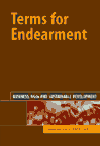
Cross-sector partnering for sustainable development has been around a while now.. its 13 years since the first book on this came out, that I co-wrote with David Murphy, and 10 years since the first edited collection on the topic, which I rather artistically but confusingly titled “Terms for Endearment”.

To mark the 10 years, but also to kick start some reflection, I asked some of the contributors to Terms to provide reflections 10 years on. They all talk about how partnering became a key part of the landscape of civil society, of corporate responsibility and of sustainable development policy, but how its not achieving enough, and not as much as what we felt it could when we got excited enough to focus our time on it, as either practitioners or analysts.

That’s not to knock cross-sector partnering and the work we have done in the past or what partnerships are achieving today.. for instance, helping create the Marine Stewardship Council remains one of my career achievements, even though it was still my first year after Uni (not sure what that says about the subsequent years!) The MSC, a sustainable fishery accreditation council, is doing well, but it wont save the world’s fisheries, and so we have to reflect on what these partnerships can achieve in future to meet the scale and urgency of the challenges we face. We will be hampered in those reflections if we fall into a trap of what I call “partnerism” in a special issue of “Business Strategy and the Environment”. By “partnerism” I mean a belief, a mood even, that partnering with others is good in and of itself, so people favour being convivial and forever hopeful to keep the partnership going, rather than critically reflecting on whether it is delivering sufficient change on the ground (or in the water).

To help with that, and call for more ambitious partnering, later this year my 3rd book on the cross-sector partnering topic comes out. It seemed about time, 10 years after the last, as teaming up on the world’s problems still seems to make sense to me, and many other people, but now we really have to team up to change the rules of the game, and level the playing field…. excuse the metaphors… I borrow them from one chapter in Terms for Endearment, by Uwe Schneidewind. Back then he was writing about the need for partnerships to create coalitions for re-structuring economy and society, rather than seeing these are entirely voluntary initiatives that wouldnt impact on regulations.

Uwe is now President of the Wuppertal Institute. Indeed, the contents of Terms for Endeaarment reads like a Who’s Who of innovative thinkers in the sustainable business space, with Georg Kell now Head of the UN Global Compact, Kumi Naidoo now head of Greenpeace International, and Professors Crane, Newell and Ali all leading analysts in their field. These 3 academics, along with the world’s leading advisor on social change networks, Steve Waddell, have all provided reflections on partnering to mark the anniversary. You can read them on my consulting site:
Critical thinking on partnership: Free chapters mark ten years and
Reflections on 10 years of cross sector partnership/

You can also get a copy of the book for half price until the end of the year, as well as accessing a number of the chapters for free.

Unfortunately the first book on the topic is now something of a collectors item, if the prices on Amazon are anything to go by… Ill see if I can put in online by the end of the year.

My new book wont go over old ground, so read up on this older stuff first! Sean Ansett, who was CSR boss at Gap at the time and now has gone upmarket, with a British Luxury brand, thinks that Terms is still very relevant today…

“Ten years after Terms for Endearment was published it continues to be groundbreaking, as it provides a more nuanced analysis of cross-sectoral partnering than many studies on the subject, and maps out an agenda for corporate citizenship that continues to inspire us today. A decade ago Terms for Endearment was critical in helping me to realize the power of partnerships and that in order for sustainable development to be effective collaboration by stakeholders from distinct sectors sharing their respective experience, expertise and resources was the only way forward and that we could no longer go it alone. The partnership examples where invaluable to formulating our approach.”
– Sean Ansett

Thoughts on the future of CSR, ESG, Responsible Finance and Social Enterprise

This Friday CSR Geneva participants will be sharing their views on the future of this field of practice – what is likely and what we each feel is needed. What follows is an excerpt from my book “The Corporate Responsibility Movement”, published last year. In it I describe the emergence of a movement and suggest that we learn from past movements, and social science scholarship on social movements, to better effect systemic change in society (or, to use the Gladwellian lingo used in the UN Global Compact Summit last month, to reach a “tipping point” in business sustainability).

Read on, and do share your views on the future of CSR, ESG, Responsible Finance and Social Enterprise, especially as it relates to what Geneva-based organisations are or can do, and what CSR Geneva might do in future; via our CSR Geneva Linked In group.

“The key trends in corporate responsibility that can be identified from the events and views chronicled in this volume are:

Standardising. As more people and organisations work in this field, so the need to compare and benchmark performance increases, and new codes and qualifications emerge

Mainstreaming. As the limits of individual corporate action in delivering commercial returns and addressing the scale of societal challenges become apparent, so more executives are looking at how to encourage broader changes in society to allow them to invest more in social and environmental excellence

Integrating. As the commercial and legal relevance of performance on social, environmental and governance issues grows, so does the need to integrate this into the various organisational functions, such as marketing, design, human resources and so on

Levelling. As economic, political and cultural power shifts from the West to the rest of the world, so the CR strategies and performance of Southern corporations becomes more important, not only in the global South, but even in the West, and more CR initiatives emerge from non Western countries with their own values and emphasis

Enterprising. As the limits of existing business models and corporate forms in delivering solutions to societal problems appear, as well as the limits of tradition philanthropy and advocacy, so more companies seek to profit from provision of innovative market-based solutions to societal problems

Yoyoing. As the underlying drivers for corporate responsibility increase, so more societal challenges are translated into matters of corporate responsibility and opportunity, and so various issues yoyo to the top of the corporate agenda and suggest a redefinition of the challenge as one of sustainability, ethics, rights, accountability, governance, innovation, efficiency and so on. In light of such yoyoing, the ‘responsibility’ framework remains useful

If you benefit from mnemonics, the initial letters make this a ‘smiley’—‘:-)’—of emerging corporate responsibility trends. The mainstreaming and enterprising trends, which parallel the emergence of societal leadership and social innovation strategies from companies, show how executives have been learning through their engagement with corporate responsibility and that there is an endogenous desire from within the corporation.”

(from The Corporate Responsibility Movement, Jem Bendell, 2009, Greenleaf Publishing, pg 12-13) http://www.greenleaf-publishing.com/productdetail.kmod?productid=2767

Crowd-sourcing philosophy on Facebook

The power of crowd-sourcing information and ideas is proven by the power of wikipedia. New innovations in crowd sourcing include crowd funding, for instance for the movie Age of Stupid.

I decided to have a crack at this for something quite abstract, yet very important.

I have increasingly realised how easy it is for people to assume that one “thing” is “good” and become attached to that assumption in ways that lead to bad judgement. It happens a lot in the worlds of organisational and policy development. Examples in my field include cross-sector partnerships being seen as always good, or U process facilitation as always key, or government subsidy or regulation related to climate change as always good. Im a fan of each of these, but I’ve seen how assuming such things to always be good without understand context or intention, is a real problem. I realised this is something related to very deep themes around systems thinking and non-attachment. So, I thought I’d put the question out to my pals on facebook, to see how they could help me clarity these insights, so I could then communicate them more clearly in my advisory and writing.

Here are the preliminary results. If you can, please add in comments on this post, and Ill continue to crowd-source philosophy through wordpress!

The thread:

May 17th Facebook status: Jem is looking 4 egs or quotes 2 illustrate a problem of mistakenly thinking a practice or thing is itself “good”, rather than seeing it as good at a particular time due to its context-dependent effect & people’s intention behind it, so that no “thing” is good, except an intention & an ability to understand effects in cont…ext. The same thing in different contexts & with different intentions is not the same thing. Ideas?

Jerri Husch
read some of the early work in anthropology, ie. Clifford Geertz who talks about meaning creation. Or read some of Peter Berger and Luckmann’s stuff from the ’70’s who talk about action and the “social context of meaning creation”. They were the early ones to talk about how the “norms” of what is “good” and what is “bad” are based on the social context of the actors and objects….. 30+ years later they are still the best—-good luck with the work and would love to see what you come up with.
May 17 at 1:08am ·

Jem Bendell
thx. im not wanting to study it, simply to communicate this principle as simply as possible, and mention any classics e.g. from antiquity, that make the same point. any ideas?
May 17 at 1:24am ·

Jerri Husch
maybe check this out…..a good overview and maybe some quotes?http://books.google.com/books?id=kd3w_tWWeewC&pg=PA35&lpg=PA35&dq=berger+and+luckmann+objectification&source=bl&ots=tDLpE3YYXZ&sig=SKkqJTkl-h092Mo7Z6UpiHRTLRs&hl=en&ei=IH_wS7DZLsP6lwef9dm1CA&sa=X&oi=book_result&ct=result&resnum=9&ved=0CDsQ6AEwCA#v=onepage&q&f=false
May 17 at 1:32am ·

Trineesh Biswas
more neo-classical than classical, but economic governance in the uk and the us for most of the last thirty years has been marked by the notion that privatisation, deregulation, and market forces were always good and efficient, with insufficient case-by-case analysis.
May 17 at 9:45am ·

Linda Popova
A tip from a Classicist, though not necessarily easy to communicate…Read Derrida’s essay “Plato’s Pharmacy”, which, among other things, discusses the “betterness” of the spoken word over the written. It is essentially a discussion of Plato’s dialogue Phaedrus and the relationship between memory and writing. It is centered on the use of the word… See More ‘pharmakon’, which in ancient Greek means both remedy and poison. Socrates’ death by drinking the hemlock is hence said to be ambiguous: is it damnation or salvation? The Phaedrus itself makes use of two further myths – the myth of the cicadas and the myth of Theuth – to illustrate that point…Also of interest, on the ambiguity of mental concepts (metaphors) dependent on context, Lakoff’s and Johnson’s book Metaphors We Live By is a good primer, with less linguistic jargon than my first recommendation. Good luck. Fascinating subject. Would be curious to see your take on it. Best, L
May 17 at 9:46am ·

Linda Popova
p.s. And then, of course, there’s Kant’s take on the subject and my musings on the Patriot act (with which I am sure you will disagree), but nonetheless, you could use this as an example of divergent vs convergent thinking. Since science should be based on divergent mental models, i.e. competing hypotheses rather than scholarly dogma (convergent politics), I am happy to be in disagreement:-)

Late Night Thoughts on the Patriot Act: Size Matters


May 17 at 10:05am ·

Kate Tench
To raise the tone somewhat and spin netgative to positive – “Even a stopped clock tells the right time twice a day” Withnail & I (I believe it was “I”).
May 17 at 11:10am ·

Tiago Pinto-Pereira
“Knowledge is neither good nor bad, but man’s use of
it can be either good or bad.” Paraphrases a sentence i remember in my theory of knowledge course in high school. Not sure of the origin of this epistemological sentence.
May 17 at 1:01pm ·

Vicente Garcia-Delgado
The problem arises because we keep under the illusion that things are “things” when they are really “processes”. For example rather than saying “I am” we ought be saying “I become.” (try that for size…)
May 17 at 3:33pm ·

Jerri Husch
what a great conversation!! Thanks Jem et. al.!!!
May 17 at 4:24pm ·

John Manoochehri
Those are too complicated as examples.

Start with the original myth: the Midas touch. King Midas wanted gold, because it was his hearts desire, and was granted the wish that all he touched would become gold. He touched a tree and rejoiced at the golden tree. He touched his daughter – and then was distraught at the golden daughter. “The same thing… See More in different contexts & with different intentions is not the same thing.”

This story has at least two resonances: the problem of proxy-indicators of welfare, and the problem of the changed context.

One reason Midas liked gold, and the reason we like money, and consumer goods, is that they are ‘vehicles’ or welfare, they ‘carry’ welfare, but they are not in fact happiness or value themselves.

What happens all too often is that these vehicles of welfare, in particular when we get used to ‘storing’ them, as a way of holding over welfare into the future for example (e.g. by hoarding gold to buy more things in the future, banking money, etc), become ‘proxies’ of welfare, i.e. we see them as stand-ins for the welfare itself, and thereby, equivalent to the welfare itself, in the mind. The need to translate the proxy into the actual welfare recedes, and we become obsessed with money and object ownership, even while being unhappy!

Thus we are reminded “only when the last tree has died and the last river has been poisoned, and the last fish has been caught, will we realise that we cannot eat money”. The child that has a hoop and a stick is happy, and the man with a house full of goods is sad, even if the house holds his old hoop and stick. “The same thing in different contexts & with different intentions is not the same thing.”

The other resonance is problem of changed context, where, not particularly because one’s concept of, or intention for, an object or action has changed (e.g. from an object as a vehicle of welfare, to an object as a proxy of welfare), but because the situation has changed, and thereby the welfare effect of the object or action has changed.

The hopeful boyfriend who brings a beautiful rose to his second date, shining with expectation that the girl will fall for his charms, but forgetting his girlfriend is allergic to roses; the father trembling down the stairs towards a disturbing noise, with a baseball bat clutched for protection, discovering it is just his child watching TV; the mythical king mistakenly turning to gold what he valued more than gold, more than anything – all of these are examples of an initial intended welfare effect of an object or action having quite the opposite effect (rose > love; rose > sickness; baseball bat > protection; baseball bat > threatening act; golden touch > more lovely gold things; golden touch > one less lovely daughter).

Or, as you put it. “The same thing in different contexts & with different intentions is not the same thing.”
May 17 at 11:05pm ·

Jem Bendell
im beginning to find a wonderful new use for facebook because of u guys! Hey, its funny how people think that someone having a midas touch is a good thing. Many people speak of a designer or ceo having a midas touch for a brand.. and yet.. the midas touch is a tragic story of greed and ignorance.
May 18 at 12:27am ·

Jem Bendell
ps: this has been such an interesting use of fb ill blog about it, so anyone else wanna chime in this week? all tips welcome.
May 18 at 12:28am ·

Vicente Garcia-Delgado
go ahead! “I am becoming” game!
May 18 at 12:31am ·

The Final Annual Review from Lifeworth – challenging Capitalism!

For the past 9 years I have written an annual review of the corporate responsibility field. In each review I have focused on what I thought were key trends, and sought to promote heartfelt and progressive engagement in this field. 2010 is the final year of my writing quarterly reviews in the leading Journal of Corporate Citizenship. Next year, therefore, I will produce a new edited book, with co-author Ian Doyle, that analyses the last 5 years. Then, Ill focus less on written commentary and more on implementing the ideas and insights from the past decade.  So, as this is the final annual review, I thought it important to encourage us all to use this time of post-crisis reflection to go deeper, and see how our work might relate to the kind of economic transformations we need for a fair and sustainable world. Hence, when I saw how many people are now debating fundamental elements of “capitalism” I thought it important to bring this to the fore. Because, as the World Economic Forum draws to a close in Davos, the real debate about the future of our economic systems is only getting started… in the real world of people’s communities and businesses. The press release for the new review follows below.

Post-crisis, Capitalism now a focus for CSR, says Lifeworth Review

Press Release from Lifeworth. February 1st 2009.

Capitalism is up for debate, and that’s a good thing, according to a new review from a management consultancy. “The dual financial and climate crises are leading people in all walks of life to question the kind of economy that makes sense for their businesses, communities and families,” explains lead author of the review, Associate Professor Jem Bendell. “As well as some anger at bankers, the financial crisis has led many to ask deeper questions about finance in general and, therefore, about capitalism. From bars to seminars, bookshops to board meetings, capitalism is being discussed – openly and critically,” he claims.

Entitled “Capitalism in Question”, the annual review describes how politicians and even business leaders are calling for more critical assessment of what kind of economic system we need for a fair and sustainable future. The review from Lifeworth Consulting summarises over a dozen books that have been published in the last weeks that debate the relative merits of capitalism and what form of economic governance is needed post-crisis, and in a new era of economic power. “The majority of these new books seek to do something that previously seemed neither necessary or interesting − to defend capitalism,” says John Stuart of Greenleaf Publishing, which supports the review.

Bendell explains that defensiveness wont help. Referring to the “Restoring Trust” report overseen by Allianz, Barclays Capital, Blackstone, and Carlyle Group, among others, he said “seeking to defend one’s immediate interests, as the banks writing the recent World Economic Forum report clearly did, is not how we are going to discover together the next step in our economic evolution. Fearful people in incumbent institutions may waste our time with diversionary drivel, but real exploration of the core issues is unavoidable. The question now is who should participate and how.”

Co-author of the review, Lifeworth Consulting’s Ian Doyle, explained that “much of the corporate social responsibility, or CSR agenda, has been predicated on a belief that government is constrained by global finance and can, or should, only intervene in markets to a limited extent. The giving of huge amounts of money to private banks may suggest that global finance is still dominant, but it also shows that sometimes when called on to act, most governments will intervene in markets in dramatic ways. So it’s not unreasonable for people to look to their governments to now shape responsible business practice more than before. And that is what we are seeing.”

The review is a call for people to become more involved in exploring how to evolve economic systems to promote fair and sustainable societies, says Bendell. “We are calling for this kind of engagement because after doing nine years of quarterly responsible business trends analysis for the Journal of Corporate Citizenship, we have concluded that there is a nascent social movement for the transformation of business and finance. Behind the jargon of corporate social responsibility, corporate accountability, environmental management, social enterprise, and responsible finance, are people like you and me who want to change the way business does business and the way money makes money. As such we need to think through what we are aiming for, longer term, and how we can work in concert. We all need to look up from our projects and shape the unfolding programme of economic transformation.”

To contribute to the debate, Lifeworth offers a framework for democratising capitalism. As Bendell, who is also Lifeworth’s director explains, “It’s simply that we need more governance of capital by people who are directly affected by its ownership and control. From that one concept flow many implications for tax, currencies, stocks, and all social and environmental regulations. This democratisation of capitalism could be the ultimate goal of the corporate responsibility movement, and the seeds of this approach are already to be found in the ideas and practices of many people working on corporate responsibility today.”

A discussion of economic systems can seem distant from the day-to-day preoccupations of most executives and the academics who seek to educate them, but as Bendell suggests, “making such connections will be important if the corporate responsibility movement is to have a substantial and lasting effect on commerce and society.” In ‘Capitalism in Question’ some initial guidance is given for how business leaders and educators can play a socially progressive role at this time. Specific multi-stakeholder initiatives are recommended.

The review of trends in corporate responsibility during 2009 includes analysis of government stimulus packages, responsible tax management, responsible mining, responsible cosmetics and beauty businesses, as well as particular trends in Asian and Francophone countries. It also explores the potential of ‘design thinking’ for sustainable business innovation, and provides in-depth analysis of the implications of the Copenhagen climate summit.

“Deep changes will be required in economic governance if we are to achieve a sustainable society… Capitalism will change, there is no doubt, and it must change so that it delivers both private wealth and public good” explains Professor Malcolm McIntosh of the Asia Pacific Centre for Sustainable Enterprise. “As we enter a period of potential reconfiguration of economic governance, leaders of organisations will need to better understand the issues, actors and dynamics to be successful. Part of Griffith Business School in Australia, Professor McIntosh’s centre supported the free release of this review to promote creative thinking at a time of critical global challenges and because “the lead author Jem Bendell, is an important commentator on the world stage.”

Dr Bendell says there are important implications for management education. “In Griffith’s new “Graduate Certificate for Sustainable Enterprise” we help our students to navigate increasingly complex social and political contexts so they can find ways to prosper by being part of the solution.”

‘Capitalism in Question: The Lifeworth Annual Review of 2009’ is available in pdf for free download at http://www.lifeworth.com/consult/2010/02/annualreview/

Lifeworth’s responsible enterprise trends analysis during 2010 can be obtained by subscribing to the ‘Journal of Corporate Citizenship’. New subscribers to the journal before March 31st 2010 receive all 2009 copies for free. Visit http://www.greenleaf-publishing.com

Information on Griffith’s research centre and graduate certificate is available at http://www.asiapacificsustainableenterprise.com/

For media enquiries about ‘Capitalism in Question’ contact Jem Bendell via connect [at] lifeworth.com or +44(0)2071936102

Sustainable Enterprise Summer School in Australia

Study sustainable enterprise in Brisbane, with world experts, during the Australian summer, and be half way to a Graduate Certificate in Sustainable Enterprise.  The two 5 day intensive courses are taught from November 28th and January 16th, by Dr Jem Bendell and Professor Malcolm McIntosh at Griffith Business School. Sign up by October 23rd, using the course links below.

The summer school is offered by the new Asia Pacific Centre for Sustainable Enterprise and comprises:

Stakeholder Management (7507GBS)
28 November – 2 December 2009 (inclusive)

This course provides students with a greater understanding of the business-society relations that shape sustainable enterprise and finance. Participants explore the various organisations constituting the business environment and the different ways of engaging them. The latest challenges in investor relations, consumer relations, government relations, and relations with non-governmental organisations are explored, covering topics such as sustainable marketing and responsible investment. More on the course is at http://www3.griffith.edu.au/03/STIP4/app?page=CourseEntry&service=external&sp=S7507GBS

Sustainable Enterprise, Leadership and Change (7508GBS)
16 January – 20 January 2010 (inclusive)

This course enables students to integrate their understanding of, and invigorate their commitment to, the generation of sustainable enterprise. Students will explore enterprise solutions to societal challenges, such as social disadvantage and biodiversity conservation. With visits to relevant organisations and communities, and development of sustainable enterprise plans, students will learn concepts, styles and skills of leadership that are relevant to sustainable enterprise. More on the course is at http://www3.griffith.edu.au/03/STIP4/app?page=CourseEntry&service=external&sp=S7508GBStgraduate-courses.

The Tutors

Stakeholder Management is taught by Dr Jem Bendell, who has been promoting and supporting responsible business as a consultant, academic and entrepreneur for 14 years. As a director of the progressive professional services firm, Lifeworth, he has worked with corporations, NGOs and United Nations agencies on corporate responsibility issues in over a dozen countries. He is a leading international commentator on corporate responsibility, with over 50 publications on this subject, including three books, a column and four United Nations reports. He has helped create a number of innovative responsible enterprise initiatives, such as the Marine Stewardship Council, and his work has been credited with inspiring the formation of the UN Global Compact, the world’s largest corporate responsibility initiative. He is an expert in cross-sector partnering, and in recent years has become a specialist in sustainable luxury, appearing at conferences and on television about the future of the industry.

Sustainable Enterprise, Leadership and Change is taught by Professor Malcolm McIntosh,  a writer, broadcaster and teacher on corporate citizenship, sustainability and accountability. Professor McIntosh has pioneered teaching corporate responsibility and sustainability in universities in the UK, Japan, Australia, New Zealand and South Africa and been involved in publishing over ten books in this area and producing films for BBC TV. He has been a Special Advisor to the UN Secretary-General’s Global Compact, and has worked for UNEP, the ILO and UNDP and many global corporations, including Shell, BP, Pfizer and ABB and a number of INGOs. He has been an adviser to the governments of the UK, Norway and Canada on CSR strategy. He was Founding-Editor of the Journal of Corporate Citizenship. He is the Founding Director of Griffith’s new Asia Pacific Centre for Sustainable Enterprise.

Part of the South Bank campus
Jem
Jem
Malcolm
Malcolm

Asian CSR set to reshape the global business environment, according to Lifeworth review.

Press release, 25th May 00.01 GMT, Lifeworth, Manila.

Asia is becoming a leading region for corporate social responsibility (CSR), as its businesses gain international influence, according to some leading CSR academics and practitioners, writing in the eighth global review from a CSR consulting firm. “Diverse Asian approaches to responsible enterprise will increasingly affect business practices around the globe. Not only can this trend be welcomed, it is essential to achieve a fair and sustainable world,” argues lead author of the review, Dr Jem Bendell.

The Eastern Turn In Responsible Enterprise describes the rise of Asian business and finance that was hastened by events during 2008. It argues that although expanding economic power generates difficult social and environmental challenges, the world needs Asian business and society to help innovate the technologies, processes and concepts that will help us meet the critical challenges of our time, such as climate change and poverty eradication. It explores some initial implications of this global shift, and some characteristics of Asian forms of corporate social responsibility (CSR). “In order for executives to respond to the global challenges of our time, we must recognise and learn from sustainable innovations that are occurring everywhere, including across Asia, not just in one region,” concludes Dr Bendell, director of Lifeworth.

The review begins by chronicling the economic rise of Asia. The region has become home to the majority of the world’s middle classes. Asia now trades amongst itself more than with the rest of the world and it holds the vast majority of the world’s savings. Asian businesses continue to acquire famous brands from the West. “The current crisis has sharply accentuated the Eastern Turn in the world order,” notes the Pro-Vice Chancellor of Griffith University, Professor Michael Powell, in a foreword. The shift in global power is one of a number of implications of the economic crisis for responsible enterprise and finance that the review explores in detail.

The review shows how this rise in economic power is being followed by a rise in activity on the social and environmental performance of business. It describes how domestic factors within Asian societies are driving CSR, such as growing environmental awareness. Director of ethical reputation analysts Covalence, Antoine Mach explains that “coverage of CSR issues in Asia by the press and non-governmental organisations continues to grow year on year.” This domestic pressure marks a development from recent years where Western interests have been key in encouraging the adoption of CSR codes by Asian business.

Commenting on the review, Stephen Hine of the responsible investment analysts EIRIS, explains that “whilst CSR has traditionally been seen as something primarily undertaken by Western companies there is increasing evidence of it being seen as important by Asian companies.” The review provides data on the growth of CSR-related activities, such as the level of reports, institutes, and certifications on social and environmental performance. For instance Asia has become the top region for IS014001 environmental management certifications and reports issued in compliance with the Global Reporting Initiative (GRI) guidelines. It also highlights some environmental innovations from Asian businesses, such as BYD Auto in China, which is rapidly establishing itself as a leading electric car maker, and BetterPlace.com from Israel, which is a developing integrated electric car recharging systems with auto makers. “It is increasingly clear that many people in Asia see the need for a focus on responsible enterprise and will increasingly lead the way in responsible business development,” notes Professor Powell.

Rising academic interest in CSR within Asia is also chronicled. The review is published to coincide with the launch of the Asia-Pacific Centre for Sustainable Enterprise at Griffith Business School in Australia. Professor Powell sees the potential for business schools to help address the changing global business environment. “No fewer than 30 business schools in the “East” have signed on to the UN Principles of Responsible Management Education and that number is growing all the time.” he writes in a foreword.

“The Eastern Turn in responsible enterprise is not an option,” explains Professor Jeremy Moon of the International Centre for Corporate Social Responsibility (ICCSR), at the University of Nottingham, a leader in internationalising research on CSR. “It brings new normative, conceptual and operational challenges,” he explains in the review. The Eastern Turn in Responsible Enterprise postulates on some common characteristics of Asian CSR in comparison to the West, highlighting implications for policy, practice, and research.

Also author of the new book The Corporate Responsibility Movement, which describes the emergence of a social movement of business people transforming corporations, Dr Bendell concludes that people working on CSR could benefit from more cross-cultural dialogue on globally responsible enterprise and finance. The review even suggests that insight into new forms of business and finance after the crisis could come from such a dialogue, pointing in particular to the Gandhian concept of the trusteeship of assets.

Further Information:

The review can be viewed for free via http://www.lifeworth.com where a fully referenced electronic or hardcopy can also be purchased.

The review is published by Lifeworth Consulting, a boutique professional services firm specialising in responsible enterprise strategy, evaluation and education. It includes the quarterly reviews from the Journal of Corporate Citizenship (http://www.greenleaf-publishing.com). It is written by Jem Bendell, Niaz Alam, Sandy Lin, Chew Ng, Lala Rimando, Claire Veuthey, and Barbara Wettstein.

The ideas in the review will be discussed at a conference organised by the Asia Pacific Academy of Business in Society (APABIS), in November 2009 (http://www.apabis.org). A special issue of the the journal Business Strategy and the Environment will also explore these issues in connection with inter-organisational collaboration, edited by the lead author of the review (https://jembendell.wordpress.com/2009/05/22/asia-pacific-csr-partnerships/).

The review is made possible with the support of the International Centre for Corporate Social Responsibility (ICCSR) at Nottingham Business School (http://www.nottingham.ac.uk/business/ICCSR), Griffith Business School (http://www.griffith.edu.au/gbs), EIRIS (http://www.eiris.org), Covalence (http://www.covalence.ch) and Greenleaf Publishing  (http://www.greenleaf-publishing.com).

“The Corporate Responsibility Movement” is published by Greenleaf, March 2009, and is available at: http://www.greenleaf-publishing.com/productdetail.kmod?productid=2767

To contact the authors of this review email enquiries at lifeworth.com.

Asia Pacific CSR Partnerships

Engaging stakeholders for responsible enterprise and finance in the Asia Pacific

Call for Papers for a special issue of the journal Business Strategy and the Environment.

Edited by Jem Bendell, Juliet Roper and Eva Collins. Deadlines: 19th June 2009 1st November 2009

The formation of strategic alliances between companies for mutual commercial benefit is a widely used approach by contemporary business. The development of such alliances with non-commercial organisations, such as government agencies and voluntary associations, to deliver social and environmental outcomes, is a more recent phenomenon. In the past decade such cross-sectoral strategic alliances have become a key mechanism for pursuing corporate sustainability and responsibility. By bringing together their respective competencies and resources for the greater good, people in governments, business, civil society and multilateral agencies have sought innovative ways to respond to many contemporary sustainable development challenges: climate change; human security; the prevention and treatment of major diseases; ethics, governance and responsible investment; entrepreneurship and employment; pension and superannuation funds management; and, sustainable financing for development. Globally, the appetite for such strategic alliances and stakeholder engagement appears strong. Over 90% of corporate executives responding to a World Economic Forum survey felt that in future “partnerships between business, government, and civil society would play either a major role or some role in addressing key development challenges.” This interest is parralleled by an expanding literature on inter-organisational relations in management, organisation and international development studies, among other disciplines.

Although closer stakeholder engagement and new strategic alliances may hold considerable potential for promoting sustainable development, participants from the different sectors recognise that there are considerable inherent risks. Non-Governmental Organisations (NGOs) and UN agencies are concerned that participation in consultations and alliances with business could threaten their integrity and independence. Businesses fear that too much time and money spent on stakeholder dialogue and alliances with not-for-profit organisations might divert them from their ultimate aim of producing goods and services as profit making enterprises in order to benefit their owners and workers. Governments often raise important questions about the legitimacy, governance, and accountability of cross-sector alliances, particularly those that exclude or undermine public sector interests. As strategic alliances have become more widely used mechanisms for policy development and implementation, these questions about their effectiveness and accountability become more important. In the Asia Pacific region (Asia, Australasia and the Pacific) the nature of societal challenges, the level of business interest in corporate responsibility, the capacity of civil society, and existence of good governance, vary greatly. The relevance and risks of cross-sectoral strategic alliances for sustainable development therefore also vary. This special issue of the journal Business Strategy and the Environment aims to bring together perspectives on the nature of stakeholder engagement and strategic alliances in the Asia Pacific region, to add to the international debate and practice of alliances for sustainable development, while also ensuring that insights are relevant to the specific contexts of practitioners, policy makers and educators in the Asia Pacific.

Call for Contributions:

We invite interdisciplinary papers on the topic of “Engaging stakeholders for responsible enterprise and finance in the Asia Pacific”. Interdisciplinary papers that tailor their research questions and analysis to the needs of identifiable user groups, whether in business, government or civil society will be particularly welcome. In particular, we invite papers that explore any of the following issues: The nature and impact of strategic alliances and stakeholder engagement on responsible investment, financing and sustainable development across the Asia Pacific region. The characteristics of sustainable strategic alliances (e.g., aims, structure, decision-making, financing, communication) and how they influence performance. The strengths/weaknesses, and costs/benefits, of various types of strategic alliances and stakeholder engagement and how their performance could be improved. The role of government and public policy in shaping business involvement in strategic alliances with the private sector and civil society across Asia Pacific. The personal competencies required for effective inception, management and scaling of strategic alliances and stakeholder engagement. The likely future of strategic alliances and stakeholder engagement in the Asia Pacific region, given current trends in the economy, politics, ecology and technology. The environmental, social and governance challenges and opportunities facing corporations and how their responses provide contexts for sustainable development and stakeholder engagement. Case studies relevant to the conference theme. Critical perspectives on the relevance or performance of cross-sectoral collaborations. Pedagogical and or curriculum initiatives surrounding teaching of strategic alliances in the area of sustainability

Submission procedures:

Abstracts (2-3 pages to a maximum of 1,000 words) can be submitted either for consideration for the special issue alone, or for a conference on this issue and also the journal. The conference is organised by the Asia Pacific Academy of Business in Society (APABIS), in November 2009. For consideration for the conference and the journal, submit your abstracts to Chris Auld c.auld@griffith.edu.au by 19 June 2009. All abstracts submitted for the conference will be reviewed and authors notified of acceptance by 13 July 2009. Abstracts for consideration for the journal and not the conference can be submitted until November 1st 2009. These should be sent to jb at lifeworth.com Authors will be notified by November 27th whether they are invited to provide full papers for consideration. Papers presented at the conference are more likely to be successful, due to the potential for greater feedback. Please visit http://www.apabis.org for further details on the APABIS conference.

Globalising Trusteeship

Jem At Jallian Wala Bagh in April 2009
Jem Bendell visiting Jallian Wala Bagh in April 2009

On April 13th, ninety years ago, a British General ordered the firing on people peacefully protesting the repression of India. Mohandas K Gandhi was so moved by the massacre in Amritsar that he called for a special week to be observed every year – a Satyagraha Week. “Satya” means truth, “Graha” means both ‘involved in’ and ‘global’. Gandhi used satyagraha to describe a non-violent way of life, that does not participate in oppression wherever it occurs, and challenges it in non-violent ways. It became synonymous with India’s liberation movement.

Due to the work of Varsha Das and her colleagues at the Gandhi National Museum I was reminded of Gandhi’s teachings, and began re-reading what he said and did about life, politics and economics. As you probably are yourself, I was familiar with his famous phrases including that “we must be the change we want to see in the world’. But as I read on, I realised his views are very relevant to the current global economic crisis and the work I do on sustainable enterprise and finance.

The recent G20 failed to launch a deep reconsideration of the global economy, and some of its precepts, such as current concepts of property and a consumption-led economy. I suppose the pressures on the leaders for more-of-the-same were immense. But it has become clear that is up to us to begin a broader dialogue. Gandhi called for the Satyagraha Week to be one of fearless yet convivial dialogue about the truth of society and to redouble our efforts to live by that truth. Reading that affirmed some of the work I did this past year, with the Global Finance Initiative. After consultations with finance professionals and stakeholders in dozens of countries we concluded with a recommendation that dialogues on changes in financial systems are required that are:

  • Foundational, addressing profound questions about the purpose of the financial system and the principles that direct its actions;
  • Comprehensive, encompassing the connections between accounting systems, currencies, regulatory systems, economic structures and all parts of the financial system;
  • Inclusive, with processes reaching beyond traditional insiders, to engage responsible investors, multi-stakeholder groups working on finance issues, asset owners, labor, NGOs and critical academics, and be truly global;
  • Systemic, connecting financial stability to the real economy, social equity, and environmental sustainability.

This dialogue could be part of a global truth-seeking — a ‘Global Satyagraha’. Beyond his views on dialogue and truth-seeking, MK Gandhi’s views are relevant to the future of the global economy and our work on responsible enterprise and finance in at least four ways: economic equality, appropriate technology, self-reliance, and trusteeship.

Challenging both the caste system and negativity between religions, he promoted the equality of all peoples, which meant non discrimination in employment and economic affairs. He also believed that technology could be good if did needed work, but bad if it put people out of work. This philosophy led him to spend many hours working on the spinning wheel, a technology that was appropriate to the economic level of villagers across India at the time. Another important aspect of the spinning wheel was how it generated self-reliance. Gandhi spoke of ‘swadeshi’ or economic self-sufficiency, as the only way that India would achieve self-determination. He called on his country-people not to pay into the system of empire by buying foreign clothes. In our current context the implication here is not simply that we produce for ourselves, but that we seek to become independent of systems of exploitation for our own livelihoods and lifestyles.

Jem Bendell at site of MK Gandhi assasination, March 2009

These aspects of Gandhian economics are well documented and discussed. Like many business folk the world-over, many Indian executives do not see the relevance of these approaches to modern business, viewing them as anachronistic. Yet, in a resource-constrained and climate-threatened world, where hyper-inequality fuels violence, the need for principles and practices of equality, appropriateness and self-reliance to pervade business is clear.

What stunned me was the resonance of his views on ‘trusteeship’ with the latest thinking within the corporate responsibility movement. More of us have come to understand that we need to redesign the systems of corporate governance and finance in order to create more sustainable and responsible economies, and that business executives can and should engage in public policy debates to promote that redesign. In my latest book, I develop the concept of “capital democracy” to describe an economic system that responds to this understanding. I write:

Corporate Responsibility Movement, Bendell et al, March 2009

“In a democratic society, property rights should only exist because people collectively decide to uphold them; they are not inalienable but are upheld by society as a matter of choice. Therefore, if society confers us the right of property, then we have obligations to that society. Today property rights have become so divorced from this democratic control that they are undermining other human rights. A reawakening to a basic principle is required: there can be no property right without property duties, or obligations. From such a principle, it should not be left up to the powerful to decide if they are responsible or not, or if they are carrying out their obligations or not. Instead, the focus shifts to the governance of capital by those who are affected by it” (Bendell, et al, 2009, Pg 33 to 34).

The Mahatma’s view of trusteeship is the same, but elegant in its simplicity. It arises from an understanding that everything is owned by everyone, and wealth is owned by those who generate it. Thus the one who controls an asset is not an owner but a trustee, being given control of that asset by society. Gandhi wrote “I am inviting those people who consider themselves as owners today to act as trustees, i.e., owners, not in their own right, but owners in the right of those whom they have exploited.” In the Harijan paper his views on trusteeship of property were later documented to clarify “It does not recognize any right of private ownership of property except so far as it may be permitted by society for its own welfare” and “under State-regulated trusteeship, an individual will not be free to hold or use his wealth for selfish satisfaction or in disregard of the interests of society.” He also wrote that “for the present owners of wealth… they will be allowed to retain the stewardship of their possessions and to use their talent, to increase the wealth, not for their own sakes, but for the sake of the nation and, therefore, without exploitation.” All those years ago the Mahatma was proposing an economic system that many people are only beginning to conceive of today. If you have my book, I apologise for my prior ignorance of Gandhi’s trusteeship concept. If you don’t have it under your trusteeship yet, hey, it’s still worth reading!

Sangeeta Das of the Gandhi Smriti Museum revealed to me how some Indian industrialists supported many of Gandhi’s ideas and applied some to their own business. Upon reading the views of some current Indian business leaders I see the concepts of equality and trusteeship have informed their voluntary corporate responsibility efforts. However, I am left with a sense that the concept of trusteeship has much untapped potential as an economic system, codified into public policy and regulation. The current crisis demonstrates the need to globalise trusteeship, or capital democracy, as an approach that can be debated and interpreted into new principles and policies for economics, finance and enterprise. In addition it is clear that concepts of appropriate technology and self-reliance have much more to offer both to corporate strategy and public policy than currently the case. I wonder whether Indian business leaders could play a role in bringing this insight to the world.

The life of Gandhi is important not only for his views on economic systems but also on how to bring them into being. In my book I argue that the global challenges we face mean those of us who work to make business better must start thinking and planning like a movement. “The corporate responsibility movement is a loosely organised but sustained effort by individuals both inside and outside the private sector, who seek to use or change specific corporate practices, whole corporations, or entire systems of corporate activity, in accordance with their personal commitment to public goals and the expectations of wider society.” (Bendell, et al 2009, pg 24). As a movement leader, we could learn from Gandhi’s mastery of symbolic communication combined with personal authenticity, his embrace of both dialogue and direct action, his respect for people no matter the differences, and his demonstration that we must ourselves disengage with systems that uphold a lie. More of us can mobilise our networks and knowledge for transformative ends. And if it means changing our lives to be less economically dependent on the status quo, then that’s what we must do.

The recent violence from authorities against protesters and bystanders (and the truth) at the G20 is yet another reminder of the need to learn how to engage in a transformative non-violent movement that provides people diverse ways to participate while sucking energy out of violent systems. On the 90th anniversary of the hundreds who died in Jallianwala Bagh, we can remember how their memory inspired millions in the pursuit of truth and freedom.

I will be discussing some of these ideas in a webinar, online, and seminar in Geneva, called: “The Corporate Responsibility Movement: Where are we going and why?” Seminar: Thursday May 14, from 12.30 to 14.00 Swiss time, Uni Mail, 40 bd du Pont d’Arve, Geneva, room MR 150 (ground floor, opposite the cafeteria). Register: csr@unige.ch.  Webinar: Tuesday May 19, from 16:30 to 18:00 UK time, organised by CSR International. Venue is “online”. Register: clemence@csrinternational.org http://www.csrinternational.org/?p=273

The Corporate Responsibility Movement, Jem Bendell et al. March 2009 ISBN 978-1-906093-18-1
http://www.greenleaf-publishing.com/productdetail.kmod?productid=2767

Thx to Suzy, Satjiv, Inderpreet, Nandita, Varsha and Sangeeta for unwittingly guiding my serendipitous journey in India.

Naked in Davos

Davos kicks off again this week, with its head Klaus Schwab saying he wants to help shape the new rules for global finance, with the World Economic Forum (WEF) playing a similar role to the Bretton Woods meetings at the end of World War II. Given that his organisation praised and promoted the very actors whose greed and pride combined to ruin so many people’s lives, some might ask “does he have no shame?” Before the Forum can play a useful role in convening dialogue to generate any useful insights into what we need to do internationally in face of the crisis, its management could benefit from some ancient truths about how we understand our world.

“We see things as we are, not as they are” it says in The Talmud. If I am someone who wants to benefit from society’s resources and respect, and therefore associate with the people, organisations and ideas ‘in power’, how will I see “things”? Will I see them in a way that accepts, even praises, the status quo, and scoff at ideas which seem to challenge power? Most likely.

Since the beginning of recorded history there have always been people willing to sell their intellectual prowess to those in power. “The exceptions seem so rare that they are talked about for centuries afterwards. The most famous being Socrates. More typical are those who come up with reasons that the status quo is the appropriate organization of society and that those in power are the perfect persons to be running things” explains Robert Feinmann.(1) Until the 18th Century religious leaders played a key role in providing justifications for power, such as the “divine right of kings”. Their influence waned with the Age of Enlightenment and modern science. “What is needed is a “scientific” rationale for the organization of society” says Feinmann. “This role has now been taken over by economists. Using statistics and mathematical theories they have been able to produce whatever justification was desired by those employing them. Proof of their intellectual dishonesty is easily found. For every economist who can “prove” the effectiveness of, say, trickle down economics there is another who can demonstrate that such policies are a complete failure,” he notes.

In the field of academia called “business studies” this approach is often taken to the extreme, as an academic’s concept finds its validity in being adopted by a famous CEO. As a result business academics have often been seen as the intellectual rentboys of corporate elites. The alternative should not be a retreat to the libraries, but to be clear about the type of business and business person a business school seeks to inform. For the difference between a management guru and a management geek is not only the style of communication and the reach of their ideas, but also how they see a wider context and serve a higher purpose.

Organisers of the World Economic Forum like to think it is the leading intellectual forum on the world of business. It is the leading forum in terms of size and power, but intellectually? As the financial system has unraveled, their minor mea culpas mixed with “told you so” (due to passing mentions of house price bubbles in their reports) have been particularly revealing. In interviews with Bloomberg, leading staff at the WEF said “chief executive officers who gathered in Davos, Switzerland, over the last five years didn’t listen to warnings from their peers. Davos organizers also say they failed to play tough with the financial-industry bosses, opting to accept their funding and let them turn Davos into a rave-up for Wall Street excesses.” (2). Leaders of the Forum have been putting their failure down to excess, rather than principle. “We let it get out of control, and attention was taken away from the speed and complexity of how the world’s challenges built up,” said Schwab. If not so much money had been taken from Wall Street speakers at Davos, would the WEF really have been much smarter? Hardly. The lesson for us must be that an institution that pays its bills by convening the world’s largest companies to entertain them at high-powered meetings will be beset by systemic sycophancy.

Some Forum staff complained that delegates did not seriously listen to helpful sessions on emerging bubbles. But what do they expect when you are in the Alps and Angelina Jolie might be at the bar? The hubris of some involved in the Forum is that they are an emerging power in global governance as significant as the UN. Yet, despite any good intentions, would it not be a fascist planet if the world’s largest corporations would be able to set the agenda for policies across the world?

A Davos delegate for seven years warned finance bosses “about global risk and the abusive nature of their actions, but they had no incentive to change.” The World Bank Director of Governance and Anti-Corruption, Daniel Kaufmann continued “why should they have listened to us? I see it with my 10- year-old daughter, who scolds me because I don’t put the garbage in the correct bin. Let’s not delude ourselves. It’s impossible to teach old dogs and investment bankers new tricks unless you change the incentive structure.” (2)

This story implies that if one is truly committed to improving the state of the world then one must reach out beyond the old dogs and fat cats. More than that you must seek to be accountable to others. Perhaps if the WEF had listened to the protesters outside the luxury hotels, rather than only their handpicked NGO leaders, might they have developed a better sense of the state of the world? Mamy WEF staff mistakenly thought such protests were about specific social and environmental concerns, which they could then effectively incorporate into the agenda with some new initiatives. A bit of glam philanthropy to warm hearts in the Alps. Other staff realised that the criticisms were of an economic kind, particularly as the counter World Social Forum developed. However, their disagreement is not merely on economic theories of how to encourage social development, but on the legitimacy of WEF delegates to decide for others.

The ambitions of this year’s Forum suggests that message has not sunk in. To seek to shape the future of global finance, and thus the global economy, and hence the lives of all peoples on Earth,  in their current elitist and unaccountable form, will cause concern from across civil society. The World Economic Forum might soon find that not only were they some of the highest praisers of the Emperor’s new clothes: they were those clothes. If the Forum wishes to become more than an insubstantial adornment to power, and play a positive role in the future of the world, the organisers  must recognise the role of power and pride in shaping what we are able to truly “know” and embrace greater accountability and diversity. Otherwise, if the delegates remain intellectually naked in Davos, our world may catch their cold.

If interested in NGO accountability, check out my UN report on the topic at:

Click to access NGO_Accountability.pdf

If interested in a concept for a new form of democratic capitalism, check out my new book at:
http://www.greenleaf-publishing.com/productdetail.kmod?productid=2767

Refs
(1) http://robertdfeinman.com/society/whores.html
(2) Copetas. A. Craig, `Out of Control’ CEOs Spurned Davos Warnings on Risk, Oct. 24, Bloomberg.

Issues Arising for Corporate Responsibility due to International Developments

Stepping back from the day to day, we should at times ask what is happening in the world of corporate responsibility and corporate sustainability, as a field of interest, and to the voluntary pursuit of responsible or sustainable behaviour by business people? To answer that we can try to consider what is happening in the worlds of business and society more broadly.

In 2008 we are experiencing the same megatrends that have made this area of interest more important in the last 15 years: continuing challenges with our environment, increasing inequalities, persistent poverty and injustices, and a continuing situation where economic globalisation has given some corporations more power in relation to governments and communities, but where people also have new opportunities to connect and to pursue business for social purposes. But this year three developments are becoming clearer that are particularly interesting for how the field of corporate responsibility (CR) may develop:

  • The Financial Crisis
  • The “Rise of the Rest”
  • Rising environmental awareness across the South

Implications of the financial crisis

The stock market is crashing around the world, exchange rates are volatile, and credit is expensive or unavailable, there is recession in the West, and a slowing rate growth in the rest of the world. Therefore people are beginning to ask the following questions:

  • Is CSR recession proof? Meaning: is the voluntary pursuit of responsible business going to suffer when budgets are squeezed. Is CSR a choice? Articles in blogs and magazines are asking about that.
  • Has most responsible business activity been irrelevant, beside the point, not focused on the basic issues of governance and economic systems? This was asked in 2001 after Enron collapse, and is being asked again, this time also in terms of the work on socially responsible finance and investment.
  • Will people demand deep reform of the financial system, and therefore perhaps the wider economic system? The questions about executive pay are now mainstream. Litigation is beginning. People are becoming aware of the licence to print money that is given to banks and thus their shareholders and employees that is enshrined in a monetary system based on the issuing of debt by private banks.
  • Will values change? As people question the unrestrained pursuit of financial self interest, and as people fall on hard times, will people think again about themselves and their neighbours?
  • Will neoliberal ideology around deregulation and market approaches be fractured and new ideas emerge about managing capitalism and if so how will voluntary corporate responsibility efforts relate to that?

Implications of the “Rise of the Rest”

The current financial crisis is hitting the whole world, but it originates in the late industrial countries we call “the West” and is having a greater impact on both their financial systems and real economies, while also undermining the basis of the West’s levels of power and consumption in recent decades – cheap credit. Many nations in the Middle East and Asia have huge reserves and are now investing this through Sovereign Wealth Funds. The fundamentals of many Asian economies remain strong. The growing role of non-Western companies around the world, in influencing the lives of workers, communities and their environments, is shaping the future landscape of corporate responsibility challenges and initiatives. Therefore some people are beginning to ask the following questions, albeit not the mainstream CSR practitioners, most of whom are yet to awaken to the implications of these shifts:

  • Will non-Western companies experience the same pressures for adopting voluntary corporate responsibility as Western companies have in recent years?
  • Will investors and consumers in non-Western countries become aware of what is done throughout the value chains of the products and services they benefit from, will they care, and will they be able to express that in behavioural change?
  • Will managers in non-Western companies see it more as government’s role to manage social and environmental issues, not a part of their own work as globally responsible business leaders?
  • Will voluntary corporate responsibility continue to be seen as a Western import by many non Western business leaders, and thus seen as doing whats required by Western consumers rather than emerging from your own community’s values? If so, what might happen if the West becomes less important to their businesses?
  • Will the Sovereign Wealth Funds compound problems with disengaged bottom-line focused share ownership, rather than active responsible investment, due to political pressure not to engage with the management of the companies they invest in?
  • Will new initiatives emerge from the rest of the world that are persuing values through the private sector in ways that might affect the lives of workers and communities in the West and how will the West react to that, especially if the values are culturally specific?
  • Will the rhetorical power of universal principles relating to human rights and dignity that are enshrined in conventions of the United Nations become less authorative if that organisation is increasingly challenged as an anachronism of the World War II settlement? How might moral power on the global scene evolve?
  • As Western philanthropy wanes, due to the stock market crash, and Eastern and Southern philanthropy grows, what are the implications for civil society organisations, everywhere, and at the international level? In turn, what are the implications for the way civil society shapes the field of corporate responsibility? Will different agendas begin to be favoured over others by the new philanthropy? How could the new philanthropists of Asia be encouraged to learn from the history of efforts at social change and play a useful social purpose, internationally?

Rising environmental awareness in Asia and ‘South’

Many people working on corporate responsibility have assumed that the drivers for voluntary responsible business are higher in the UK and Northern Europe than Southern or Eastern Europe, and higher than in North America, and in turn higher than in the rest of the world. This is largely put down to the levels of consumers and investor awareness, free media, and sizeable middle classes with disposable incomes, and thus with a level of discretion in their consumption and employment, as well as a reasonable level of philanthropy to support a civil society. People in the West and in the rest of the world have often articulated aspects of that view, to say that contemporary voluntary responsibility is a Western originated phenomenon. This seemed intuitive, but the evidence to back up this view was not systematically gathered. In 2008 some market research agencies, including WPP and IFOP did global studies on environmental awareness and consumer behaviour, and found that levels of concern about the environment are actually higher in parts of Asia, particularly in China, than in parts of Europe or in the USA. They also found higher levels of concern about the environment in Asia, when purchasing products. This is a major finding, and raises a number of questions, which are not being asked yet because not many people know about this data and are operating on the basis of a false assumption of a lack of interest in environmental issues:

  • Is evidence of green consumer awareness across Asia and the South the product of poor research, rather than a real situation?
  • If it is real, is this a new phenomenon and why is it happening?
  • If it is real, does it stem from similar values to environmental consumer concern in the West, or from something else?
  • Is this a widespread phenomenon and an early sign of a turning away from the major commercialisation of cultures in Asia and the rest of the world in the past decades?
  • Could the pace of eco-modernisation in Asia be faster than in the West due to the stronger role of government in society?
  • Are companies ready to provide the necessary environmentally preferable alternatives to help this awareness become behavioural change?
  • Will the institutions to watch out for and punish greenwash be put in place fast enough to enable this new awareness to lead to effective behavioural change, rather than mistaken understandings and eventual disenchantment due to corporate greenwash?
  • Could this wave of awareness lead to a wave of eco-innovation in Asia that could help solve some of the worlds resource and energy challenges, and how could that be supported?

In 2008 I have spent many months in Asia, meeting with people in the marketing and financial sectors, as well as the broader corporate responsibility arena, and the budding philanthropy sector, to develop some insights into these underlying trends that I believe will shape the future of business in society.

Some of the questions relating to the financial crisis I discuss in my new book “The Corporate Responsibility Movement” and in the forthcoming issue 31 of the Journal of Corporate Citizenship. In The Lifeworth Annual Review of 2008, to be published in late January, we will discuss all of these issues in further detail. In advance of that I’d welcome any thoughts on these issues…

I’m also looking forward to discussing these issues at the first Global Social Innovation Forum in Singapore in November. If you are interested in going, request an invite by mentioning my name to Erin Frey <erinfrey@socialinnovationpark.org>