When my book Breaking Together came out in May, some of my climate activist friends were surprised that I gave significant attention to rebutting scepticism on the existence of manmade climate change. I also surprised some of my colleagues at COP27 a year ago, when I gave a short talk on the rise of a new form of scepticism. That new form is couched in the important desire to resist oppression from greedy, hypocritical and unaccountable elites. I think the surprise of some that we still need to respond to climate scepticism reflects the bubble that many people working on environmental issues exist within. That’s a bubble of Western middle classes who believe they are well-informed, ethical and have some agency, despite relying on the Guardian, BBC or CNN for much of their news. Outside that bubble, there has been a rise in the belief that authorities and media misrepresent science to protect and profit themselves, while controlling the general public. That was primarily because of the experience of the pronouncements and policies during the early years of the pandemic. When people who are understandably resistant to that Covid orthodoxy have discovered the way elites have been using concern about climate change to enrich themselves, such as through the carbon credits scam, many have become suspicious of the whole agenda on climate change. Those of us who know some of the science on climate, and pay attention to recent temperatures and impacts, can feel incredulous at such scepticism. My green colleagues ask me: “How can someone deny what’s changing right before their very eyes?”
Although I resigned my academic position to increasingly focus on local resilience efforts in the country I have now emigrated to, Indonesia, during 2024 I will continue to share thoughts on collapse risk, readiness and response. I will do that in four ways – essay writing, podcast interviews, public lectures, and short courses. As long as world systems hold together until March 2025, and I stay fit and well (!!), then I will be speaking and teaching in Australia, Belgium, Hungary, Mexico, Switzerland, Germany, UK and the USA. In Belgium in March, I will be joined by Satish Kumar and Pablo Servigne. In April in Budapest I will be celebrating 5 years of the Deep Adaptation movement in the country with the largest national group.
My keynote talk Mexico in October will mark the launch of the Spanish language version of Breaking Together. Then I will head to Oakland (California) that month to teach. In November I will present at some international NGOs and the United Nations, in Geneva, which will also include the launch the French version of the book, before I head to Berlin to present there. I will conclude my book tour in Brazil in early 2025, to launch the Portuguese translation of the book.
Aside from events in those locations, I will teach an online course “Leading Through Collapse” twice a year, scheduled to be suitable for any time zone. Any income from these activities already has a destination… the regenerative farming school I’m co-developing here in Bali.
My aim with these events around the world is to support people who are bringing collapse-awareness to their professions and public, in different regions and languages. This is the first international tour I am doing for 7 years, and I don’t intend to do another for many years, if ever. Therefore, I don’t feel guilty about the flying involved, as, like me, I still encourage people to fly less and fly effectively i.e. we should think about what we are trying to accomplish. Of course, that is how we can reflect on why we do anything that has an impact on the environment. Having a better reason to travel than the largest polluter in the world, which is the US military (not including proxy wars), probably isn’t a high enough bar to set for ourselves, although puts things in perspective 😉
If you would like to receive information on my events or courses in one of the countries I just mentioned, then please sign up to the relevant notification list below.
Donate to keep Jem writing / Read his book Breaking Together / Read Jem’s key ideas on collapse / Subscribe to this blog / Study with Jem / Browse his latest posts / Read the Scholars’ Warning / Visit the Deep Adaptation Forum / Receive Jem’s Biannual Bulletin / Receive the Deep Adaptation Review / Watch some of Jem’s talks / Find Emotional Support / Jem’s actual views on Covid
Look at those trees! Unburned! That proves weapons were used and it’s a conspiracy!
Oh, wait, that is a picture of a fire from a decade ago, before any ‘Directed Energy Weapons’ had been trialled. The unburnt trees are standing next to burned out houses in Valparaiso because that’s what happens with urban fires. Wooden houses catch fire easily from being hit by burning embers blown on the wind. But green leaves on living trees don’t catch fire so easily from those embers. Have you ever tried putting green leaves on a bonfire? It might get a bit smoky, but they don’t burn easily. In case you’re in any doubt, you could pick from a list of major fires in the 2010s, and search for images to discover how many of the trees ‘mysteriously escaped’ any of laser beams (which didn’t exist).
The reason a wildfire can burn many trees in a forest, not an urban area, is because the fire can pass through the canopy, so an actual flame passes from tree to tree. Crucial to such wildfires is the amount of dry matter on the forest floor, and the number of dead trees due to disease – as they can catch fire easily. Extremes of heat and cold, dry and wet, as well as the shrinking of forest area due to felling, are all known to increase the number of diseased trees, and therefore the likelihood of localised fires becoming massive wildfires. That is the best explanation for why, globally, forest fires have roughly doubled in the last 20 years. In case you didn’t know it yet, I am writing about these fire dynamics because of the tragic fires in Hawaii. In particular, there is strangely popular theory about the deadly fire in the town of Lahaina. The theory has meant that popular youtubers with massive audiences have chosen to ignore the reasons why forest fires became worse in recent years, and what we could be doing to try to reduce that in future. The conspiracy theory goes like this: the fires are started by Directed Energy Weapons (DEW), to create panic about climate change, and to force cities that resist adoption of ’15-minute smart city’ policies to curb private vehicle use. Some of the conspiracy theories also like to claim that the 15-minute smart cities agendas will curb personal movement rather than just cars (although there have been no such proposals or initiatives). The ‘evidence’ put forward for this view of the fires in Hawaii, includes: the fires only burned properties not trees, that the ashes look weird, boats were burned in the water, there are images of Direct Energy Weapons being used, and that Hawaii is hosting a 15-minute smart cities conference. Writing more than a week later, there are still many videos being widely shared on TikTok and other platforms that make some or all of these claims (see the ‘screen grab’ one of the most popular).
Every 5 months or so I send out a summary of some of what I’ve been doing. Last weekend I sent the latest. It follows below. If you would like to get the next into your inbox in about 5 months, sign up here.
How is your experience of social media these days? There is quite a lot of stress-inducing news and modes of interaction online. In my case, being kicked off Twitter a month ago with no explanation has had an upside – and not just less screen time! It has given people the opportunity to express their views on dialogue and censorship. Friends and colleagues have sent me messages from all kinds of people who are saying my account should be restored, as well as senior-ranking academics who are actually celebrating me being censored. That’s quite revealing, isn’t it?
Psychologists know how our fear of feeling painful emotions can lead to us suppressing them by directing our anger at people whose existence reminds us of the reason for our painful emotions (they call that response ‘experiential avoidance’). If you disagree or deny that environmental disruption is already so severe and self-reinforcing that the breakdown of industrial consumer life is unavoidable, then you may feel more uncomfortable as reality hits home. The world is witnessing major disruptions, ocean temperatures are freakish, and the month of July was globally 1.5C degrees above pre-industrial temperatures, indicating that many self-reinforcing feedbacks are likely [see endnotes]. As I describe in my book’s chapter on the food system, a ‘multi-breadbasket failure’ with huge implications for grain markets has been calculated as near certain within 3 years of such a global temperature rise. In response, many senior ranking climatologists are doubling down on criticising those of us who warned 5 years ago, or more, that the current situation was the most likely scenario. In my book chapter on climate, there is a section where I revisit the claims in my Deep Adaptation paper of 2018, and show that 2023 observational data and climate science corroborates what I concluded back then (you can listen to the chapter for free, or get the whole audiobook).
The COP27 climate conference announcement of a new fund, of unknown quantity, for the loss and damage occurring due to climate chaos, means it might appear that politicians and bureaucrats are finally getting real about how bad the situation is. So could they be catching up with the ‘Deep Adapters’? Unfortunately, no fund will ever be able to recompense the loss and damage that is being suffered – and will be suffered – from the impacts of climate and ecological breakdown. No international currency, bank, or payment system will likely survive the extent of disruption when impacts of global heating really kick in. I am just back from my first and last climate conference, and not only experienced it as an exercise in denial but one that is made impenetrable by the numbers of people and resources maintaining it in myriad ways. Even critics of COP27, and climate policies more generally, have their budgets, wages, skills, and status tied to the story of ultimate salvation from climate chaos. A consequence of this denial is not looking at the root causes of our predicament. Which might also be a reason for the denial. So let’s go there…
Text of speech delivered at COP27, Nov 9th 2022, Sharm El Sheikh, Egypt, by Prof Jem Bendell. Check against delivery. The video of the speech:
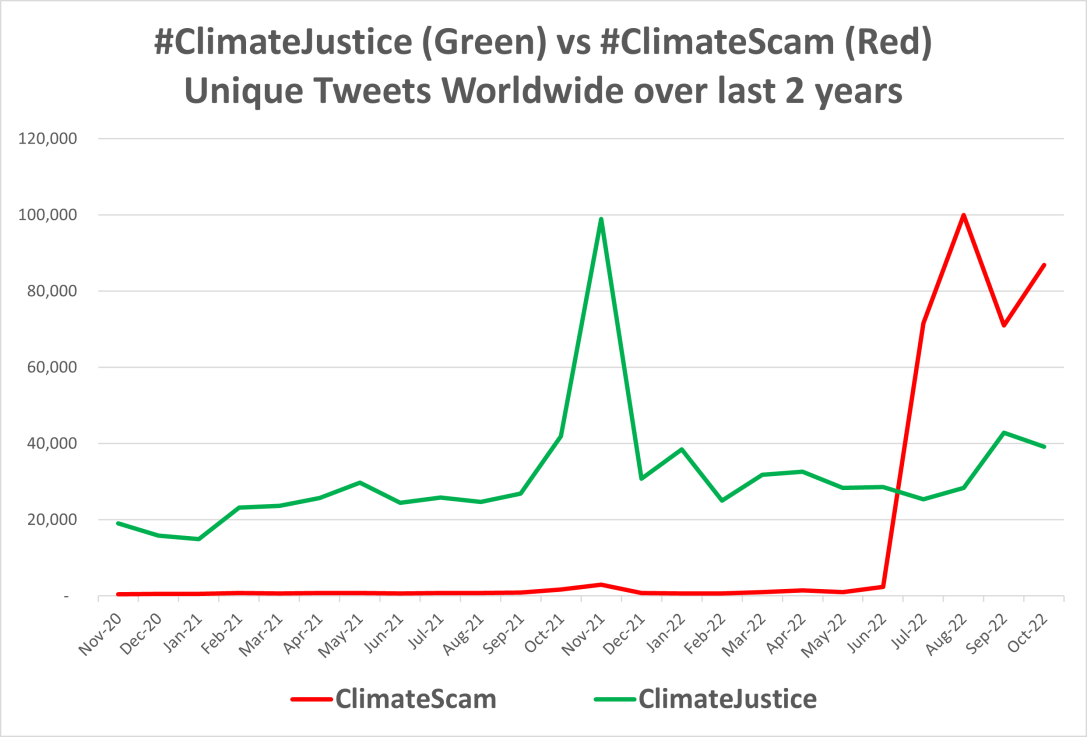
“We have a communications problem. Just as political support for climate action is growing, so political resistance to climate action is also growing. The use of the hashtag #ClimateScam has exploded since July of this year. From never exceeding more than 3,000 tweets in any month up to June 2022, it has been used 70,000-100,000 times per month in the four months since. Compare that to the hashtag #ClimateJustice, which has averaged about 30,000 tweets per month for the last two years and almost hit 100,000 unique tweets in the month of COP26 in Glasgow, with all the world’s media attention. But now? #ClimateScam is being used two and a half times for every #ClimateJustice tweet throughout the last 4 months. These twitter trends are one indicator of a growing resistance to climate action.
In the last few years a few people have suggested additional “Rs” for the 4 questions that comprise the Deep Adaptation framework for reflection and dialogue within an expectation or situation of societal disruption and collapse. As the idea of DA is used with groups around the world, various new ideas on what it means and what personal and group practices are relevant are emerging. One new R that I learned about recently is “Reverence.” That is what Reverend Lauren Van Ham adds to the framework as she uses it for the past couple of years with seminarians and faith-based communities. In my recent Q&A I asked her what a question might be that relates to Reverence, as I think DA involves inquiry, rather than simple answers. That is because societies and people are diverse, and an environmental breakdown affects all of it and, ultimately, everyone, thereby making generalised recommendations somewhat problematic!
This is the 2nd in a 7-part essay on the type of policy innovations that would respond to the truth of the environmental predicament and, also, why most environmental professionals ignore such ideas to promote limited and limiting ideas instead. These ideas on a #RealGreenRevolution provide a contrast to current agendas, with the aim of encouraging a global environmental movement as a rights-based political force. In this essay I focus on that sexy topic of taxation, and how to transform it to provide the price signals and funds to radically alter behaviours in fair ways.
To receive each part of the essay, subscribe to my blog, using the box on the right. To engage with other people who are responding to these ideas, either engage on the Deep Adaptation Leadership group on LinkedIn (where I will check in) or the Deep Adaptation group on Facebook, or by following the hashtag #RealGreenRevolution on twitter. The introductory Part 1 provides context.
In 1997 one of the key ideas being discussed for how to help the whole planet reduce its carbon emissions was a taxation on carbon emissions. Using taxes to influence behaviours through market systems was something most governments had experience of and could be trialled quite easily. However, under the then US Vice President Al Gore, the delegation from the United States stopped that initiative and instead advanced the idea of creating markets for carbon permits. The resultant Kyoto Protocol started that process whereby we have witnessed polluters being given permits which they could then sell. Many environmental experts regurgitated the arguments of corporate public relations, that a cap-and-trade system would be better for the climate by identifying specific limits. Such carbon pie in our overheating sky was gobbled up by financial elites. The cap-and-trade systems have done little to nothing on carbon emissions, which have continued to rise ever faster around the world. I mention this history, as it is an example of how the mundane everyday influence of people working for corporations and governments focused on corporate interests can produce results that are ‘omnicidal’. That word means the killing of all life, and I use it because 1997 was the last chance humanity had to create a framework that could have slowed climate change sufficiently to avoid a manmade catastrophe for life on Earth. I don’t blame you Al, but the fact you are quoted with respect and excitement by environmentalists today suggests how ill informed, uncritical, timid and sycophantic to power the green movement and sector has become.
To receive a copy of this newsletter every 3 months in your inbox, subscribe here.
Editorial from Jem Bendell
Although lockdowns have warped my sense of time, and perhaps yours too, it is actually more than 3 months since the last Deep Adaptation Quarterly. There was a hiatus, as I focused on new work after leaving the Deep Adaptation Forum at the end of September, and the Forum team re-organised for their post-Jem era. It has been great to see volunteers step up to now join the small Core Team of organisers, with Kat Soares becoming the new coordinator of the Forum. She is in a team of 4 freelancers working part time to coordinate over a hundred volunteers around the world to support people with finding meaningful ways of living creatively from their collapse anticipation. As they need to cover their basic costs, it would be useful if you can chip in now, as any donations given to them by the end of March will be matched by a donor.
How on earth do we approach these times well? What might resource us to face our collapsing social and ecological systems with open hearts, wilder questions and renewed capacity? In mystic traditions, soul craft and the work of artists The Void is the place of possibility, emergence and the other/wise. And so we invite you to come and lean into the trouble, as a lover might; tender, curious and courageous. As we play our parts in communities and workplaces to meet these times well, we believe it’s important to pause, play and call upon the creative spirit.
Are you an educator, policy maker, artist, activist, therapist, business or community leader working with Deep Adaptation? Would you like time to dwell with the unknown in good company?
This isn’t fiddling while Rome burns, this is a call for people who are actively engaged in our crisis to build your muscles of presence, love and creativity.
We’ll touch on the ‘4 Rs’ of Deep Adaptation: Resilience, Relinquishment, Restoration and Reconciliation, maybe explore a few more for luck, leaning in to the marginal and the mysterious that often get left behind in the fullness of our daily lives and the urgency of action.
Part regenerative retreat, part creative lab, our time will include:
Being alone on the land, connective practices, movement, breathwork and space for strong feelings to be met well in good company.
Creative stimuli and time for writing, devising, making, composing etc. Improvisation and the sacred fool. Embodied explorations of Kissing the Void.
Offerings at the feet of grief and mystery; feral rituals and invocations to things we trust and long for, songs of courtship to both the human and the more than human world, the ecosystems and the lands we love.
This gathering serves to inspire and resource us individually and collectively in order to deepen the potency of our work in the world. Join us.
To apply please email kissingthevoidevent@gmail.com
The Facilitators
Toni Spencer (Lead facilitator):
Toni is a Curator with the Emergence Network leading on ‘Vulture: Courting the Otherwise in a Time of Breakdown’. In 2018 she co-lead a Deep Adaptation Deep Dive and is part of the Deep Adaptation Forum. Toni initiated ‘the pause’ as part of Extinction Rebellion: an invitation to bear witness and to lean in to the liminal in the midst of action: part of an ongoing inquiry in to ‘A Politics of Wonder’.
As a lecturer and course leader Toni has taught on the faculty of Schumacher College and Goldsmiths, University of London and as a participatory artist and facilitator with Encounters Arts, Embercombe, the Transition movement, St Ethelburgas and others. She is on the team for Call of The Wild with Wildwise /Schumacher College.
She has an Action Research based MSc in Responsibility and Business Practice and is trained in a range of facilitation modalities; awakening, deep ecology and embodiment practices; grief tending and activism.
Prof. Bendell originated the concept of Deep Adaptation to near term societal collapse due to climate chaos (his paper was downloaded over 400K times in the first 9 months).
For the previous 20 years he had been a researcher, educator, facilitator, advisor, & entrepreneur in the field of sustainable development. Clients included corporations, UN agencies, charities and political parties. He helped create the Marine Stewardship Council and The Finance Innovation Lab. As a leadership specialist, he worked with the leadership office of the Labour Party during the 2017 general election, including speech writing. Bendell launched Masters degrees on sustainability and leadership. With over 100 publications in sustainable business, his work on currency innovation gained significant international media attention. In 2012 he was recognised by the World Economic Forum as a Young Global Leader.
In response to the latest climate science, he now focuses on helping humanity face climate-induced disruption and founded the Deep Adaptation Forum.
Jem will not be taking a fee for this retreat and he will not be co-hosting another retreat before March 2020. https://jembendell.com/
Tina Sharman:
Tina is a breathwork facilitator, coach and a director and co-founder of a land-based education project (www.onthehill.camp) where she now lives and which she runs with her partner and team. Before this she lived and worked for many years at Embercombe (www.embercombe.org) where she still co-runs the Journey programme and The Descent. She is a potter, making hand-built, smoke fired vessels and is a part of The Waiting Room, an interactive, improvised theatre group.
The Venue
The venue is a beautiful converted farm in a South Devon valley. An artists led project dedicated to supporting creativity and research, it is part of CultureDeclaresEmergency https://coombefarmstudios.com
The group size will be limited to 15 people (plus team). Food will be mainly vegan with some local organic dairy and wild meat options. For any access needs contact us.
Costs
Price includes all food, accommodation, hosting, facilitation and materials. We’ve created a 3 tier price system with some variables to try and make this event as accessible as possible: 1. £900 / 2. £650 / 3. £450
There is Potential room sharing / camping / bursary options / luxury accommodation : be in touch for detail.
NB There will be limited places for options 3+4. Your generosity in paying the fee option 1. will enable more people to access this event.
More details and options to apply will be available soon via our application form but in the meantime please contact kissingthevoidevent@gmail.com
the pause is a radical act, an invitation to stop in the midst of action, to disrupt our normal modes of being, to collectively fall silent and become aware of the moment we’re in.
the pause is counter to the culture that has driven us to the brink of extinction. It is an invitation for everyday magic to unfold.




You must be logged in to post a comment.